Summary
- AI visibility tools track how your brand appears in ChatGPT, Perplexity, Claude, Gemini, and Google AI Overviews -- essential as users shift from traditional search to AI-powered answers
- The market splits into monitoring-only dashboards vs. action-oriented platforms that help you fix visibility gaps with content generation and optimization
- Promptwatch leads as the only platform combining monitoring, content gap analysis, AI-powered content generation, and crawler log tracking -- turning insights into action
- Most competitors (Otterly.AI, Peec.ai, AthenaHQ) focus purely on tracking without helping you improve rankings, while enterprise options (Profound, Scrunch) offer strong features at higher price points
- Key decision factors: number of AI models tracked, prompt volume data, content optimization tools, crawler log access, and whether the platform just shows problems or helps solve them
What are AI visibility tools and why do you need one?
AI visibility tools track how your brand appears in responses from ChatGPT, Perplexity, Claude, Google AI Overviews, and other AI search engines. Unlike traditional SEO tools that monitor Google rankings, these platforms answer a different question: when someone asks an AI model about your industry, does it mention your brand?
The shift matters because search behavior is changing. Millions of users now ask ChatGPT or Perplexity instead of Googling. If your brand isn't cited in those AI responses, you're invisible to a growing segment of your audience.
Traditional SEO metrics -- keyword rankings, backlinks, domain authority -- don't tell you anything about AI visibility. You need specialized tools that actually query AI models, analyze the responses, and track which brands get mentioned.
The two types of AI visibility platforms
The market splits cleanly into two camps:
Monitoring-only dashboards show you data. They run prompts across AI models, count brand mentions, and display charts. You see where you're invisible, but you're on your own to fix it. Most tools fall into this category.
Action-oriented platforms show you what's missing, then help you fix it. They identify content gaps, generate optimized articles, and track improvements. Fewer platforms offer this, but it's the difference between a diagnostic tool and an optimization platform.
Promptwatch is the only platform that closes the full loop: find gaps, generate content, track results. Most competitors stop after step one.

How AI visibility tracking actually works
These platforms query AI models with prompts relevant to your industry, then parse the responses to detect brand mentions. The process looks like this:
- You define a list of prompts ("best project management software", "how to improve team collaboration", etc.)
- The tool submits each prompt to ChatGPT, Perplexity, Claude, Gemini, and other models
- It analyzes the AI-generated responses to find brand mentions, citations, and recommendations
- Results appear in a dashboard showing visibility scores, mention frequency, and competitive positioning
Some platforms run prompts manually on a schedule. Others use APIs where available. The best tools track 8-10+ AI models and refresh data daily or weekly.
Key features to look for in an AI visibility tool
Not all platforms offer the same capabilities. Here's what separates basic trackers from comprehensive solutions:
Number of AI models tracked
More models = better coverage. Look for platforms that monitor:
- ChatGPT (OpenAI)
- Perplexity
- Claude (Anthropic)
- Google AI Overviews
- Google AI Mode
- Gemini
- Meta AI (Llama)
- DeepSeek
- Grok
- Mistral
- Copilot
Some tools track 3-4 models. The best track 10+. Promptwatch monitors all major AI engines.
Prompt volume and difficulty data
Knowing which prompts get asked most often is critical. Prompt volume estimates tell you which queries are worth targeting. Difficulty scores show which ones you can realistically win.
Most competitors don't provide this data. You're guessing which prompts matter. Platforms with prompt intelligence (like Promptwatch) show you exactly where to focus.
Content gap analysis
The most valuable feature: showing you which prompts competitors rank for but you don't. This is the difference between "here's your visibility score" and "here's what you need to fix."
Answer Gap Analysis (Promptwatch's term) identifies the specific topics, angles, and questions AI models want answers to but can't find on your site. You see the exact content you're missing.
AI content generation
Some platforms include built-in AI writing agents that generate articles optimized for AI visibility. This isn't generic SEO content -- it's engineered to get cited by ChatGPT, Claude, and Perplexity based on real citation data.
Promptwatch's AI agent analyzes 880M+ citations to understand what content gets referenced, then writes articles targeting those patterns. Most competitors lack this entirely.
Crawler log tracking
AI models crawl your website to gather information. Crawler logs show which pages ChatGPT, Claude, and Perplexity are reading, how often they return, and any errors they encounter.
This is critical for diagnosing indexing issues. If AI models can't access your content, you won't get cited. Very few platforms offer crawler log tracking -- Promptwatch does, most competitors don't.
Citation and source analysis
See exactly which pages, domains, Reddit threads, and YouTube videos AI models cite in their responses. This tells you where to publish and what to optimize.
Some platforms show citation counts. The best show the actual sources with URLs, so you can analyze why certain content gets referenced.
Reddit and YouTube tracking
AI models pull heavily from Reddit discussions and YouTube videos. Platforms that surface these sources give you a channel most competitors ignore.
Promptwatch includes Reddit and YouTube insights. You see which threads and videos influence AI recommendations for your industry.
ChatGPT Shopping monitoring
For e-commerce brands, ChatGPT's shopping features matter. Some platforms track when your products appear in ChatGPT's recommendations and shopping carousels.
This is niche but valuable for retail and DTC brands. Promptwatch tracks ChatGPT Shopping; most alternatives don't.
Competitor benchmarking
Compare your AI visibility vs. competitors across models. See who's winning for each prompt and why. Heatmaps and side-by-side comparisons make this actionable.
Every platform offers some form of competitor tracking. The depth varies -- some show basic mention counts, others provide detailed competitive analysis.
Multi-language and multi-region support
If you operate in multiple countries or languages, you need tools that can monitor AI responses in those markets. Customizable personas that match how your actual customers prompt are a bonus.
Promptwatch supports any language and region. Some competitors are English-only or limited to a few markets.
Top AI visibility platforms compared
Here's how the leading platforms stack up across key capabilities:
| Platform | Models tracked | Prompt volumes | Content generation | Crawler logs | Starting price |
|---|---|---|---|---|---|
| Promptwatch | 10 | Yes | Yes | Yes | $99/mo |
| Profound | 8+ | Limited | No | No | ~$300/mo |
| Otterly.AI | 6 | No | No | No | $49/mo |
| Peec.ai | 5 | No | No | No | $99/mo |
| AthenaHQ | 8+ | No | No | No | $149/mo |
| Search Party | 6 | Limited | No | No | Custom |
| Scrunch | 8+ | No | No | No | ~$400/mo |
| Ahrefs Brand Radar | 3 | No | No | No | Included |
| Semrush | 4 | No | No | No | $139.95/mo |
Promptwatch: The action-oriented leader
Promptwatch is the only platform rated as a "Leader" across all categories in a 2026 comparison of 12 GEO platforms. The core difference: most competitors are monitoring-only dashboards that show you data but leave you stuck. Promptwatch is built around taking action.
The action loop:
- Find the gaps: Answer Gap Analysis shows exactly which prompts competitors are visible for but you're not. You see the specific content your website is missing.
- Create content that ranks: The built-in AI writing agent generates articles grounded in real citation data (880M+ citations analyzed), prompt volumes, and competitor analysis. This isn't generic SEO filler -- it's content engineered to get cited by AI models.
- Track the results: See your visibility scores improve as AI models start citing your new content. Page-level tracking shows exactly which pages are being cited, how often, and by which models.
Additional capabilities:
- AI Crawler Logs: Real-time logs of AI crawlers hitting your website -- which pages they read, errors they encounter, how often they return
- Prompt Intelligence: Volume estimates and difficulty scores for each prompt, plus query fan-outs showing how one prompt branches into sub-queries
- Citation & Source Analysis: See exactly which pages, Reddit threads, YouTube videos, and domains AI models cite
- Reddit & YouTube Insights: Surface discussions that directly influence AI recommendations
- ChatGPT Shopping Tracking: Monitor when your brand appears in ChatGPT's product recommendations
- Competitor Heatmaps: Compare your AI visibility vs competitors across LLMs
- Multi-language & Multi-region: Monitor AI responses in any language, from any country
Pricing: Essential $99/mo (1 site, 50 prompts, 5 articles), Professional $249/mo (2 sites, 150 prompts, 15 articles, crawler logs), Business $579/mo (5 sites, 350 prompts, 30 articles). Free trial available.
Target audience: Marketing teams, SEO teams, digital agencies, and any brand that wants to be visible in AI search results.
Profound: Strong features, higher price point
Profound offers robust monitoring across 8+ AI models with agency-focused features like white-label reporting and client management. The platform includes answer engine insights, agent analytics, and shopping tracking.

What it does well: Agency mode with brand configurations, pitch environments, and client dashboards. Strong competitive analysis and prompt tracking.
What it lacks: No content generation tools, no crawler logs, limited prompt volume data. You see the problems but don't get help fixing them.
Pricing starts around $300/mo for individual plans, with custom agency and enterprise pricing.
Otterly.AI: Affordable monitoring-only option
Otterly.AI tracks 6 AI models with a focus on brand mention monitoring. The interface is clean and the pricing is accessible.

What it does well: Simple setup, affordable entry point at $49/mo, decent coverage of major AI models.
What it lacks: No prompt volume data, no content optimization, no crawler logs, no visitor analytics. Pure monitoring without actionable insights.
Good for: Small businesses that just want basic visibility tracking without optimization features.
Peec.ai: Multi-language tracking
Peec.ai emphasizes multi-language support, making it useful for international brands. Tracks 5 AI models with brand mention alerts.

What it does well: Strong language coverage, clean dashboards, reasonable pricing at $99/mo.
What it lacks: Limited to 5 models, no content generation, no crawler logs, no prompt intelligence. Another monitoring-only tool.
Good for: Brands operating in multiple languages who need basic tracking.
AthenaHQ: Monitoring-focused with decent coverage
AthenaHQ tracks 8+ AI search engines with brand visibility monitoring and competitive analysis.

What it does well: Good model coverage, competitor benchmarking, alert notifications.
What it lacks: No content optimization tools, no content generation, no crawler logs. Shows you where you're invisible but doesn't help you fix it.
Pricing starts at $149/mo.
Search Party: Agency-oriented
Search Party positions itself as an AI automation agency with embedded engineers. The platform includes visibility tracking but focuses more on agency services.
What it does well: Agency support, custom implementations, broader automation capabilities.
What it lacks: Limited prompt metrics, no content gap analysis, higher price point with custom pricing.
Good for: Agencies that want hands-on support and custom implementations.
Scrunch: Influencer marketing angle
Scrunch combines AI visibility tracking with influencer marketing features, tracking 8+ models.
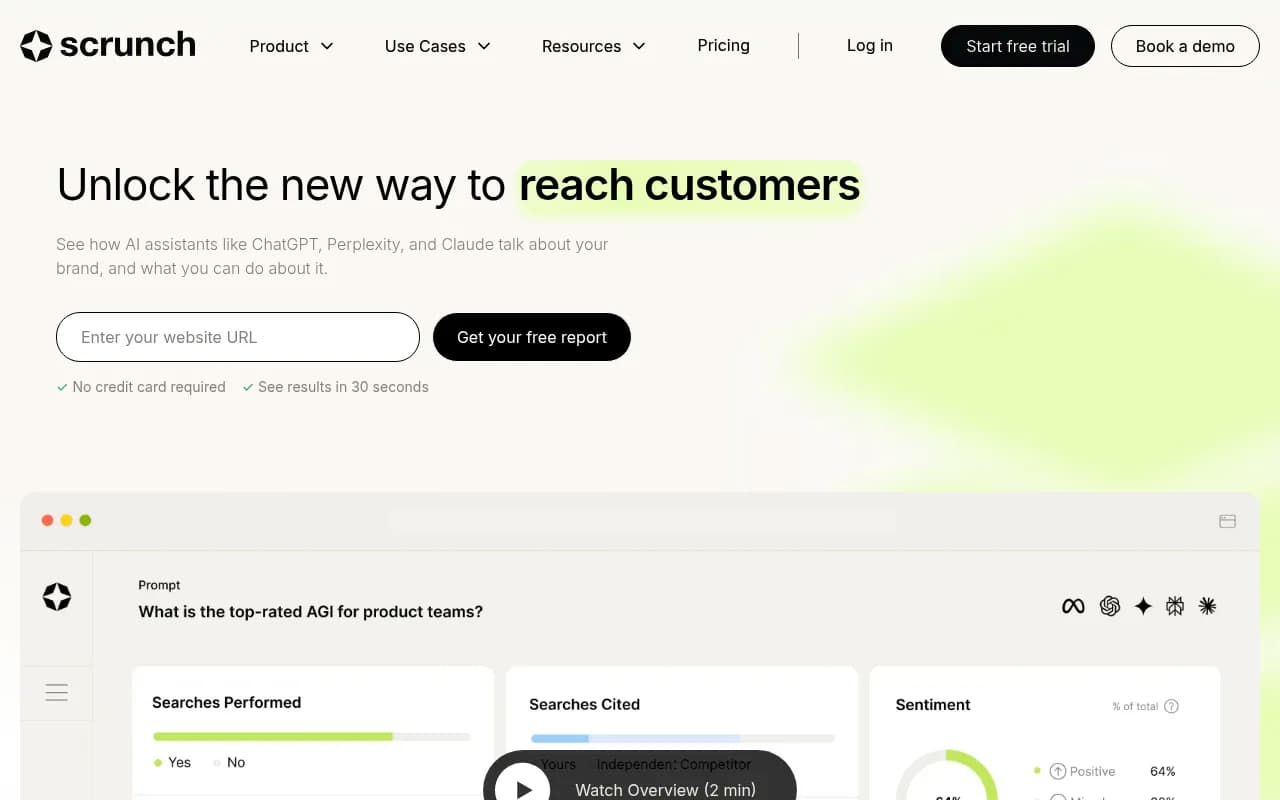
What it does well: Unique angle combining AI visibility with influencer discovery, strong feature set.
What it lacks: Higher price point (~$400/mo), no Reddit tracking, no ChatGPT Shopping, no content generation.
Good for: Brands that want AI visibility tracking alongside influencer marketing tools.
Ahrefs Brand Radar: Limited but included
Ahrefs added Brand Radar to track brand mentions in AI search results. It's included with Ahrefs subscriptions.
What it does well: No additional cost if you already use Ahrefs, familiar interface.
What it lacks: Only tracks 3 models (ChatGPT, Perplexity, Gemini), fixed prompts you can't customize, no AI traffic attribution, no content optimization.
Good for: Existing Ahrefs users who want basic AI visibility tracking without paying for another tool.
Semrush: Traditional SEO tool with AI features
Semrush added AI search monitoring to its all-in-one SEO platform. Tracks 4 models with fixed prompts.
What it does well: Part of a comprehensive SEO suite, familiar to most marketers.
What it lacks: Limited to 4 models, fixed prompts you can't customize, no deep AI search optimization, no crawler logs.
Good for: Teams already using Semrush who want basic AI visibility tracking as part of their existing subscription.
Choosing the right platform for your needs
Your decision depends on what you actually need:
If you want to improve AI visibility, not just track it: Promptwatch is the only platform that combines monitoring, content gap analysis, AI content generation, and crawler logs. You see what's missing and get tools to fix it.
If you're an agency managing multiple clients: Profound offers strong agency features with white-label reporting and client dashboards. Higher price point but built for agency workflows.
If you just need basic monitoring on a budget: Otterly.AI at $49/mo gives you brand mention tracking across 6 models without advanced features.
If you operate internationally: Peec.ai emphasizes multi-language support, though Promptwatch also handles any language and region.
If you already use Ahrefs or Semrush: Their built-in AI visibility features are limited but cost nothing extra. Good for basic tracking if you're not serious about AI optimization.
If you want influencer marketing alongside AI visibility: Scrunch combines both, though at a higher price point.
What the data shows about AI visibility tools in 2026
The market is maturing fast. A year ago, most platforms were basic trackers showing brand mention counts. Now the leaders offer:
- Prompt volume estimates and difficulty scoring
- Content gap analysis showing exactly what you're missing
- AI-powered content generation trained on citation data
- Crawler log tracking to diagnose indexing issues
- Reddit and YouTube insights
- ChatGPT Shopping monitoring
- Multi-language and multi-region support
The gap between monitoring-only tools and action-oriented platforms is widening. In a 2026 comparison of 12 GEO platforms, Promptwatch is the only one rated as a "Leader" across all categories. The reason: it's the only platform that helps you fix problems instead of just showing them.
Most competitors (Otterly.AI, Peec.ai, AthenaHQ, Search Party) stop at monitoring. They show you where you're invisible but leave you to figure out the rest. Enterprise options (Profound, Scrunch) offer strong features but at higher price points and without content optimization tools.
The future of AI visibility tracking
As AI search adoption grows, these tools will become as essential as traditional SEO platforms. The winners will be platforms that:
- Track the most AI models (10+ instead of 3-4)
- Provide prompt intelligence (volumes, difficulty, query fan-outs)
- Identify content gaps with specificity
- Generate optimized content that actually gets cited
- Track crawler behavior and indexing issues
- Connect visibility to revenue with traffic attribution
The monitoring-only tools will struggle. Showing data without helping users act on it isn't enough. The platforms that close the loop -- find gaps, generate content, track results -- will dominate.
Promptwatch is already there. Most competitors are still building toward it.
Getting started with AI visibility tracking
Most platforms offer free trials. Start with:
- Define your core prompts: List 20-50 questions your customers ask that should mention your brand
- Run a baseline audit: See where you currently appear across AI models
- Identify the biggest gaps: Which high-volume prompts mention competitors but not you?
- Create targeted content: Write or generate articles that fill those gaps
- Track improvements: Monitor visibility scores as AI models start citing your new content
If you want to just monitor, any platform works. If you want to actually improve your AI visibility, choose a platform that helps you create content and track results -- not just show you charts.
For most teams, that means Promptwatch. It's the only platform that closes the full action loop.