Key takeaways
- Citation share by domain tells you which sites AI engines pull from to build answers in your category. Source-type classification tells you what kind of content wins (product page vs. listicle vs. how-to). Together they are the most actionable data in AI search.
- The landscape shifted hard in 2026: product pages overtook listicles as the most-cited format in both ChatGPT and Google AI Overviews, and Reddit's ChatGPT citation share collapsed from roughly 4% to 0.5% in mid-August. Any tool you pick needs daily monitoring, not quarterly audits.
- Peec AI has the cleanest citation model in the category. Promptwatch goes further with 22 content types, 20 source types, and crawler logs that explain why you are or aren't cited. Otterly.AI is the budget entry point, and Ahrefs Brand Radar makes sense if you already pay for Ahrefs.
- Watch for the retrieval-vs-citation split. Being retrieved but not cited is a different problem from not being retrieved at all, and only a few tools separate the two.
Why citation share by domain and source type is the metric that matters
A mention count tells you your standing. A citation list tells you the raw material AI used to write the answer. That distinction is the whole ballgame in 2026, because the sources AI leans on are often third-party roundups, review sites, and community threads rather than your own pages. If you don't know which domains and which content formats are winning citations in your category, you're optimizing blind.
The data behind this moved fast this year. In July 2026, product pages led ChatGPT citations at roughly a third of the total, with listicles the fastest-growing format, per Promptwatch's ChatGPT citation type data. Google AI Overviews told a similar story: product pages overtook listicles as the single most-cited format in late July, ending the month at 17.9% vs. 16.2%, after listicles had held the top spot at around 26% in Q1. You can see the full daily breakdown in Promptwatch's AI Overviews citation type report.
Domain-level share is just as volatile. Reddit led ChatGPT citations at 3.71% in June 2026, six times the runner-up Wikipedia at 0.56%, and no domain held above 4% share, according to Promptwatch's ChatGPT citation share data. Then in mid-August, Reddit's share collapsed to an average of 0.52% between August 14 and 17, an 86% relative drop that began the same day ChatGPT started using the site: operator at scale in its query fanouts. Promptwatch's Reddit citation report documents the whole slide.
If you had built a source strategy on Reddit placements in June and checked it again in September, you'd be working from stale assumptions. That's the core argument for dedicated tooling with continuous monitoring.
Citations vs. mentions vs. retrieval: know what you're measuring
Before comparing tools, get the three layers straight, because vendors use these terms interchangeably and they are not the same:
- Mention: your brand name appears in the answer. Noisy, run-to-run variable, and only loosely tied to revenue.
- Citation: your URL (or a third-party URL you care about) appears as a source in the answer. This is what you can act on.
- Retrieval: the model pulled your page while composing the answer but didn't cite it in the visible text. Peec tracks retrieval rate and citation rate as separate numbers, and that split matters. If you're retrieved but not cited, your content is in the running and losing. If you're not retrieved at all, you have a different fix, usually an indexing or authority problem.
One more denominator problem worth knowing: engines cite very different numbers of sources per response. ChatGPT averages around 5 sources per web-search-triggered response, while AI Overviews and Perplexity average around 10, and Copilot swings wildly between under 2 and nearly 17. Promptwatch's sources-per-response data covers the details. A 2% citation share means something different on a 5-source engine than a 10-source one, so any tool that reports share without engine context is hiding useful information.
What a good citation share tool must do
Based on how the market has matured by mid-2026, here's my checklist:
- URL-level capture, aggregated by domain. You need the exact cited URLs, not just "we were mentioned somewhere."
- Source-type and page-type classification. Does the tool type every citation as listicle, comparison, product page, how-to, UGC, editorial, and so on? This is what turns a report into a content strategy.
- Repeated, cross-validated runs. AI answers vary run to run. One scrape tells you almost nothing.
- Real UI data, not just APIs. User-facing answers and citations can differ from API outputs, especially for shopping results and AI Overviews.
- Competitor benchmarking. The top 10 to 50 domains cited instead of you are your hit list for content, PR, and partnerships.
- Daily or near-daily monitoring. Given the Reddit collapse and the site: operator rollout, quarterly audits are decorative at this point.
The best tools for tracking citation share by domain and source type
1. Peec AI
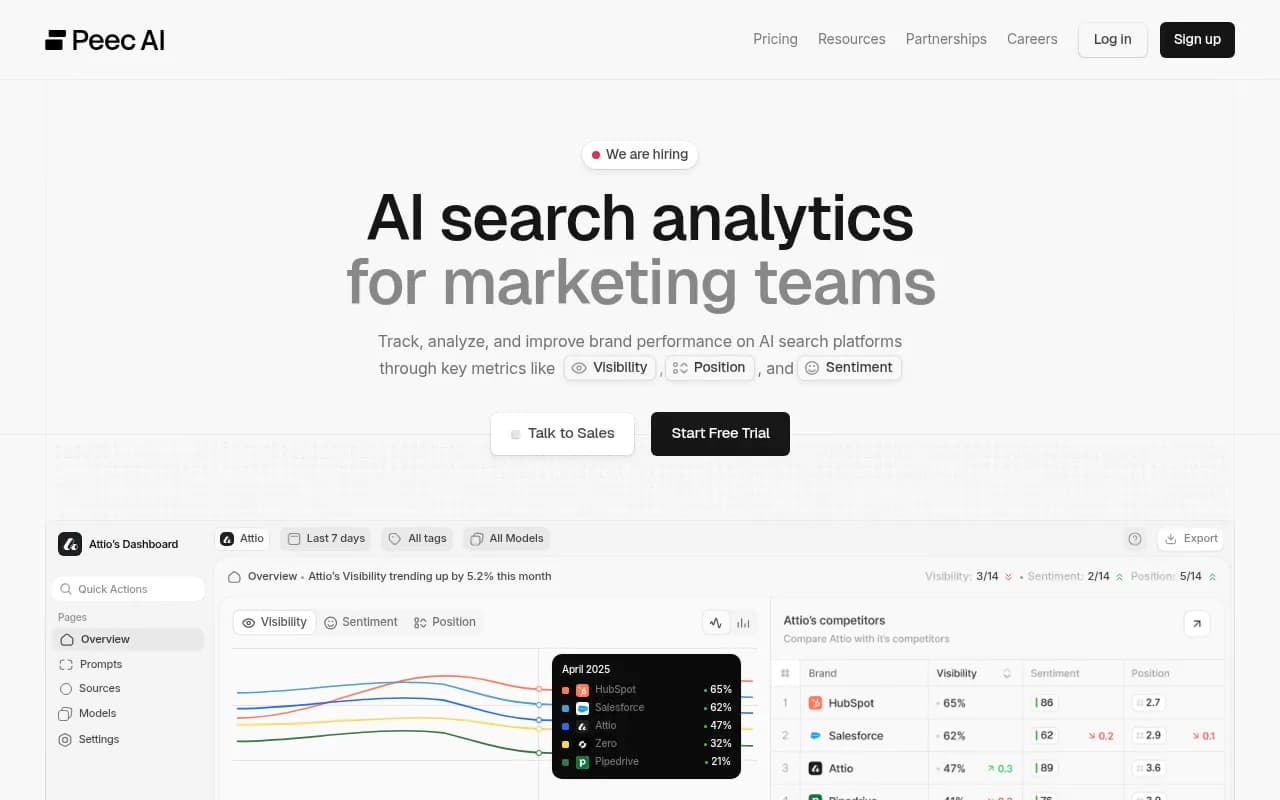
Peec has the cleanest citation model in the category, and I don't think that's controversial. It separates brand visibility (your name appears) from source visibility (your content was used), and separately splits sources from citations: every URL the model touched versus the ones it actually referenced. Domains and URLs are auto-typed as Editorial, Corporate, UGC, Reference, or Institutional, with retrieval rate and citation rate side by side. That last pairing is genuinely rare.
Pricing runs from around €70/mo (annual) for Starter up to €360/mo for Advanced, with standard plans letting you pick 3 of 6 engines and Enterprise unlocking the full model list including Claude, DeepSeek, and GPT-5 Search. One caveat: Peec is a monitoring tool. It shows you the gaps cleanly, but closing them is your job.
2. Promptwatch
Promptwatch is the tool I'd point to when you want citation share data that connects to an actual workflow. Every citation is classified into 22 content types and 20 source types, with ramp-up, peak, and decay tracked per cited page, so you can see not just that a competitor's comparison page is winning but whether its citation momentum is rising or fading. It also has dedicated Reddit and YouTube citation reports, which most competitors skip entirely, and it monitors the real user interfaces of ChatGPT, Gemini, AI Overviews, AI Mode, Perplexity, and Claude rather than relying only on API outputs.
What separates it from pure trackers is the "why" layer: AI crawler logs show when ChatGPTBot, ClaudeBot, or PerplexityBot hit your pages, what they read, and whether they hit errors, with a citation rate per page. If you're crawled but never cited, you'll see it. Content gap analysis and automated content generation then close the loop. Plans start at $95/mo, and the platform monitors 11+ engines including Google AI Mode and Grok.

3. Otterly.AI
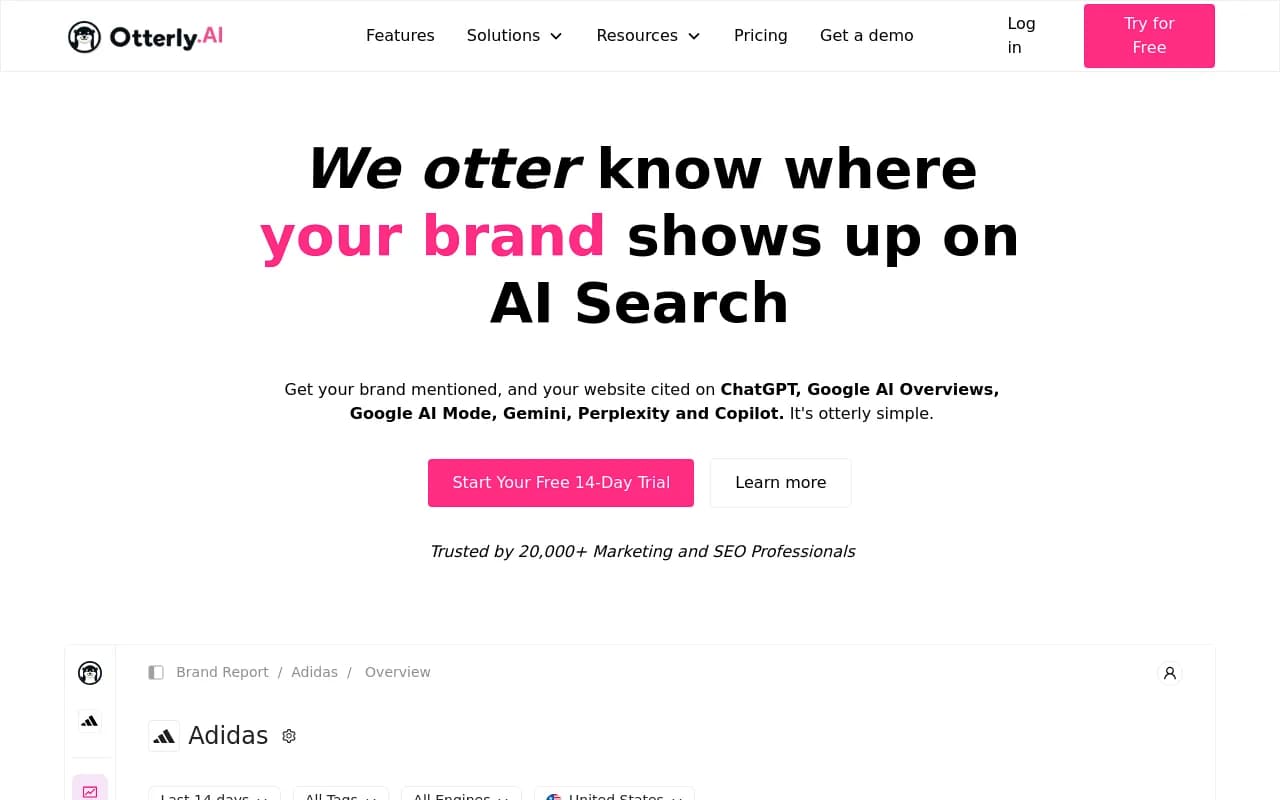
Otterly is the low-budget entry point, and it ships citation analysis on every plan rather than gating it behind higher tiers. Link Citations Analysis and Domain Ranking are included from the $29/mo Lite tier, with cited domains and URLs classified as News/Media, Community/Forum, Encyclopedia, and similar categories. All plans include daily tracking, unlimited team members, and 65+ countries, with Google AI Mode, Gemini, and Claude as paid add-ons.
The classification is coarser than Peec's or Promptwatch's, and there's no retrieval-vs-citation split. But if cost is the constraint and you need basic, honest citation share data, Otterly gets you in the game for less than anything else here.
4. Ahrefs Brand Radar
If you already live in Ahrefs, Brand Radar is the pragmatic choice. Its Cited Domains and Cited Pages reports are filterable by platform, by domain, and by responses that exclude your brand, which is a smart filter more tools should copy. The prompt set draws on 400M+ search-backed prompts derived from real People Also Ask queries across seven platforms, which gives it a groundedness that synthetic prompt lists lack. Reddit, TikTok, and YouTube citation coverage were free while in beta.
The gaps: no documented query fan-out reporting, Claude is custom-prompts-only at 8x check cost, and Grok collection has been paused. Pricing has also been moving, with tracked AI prompts bundled into core plans ($129/mo Lite and up) plus custom prompt packages, so verify the current structure on Ahrefs' pricing page before budgeting.
5. Profound
Profound is the enterprise pick, and it goes deep on agent-level attribution, which matters as AI assistants increasingly take actions rather than just answer questions. It surfaces citations at both the domain and page level. The honest weakness for this specific use case: it documents citation authority at domain level but doesn't classify citations by page or content type, which makes it an outlier in this group. If source-type strategy is your priority, that's a real gap. Starter runs $99/mo (annual commitment, ChatGPT only), Growth $399/mo with three engines, Enterprise custom.

6. AthenaHQ
AthenaHQ tracks sources by domain and page, reporting total citations, citation rate, and citation gap per prompt, with top pages and domains listed per prompt. That per-prompt citation gap view is useful for prioritizing which prompts to attack first. Entry pricing sits around $295/mo with unlimited seats included, which is a genuine differentiator against seat-limited competitors. It's monitoring-focused, so plan to pair it with an execution workflow.

7. Scrunch AI
Scrunch includes Citations/Sources on its $250/mo Core plan, covering ChatGPT, Perplexity, Google AI Overviews, and Copilot with 125 unique prompts, and Enterprise unlocks 9 LLMs plus full query fan-out and API access. The query fan-out support is worth calling out, since most tools don't model how AI expands one prompt into sub-queries at all. The trade-off is price relative to caps: at $250/mo with 4 LLMs and 125 prompts, it's above the category median, so it makes most sense for teams that specifically want the fan-out and agent-experience layer.
8. Semrush AI Visibility Toolkit
Semrush surfaces cited domains and URLs per tracked prompt in its Sources tab, at $99/mo standalone per domain. If you're already a Semrush subscriber, this is the cheapest way to add citation tracking to a stack you already pay for, and its free-tier AI site audit is better than its reputation suggests. The AI-specific data is shallower than the dedicated platforms, and prompt sets are more fixed, so treat it as a solid baseline rather than a strategic tool.
Comparison table
| Tool | Domain-level share | Page/source-type classification | Retrieval vs. citation split | Starting price |
|---|---|---|---|---|
| Peec AI | Yes, URL-level | Yes (Editorial, Corporate, UGC, Reference, Institutional) | Yes | ~€70/mo |
| Promptwatch | Yes, URL-level | Yes (22 content types, 20 source types) | Crawler logs with citation rate per page | $95/mo |
| Otterly.AI | Yes, URL-level | Basic (News/Media, Community/Forum, etc.) | No | $29/mo |
| Ahrefs Brand Radar | Yes, Cited Domains and Cited Pages reports | Partial | No | $129/mo (base plan) |
| Profound | Yes, domain and page | No page-type classification | No | $99/mo (annual) |
| AthenaHQ | Yes, domain and page | Partial | No | ~$295/mo |
| Scrunch AI | Yes | Partial | No | $250/mo |
| Semrush AI Toolkit | Yes, per prompt | Limited | No | $99/mo |
How to choose
Match the tool to who's acting on the data, because every tool here shows you sources but the workflows differ:
- If you need the data to drive content production: Promptwatch, because content gap analysis and automated generation sit next to the citation data instead of in a separate tool.
- If you want the most rigorous citation measurement for the money: Peec AI, especially if content execution is already covered elsewhere.
- If budget is the constraint: Otterly.AI. It's a third of the price of most alternatives and still gives you classified, URL-level citations.
- If you're an enterprise with multi-team reporting needs: Profound, accepting the page-type classification gap.
- If you already pay for Ahrefs or Semrush: start with Brand Radar or the AI Visibility Toolkit before adding another subscription. Data you'll actually look at beats data you won't.
For a broader view of the category, the GEO software directory at bestgeosoftware.com covers the full platform landscape, and ai-rank-tools.com focuses specifically on rank and citation trackers.
Pitfalls to watch for
Cross-tool numbers won't match, and that's expected. Methodology, collection windows, and sample sizes differ enormously. One third-party study of 1,200 prompts across four engines found editorial reviews at 22.3% of citations and Reddit at 11.4%, while Promptwatch's live UI monitoring across billions of data points shows a very different, and much more volatile, Reddit picture. When two tools disagree, check whether one is measuring API responses and the other is measuring what users actually see.
Platform-side changes break your baselines overnight. The site: operator rollout on August 8, 2026 nearly doubled ChatGPT's searches per response, per Promptwatch's fanout data, which means keyword and source mappings built before that date are stale. Any tool that lets you see crawler activity and citation trends over time will help you distinguish "we got worse" from "the engine changed."
Social source share varies wildly by engine. Reddit dominates ChatGPT's social citations at over 20x its next social source, while AI Overviews and Grok lean on YouTube, and Grok is the only engine with meaningful Facebook and Instagram citation share, per Promptwatch's social citation data. A source strategy that works on one engine can be irrelevant on another, so multi-engine tracking isn't optional.
Page type matters even within a single domain. LinkedIn citations are a good example: Pulse articles and regular posts make up roughly 70% of LinkedIn's citations across engines, but ChatGPT treats LinkedIn as a company directory, favoring company pages at 23.8% while citing Pulse articles only 8.8% of the time, and Perplexity uniquely favors fresh feed posts over polished long-form. Promptwatch's LinkedIn page-type report has the full breakdown. Tools that only report domain-level share will hide this entirely.
Final thoughts
The tools worth paying for in 2026 are the ones that classify citations by domain and source type, run continuously, and connect to something you can actually do about the gaps. Peec AI and Promptwatch lead on measurement rigor, with Promptwatch pulling ahead when you want the citation data to feed directly into content work. Otterly covers the budget end, Ahrefs and Semrush cover the "already subscribed" end, and Profound holds the enterprise end despite its classification gap. Whatever you pick, set your baselines now and re-check them monthly, because if 2026 proved anything, it's that the sources AI trusts can change in a week.