
Key takeaways
- Elmo is the most mature open-source AI visibility tracker: MIT-licensed, free to self-host, with 36 releases since July 2025 and an optional hosted Elmo Cloud from $29/mo.
- Voyage is a different kind of project. Its open-source repo, voyage-geo-agent, is built around a CLI and agent workflow, so it fits developers more than marketers who want a dashboard.
- "Free to self-host" is not free to run. You pay for LLM API keys, scraping providers, a database and the time to maintain it all.
- Licenses matter more than feature lists. MIT and Apache-2.0 are permissive; AGPL-3.0 and GPL-3.0 add conditions on modified versions.
- Pay for a platform when you need crawler logs, traffic attribution, content execution or a team that can't babysit infrastructure.
Why people look for open-source GEO tools
Most AI visibility tools are closed, hosted dashboards. You hand over your prompts, trust the score that comes back, and hope nobody changes the methodology next quarter. For a number that ends up in a board deck, that is uncomfortable.
Open source flips it. You can read exactly how a metric is calculated, keep prompts and history in your own database, and walk away without a migration. Those are real benefits, and the reason this category exploded in 2026.
The catch is that the category is also young and noisy. According to TopCited's GitHub analysis from 10 November 2026, 858 of the 915 repositories describing themselves as GEO tools were created in 2026, 530 have zero stars, and only 25 have 100 or more. A handful of projects hold most of the attention, and a lot of the rest is weekend work.
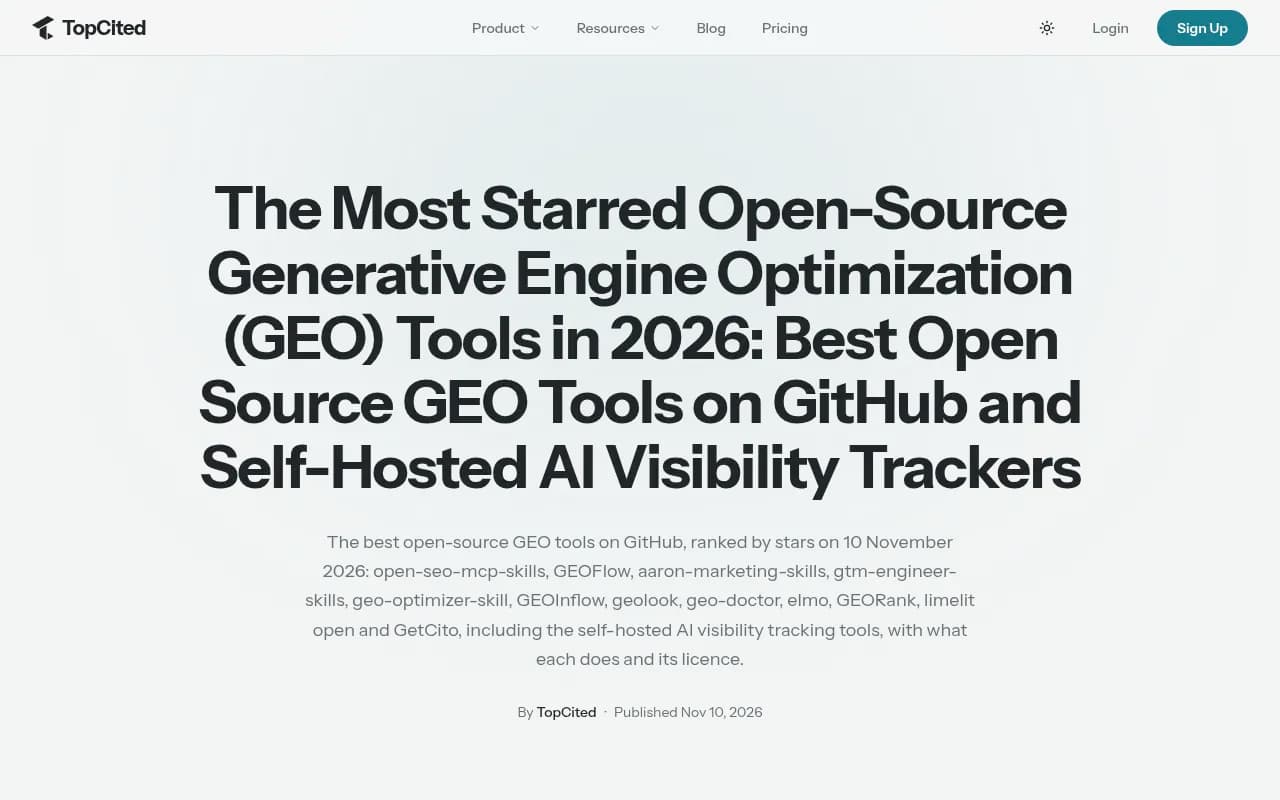
That list is worth a look because it shows how mixed the label "GEO tool" is. Only a few are self-hosted trackers (elmo, limelit open, GetCito, geolook). The rest are agent skills, site fixers, content production systems or crawler analytics. Comparing them directly is like comparing a spreadsheet to a CMS.
The open-source landscape at a glance
| Tool | What it is | License | Managed option | Stars (10 Nov 2026) |
|---|---|---|---|---|
| Elmo | Self-hosted AI visibility tracker | MIT | Elmo Cloud, from $29/mo | 584 |
| Voyage (voyage-geo-agent) | CLI and agent for GEO optimization | Not verified | Not verified | Not verified |
| gtm-engineer-skills (same org as Voyage) | 12 Claude Code and Codex skills | MIT | No | 1,359 |
| Ansvisor | Open-source tracker, most contributors | MIT | Cloud with 14-day trial | Not listed |
| GetCito | Tracker, history of forks and rewrites | MIT (fork) | Hosted version exists | 426 |
| geolook | Self-hosted tracker sampling 17 engines | MIT | None | 812 |
| limelit open | Tracker in a single Go binary | Apache-2.0 | Not verified | 438 |
| GEOFlow | Content production and multi-site distribution | AGPL-3.0 | Commercial license separate | 4,056 |
| GEOInflow | AI crawler and referral analytics | MIT | None | 829 |
Stars are a popularity signal, not a quality signal. geolook has more stars than Elmo but is self-host only, and Elmo's own comparison notes it hasn't had a commit since August 2026. Treat that as a vendor claim worth checking on GitHub yourself, since Elmo is a competing project.
Elmo: the default choice for self-hosted tracking
Elmo is the project I would start with if you want a real tracker rather than a script. It comes from elmohq, has been public since August 2025, and covers ChatGPT, Google AI Mode, Google AI Overviews, Gemini, Perplexity, Claude and any OpenRouter model.
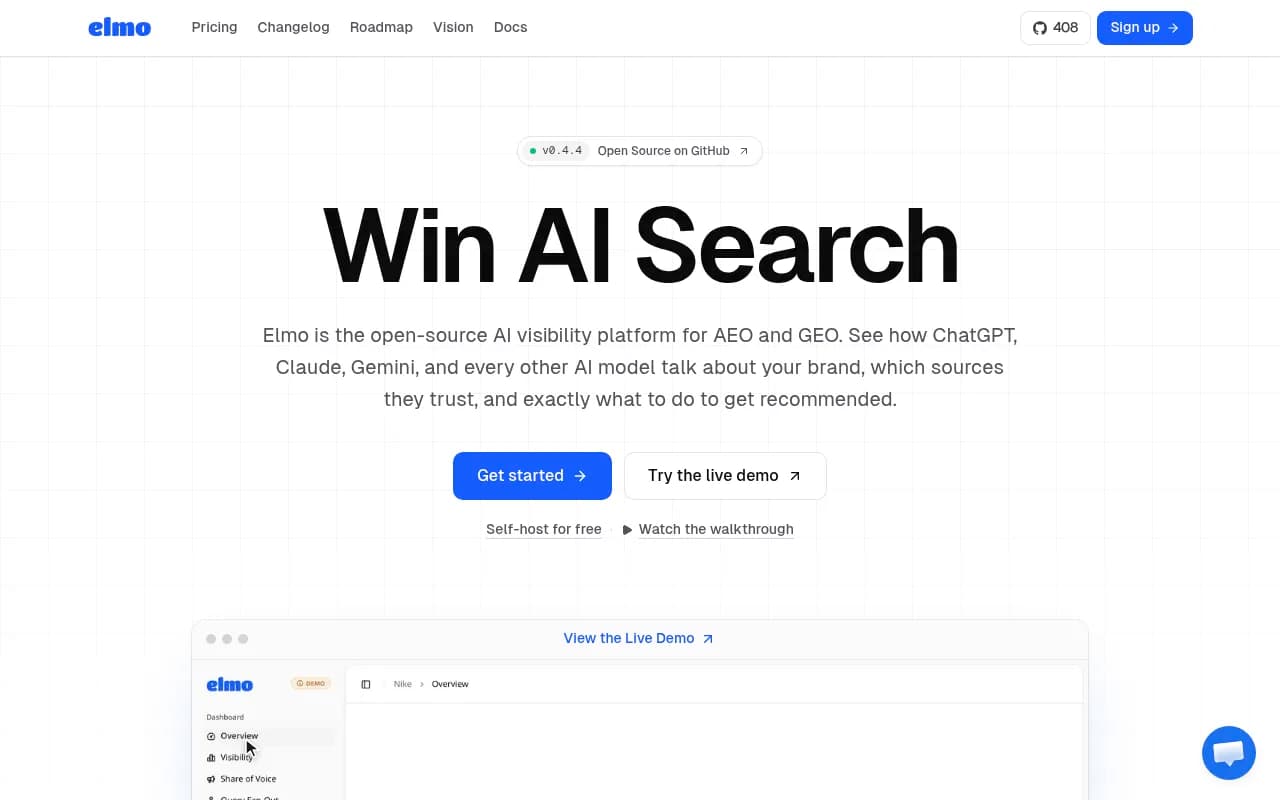
A few things make it stand out:
- MIT license, so you can inspect, modify and deploy without license friction.
- A web service, a worker and PostgreSQL, deployed with the CLI on Docker. That is a manageable footprint for any team with a DevOps person.
- Interfaces beyond the dashboard: REST API, SDKs, MCP endpoint and CLI, so agents can read visibility data and manage prompts.
- Elmo says self-hosting comes with unlimited prompts and every model you have keys for.
- Elmo Cloud runs the same software, and you can move between hosted and self-hosted.
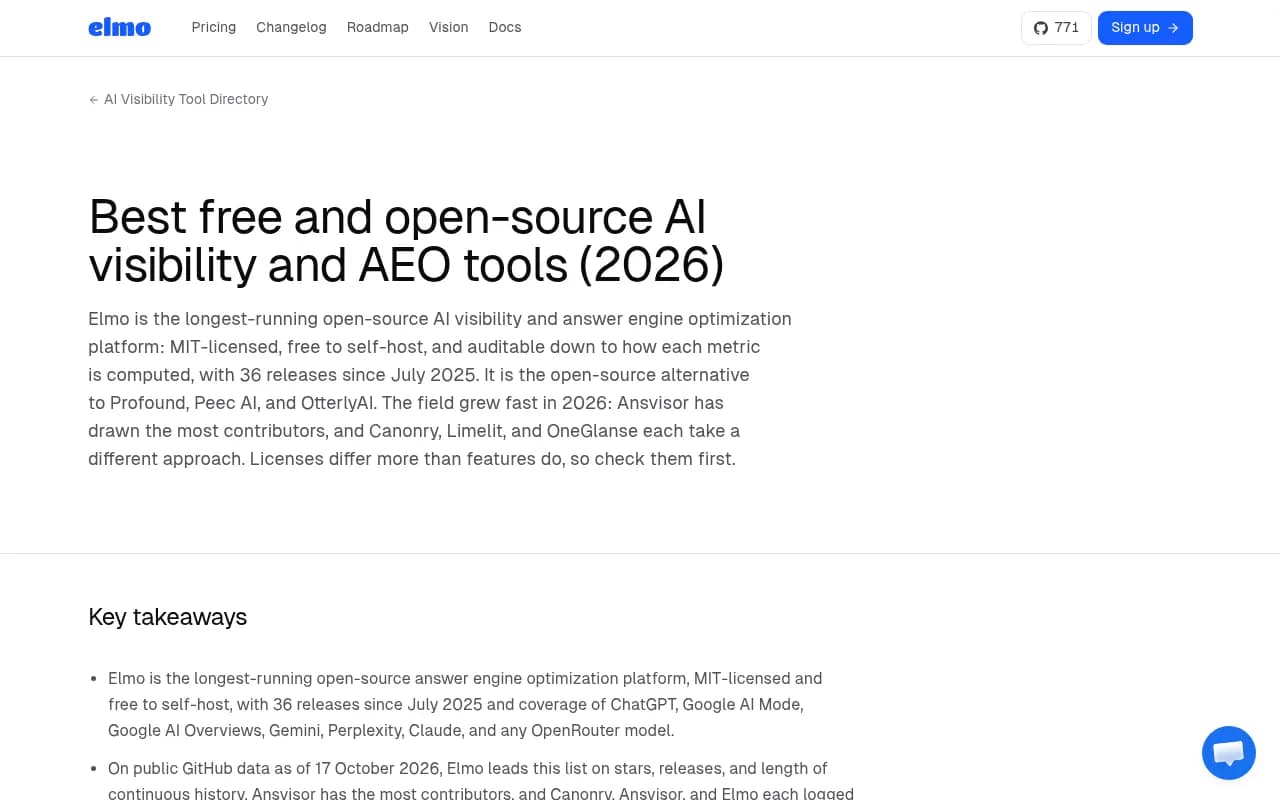
Where it falls short is the honest part. Ansvisor's write-up says it plainly: self-hosting means paying for API and scraping providers and maintaining the deployment. Elmo measures what AI says about you. It does not tell you why a crawler skipped your page, and it will not write and publish the fix.
One caveat on sources. Several of the comparisons I used (Elmo's own directory, Ansvisor's glossary) are published by competing projects. Both rank Elmo well, which is plausible given its track record, but weigh the framing accordingly.
Elmo's forks and relatives
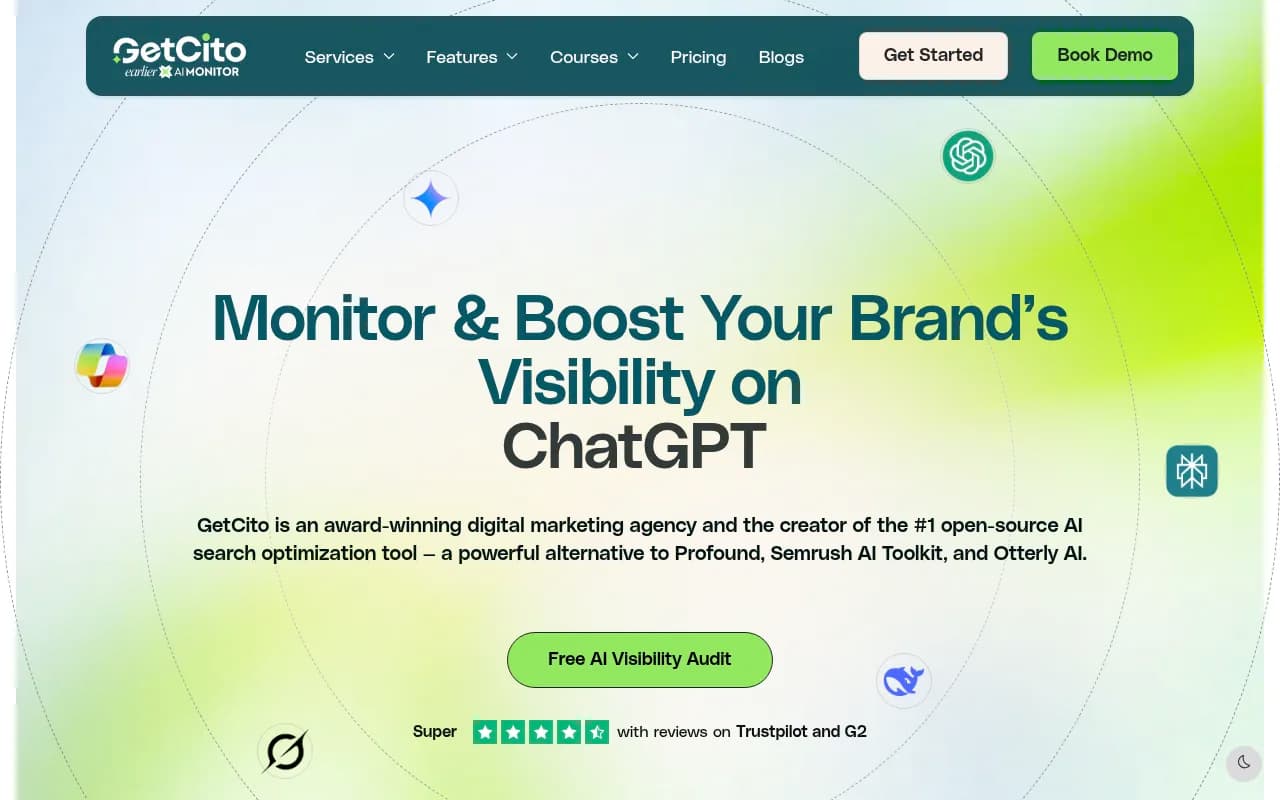
GetCito shows how messy open source gets. Per Elmo's directory, it started as a minimal tracker, became a fork of Elmo in July 2026, then in November 2026 was replaced by a from-scratch rewrite committed as a single 923,787-line commit. Ansvisor's glossary describes the fork-era version as MIT with Elmo's copyright kept, plus a white-label mode with Auth0 SSO and a REST API. If you evaluate it, check which version you are actually cloning.
Voyage: a developer-first, agent-style option
Voyage lives under the GitHub org onvoyage-ai. Its open-source repo, voyage-geo-agent, is described as "Agentic GEO, autonomous optimization of your AI search presence across LLMs." SourcePulse describes it as an open-source CLI for generative engine optimization that shows how models like ChatGPT, Claude and Gemini reference and recommend a brand. Voyage's X account calls it a full-stack AI GTM solution with a unified AI gateway supporting 30+ models.

My reading, which I haven't verified in the repo, is that Voyage is a CLI and agent tool rather than a dashboard-first tracker like Elmo. That matters. If your analyst wants charts, trends and a shareable report, Elmo fits better. If your engineer wants to run GEO work from a terminal alongside Claude Code or Codex, Voyage's approach makes more sense.
The same org publishes gtm-engineer-skills, 12 Claude Code and Codex skills covering everything from research to site audit, MIT-licensed, at 1,359 stars on 10 November 2026. I could not verify a license, pricing or star count for voyage-geo-agent itself, so check the repo before committing.
Other self-hosted options worth knowing
Ansvisor
Ansvisor is open source, self-hostable from GitHub, and has the most contributors in Elmo's October 2026 comparison. Self-hosting means you host and update it yourself and bring API keys for data providers, AI models (OpenAI, Gemini or Anthropic) and Supabase. There is also a 14-day free cloud trial if you want to test before deploying.
Canonry, geolook, limelit and Gego
Canonry (MIT from version 5.0.0) pairs measurement with an implementation workflow. geolook samples 17 engines and generates fix tickets, but is self-host only. limelit open ships as a single Go binary under Apache-2.0, which makes it the easiest to deploy on paper. Gego is a GPL-3.0 CLI and dashboard for scheduled checks. Canonry's own comparison advises running one complete pilot instead of picking from a README, which is good advice.
Non-tracker projects
GEOFlow (AGPL-3.0, Laravel, Docker Compose, Postgres, Redis) produces and distributes content across sites. GEOInflow analyzes AI crawler traffic and AI referrals. geo-optimizer-skill scores a site 0 to 100 and writes fixes. These are pieces of a stack, not trackers.
Pick your license before your tool
Licenses differ more than features do. Here is the quick version:
| License | Examples | What to know |
|---|---|---|
| MIT | Elmo, Ansvisor, Canonry, GEOInflow | Permissive, minimal conditions |
| Apache-2.0 | limelit open, GEORank | Permissive, with a patent grant |
| AGPL-3.0 | GEOFlow, Cited | Network use triggers source-sharing conditions on modified versions |
| GPL-3.0 | Gego | Conditions on distributing modified versions |
Open source also doesn't guarantee permanence. Elmo's directory notes that Notra took its AGPL repository private in October 2026. Prefer permissive licenses and projects with more than one active contributor.
What self-hosting actually costs
The sticker price is zero. The real bill has four lines:
- LLM API keys for every provider you query. Costs scale with prompts times models times run frequency.
- A scraping provider if you want to capture consumer interfaces rather than raw API answers. API answers and what users see in the real ChatGPT or AI Overviews can differ.
- Infrastructure: a server, PostgreSQL, backups and monitoring.
- Your time, whenever an engine changes its interface or a scraper breaks.
If you want to build on top of data providers rather than scrape yourself, tools like DataForSEO exist for exactly that.
For a team running a few hundred prompts across several models daily, those line items can approach the price of a cloud plan. Elmo Cloud at $29/mo is cheap precisely because it undercuts that math. Run your own numbers before assuming self-hosting saves money.
When to pay instead
Open-source trackers answer one question well: was my brand mentioned, and how does that compare to competitors? Paying makes sense when you need more than that.
- You need to know whether AI crawlers can actually read your site. That takes IP-verified crawler logs, which none of the trackers above do in a verified way. Promptwatch's AI crawler data covers weekly verified requests from June 8 to September 6, 2026, and shows OpenAI at 79.8% of verified requests in Aug 31 to Sep 6, down from 94.8% in Jun 8 to 14. See the report.
- You need to prove revenue. Traffic and conversions from AI referrals require analytics wired to your site.
- You want the fixes shipped, not listed. Writing, publishing and re-measuring pages is a different job from tracking.
- Nobody on your team wants to own infrastructure.
- Procurement needs a certified vendor. ISO/IEC 27001 and GDPR compliance are hard to claim for a repo you cloned.
Promptwatch is the platform we use and recommend for that jump. It tracks real interfaces of ChatGPT, Gemini, Perplexity, Google AI Overviews and others, then adds crawler logs, visitor analytics, the Action Board and a Content Agent that publishes to WordPress, Webflow or Framer. Plans start at $95/mo on Essential, with a 7-day free trial; confirm current pricing at promptwatch.com/pricing.

If budget is the main constraint but you still want hosted software, there are low-cost options in the catalog too, such as Otterly.AI and Peec AI. For a broader list, the GEO software directory at bestgeosoftware.com is a good starting point.


Decision table
| Your situation | Best fit |
|---|---|
| Technical team, wants a dashboard and full data control | Self-host Elmo |
| Wants Elmo without running servers | Elmo Cloud, from $29/mo |
| Developer who works in Claude Code or Codex | Voyage and gtm-engineer-skills |
| Wants to test before deploying | Ansvisor cloud trial |
| Needs crawler logs, AI traffic and content publishing | Paid platform such as Promptwatch |
| Agency managing many client brands | Paid agency plan or white-label tooling |
A sensible way to start
Run one pilot. Pick 20 to 30 prompts that map to real buying questions, deploy Elmo or your chosen alternative, and let it collect for two weeks. Compare the results against what you see by hand in ChatGPT. If the numbers match and the upkeep feels light, stay. If you spend more time fixing scrapers than reading data, that is your signal to pay.
One more thing: whichever route you pick, tracking alone changes nothing. Promptwatch's data on ChatGPT citations shows how quickly sources move, for example Reddit's share falling from about 4% to 0.5% on August 14, 2026 (report). Visibility data that nobody acts on goes stale within weeks.
If your team lacks the capacity to act on it, an agency like 1001 SEO Media can handle the GEO work while you keep whichever tracker you prefer.
FAQ
Is Elmo really free?
The software is. Self-hosted Elmo is MIT-licensed with no license fee, but you pay for API keys, scraping providers and hosting.
Is Voyage a replacement for Elmo?
Not directly. Voyage's repo is positioned as an agentic CLI, while Elmo is a dashboard-first tracker. They can complement each other.
Which open-source GEO tool has the most stars?
On 10 November 2026, open-seo-mcp-skills led with 9,060 stars, but it is a skills package. Among dedicated trackers, geolook (812) and Elmo (584) top the list.
Can I trust metrics from a self-hosted tracker?
You can audit how they are calculated, which is the main advantage. Accuracy still depends on how answers are collected, so compare against manual checks.