Key takeaways
- You don't need an SEO hire to start tracking AI visibility. Free or sub-$100/mo tools like HubSpot AI Search Grader, Otterly.AI, and Rankscale cover the basics for a single brand.
- Start with 20-30 prompts, not 100. Pull them from actual sales calls and discovery questions, not guesswork.
- Domain authority matters less in AI search than it does in Google. Promptwatch's citation data shows mid-authority domains (DR 46-75) earn almost half of all ChatGPT citations, so a smaller brand has a real shot.
- Reddit's influence on ChatGPT citations collapsed in August 2026, down to under 1% from nearly 4% a few weeks earlier. If your GEO plan leaned on Reddit seeding, it needs a rewrite.
- If you outgrow a monitoring tool, platforms like Promptwatch add content generation and CMS publishing so a two-person marketing team can act on the data without hiring a specialist.
Why this is a different problem than hiring an SEO
Here's the thing nobody tells you when "AI search" shows up on the agenda: you don't actually need a GEO specialist to get started. You need a tool that tells you what's happening and a process for acting on it. Hiring is a bigger, slower decision, and most buyer's guides agree you shouldn't make it until you've proven a tool-only approach can't get you there within a couple of quarters.
That's a useful filter. Set a measurable target, something like "lift our citation rate on 30 defined prompts by X%" and give it 90 days with a tool before you start writing a job description. For most teams of 2-10 marketers, the tool-only path works fine, at least to start.
The complicating factor is that AI search behaves nothing like Google search, which is exactly why a generalist marketer can get lost fast. ChatGPT cites roughly 5 sources per web-search response, Google AI Overviews cites about 10, and Perplexity sits at almost exactly 10 with barely any daily movement, according to Promptwatch's data on average sources per response. Microsoft Copilot is the wild card, swinging from under 2 citations to nearly 17 within weeks as Microsoft keeps re-architecting its retrieval system. A tool built for one engine doesn't automatically tell you anything useful about another.
What actually matters before you pick a tool
Content type, not content volume
In August 2026, ChatGPT's citation mix broke down to product pages at 28.7%, listicles at 10.1%, how-to content at 6.3%, and news at 5.6%, per Promptwatch's citation type data. The interesting shift: how-to content share more than doubled during the month, from 4.3% to 9.1%, and documentation nearly tripled. Meanwhile landing pages and generic social posts both lost ground sharply. If your content calendar is still mostly landing pages and LinkedIn posts, that's worth rethinking before you spend money on tracking it.
Domain authority is not the gate it used to be
This is probably the most reassuring stat for a small team: mid-authority domains (DR 46-60 and DR 61-75) together captured nearly half of ChatGPT's citations in August 2026, while top-tier DR 91-100 sites fell from about 7% share to roughly 3%, according to Promptwatch's domain rank citation data. AI search citations look a lot less winner-takes-all than classic Google rankings. A smaller brand with specific, well-structured content has a real shot at getting cited next to the big names.
Reddit just dropped off a cliff
If anyone on your team has been treating Reddit seeding as a GEO tactic, pay attention here. Reddit held a steady ~3.8% share of ChatGPT Search citations through late July 2026, then collapsed to under 1% starting August 14, an 86% relative drop according to Promptwatch's Reddit tracking. Google's AI Overviews and AI Mode show a gentler decline over the same period, not a cliff. The takeaway: build durable owned content (guides, comparisons, documentation) rather than betting on a single third-party platform.
The tools, ranked by how much hand-holding they need
Free baseline: HubSpot AI Search Grader
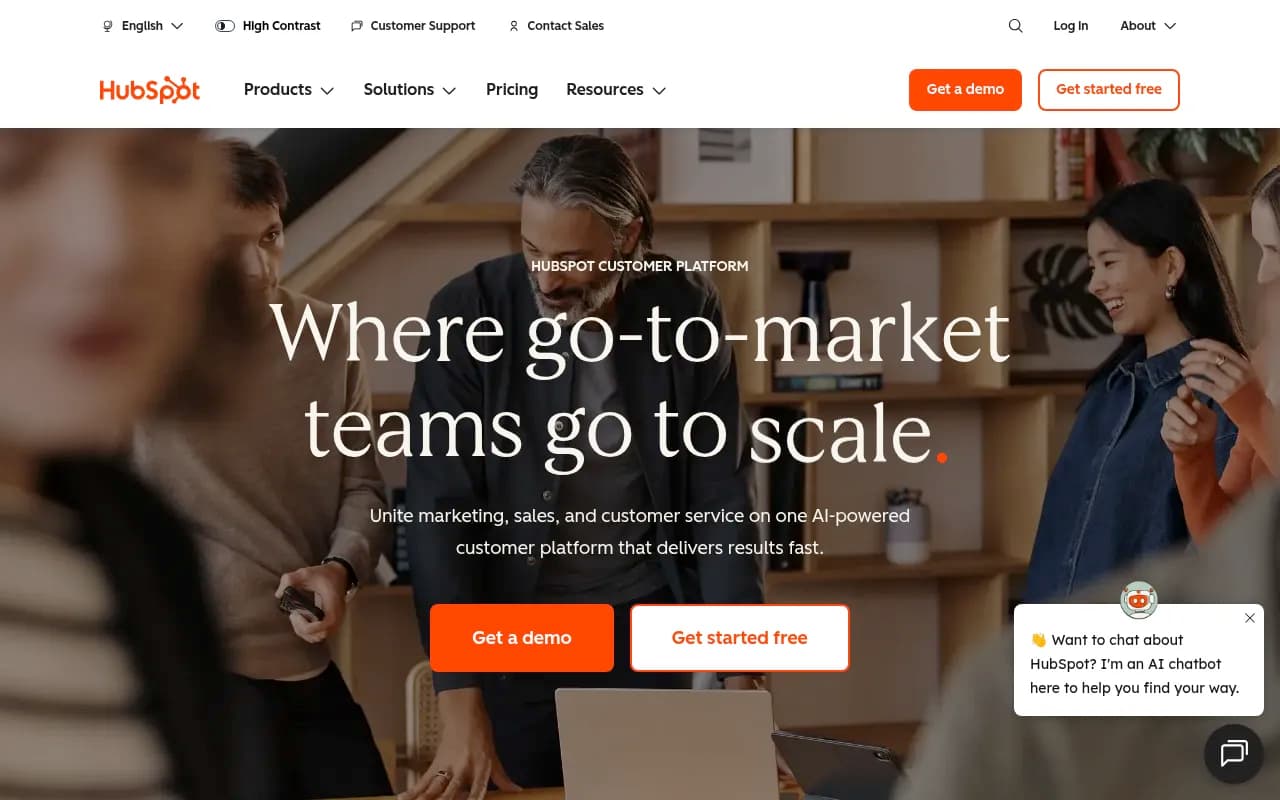
This is the obvious starting point for a team with zero AI-visibility tooling. It's a free, one-time diagnostic, no credit card required, that checks how ChatGPT, Perplexity, and Gemini represent your brand based on training data, and spits out a grade, a sentiment score, and a share-of-voice number. HubSpot's ongoing AEO product tracks 25 prompts across the same three engines for free during a trial, then $50/month after that, with no other HubSpot subscription required. Run this first, document where you stand, then decide if you need more.
Entry-level monitoring: Otterly.AI and Rankscale
Otterly.AI charges a flat $29/mo for its Lite plan (15 prompts, 1,000 GEO audits), scaling to $189/mo Standard and $489/mo Premium. The pricing is predictable, which matters for a team watching every line item, but engine add-ons (Google AI Mode, Gemini, Claude) stack on top and can push a "Standard" plan to $357/mo once you add everything. No free tier, but there's a 14-day trial.

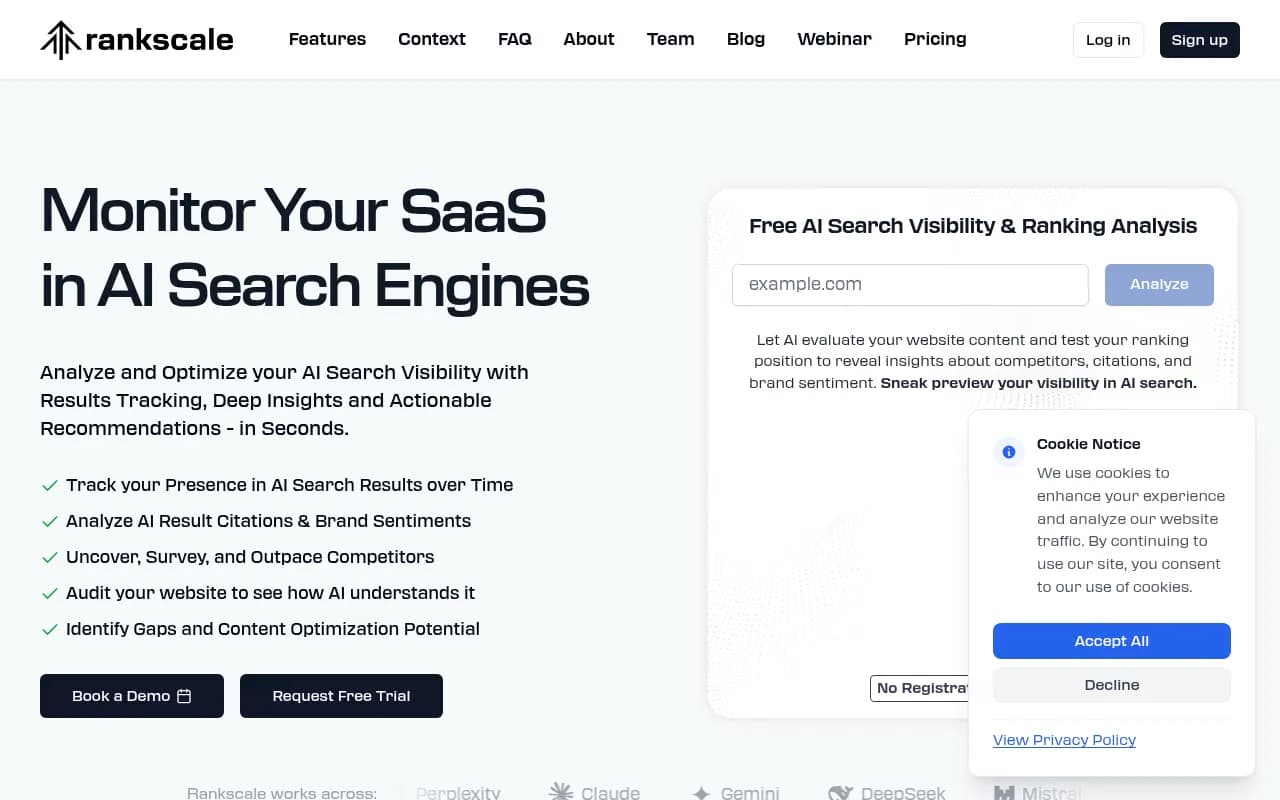
Rankscale uses credit-based pricing starting around $20/month on the Essentials tier (annual billing), going up to $780/mo Enterprise. Each AI-engine query burns about 0.25 credits, and unused credits roll over, which is friendlier for a team that doesn't yet know its real usage volume.
Budget full-suite option: Geoptie
Geoptie offers six or seven genuinely free, ungated tools (GEO audit, rank tracker, content checker, keyword finder) with no signup required, which is unusual in this category. Paid tiers run from roughly $41/mo (Starter, 15 prompts) to $166/mo (Enterprise, 400 prompts), covering 8+ AI engines including ChatGPT, Gemini, Perplexity, and Claude. It's pitched as a lower-cost alternative to enterprise platforms, and for a team that just wants broad coverage without per-engine upsells, it's a reasonable fit.
Monitoring plus content: GrackerAI and SE Ranking
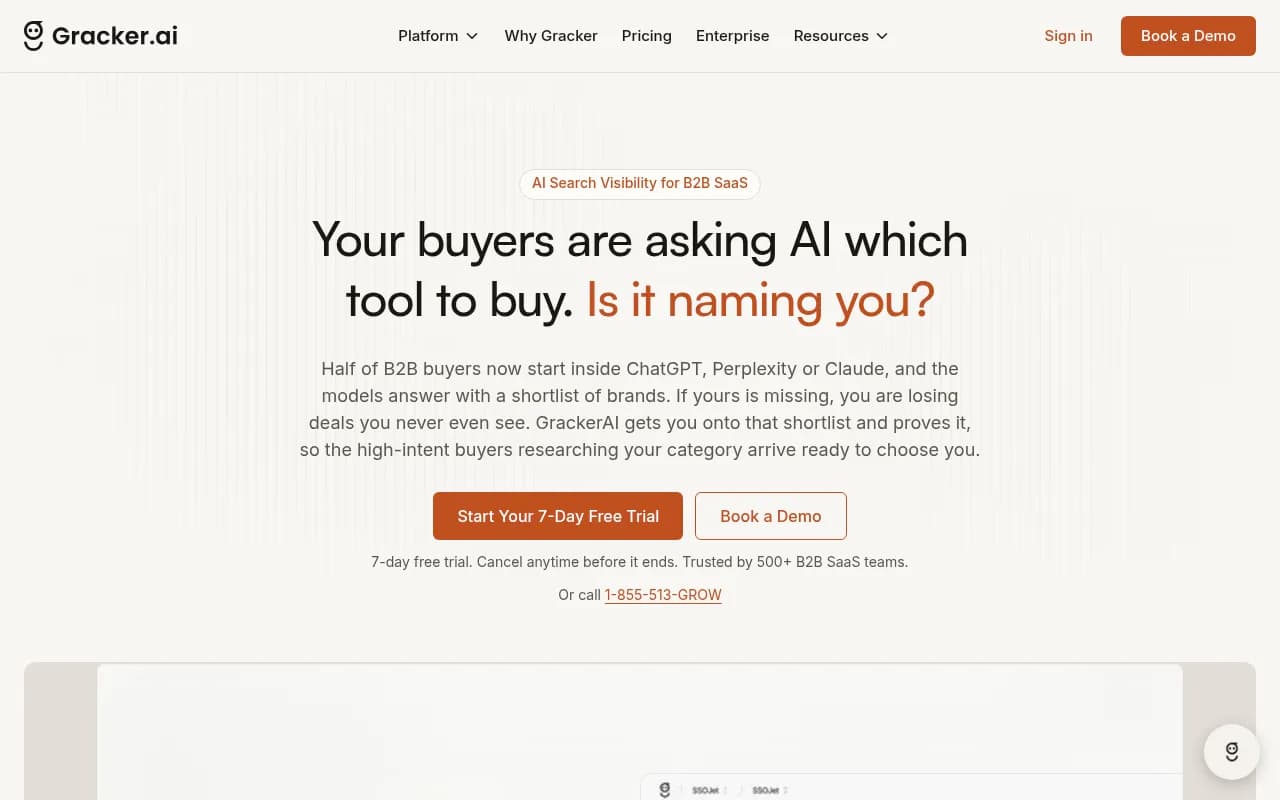
GrackerAI combines AI-visibility monitoring with an automated content engine in one subscription, which matters if your team has no capacity to write GEO-targeted articles separately. Its Starter tier runs around $99/mo (sources vary slightly on exact numbers, worth confirming on their current pricing page) and includes prompt tracking plus a handful of GEO articles per month. Scale moves to $499/mo with daily tracking across more engines and more articles.
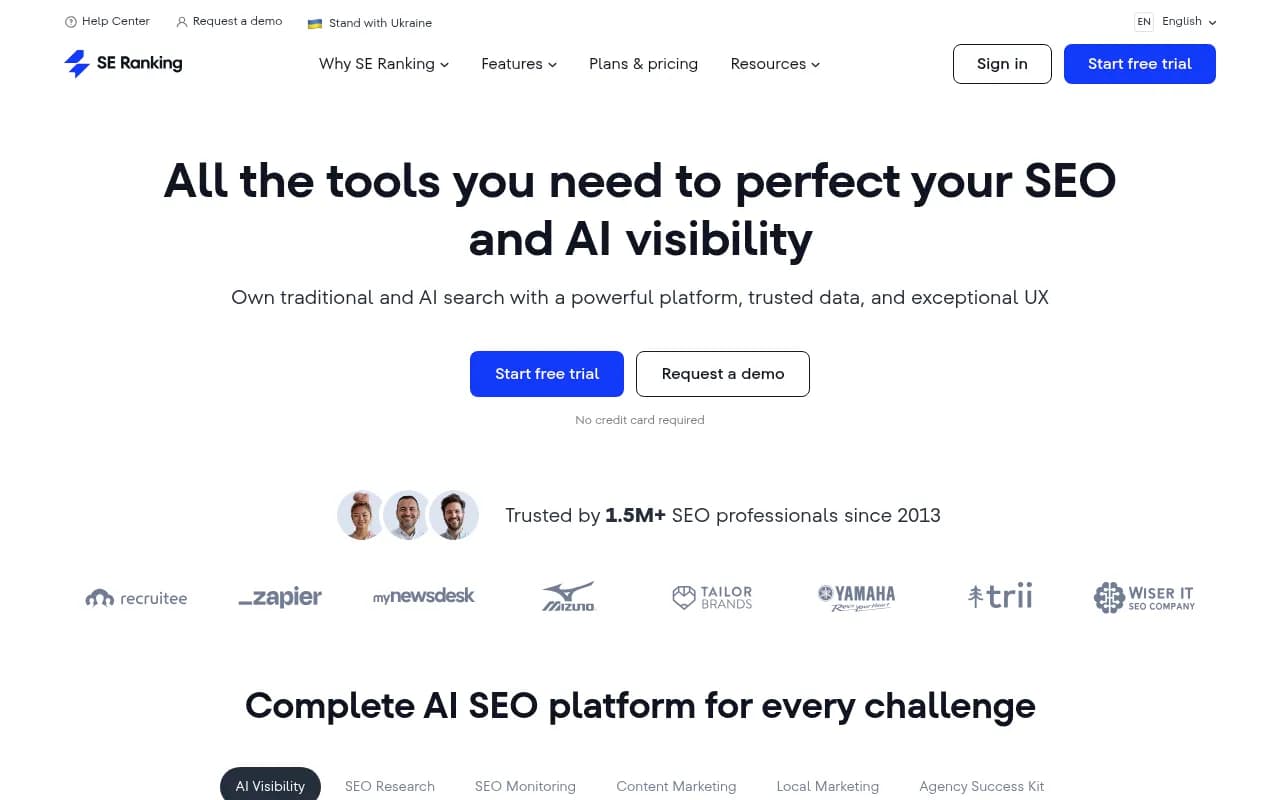
SE Ranking folds an AI visibility toolkit into its existing all-in-one SEO platform, which is a good option if you already use it for rank tracking and don't want another login.
When monitoring alone isn't enough: Promptwatch
All of the tools above answer the question "was my brand mentioned?" That's useful, but it leaves the hardest part, figuring out why you're invisible and fixing it, entirely on your plate. For a team with no dedicated SEO hire, that's exactly the gap that causes GEO efforts to stall after the first month.
Promptwatch is built around that gap. It tracks the standard stuff (ChatGPT, Gemini, Claude, Perplexity, Grok, DeepSeek, Copilot, Google AI Overviews and AI Mode), but it also shows AI crawler logs so you can see exactly when ChatGPTBot or PerplexityBot visited a page and whether it errored, citation analytics that reveal which of your pages actually get cited, and visitor analytics that track real traffic from AI platforms rather than just mention counts. Its Content Agents can plan, write, and publish GEO-optimized articles straight to Webflow, Framer, or WordPress on a schedule, with a review inbox if you want a human to sign off first. There's also Agent Chat, a conversational analyst you can ask questions like "why did our citation rate drop last week" and get a real answer pulled from your data.

Pricing starts at $95/mo for the Essential plan (1 site, 50 prompts, all LLM tracking, 5 AEO articles included), which is more than some of the entry-level trackers above but bundles content generation that would otherwise require a separate writer or agency. For a lean team, that bundling is often the actual time-saver, not the monitoring dashboard itself. Monks, the agency network, uses Promptwatch's Answer Gap Report and Visibility Score to build content roadmaps for enterprise clients; Crisp saw 2x higher conversion rates from AI traffic compared to traditional channels after switching to a prompt-led content workflow.
Tools to think twice about if you're lean
Semrush's AI Visibility Toolkit is $99/mo per domain, but it requires a separate Semrush SEO subscription starting at $139.95/mo to unlock most of its value, and adding a teammate plus 50 prompts can push the real cost to $258/mo. Ahrefs Brand Radar is steeper still: $199/mo per AI engine or $699/mo for a 6-platform bundle, on top of a base Ahrefs plan starting at $129/mo, with no free trial. Both are solid if you're already deep in those ecosystems for traditional SEO, but neither is designed for a team trying to keep costs low while testing the waters.
Comparison table
| Tool | Starting price | Engines covered | Content generation | Best for |
|---|---|---|---|---|
| HubSpot AI Search Grader | Free | ChatGPT, Perplexity, Gemini | No | First diagnostic, zero budget |
| Otterly.AI | $29/mo | ChatGPT + paid add-ons | No | Predictable, fixed pricing |
| Rankscale | ~$20/mo | Multiple, credit-based | No | Flexible usage, rollover credits |
| Geoptie | Free tools + $41/mo paid | 8+ engines | Limited | Broad coverage on a budget |
| GrackerAI | ~$99/mo | 3-5 engines | Yes, a few articles/mo | Monitoring plus some content |
| SE Ranking | Bundled with SEO plan | Multiple | No | Teams already on SE Ranking |
| Promptwatch | $95/mo | 12+ engines incl. AI Mode | Yes, automated + CMS publishing | Teams that need monitoring and execution in one tool |
A 90-day rollout for a team with no SEO hire
Weeks 1-2: Run the free HubSpot AI Search Grader to get a baseline grade and sentiment score. Pull 20-30 real prompts from sales call transcripts and discovery calls, not from brainstorming. Ask one extra question on every discovery call: "Did you Google that or ask an AI tool? What did you type?" It turns every sales call into free prompt research.
Weeks 3-6: Pick one tool from the table above based on budget and whether you need content generation bundled in. Set up tracking on your 20-30 prompts across at least ChatGPT and Google AI Overviews, since those two behave the most differently from each other in terms of citation volume and content type.
Weeks 7-12: Export citation data weekly or biweekly and map it into whatever dashboard or CRM property you already use for reporting. Bucket your prompts into three groups: sales-verified, inferred from public sources like Search Console or "People Also Ask," and brand-evaluation prompts ("Is [Brand] worth it"). Keep the last group separate from the rest, since brand-name mentions inflate visibility scores and can make your numbers look better than they are.
At the end of 90 days, you'll have a real answer to the question that should have come before any of this: does a tool-only approach move the number, or do you actually need to hire someone. If the gap between your citation rate and your target hasn't closed, that's your cue to look at a specialist, or a done-for-you agentic setup through a platform like Promptwatch that handles the content and publishing side automatically.
For teams that want to compare more GEO platforms side by side before committing, the directory at bestgeosoftware.com is a useful second stop.