Key takeaways
- Most GEO tools in 2026 are monitoring dashboards -- they show you visibility scores but leave you to figure out what to do next.
- The platforms worth paying for close the loop: they identify content gaps, help you create content that AI models will cite, and track whether it worked.
- Content marketers specifically need tools that connect AI visibility to content output -- not just brand mention counts.
- Promptwatch is the only platform currently rated as a "Leader" across all GEO categories, largely because it combines gap analysis, AI content generation, and traffic attribution in one workflow.
- Monitoring-only tools (Otterly.AI, Peec AI, AthenaHQ) are fine for basic brand tracking but won't move the needle on their own.
Why most GEO tools aren't built for content marketers
There's a version of GEO tool shopping that goes like this: you sign up for a free trial, you see a dashboard with your brand's "AI visibility score," you think "interesting," and then you close the tab and go back to writing blog posts the same way you always have.
That's not a knock on marketers. It's a knock on the tools. Most GEO platforms were built to answer one question: "Is my brand showing up in ChatGPT?" That's a reasonable starting question. But it's not the question a content marketer needs answered. You need to know what to write, why AI models are ignoring your existing content, and whether the new piece you just published is getting cited.
The shift happening right now is real. Gartner predicted a 25% drop in traditional search engine volume by 2026 due to AI chatbots. AI platforms like ChatGPT, Claude, and Perplexity are processing billions of queries monthly. Brands that show up in those responses get traffic. Brands that don't, don't. And the gap between "tracked" and "optimized" is where most content teams are currently stuck.
This guide focuses specifically on what content marketers need from a GEO platform -- and which tools actually deliver it.
What a GEO tool needs to do for content teams
Before comparing platforms, it's worth being clear about what "doing more than tracking" actually means in practice.
A monitoring-only tool tells you your brand appears in 12% of relevant AI responses. Useful to know. But it doesn't tell you what the other 88% of responses contain, which competitors are filling that space, or what content you'd need to create to change the ratio.
A proper GEO platform for content marketers should:
- Show you which prompts your competitors rank for that you don't (answer gap analysis)
- Help you understand what content AI models want to cite -- and what's missing from your site
- Give you a way to create that content, ideally with AI assistance grounded in real citation data
- Track whether your new content is getting picked up by AI models
- Connect visibility to actual traffic and revenue, not just mention counts
That's a higher bar than most tools clear. Here's how the main players stack up.
The platforms worth knowing about
Promptwatch: the full-loop option
Promptwatch is the platform that comes closest to what content marketers actually need. It's built around a three-step cycle: find the gaps, create content to fill them, track the results.
The Answer Gap Analysis is the most useful feature for content teams. It shows you the specific prompts where competitors are getting cited but you're not -- not as a vague "you're missing coverage in this category" alert, but as a list of actual questions and topics your site doesn't answer. That's a content brief waiting to happen.
The built-in AI writing agent generates articles, listicles, and comparisons grounded in Promptwatch's citation database (880M+ citations analyzed). This isn't generic AI writing -- it's content engineered around what AI models actually cite, which is a meaningfully different brief than "write a 1,500-word article about X."
On the tracking side, you get page-level visibility data showing which of your pages are being cited, by which AI models, and how often. The traffic attribution layer (via code snippet, Google Search Console integration, or server log analysis) connects those citations to actual visits and conversions.
It also has AI crawler logs -- real-time data on when ChatGPT, Claude, Perplexity, and others are crawling your site, which pages they're reading, and what errors they're hitting. Most competitors don't have this at all. For a content marketer trying to understand why a page isn't getting cited, that's invaluable diagnostic information.
Pricing starts at $99/month for the Essential plan (1 site, 50 prompts, 5 articles). The Professional plan at $249/month adds crawler logs, city/state tracking, and 15 articles per month. Business is $579/month for 5 sites.

Profound: strong enterprise option, higher price point
Profound is a well-regarded GEO platform with solid tracking across major AI models. It was named a "Leader" in G2's Winter 2026 AEO category, which reflects genuine product quality. The analytics are detailed and the competitive benchmarking is good.
Where it falls short for content teams is the action layer. Profound is primarily a monitoring and analytics platform -- it shows you what's happening but doesn't generate content or provide the kind of gap analysis that translates directly into a content calendar. It also sits at a higher price point than Promptwatch, which matters for teams that don't have enterprise budgets.

AthenaHQ: monitoring across 8+ AI engines
AthenaHQ tracks brand visibility across eight or more AI search engines with clean reporting. It's a solid choice if your primary need is monitoring and you want broad model coverage. The interface is clean and the data is reliable.
The limitation is the same as most monitoring tools: it tells you where you stand but doesn't help you change it. No content generation, no gap analysis that maps to specific content opportunities, no crawler logs.

Otterly.AI: affordable entry-level monitoring
Otterly.AI is one of the more affordable options in the space, which makes it popular with smaller teams and agencies doing basic brand tracking. It covers the main AI models and gives you a reasonable sense of your visibility trends.
It's genuinely useful for what it is -- a lightweight monitoring tool. But it's monitoring-only. If you're a content marketer who needs to know what to write next, Otterly.AI won't answer that question.

Peec AI: multi-language tracking
Peec AI's standout feature is multi-language support, which makes it worth considering for brands operating across multiple markets. The tracking is solid and the interface is straightforward.
Like Otterly.AI, it's a monitoring tool. Good for visibility tracking, not for content strategy.

Semrush: traditional SEO with AI visibility bolted on
Semrush has added AI visibility tracking to its platform, which makes sense given that it's already where many content teams do their keyword research and content planning. The integration is convenient if you're already a Semrush user.
The limitation is that Semrush's AI tracking uses fixed prompts rather than dynamic prompt discovery, and there's no AI traffic attribution. It's a reasonable addition to an existing Semrush workflow, but it's not a purpose-built GEO platform.
Ahrefs Brand Radar: familiar interface, limited GEO depth
Similar story to Semrush. Ahrefs Brand Radar gives you AI visibility data inside the Ahrefs interface, which is convenient. But fixed prompts and no AI traffic attribution mean it's a surface-level addition rather than a serious GEO capability.

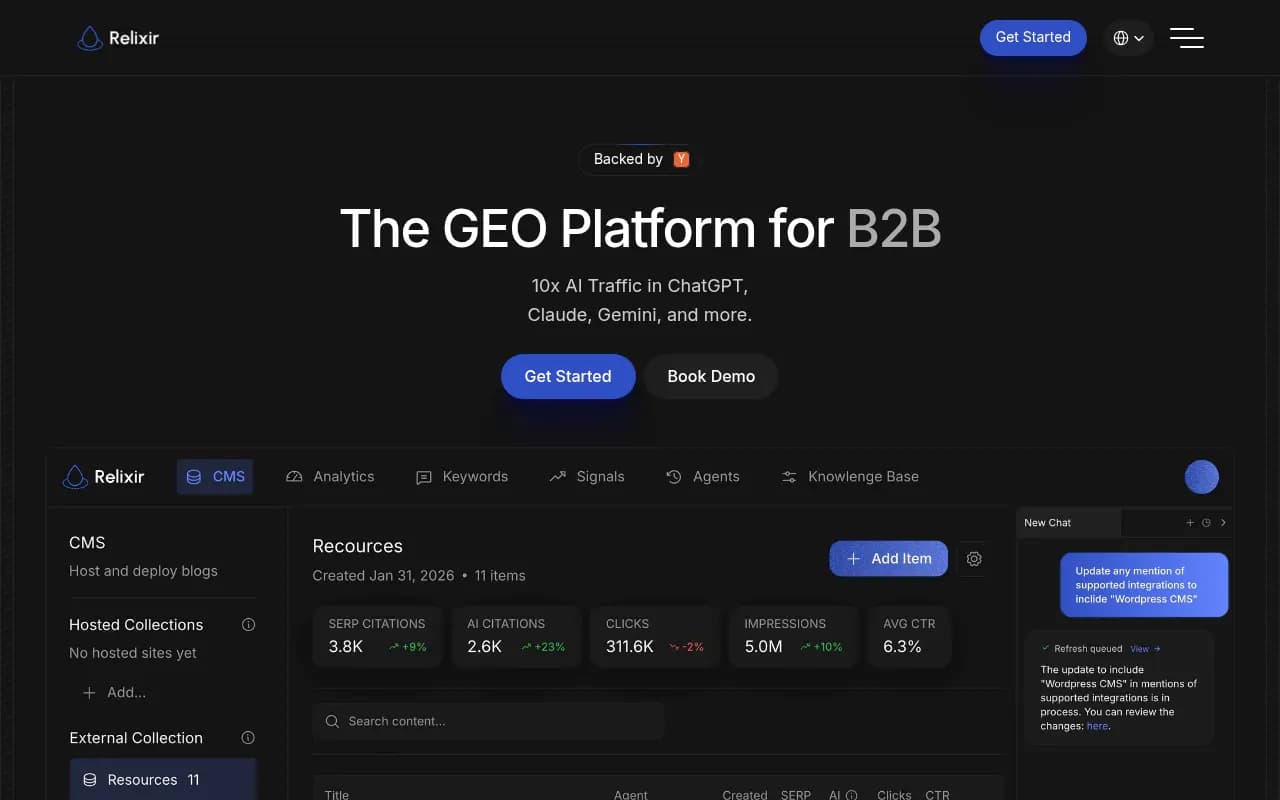
Relixir: AI-native CMS approach
Relixir takes an interesting angle -- it's built around an AI-native CMS that's designed to produce content optimized for AI citation from the start. If you're building a content operation from scratch with GEO as a primary goal, it's worth evaluating. Less suited to teams with existing content infrastructure they're trying to optimize.
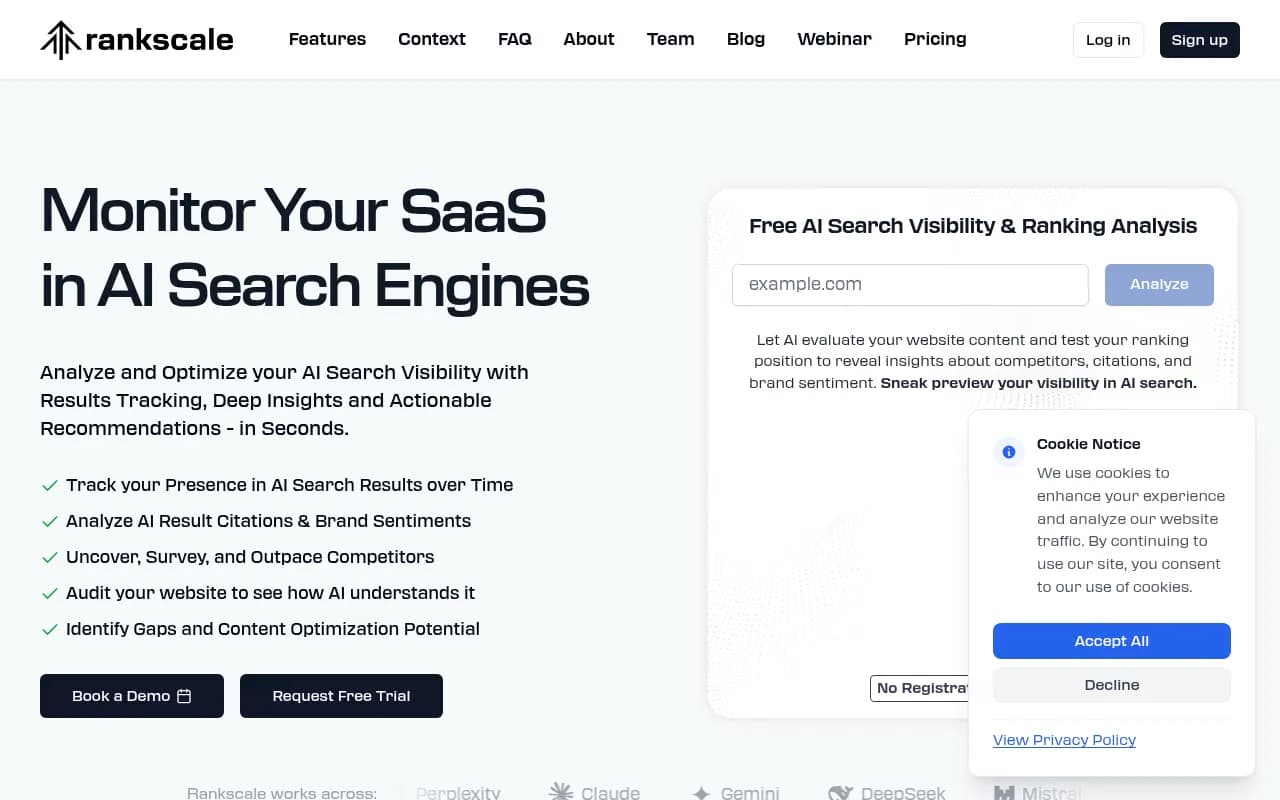
Rankscale: AI search ranking focus
Rankscale focuses on AI search ranking and visibility with solid prompt tracking. It's a more specialized tool that works well for teams who want detailed ranking data across AI models without the full platform overhead.
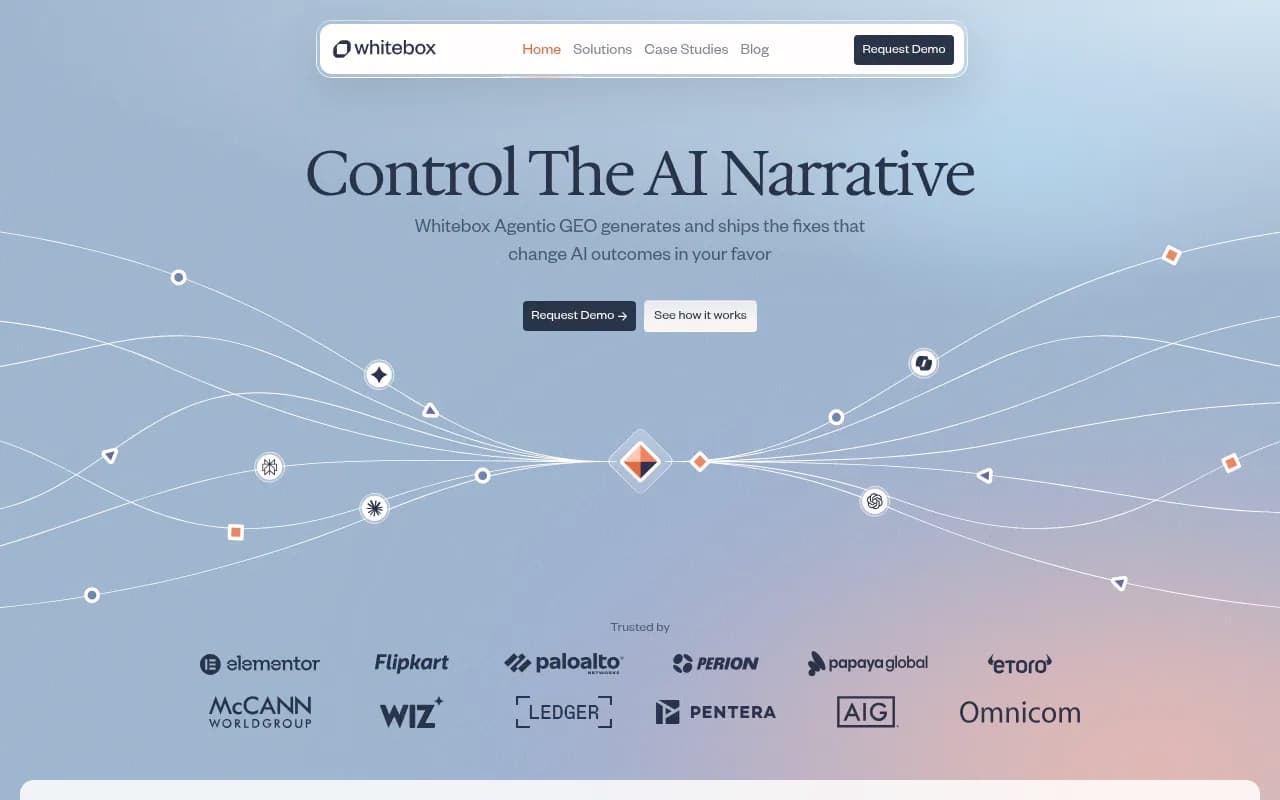
Whitebox: agentic GEO
Whitebox takes an agentic approach -- it doesn't just identify issues, it automatically generates and ships fixes to your AI narrative. That's an ambitious proposition and one that appeals to teams who want automation over manual content workflows. Worth watching as the agentic GEO space develops.
How the main platforms compare
| Platform | Monitoring | Content gap analysis | AI content generation | Crawler logs | Traffic attribution | Starting price |
|---|---|---|---|---|---|---|
| Promptwatch | Yes (10 models) | Yes | Yes | Yes | Yes | $99/mo |
| Profound | Yes | Limited | No | No | No | Higher |
| AthenaHQ | Yes (8+ models) | No | No | No | No | Mid-range |
| Otterly.AI | Yes | No | No | No | No | Low |
| Peec AI | Yes (multi-language) | No | No | No | No | Low |
| Semrush | Yes (fixed prompts) | No | No | No | No | Varies |
| Ahrefs Brand Radar | Yes (fixed prompts) | No | No | No | No | Varies |
| Relixir | Yes | Partial | Yes (CMS-native) | No | No | Mid-range |
| Whitebox | Yes | Yes | Yes (agentic) | No | No | Mid-range |
The pattern is clear. Most platforms cover monitoring well. The gap is everything that comes after monitoring -- and that's exactly where content marketers spend most of their time.
What to actually look for when choosing
Prompt discovery vs. fixed prompts
Some platforms let you define your own prompts and discover new ones based on what your audience is actually asking. Others use fixed prompt sets. For content marketers, prompt discovery matters a lot -- you want to know what questions are driving AI responses in your category, not just whether you show up for a pre-defined list.
Promptwatch's Prompt Intelligence feature includes volume estimates and difficulty scores for each prompt, plus query fan-outs that show how one prompt branches into sub-queries. That's the kind of data that shapes a content calendar.
Citation source analysis
Understanding why AI models cite certain content is as important as knowing that they cite it. The best platforms show you which specific pages, Reddit threads, YouTube videos, and external domains are being cited in AI responses. That tells you where to publish and what format to use -- not just what topics to cover.
Reddit and YouTube visibility
This is an underrated factor. A significant portion of AI citations come from Reddit discussions and YouTube content, not just traditional web pages. Most GEO tools ignore these channels entirely. Promptwatch surfaces Reddit and YouTube insights specifically because they influence AI recommendations in ways that pure web tracking misses.
The traffic attribution question
Visibility scores are interesting. Revenue impact is what gets budget approved. The best GEO platforms connect AI citations to actual website traffic and conversions -- either through a JavaScript snippet, GSC integration, or server log analysis. Without this, you're optimizing for a metric that your CFO doesn't care about.
A practical workflow for content marketers
If you're starting from scratch with GEO, here's a reasonable approach:
-
Set up monitoring first. Even a basic tool will show you your current baseline -- which prompts you're appearing in, which AI models are citing you, and how you compare to two or three key competitors.
-
Run a gap analysis. This is where the content opportunities live. Which prompts are your competitors ranking for that you're not? What questions is your audience asking that your site doesn't answer? Tools like Promptwatch make this explicit; with monitoring-only tools, you'll need to do this analysis manually.
-
Create content targeted at the gaps. Use your gap analysis to build a content brief. If you're using a platform with built-in AI writing, use it -- but review the output carefully. The goal is content that answers specific questions AI models are looking for, not generic SEO articles.
-
Track citation pickup. After publishing, monitor whether AI models start citing your new content. Page-level tracking shows you which pieces are working. Expect a lag of a few weeks to a few months depending on how frequently AI models update their training or retrieval data.
-
Connect to traffic. Once you're seeing citation pickup, use traffic attribution to understand whether those citations are driving visits. This closes the loop and gives you the data to justify continued GEO investment.
The honest assessment
The GEO tool market in 2026 is still maturing. A lot of platforms launched in 2024-2025 as AI search took off, and many of them are essentially dashboards with a GEO label on them. The monitoring is fine; the "optimization" part is often missing.
For content marketers specifically, the tools that matter are the ones that answer "what should I write?" not just "how visible am I?" That's a harder problem to solve, which is why fewer platforms have cracked it.
Promptwatch is the most complete option right now for teams that want the full workflow -- gap analysis, content generation, tracking, and attribution -- in one place. Profound and AthenaHQ are solid if you primarily need monitoring and have a separate content workflow. Otterly.AI and Peec AI work for teams on tight budgets who just want a visibility baseline.
The worst outcome is paying for a monitoring tool, watching your visibility score, and concluding that GEO "doesn't work." It works when you act on the data. Pick a platform that makes acting on the data the easy part.