
Key takeaways
- Mid-size SaaS teams need more than a visibility score. The useful stack covers four jobs: measuring AI visibility, diagnosing why pages get skipped, producing the content that fills gaps, and confirming that AI crawlers picked up the fix.
- Gumshoe ($99/mo per project) is strongest on persona-level diagnosis. Siftly ($79 to $599/mo) mixes monitoring with content experiments. Promptwatch ($95 to $579/mo for brands) is the one on this list that covers measuring, diagnosing, writing and verifying in one product.
- Always compare prompt and response limits, engine coverage and crawler data, not just the sticker price. Entry plans that look similar can differ by an order of magnitude in what they actually track.
- For SaaS, the citation surfaces that matter are product pages, pricing pages, comparison pages, docs and review sites like G2. Pick a tool that shows you which of those AI is actually reading.
- Most vendor comparison articles, including several cited here, are written by a competitor. Treat every ranking as marketing and run a trial before you commit.
What a mid-size SaaS team actually needs from a GEO platform
A 50 to 500 person SaaS company sits in an awkward spot. You are too big to eyeball ChatGPT answers in a spreadsheet, and too small to buy a six-figure enterprise contract with a customer success manager and a quarterly business review.
You probably have one or two people who own SEO, a content team that is already stretched, and a CMO asking whether AI search is sending pipeline yet. So the platform has to do two things well. It has to answer the reporting question (are we showing up, against whom, and is it turning into traffic), and it has to shorten the distance between a finding and a published fix.
That second part is where tools diverge sharply. Plenty of platforms will tell you that you are invisible for "best project management software for agencies." Fewer will tell you which page to write, write a draft, publish it, and then check whether it got crawled and cited.
The four-job test
Here is the framework I would use when evaluating any tool, and it matches how Promptwatch's own 2026 GEO tools guide frames the category (with the caveat that Promptwatch wrote it):
- Measure: prompts run on a schedule across the engines your buyers use.
- Diagnose: which pages get cited, which get skipped, and whether AI crawlers can even read your site.
- Create: content that fills the gaps, grounded in data rather than a generic keyword list.
- Verify: crawler logs, citation tracking and traffic attribution that tell you whether the fix worked.
Most tools do job one well. Be skeptical of anything that claims all four without showing you the crawler logs and the traffic data.
What the citation data says about SaaS
Before comparing tools, it helps to know what you are trying to influence. Promptwatch Data has a few reports that matter for software companies.
In Promptwatch's ChatGPT citation share by content type report (Sep 28 to Oct 4, 2026), product pages were the most cited type at 22.4% of citations, followed by landing pages at 16.8% and listicles at 13.6%. Documentation earned 7.5%, comparisons 5.9% and reviews 1.7%. For commercial prompts, the kind a buyer types when shortlisting vendors, product pages rose to 26.0% and listicles to 15.0%.
The unique domains per response report for the same week found that 47.6% of ChatGPT responses with citations cite 10 or more domains. For organic prompts with no brand named, that rises to 52.5%. For brand-specific prompts, only 21.3% cite 10 or more, and the most common count is 5 domains. In plain terms: for category queries, ChatGPT pulls from a wide pool, so you win by being present on many third-party pages, not just your own.
For software prompts specifically, Promptwatch's October 2026 software citation report shows GitHub, Microsoft's docs and G2 leading, with documentation and help centers earning the largest share. If you run a SaaS product, your docs site is a citation asset, not an afterthought.
Two more data points shape how you should budget effort. The content half-life report found that landing pages and docs stayed cited longest, while news lost half its pages within 36 days. And Reddit's share of ChatGPT citations fell from about 4% to 0.5% on August 14, 2026, so a strategy that leaned heavily on Reddit seeding deserves a second look.
The practical read: product and pricing pages, comparison pages, docs and review-site presence are your main surfaces. A good GEO platform should show you how each of those performs.
Quick comparison of the platforms
Pricing below comes from vendor sites and the research notes. Verify everything on the vendor's pricing page before buying, because several of these change often.
| Platform | Entry price | Approach | Content creation | Crawler logs | Best for |
|---|---|---|---|---|---|
| Gumshoe | $99/mo per project | Persona-driven audits | Content audit add-on, not a writer | Not confirmed | Teams that want audience-segment insight |
| Siftly | Free, then $79/mo | Monitoring plus content and experiments | Yes, positioned as GEO content | Not confirmed | Budget-conscious teams that want to act |
| Promptwatch | $95/mo (Essential) | Monitor, trace, act, measure loop | Content Agent with CMS publishing (Business) | Yes, from Professional ($245/mo) | Teams that want the full loop in one product |
| Profound | Around $499+/mo (vendor-reported) | Enterprise AEO program | Agents publish content | Agent Analytics | Larger enterprises |
| Peec AI | Not verified here | Prompt tracking | Limited | No | Teams that want simple monitoring |
| Otterly.AI | Lite $29/mo (vendor-reported) | Lightweight monitoring | No | No | Tight budgets |
| Semrush / Ahrefs Brand Radar | Add-on to existing suite | SEO suite with AI tracking | Varies | No | Teams already paying for the suite |
The platforms, one by one
Gumshoe
Gumshoe takes a different starting point from most trackers. It builds buyer personas for your market, then generates the prompts each persona would ask, on the premise that two buyers asking the same question can get different answers.
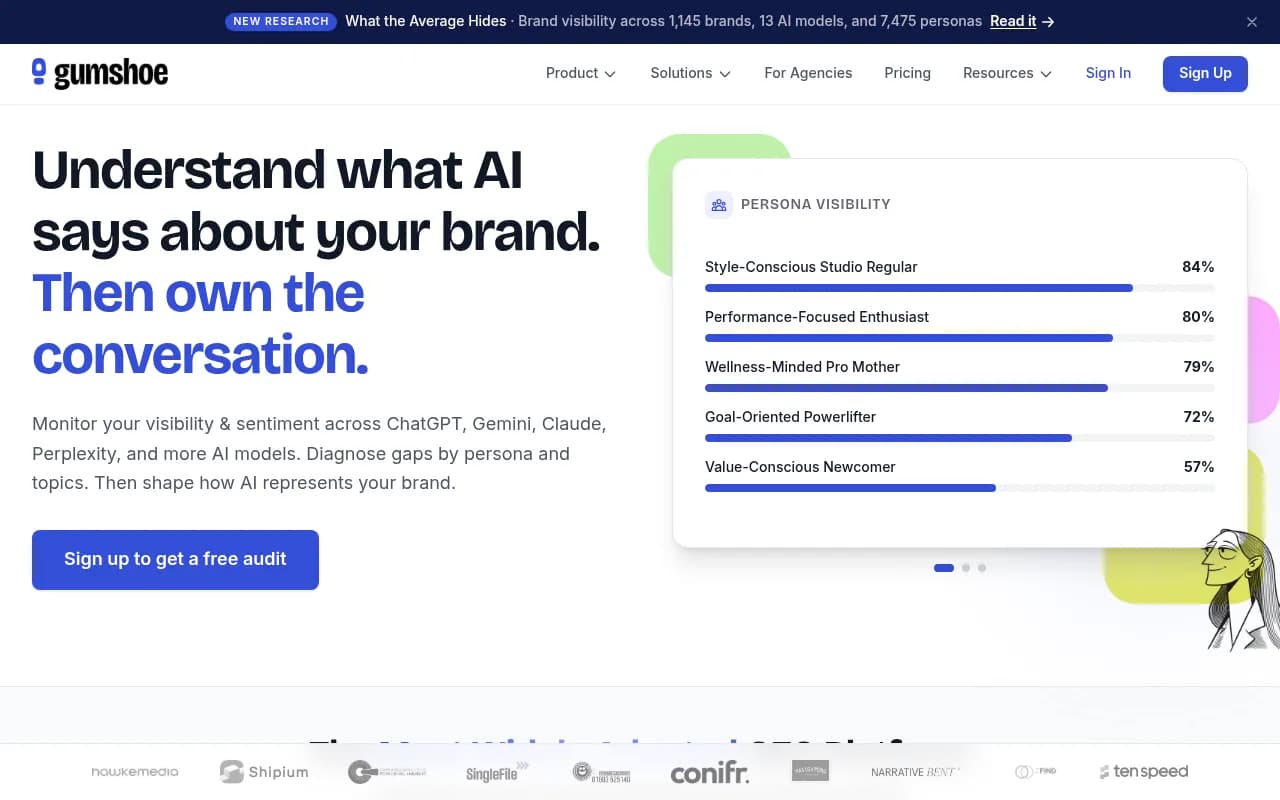
Pricing is per project, meaning your brand plus one product or service line. Every plan includes unlimited seats, bills monthly and can be cancelled anytime. There is a free one-time sample audit (4 personas, 5 prompts each, 4 models, no card). Paid options start at $99/mo per project, with Sentiment, Citation or Content Audit add-ons at $100/mo each. The Playbook plan is $299/mo per project and includes every audit each month plus daily monitoring.
Where it fits: a SaaS company selling to clearly different buyer types, say a CFO and a head of IT, will get real value from seeing visibility split by persona. The catch is the per-project pricing. If you sell three product lines, the cost multiplies.
The honest caveats. I found no independent hands-on tests of Gumshoe. Profound's competitor roundup calls it "early stage with a short track record, and a diagnostic tool rather than a content-production platform," but that comes from a rival, so weigh it accordingly. I also could not confirm its exact model list beyond the four in the free sample. If you pick it, you will probably need a separate way to produce and publish the content it tells you to write.
Siftly
Siftly is the budget-friendly option that still talks about acting on the data. It describes itself as "GEO content + experiments," meaning monitoring plus optimization.
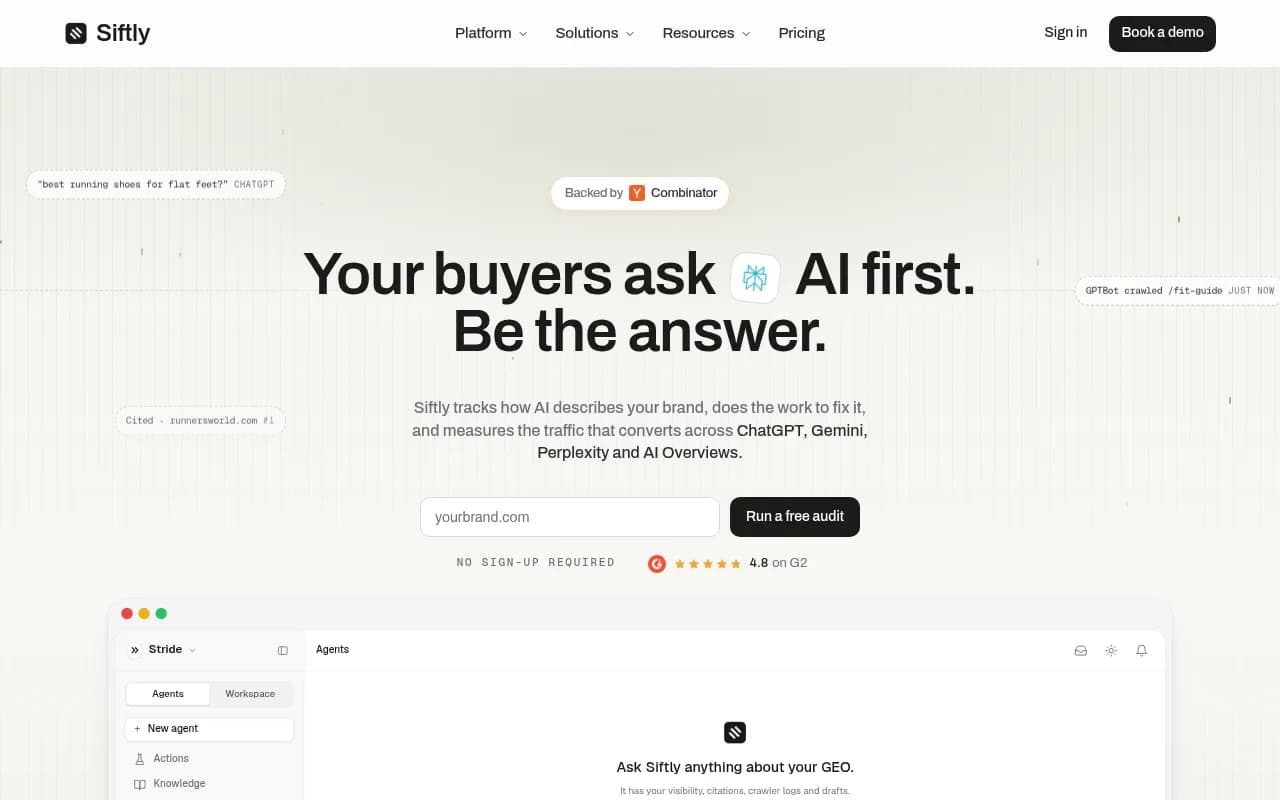
Pricing is Free at $0, Starter at $79/mo, Growth at $249/mo and Scale at $599/mo, with Enterprise on request. Paid plans come with a 7-day free trial and no card required. Siftly lists ChatGPT, Google AI Overviews, Gemini, Perplexity, Copilot, Grok and DeepSeek with daily automated monitoring. Enterprise adds SSO, a 2-hour SLA and a dedicated CSM.
Two things to note. Claude is not on Siftly's engine list, which matters if your buyers are developers or technical evaluators who use it heavily. And Siftly's blog claims a "340% average increase in AI mentions within six months." That figure is unverified vendor marketing, and I would ignore it. I also could not confirm prompt or response limits per plan, so ask before you sign up.
Promptwatch
Full disclosure: 1001 SEO Media, which publishes this site, uses Promptwatch as its own GEO platform, so factor that into how you read this section. I will try to be specific rather than glowing.

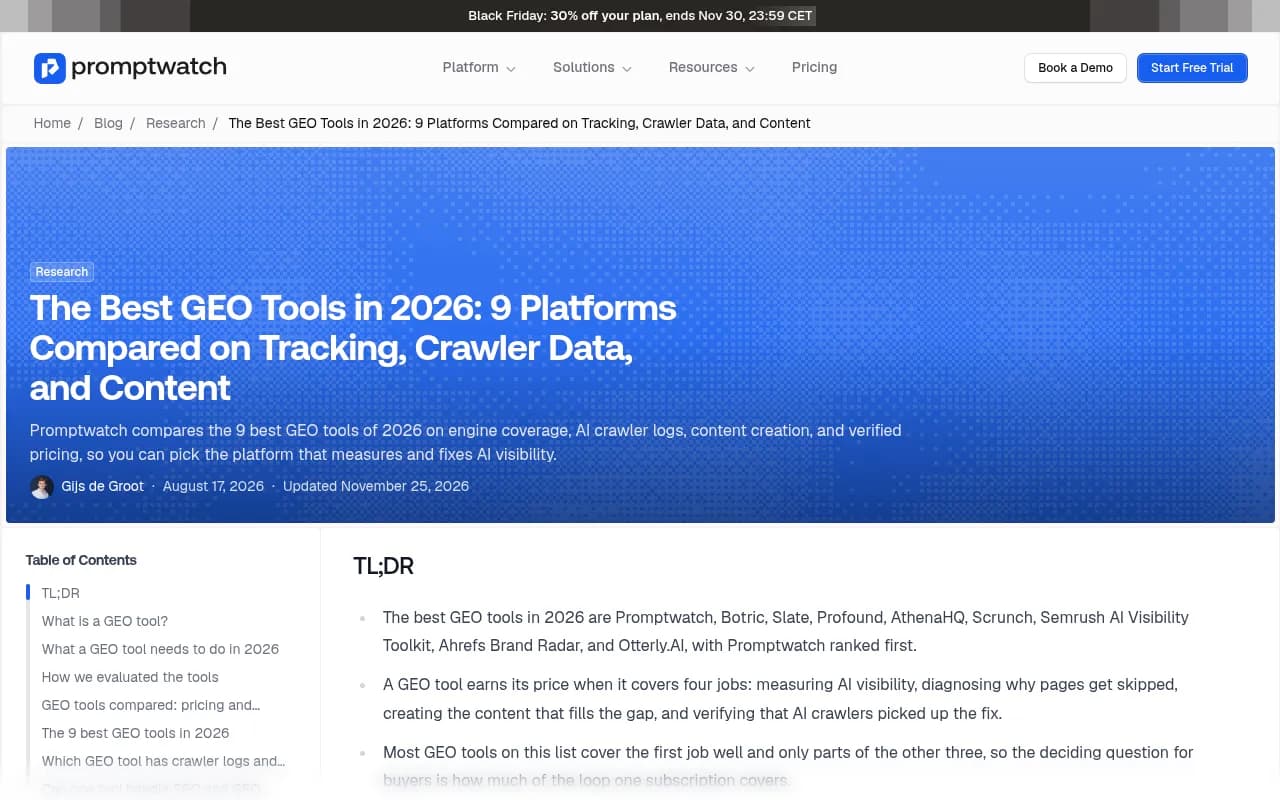
Promptwatch is built around a loop. It monitors what AI says about your brand across ChatGPT, Gemini, Claude, Perplexity, Google AI Overviews, Google AI Mode, Copilot, Meta AI and more, using the real interfaces rather than just APIs. It traces which of your pages get cited. It acts, through the Action Board, content gap analysis and the Content Agent. Then it measures, through IP-verified AI crawler logs, page tracking and visitor analytics that attribute AI-referred traffic and conversions.
For a mid-size SaaS team, the pieces that matter most:
- Crawler logs (Professional and up) separate an access problem from a content problem. If GPTBot or ChatGPT-User is hitting errors on your pricing page, no amount of new content will help.
- Content gap analysis maps your pages against the prompts AI answers, and the Content Agent (Business plan) drafts and publishes to WordPress, Webflow or Framer on a schedule you control.
- Brand Narrative and Fact Check pull out the individual claims AI makes about you, like "lacks integrations" or "expensive for small teams," and check them against your pages and the third-party pages AI cites. Narrative is on every plan; Fact Check is Business and up.
- Personas let you prompt like different buyers, which overlaps with what Gumshoe is built around.
Pricing for brands: Essential is $95/mo (1 project, 50 prompts, 6,000 responses), Professional is $245/mo (2 projects, 150 prompts, 18,000 responses, crawler logs, 5 AEO articles), and Business is $579/mo (5 projects, 350 prompts, 42,000 responses, the Content Agent, faster-than-daily tracking, Fact Check, Shopping and Ads Radar). Annual billing gives 12 months for the price of 10, and monthly plans have a 7-day free trial. Every plan includes unlimited team seats and MCP and API access.
One discrepancy worth flagging. Promptwatch's own guide says all 12 platforms are selectable on every plan, while Prismic's roundup describes four models per plan. Check the pricing page for the current terms rather than trusting either summary.
If you want to see where you stand before paying anyone, the free AI visibility report scans how ChatGPT, Gemini and Perplexity talk about your brand with no login. For a closer look, there is a head-to-head against Profound and a broader platform comparison.
Profound
Profound is the enterprise reference point. It tracks major answer engines daily on real front-end data across 50+ countries, and its agents turn findings into published content with attribution built in.

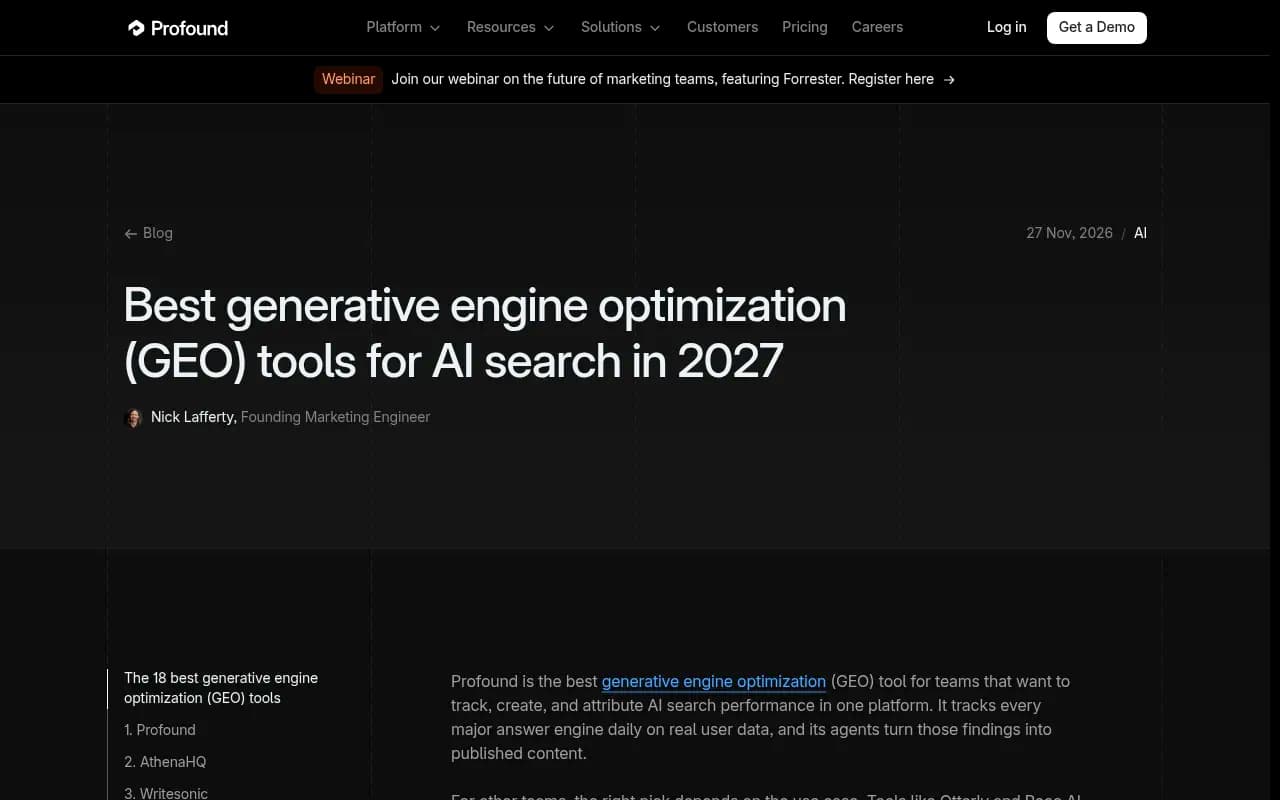
Vendor-reported pricing starts around $499+/mo on annual-billed tiers, so it is a bigger commitment than the others here. Profound's own roundup concedes it can be overkill for teams that only want a lightweight visibility score. For a mid-size SaaS company with a small team, it is worth a demo, but check whether you will use enough of it to justify the cost.
Peec AI, Otterly.AI and other monitoring tools
Peec AI and Otterly.AI sit at the monitoring end. They are easy to start with, and Otterly's entry tier is reportedly $29/mo (a figure from Siftly's blog, so verify it). The tradeoff is that they stop at the dashboard: no crawler logs, no visitor analytics, no content generation.


They make sense if you only need to answer "are we mentioned?" and you have the content muscle to act on it elsewhere.
Semrush and Ahrefs Brand Radar
If you already pay for Semrush or Ahrefs, their AI visibility features are worth turning on, mostly because the marginal cost is low.
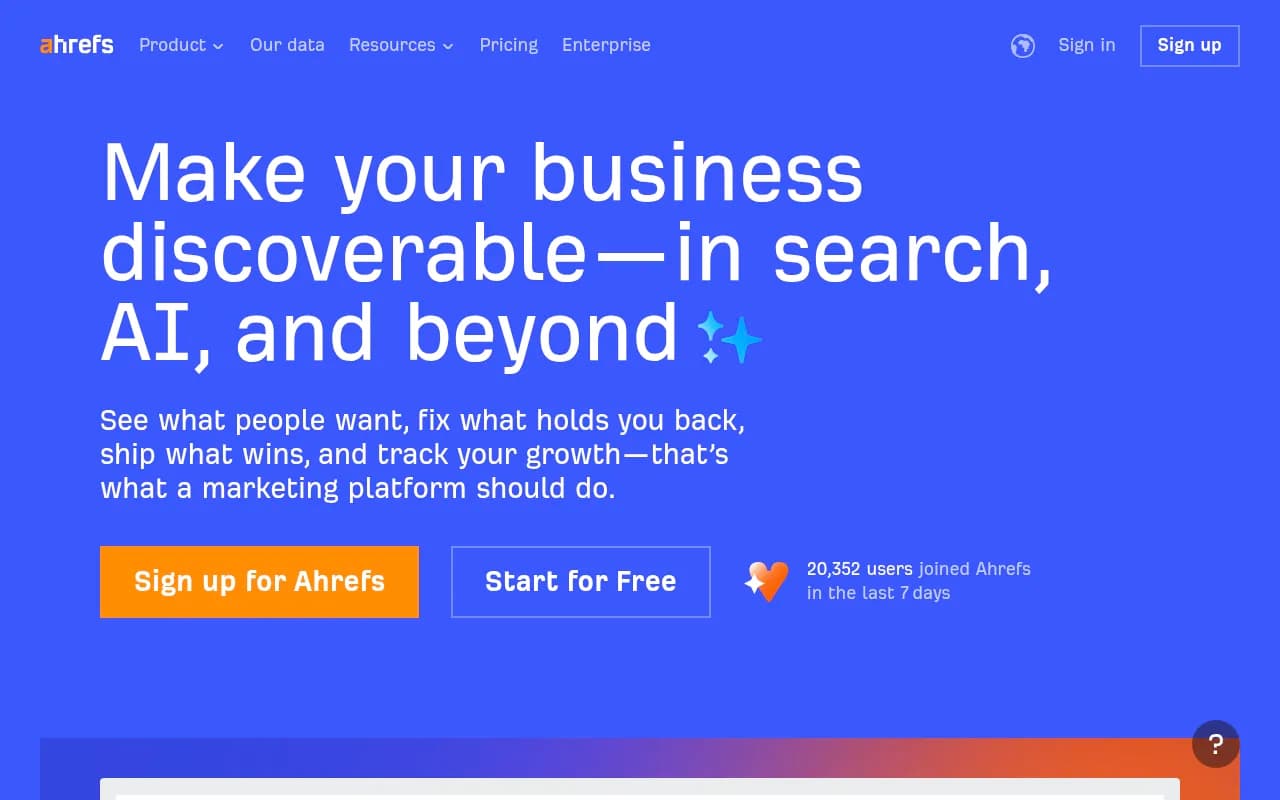
The limits are fixed prompt sets and shallower AI-specific data. They will not tell you whether AI crawlers can read your pricing page or how much AI-referred traffic converts.
Other names worth a look
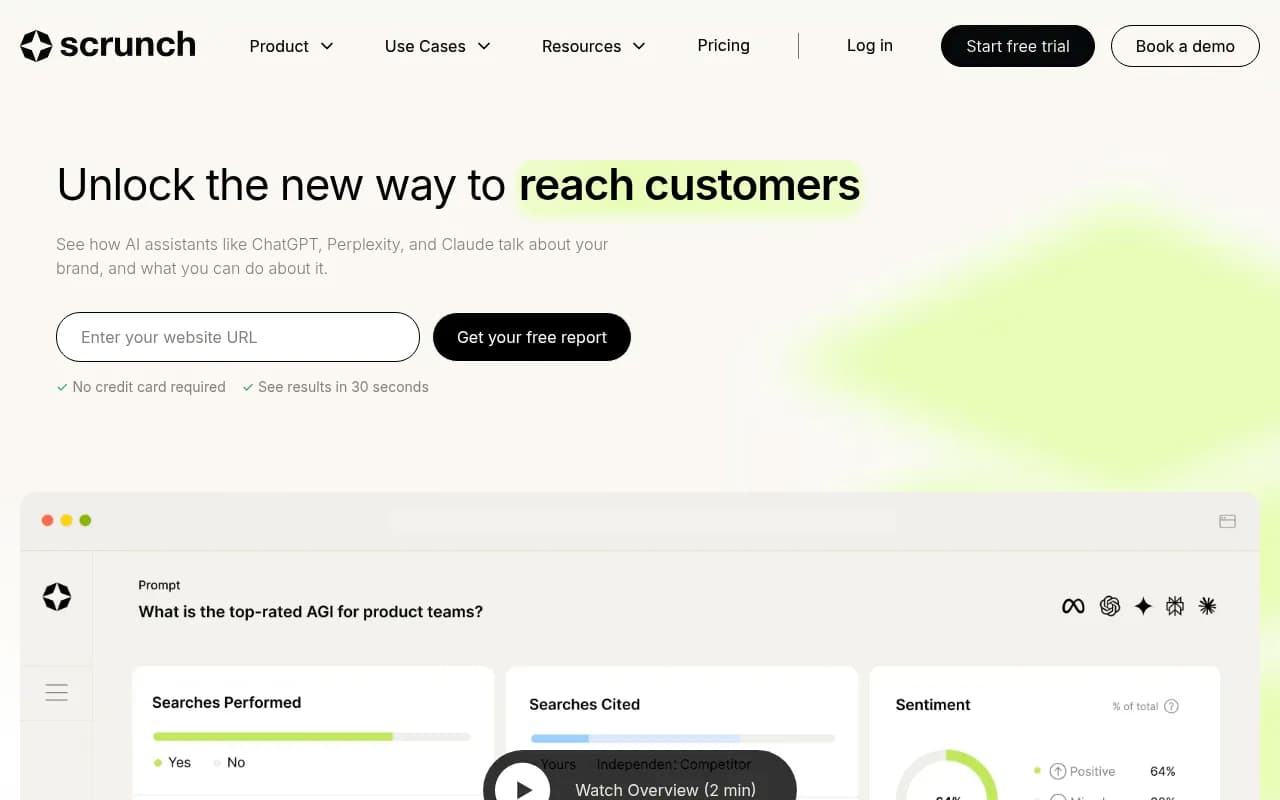
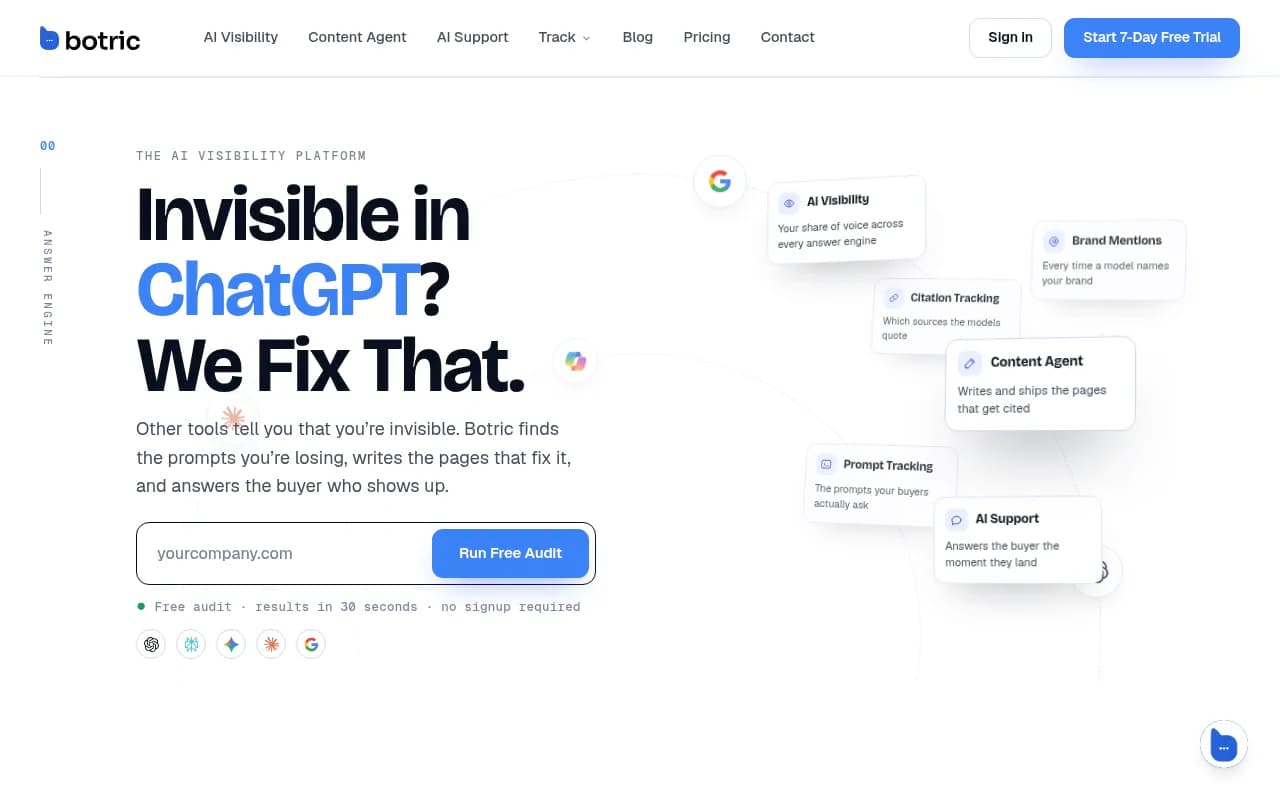
The catalog on this site lists dozens more. A few that surfaced in the research for this guide: AthenaHQ for automated on-page GEO, Scrunch for helping AI agents read your site, and Botric and Slate as newer platforms that pair tracking with content execution. I did not independently check their pricing, so treat them as shortlist candidates rather than recommendations.


If you want a wider scan of the category, the GEO software directory is a good place to browse by feature.
How to choose for a mid-size SaaS company
Start with your bottleneck
If your problem is that nobody knows where you stand, a monitoring tool at $29 to $99/mo will answer that in a week. If the problem is that you know you are invisible but cannot ship content fast enough, you need something with a writing and publishing workflow. If the problem is that leadership wants proof of pipeline impact, you need visitor analytics and attribution, which most trackers lack.
Compare the real unit of cost
Sticker price is a bad guide. Compare responses or prompts per dollar, how many engines are included, and whether the add-ons you will certainly need (crawler logs, content generation, extra projects) are in the base plan. Gumshoe's per-project pricing and add-ons can climb quickly if you have several product lines. Siftly's tiers are cheap, but I could not confirm their limits. Promptwatch publishes response counts per plan, which makes the comparison easier.
Check the engines your buyers use
SaaS buyers lean on ChatGPT, Perplexity, Gemini and Google AI Overviews, and technical buyers use Claude and coding agents too. A tool missing one of them leaves a blind spot. Remember that API outputs and real user-facing answers can differ, so ask whether a vendor tracks the actual interface.
Demand a trial
For Gumshoe, use the free sample audit. For Siftly, the free plan and 7-day trial. For Promptwatch, the 7-day trial on monthly billing. Run the same twenty prompts in each and see which one surfaces something you did not already know.
A sensible rollout for the first 90 days
- Week 1: run a free visibility scan, then set up 30 to 50 prompts covering category, comparison and branded queries. Include persona variations if your buyers differ by role.
- Weeks 2 to 3: check crawler access. Confirm AI bots can read your pricing, product and docs pages. Fix robots.txt and rendering issues before writing anything.
- Weeks 4 to 8: close the biggest gaps. Prioritize comparison pages, a clear pricing page, and docs that answer the questions buyers ask. Get listed and reviewed on G2 and similar sites.
- Weeks 9 to 12: tie traffic to pipeline. Set up AI referral tracking and compare conversion rates to other channels.
Promptwatch's 90-day GEO program in the Academy covers a similar sequence in more detail.
Final recommendation
For a mid-size SaaS team that wants measurement and execution in one subscription, Promptwatch is the most complete option on this list, with the caveat that its fullest workflow sits on the Business plan at $579/mo. If you need persona-level diagnostics and can handle content elsewhere, Gumshoe is a reasonable pick. If budget is the main constraint, start with Siftly's free plan or a low-cost monitor, and upgrade when you hit the limits.
Whichever you choose, ignore the "best GEO tool" rankings that come from vendors, including the ones this guide draws on. Run your own prompts, check the crawler data, and judge by what you can ship in the first month.
FAQ
How much should a mid-size SaaS company budget for a GEO platform?
Realistically $100 to $600 per month for the tooling. Monitoring-only tools start near $29 to $99. Platforms with crawler logs, content generation and attribution run from about $245 to $579 per month, and enterprise platforms start higher.
Do I need a GEO tool if I already use Semrush or Ahrefs?
Maybe not at first. Turn on their AI visibility features and see what you learn. Move to a dedicated platform when you need custom prompts, crawler logs or traffic attribution.
What content should a SaaS company publish first?
Product and pricing pages, comparison pages and documentation. Those are the most cited formats in Promptwatch Data's October 2026 reports, and docs and landing pages stay cited longest.
Can I trust vendor comparison articles?
Treat them as a starting list. Nearly every roundup, including those cited above, is written by a vendor that ranks itself well. Verify prices and limits on the vendor's own site.