Key takeaways
- Several genuinely useful GEO tools have free tiers or trials -- but most cap out quickly and won't replace a dedicated platform for serious work.
- Free tools are best for getting started: checking if you appear in AI answers, identifying obvious content gaps, and understanding which AI models matter for your niche.
- Google Search Console, ChatGPT, and Perplexity are the most underrated free GEO tools most marketers already have access to.
- A handful of paid GEO platforms offer free trials worth using before committing -- especially if you want crawler logs, prompt volume data, or content generation.
- If you're ready to move beyond manual checks, Promptwatch is the only platform that closes the full loop: find gaps, create content, track results.
Let's be honest about something upfront: "free GEO tools" is a slightly misleading category. Generative Engine Optimization is still maturing, and most dedicated platforms charge for the data infrastructure that makes them useful. You're not going to find a free equivalent of a full AI visibility suite the way you might find a free keyword research tool.
But that doesn't mean you're stuck paying $500/month before you can do anything. There's a real set of free and freemium tools that let you get meaningful work done -- checking your AI presence, spotting gaps, and improving your content. You just need to know what each one is actually good for.
This guide maps out the honest picture.
What "free GEO" actually means in 2026
GEO tools generally do two things: monitor (track where your brand appears in AI-generated answers) and optimize (help you create content that earns more citations). Free tools tend to cover the first function in a limited way, and almost none cover the second.
The monitoring side is expensive to run because it requires querying live AI models at scale -- ChatGPT, Perplexity, Claude, Gemini, and others -- across hundreds of prompts, regularly. That costs real money in API calls. So when a tool offers free monitoring, it's usually capped at a handful of prompts or a short trial window.
The optimization side -- content gap analysis, AI writing agents grounded in citation data, page-level tracking -- is where paid platforms earn their keep. Free tools can point you in the right direction, but they won't do the heavy lifting.
With that context set, here's what you can actually do for free.
Free tools for checking your AI visibility
Manual checks with ChatGPT and Perplexity
The most obvious free GEO tool is the AI itself. Open ChatGPT or Perplexity and ask questions your customers would ask. See if your brand shows up. See who does show up instead.
This is slow and unscalable, but it's free and it works for a first pass. A few prompts to try:
- "What are the best [your category] tools?"
- "Compare [your brand] vs [competitor]"
- "Who should I use for [specific use case]?"
If you're not appearing in any of these, you have a visibility problem worth investigating further. If you are appearing, note the context -- is it positive, neutral, or missing key information?
The limitation is obvious: you can't track this over time, you can't test across multiple AI models systematically, and you can't tell if your visibility is improving or declining.
HubSpot AI Search Grader
HubSpot offers a free AI Search Grader tool that gives you a quick snapshot of how your brand appears in AI-generated answers. It's genuinely free with no trial period -- you enter your brand name and get a report.
It's not deep. But for a first-pass assessment of whether AI models know who you are and what you do, it's a reasonable starting point.
Otterly.AI (free trial)
Otterly.AI has a 14-day free trial and is one of the more accessible entry points into dedicated GEO monitoring. It tracks your brand mentions across AI models and gives you a visibility score.
The catch: Otterly is monitoring-only. It shows you data but doesn't help you act on it. Still, for a two-week free window, it's worth running to get a baseline.

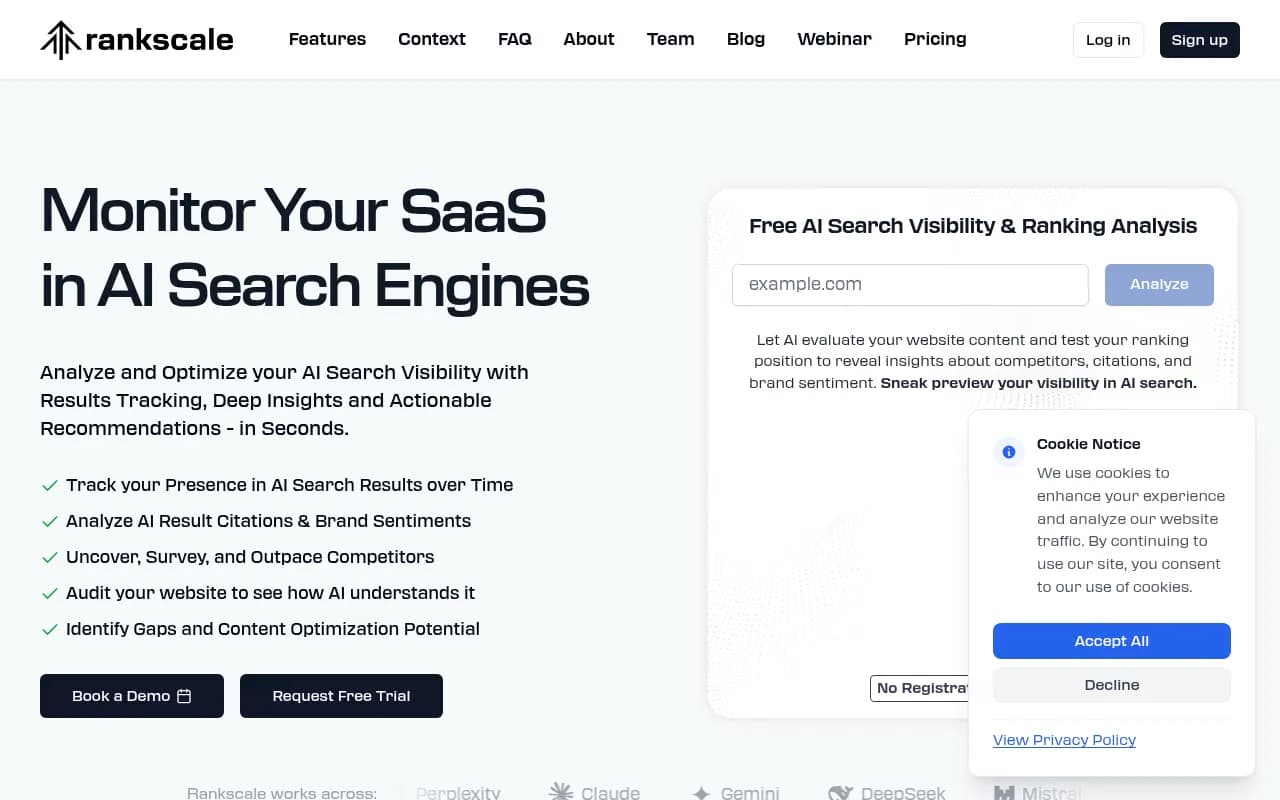
Rankscale (low-cost entry)
Rankscale starts at $20/month, which isn't free but is close enough to mention here. It covers basic AI search rank tracking and is one of the more affordable dedicated options if you need something beyond manual checks.
Free tools for finding content gaps
This is where free tools get genuinely useful. You don't need a paid GEO platform to identify what questions AI models are answering that your content doesn't cover.
Google Search Console
GSC is free, and it's one of the most underused GEO tools in existence. Here's why it matters for AI visibility: the queries that drive impressions in traditional search are often the same queries AI models use to retrieve content. If you're ranking on page 3 for a question-style query, that's a signal that your content exists but isn't authoritative enough for AI to cite.
Filter your GSC queries by question format (who, what, how, why, best, vs) and look for queries with decent impressions but low click-through rates. These are often exactly the prompts AI models are fielding -- and your content is close but not quite good enough.
People Also Ask and Google Autosuggest
Still free, still useful. PAA boxes show you the follow-up questions Google's systems associate with a topic -- and those follow-up questions are often the exact sub-queries AI models fan out into when answering a broader prompt.
If you're not answering the PAA questions around your core topics, you're leaving AI citation opportunities on the table.
Also Asked
Also Asked (alsoasked.com) maps out PAA question trees visually. Free tier is limited but useful for getting a quick picture of the question landscape around a topic. It's particularly good for spotting second and third-level questions that your content probably doesn't address.
Answer the Public
Similar to Also Asked, Answer the Public visualizes search questions around a keyword. The free tier limits daily searches, but for occasional research it's fine. Good for finding the "what is", "how to", and "why" questions that tend to appear in AI-generated answers.
Free tools for content creation and optimization
ChatGPT and Claude (free tiers)
Both ChatGPT and Claude have free tiers that are genuinely capable for content work. The specific use case for GEO: use them to draft content that directly answers the questions you've identified from your gap analysis.
The key difference between AI-generated content that gets cited and content that doesn't is specificity and depth. Generic answers don't get cited. Detailed, entity-rich answers that actually resolve a question do.
A practical workflow:
- Identify a question your brand should be answering (from GSC, PAA, or competitor analysis)
- Check what AI models currently say when asked that question
- Draft content that answers it more completely than any existing source
- Publish it and monitor whether AI models start citing it
This is manual and time-consuming, but it works and it's free.
Google Search Console + regex filtering
One underrated GSC trick: use regex filters to find queries that contain question words and are driving impressions but not clicks. These are your content gap candidates. Export them, group them by topic, and you have a free content brief.
Free tools for technical AI crawlability
Google Search Console (again)
GSC's coverage report tells you which pages are indexed and which have errors. If AI models can't find your content because it's not indexed, no amount of optimization will help. Start here.
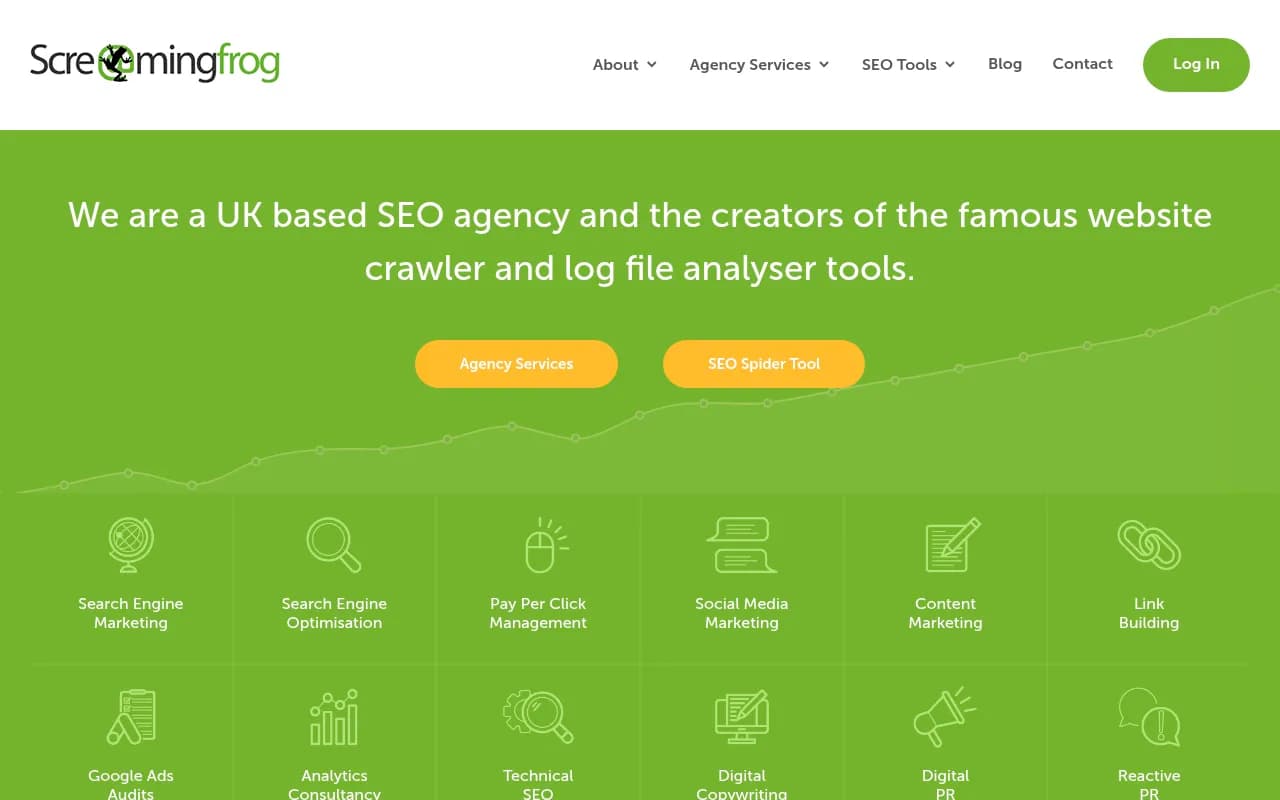
Screaming Frog (free tier)
Screaming Frog's free tier crawls up to 500 URLs. For smaller sites, that's enough to check for crawlability issues, missing meta descriptions, broken internal links, and other technical problems that might prevent AI crawlers from reading your content properly.
DarkVisitors
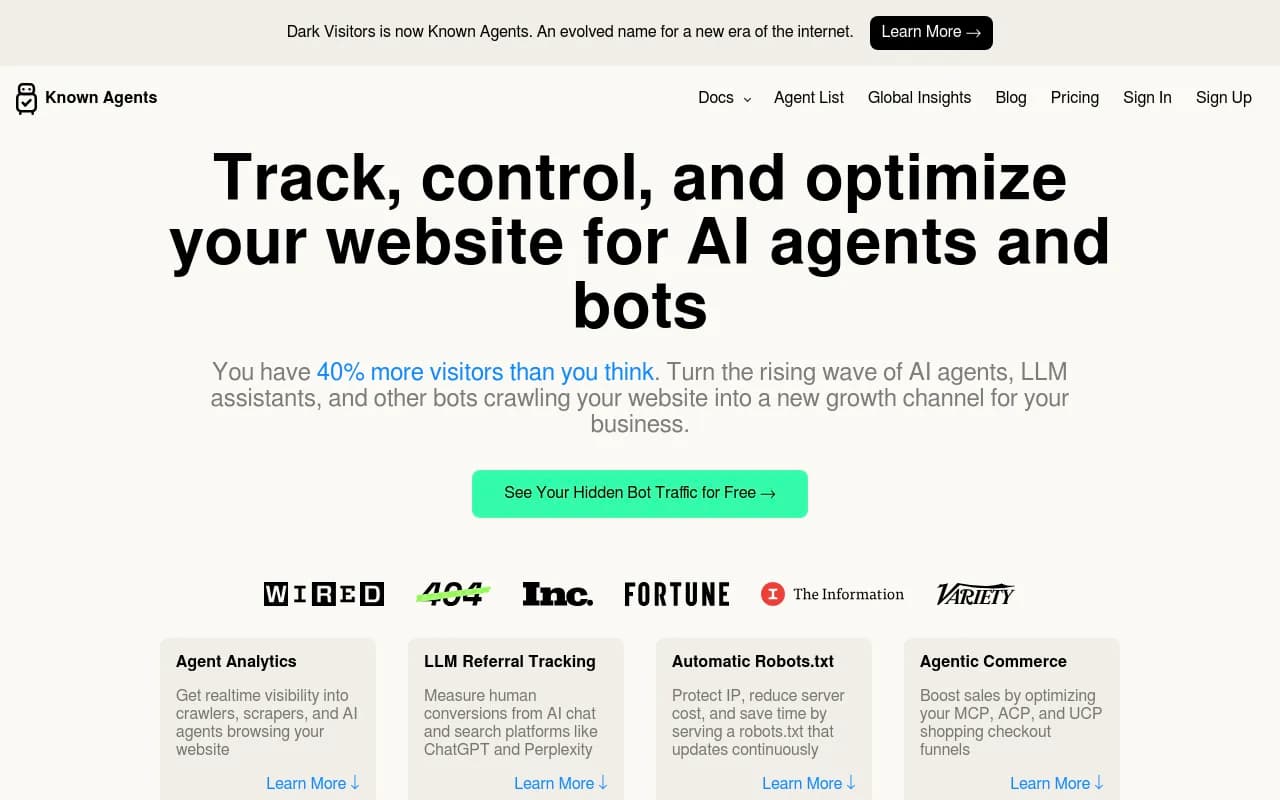
DarkVisitors is a free tool that tracks AI agents and bots visiting your website. It's particularly useful for understanding which AI crawlers are hitting your site and whether your robots.txt is accidentally blocking them. If you're blocking GPTBot or ClaudeBot, you're invisible to those models by default.
Comparison: free vs paid GEO capabilities
| Capability | Free tools available | What you're missing without paid |
|---|---|---|
| Manual AI visibility check | ChatGPT, Perplexity, HubSpot Grader | Systematic tracking, historical data, multi-model coverage |
| Content gap identification | GSC, PAA, Also Asked | Prompt volume data, competitor gap analysis, difficulty scoring |
| Content creation | ChatGPT, Claude free tiers | Citation-grounded writing, persona targeting, AI-optimized briefs |
| Technical crawlability | Screaming Frog (500 URLs), GSC | AI crawler logs, real-time indexing alerts, error tracking by model |
| Competitor benchmarking | Manual AI queries | Heatmaps, share of voice, prompt-level competitor breakdowns |
| Traffic attribution | GSC (partial) | LLM referral tracking, page-level citation attribution, revenue connection |
| Prompt intelligence | None | Volume estimates, difficulty scores, query fan-outs |
The pattern is clear: free tools handle the "what's happening" question at a surface level. Paid platforms handle the "why" and "what to do about it" questions.
When free tools stop being enough
Free tools work well when you're just getting started -- checking if you have an AI visibility problem, identifying a handful of content gaps, and making your first improvements. Most marketers can get genuine value from the free toolkit described above for the first few months.
The point where free tools break down:
- You need to track visibility across multiple AI models systematically (not just manual spot checks)
- You're managing more than one brand or website
- You want to understand why competitors are getting cited and you're not
- You need to connect AI visibility to actual traffic and revenue
- You're producing content at scale and need to prioritize which gaps to close first
At that point, you're looking at a paid platform. The question is which one.
Most GEO tools on the market are monitoring dashboards -- they show you data and leave you to figure out what to do with it. Promptwatch is built differently: it's designed around the full cycle of finding gaps, generating content to fill them, and tracking whether that content actually improves your visibility.

For teams that want to move fast, that distinction matters. Knowing you're invisible in ChatGPT is only useful if you can do something about it.
Practical free GEO workflow for 2026
If you want to get started today without spending anything, here's a workflow that actually produces results:
Week 1: Baseline audit
- Run 10-15 prompts in ChatGPT, Perplexity, and Google AI that your customers would realistically ask
- Note which ones mention your brand and which mention competitors
- Check DarkVisitors to confirm AI crawlers can access your site
- Run GSC coverage report to confirm your key pages are indexed
Week 2: Gap identification
- Export GSC queries filtered for question-format searches
- Use Also Asked or Answer the Public to map the question landscape around your top 3 topics
- Identify 5-10 questions that AI models are answering but your content doesn't directly address
Week 3: Content creation
- For each identified gap, draft a focused piece of content that directly answers the question
- Use ChatGPT or Claude to help draft, but add specific data, examples, and entity-rich detail that generic AI content lacks
- Publish and submit to GSC for indexing
Week 4: Re-check
- Run the same prompts from Week 1
- Look for any new citations of your content
- Use GSC to check if newly published pages are getting impressions
This won't give you the systematic tracking and optimization that a paid platform provides, but it's a real process that produces real results. And it costs nothing.
The honest bottom line
Free GEO tools in 2026 are good enough to get started and identify your biggest problems. They're not good enough to run a serious AI visibility program at scale.
The free toolkit -- GSC, ChatGPT, Perplexity, DarkVisitors, Also Asked, Screaming Frog -- gives you a solid foundation. Use it to validate that you have a problem worth solving and to make your first improvements.
When you're ready to move beyond manual checks and one-off content experiments, that's when a platform like Promptwatch earns its keep. The Essential plan starts at $99/month and covers 50 prompts across 10 AI models -- a reasonable entry point for most marketing teams.
But start free. The workflow above will teach you more about your AI visibility than any dashboard will in the first month.