Key takeaways
- Yext Scout fits brands that already run Yext listings and pages, and care about location-level AI visibility. Public pricing does not exist.
- Botify is a technical SEO and bot-log platform that added AI visibility as an option. It is strongest for large e-commerce and crawl-heavy sites.
- BrightEdge AI Catalyst is the path of least resistance if you already run BrightEdge. Third-party claims put cost at five figures a year, but that is unverified.
- Promptwatch is the one here with published self-serve pricing (from $95/mo) and an end-to-end loop: tracking, IP-verified crawler logs, content gaps, and a Content Agent that publishes.
- Whatever you shortlist, test on your own prompts and your own crawler logs before you sign anything.
Why this comparison is harder than it looks
Three of these four are enterprise suites with quote-based pricing. Vendors write most of the comparisons you will find online, and they are biased, including the one on Promptwatch's own blog. This guide is published by a network that recommends Promptwatch, so read the Promptwatch sections with that in mind. I have tried to separate what vendors state from what is verified, and to flag the gaps.
A caveat about my sources. I could confirm Yext's and BrightEdge's positioning from their product pages as quoted in research, but I could not verify any of their current pricing. Botify's AI features come from a third-party enterprise comparison by seoClarity (itself a competitor), so treat them as reasonably specific but not neutral. Verify everything in a demo.
The four platforms at a glance
| Platform | Heritage | AI visibility product | Pricing | Best fit |
|---|---|---|---|---|
| Yext Scout | Listings and local presence | Scout, an AI Search Visibility Agent | Not public (enterprise) | Multi-location brands already on Yext |
| Botify | Technical SEO and crawling | AI Visibility, sold as an option | Not published | Large e-commerce and technical SEO teams |
| BrightEdge | Enterprise SEO suite (20+ years) | AI Catalyst | Custom; unverified claims of $30,000+/yr | Existing BrightEdge customers |
| Promptwatch | AI-native GEO | Full platform with agents | Published, from $95/mo | Teams wanting measurement plus execution |
Yext Scout
Yext describes Scout as an "AI Search Visibility Agent". It tracks gaps by location, brand and competitor, and a newly announced feature creates brand and third-party content to improve AI visibility, per Yext's own Scout page.
Birdeye, a competitor, says Scout is integrated into the Yext platform and covers ChatGPT, Gemini, Perplexity, Grok and traditional Google search in one view. It also says visibility is mostly brand and category level, with location-specific competitive benchmarks. Take that as a competitor's claim, not gospel.
Where Scout makes sense
If you run hundreds of locations and your listings already live in Yext, Scout is the obvious first demo. The data sits next to the thing you can actually change: your listings and location pages. That is a real advantage, and I would not wave it away.
Where I would push back
The cost is the unknown. I found no public pricing, only "enterprise" or "custom". And the lock-in question is fair: the value is highest when you are all-in on Yext. If you are not, you are buying a platform to use one module.
Botify
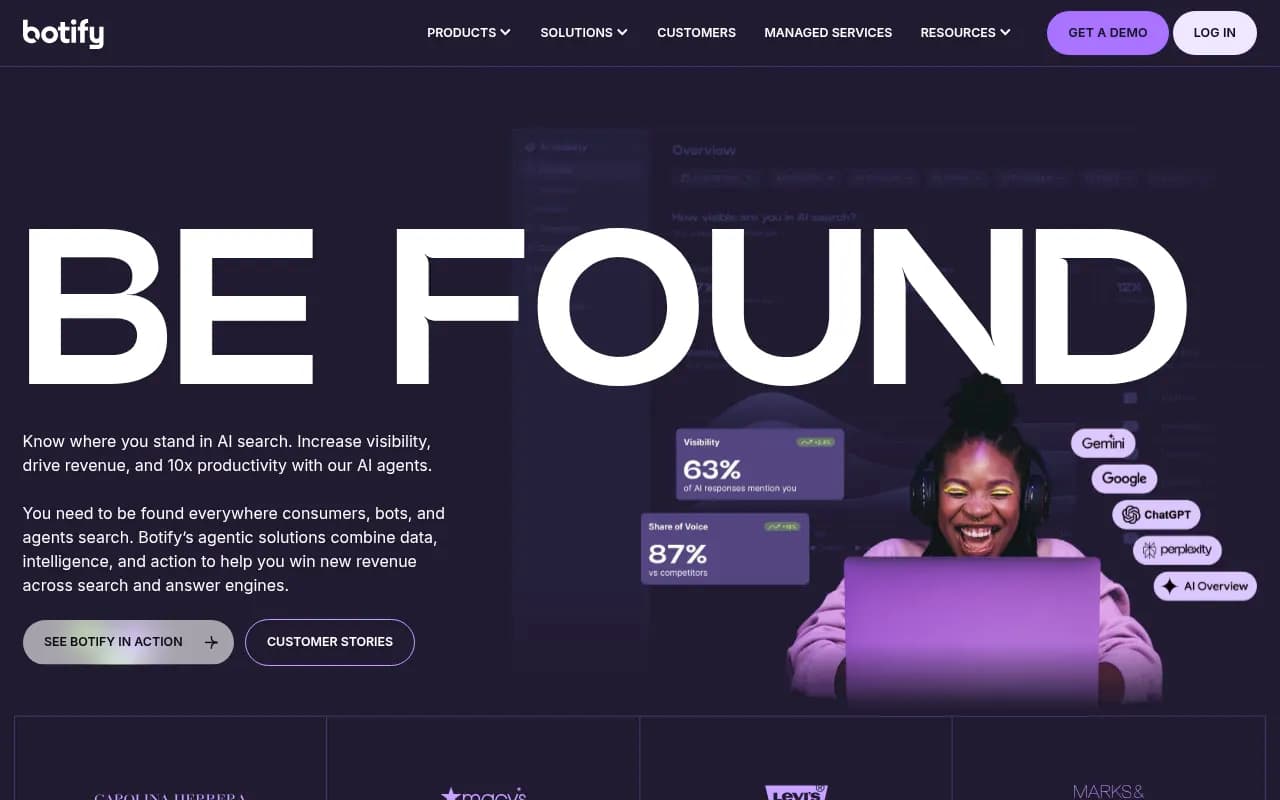
Botify calls itself an "AI search optimization platform". According to seoClarity's comparison, the AI Visibility product lists ChatGPT, Google AI Mode, Perplexity, Gemini and AI Overviews on the product page, while the FAQ names only the first three. Prompts are generated automatically from your top Google Search Console keywords and People Also Ask questions, and data updates weekly.
The interesting part is the action layer. PageWorkers and SpeedWorkers can apply changes for AI bots and serve them rendered versions of pages. SmartIndex can notify search and AI engines of page changes via IndexNow. Botify also does AI bot log analysis, which is where its crawler heritage pays off.
Details to check
- Pricing is not published. Botify says AI Visibility is an option on all plans.
- The AI Visibility FAQ says API access for it "is not currently planned", even though the wider platform has REST and export APIs and BigQuery, Snowflake, Tableau and Looker Studio connectors.
- Its MCP server was in early access, and the current status is unconfirmed.
- G2 showed 4.4 out of 5 from 80 reviews (checked September 28, 2026), covering the whole platform. Reviewers praise ease of use and integrations and criticize the learning curve and pricing.
Best fit: large e-commerce and technical SEO teams that care about how bots render and crawl pages, with AI tracking as a companion rather than the main event.
BrightEdge AI Catalyst
BrightEdge is the incumbent. One comparison says more than half the Fortune 500 use it. AI Catalyst rates brand mentions as Positive, Neutral or Negative, with reasoning, for your brand and each tracked competitor, across AI Overviews, ChatGPT, Perplexity and others. Other write-ups mention an Agent Edge feature that serves content when AI agents visit, though submission to engines is unconfirmed.
Strengths
- Traditional SEO data and AI visibility in one dashboard.
- Entity optimization and knowledge graph alignment are core.
- A large customer success team and structured onboarding.
Weaknesses
The pricing is the sore spot. A vendor-written comparison claims $30,000+ a year, and xSeek says five figures annually. Neither is verified, so ask for a written quote. Reviewers on G2 and TrustRadius, again per a competitor's summary, flag the learning curve. And if you only need AI tracking, you pay for a suite you will half use.
Promptwatch
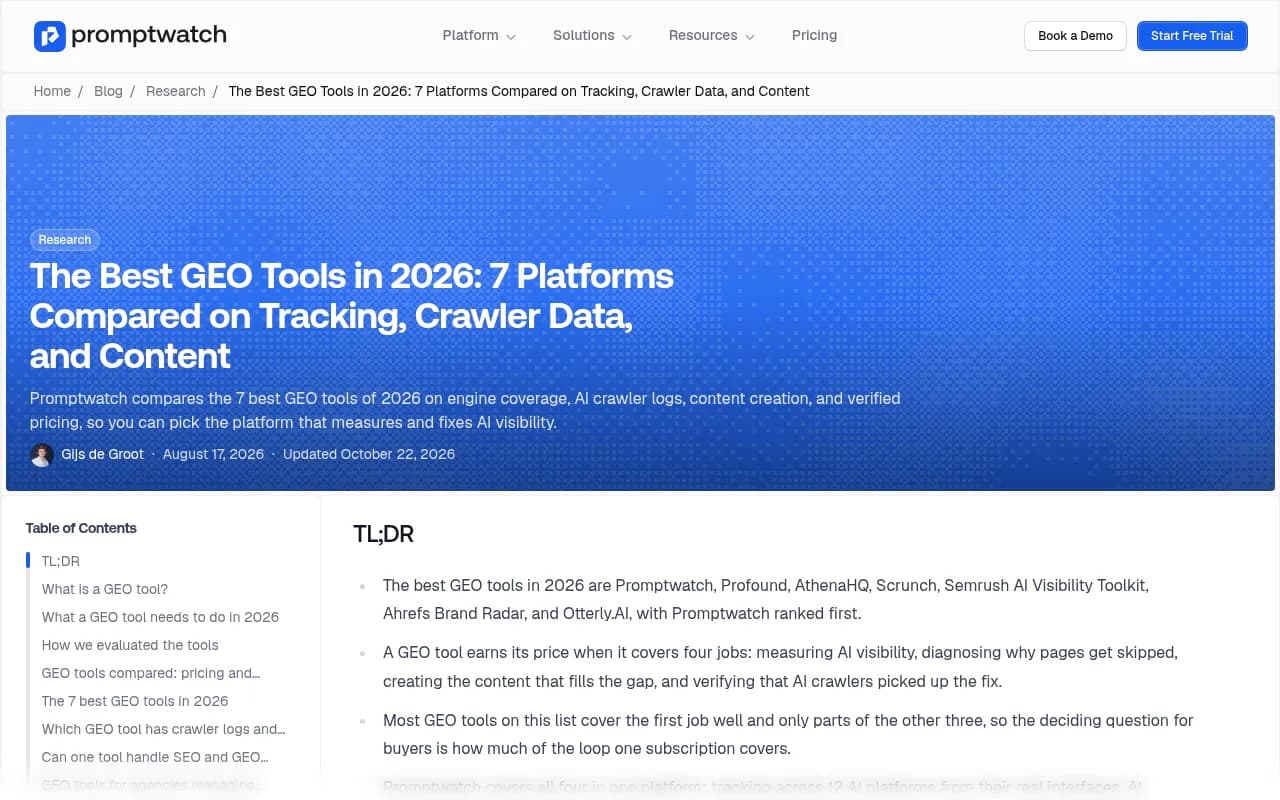
Promptwatch is the AI-native option in this group, and the only one with published self-serve pricing. It tracks the real interfaces of ChatGPT, Google AI Overviews, Google AI Mode, Gemini, Perplexity, Microsoft Copilot, Amazon Alexa, Claude and more, in each country and language, then goes beyond monitoring.

What it adds for enterprise teams
- IP-verified AI crawler logs showing which pages GPTBot, ClaudeBot, PerplexityBot and others read, and what errors they hit. Spoofed bots are filtered out.
- Visitor analytics that tie AI platforms to real traffic and conversions.
- Prompt volumes, difficulty scores and query fan-outs.
- Content gap analysis, a Content Agent that publishes to WordPress, Webflow or Framer, and an Action Board of prioritized tasks.
- Reddit, YouTube and LinkedIn citation tracking, AI Shopping and Ads Radar, plus state and city tracking from Business.
- Hosted MCP server, REST API v2, Looker Studio, Cloudflare, Vercel and Fastly integrations.
Customers include Duolingo, Yelp, Typeform, Rabobank and agencies like Monks. It is rated 4.7/5 on G2.
Pricing
Essential is $95/mo, Professional $245/mo, Business $579/mo (the Content Agent and Agentic AI Search Optimization are included here), and Enterprise is custom with SSO and a dedicated success manager. Agency plans run $199 to $799/mo. Confirm at promptwatch.com/pricing.
Honest limits
Promptwatch is not a classic SEO suite and not a listings manager. If you need 20 years of keyword and backlink data in one dashboard, or you must push location data to hundreds of directories, you will pair it with other tools, not replace them.
Feature comparison
| Capability | Yext Scout | Botify | BrightEdge | Promptwatch |
|---|---|---|---|---|
| AI engine tracking | ChatGPT, Gemini, Perplexity, Grok (per Birdeye) | 3 to 5, varies by page | 3 named on AI Catalyst page | 12 platforms from real UIs |
| Location-level data | Core strength | Not a focus | Multi-market | Country on all paid, state/city from Business |
| AI bot log analysis | Not confirmed | Yes | Agent Edge for serving content | IP-verified logs, citation-rate per page |
| Content creation | Newly announced | Bot-facing delivery | Not confirmed | Content Agent with CMS publishing |
| Traditional SEO data | Limited | Strong technical SEO | Full suite | Search Console and Bing data only |
| Public pricing | No | No | No | Yes |
| API / MCP | Not confirmed | API limited for AI Visibility | Standard integrations | REST API and MCP on paid plans |
What the data says you should be testing
Whichever platform you pick, check it against real AI behavior, because the numbers shift quickly.
Crawler access matters first. In Promptwatch Data's AI crawler traffic report (Jun 8 to Sep 6, 2026), OpenAI accounted for 79.8% of IP-verified AI crawler requests in the week of Aug 31 to Sep 6, down from 94.8% in early June. The report suggests comparing your own logs with that mix: a provider that is large in the chart but near zero in your logs likely means you are blocked. That is a good test for Botify's log analysis and Promptwatch's crawler logs alike.
Crawler mix is also changing. Promptwatch Data found Meta-WebIndexer grew from about 2% to nearly 38% of tracked AI crawler requests between mid-July and August 9, 2026. A platform that only watches the big three bots would miss that.
For content, Promptwatch's citation share by content type data (Sep 28 to Oct 4, 2026) shows product pages as ChatGPT's most cited type at 22.4%. And citations are not exclusive: almost half of ChatGPT responses cite 10 or more unique domains in the same week. So the bar is not "rank first", it is "be in the pile".
Finally, fan-outs. Promptwatch's ChatGPT query fanout data shows averages of 2.15 per response in early December 2025 and exactly 1.0 after fan-outs returned in April 2026, with query length falling to about 53 characters. A platform that shows you the sub-queries lets you build focused pages for them.
How to choose
Pick Yext Scout if
- You already run Yext and location pages are the revenue driver.
- Your procurement team prefers one vendor.
Pick Botify if
- Your site is huge, JavaScript-heavy or e-commerce, and rendering for bots is the problem.
- You already use Botify for technical SEO.
Pick BrightEdge if
- You are a BrightEdge customer and AI Catalyst is a cheap add-on for you.
- Fortune 500 vendor stability is a hard procurement requirement.
Pick Promptwatch if
- AI search is its own program and you need to see why you are not cited, fix it, and measure the result.
- You want published pricing and a short trial rather than a multi-week sales cycle.
- Agencies manage many clients (unlimited projects on agency plans, white-label reports).
Many enterprise teams will end up combining them: a suite or listings platform for the existing stack plus a dedicated GEO platform for AI-specific work. Other options worth a look include Profound, Conductor and seoClarity. The GEO software directory at bestgeosoftware.com lists more.

A fair pilot in four steps
- Write 50 to 100 real prompts across your top topics, including branded, comparison and location-specific ones.
- Run the same set in each tool for two to four weeks and compare against manual spot-checks in the actual ChatGPT and Google interfaces. API-only data can differ from what users see.
- Pull your server logs and check each platform's crawler data against them.
- Ask each vendor to show one action it took or recommended that moved a metric. Monitoring alone is the cheap part.
If you would rather have a team run this evaluation, agencies like 1001 SEO Media do GEO audits and work with Promptwatch as their AI visibility platform.
Bottom line
Yext Scout wins on local if you are already in Yext. Botify wins on technical crawling. BrightEdge wins on inertia and breadth. Promptwatch is the one built around the full AI search loop, with prices you can read before talking to sales. Get written quotes from the first three, and run the pilot above before you commit.