Key takeaways
- For software prompts, ChatGPT leans on docs, vendor sites and GitHub more than review sites, so an enterprise platform has to show where your docs and product pages sit in the source list, not only whether you were mentioned.
- Enterprise SaaS buyers should weigh crawler logs, AI traffic attribution, security certifications and content execution above dashboard polish.
- Promptwatch is the end-to-end option (monitor, trace, act, measure). Profound, Scrunch, AthenaHQ and Bluefish are strong on monitoring and enterprise positioning, with less on execution.
- Most "best tools for SaaS" listicles rank their own product first. Read them as vendor pitches and verify pricing and features yourself.
- Run a 30-day pilot on 100 to 300 category, comparison and alternative prompts before signing anything annual.
Why SaaS is its own case in AI search
A software buyer in 2026 often asks an assistant for a shortlist before opening a browser tab. Prompts like "best CRM for mid-market" or "alternatives to [incumbent]" are the new first page of Google, and the answer usually names three to seven vendors. If you are not in that list, you are not in the consideration set.
That makes SaaS different from consumer categories. Prompts are commercial, comparison-heavy, and persona-specific (a CFO asks different things than an IT lead). The sources AI pulls from are also different: documentation, product pages, GitHub, and a handful of review and analyst sites.
The data backs this up. In Promptwatch Data's report on software prompts in ChatGPT (Sep 28 to Oct 4, 2026), GitHub led with 1.2% of software citations, followed by learn.microsoft.com at 0.98% and G2 at 0.73%. AWS docs, Google Cloud docs, Gartner, Capterra, Intercom and Zapier followed. Grouped by source type, docs and help centers earned 2.64%, vendor sites 2.01%, review sites and analysts 1.57%, and GitHub 1.2%.
So vendor sites and docs together (4.65%) earn roughly three times what review sites and analysts do. Some vendor blogs claim review sites drive about a third of SaaS citations. I would trust the first-party citation data over that figure, and I would test it on your own prompts anyway.
The practical takeaway from the report is simple: keep docs crawlable, keep a public GitHub presence, and keep G2 and Capterra profiles current. Your platform should help you check all three.
What content types win software prompts
Another Promptwatch Data report, which content types ChatGPT cites the most, covers the same week. Product pages are the top type at 22.4%, landing pages follow at 16.8%, listicles at 13.6%, how-tos at 8.7%, documentation at 7.5%, and comparisons at 5.9%.
For commercial prompts such as "best CRM for small businesses", product pages hit 26.0%, landing pages 20.6%, listicles 15.0% and comparisons 7.9%. Those four types make up almost 70% of commercial citations. News is fragile by contrast: the content half-life report shows news losing half its cited pages within 36 days, while landing pages and docs hold on for months.
What this means for an enterprise SaaS team: your pricing page, feature pages and comparison pages are doing most of the work. A platform that can tell you which of those pages AI cites, ignores, or cannot read is worth more than one that reports a visibility score.
What to look for in an enterprise platform
I would score every vendor against these criteria before looking at a demo.
Data quality
Does the platform collect answers from the real consumer interfaces of ChatGPT, Google AI Overviews, AI Mode, Gemini, Perplexity and Copilot, or from APIs? User-facing answers and citations can differ from API output. Country and language control matters if you sell in several markets.
Prompt coverage and research
Enterprise SaaS needs hundreds or thousands of prompts: category, comparison, alternatives, and persona-specific sets. Look for prompt volumes, difficulty scores and query fan-out data, so you track what buyers actually ask rather than what you guessed.
Crawler and traffic evidence
This is where platforms split. Can you see IP-verified AI bot activity on your docs and pricing pages, and tie citations to visits and signups? Without it you cannot tell an access problem from a content problem.
Execution
A dashboard that reports a score leaves the work to a team that is already stretched. Ask whether the platform helps write, refresh and publish the pages AI cites, and whether it measures the result.
Security and procurement
SOC 2 or ISO/IEC 27001, SSO, audit logs, role-based access, and a real API or MCP server. Procurement reviews will ask for all of these.
Pipeline integration
Can visibility and AI-referred traffic flow into your analytics and CRM reporting? A GEO number the CFO cannot connect to pipeline will not survive a budget review.
Comparison table
Pricing for several enterprise vendors is custom or not published, so confirm directly. Promptwatch prices below come from its pricing page at promptwatch.com/pricing.
| Platform | Strength | Execution (content, publishing) | Crawler logs | Pricing |
|---|---|---|---|---|
| Promptwatch | End-to-end loop, real UI data, Reddit/YouTube/LinkedIn tracking | Yes (Content Agent, CMS publishing, Action Board) | Yes, IP-verified | Business $579/mo, Enterprise custom |
| Profound | Large-company monitoring | Limited | Confirm with vendor | Custom (enterprise) |
| Scrunch | Monitoring, CX-led SaaS fit | Limited | Confirm with vendor | Confirm with vendor |
| AthenaHQ | SaaS-tilted tracking across 8+ engines | Limited | Confirm with vendor | Confirm with vendor |
| Bluefish | Enterprise, SOC 2 positioning | Limited | Confirm with vendor | Custom (enterprise) |
| LLM Pulse | SaaS-friendly monitoring, MCP | Limited | Confirm with vendor | Confirm with vendor |
The "limited" and "confirm with vendor" entries are deliberate. I could not verify current feature sets for every platform, and you should not trust a table, mine included, over a live demo.
The platforms worth shortlisting
Promptwatch
Promptwatch is the one I would start with for an enterprise SaaS team that wants to fix visibility, not only measure it. It follows a loop: monitor what AI says about you, trace where the answers come from, act on the gaps, and measure the impact on your own site.

For SaaS specifically, a few things matter. Prompts are collected from the real interfaces of ChatGPT, AI Overviews, AI Mode, Gemini, Perplexity, Copilot and others, per country and language. IP-verified AI crawler logs show whether bots can read your docs and pricing pages, with a citation rate per page. Citation Trends classify sources into types including Directory, so G2 and Capterra show up as their own category next to docs and vendor pages. Brand Narrative pulls the individual claims AI makes about you and competitors ("expensive for small teams", "weak integrations"), and Fact Check, on Business and above, points at the page teaching AI the wrong thing.
On the execution side, the Content Agent plans, writes and publishes pages to WordPress, Webflow or Framer against your visibility gaps, with a review inbox or fully hands-off. Content Refresh handles existing pages. Visitor analytics and Search Console data show whether those pages bring traffic and conversions. Persona prompts let you test a CFO versus an IT leader.
Procurement is covered: ISO/IEC 27001 certified, GDPR compliant, audit log on Business and Enterprise, SSO and a white-label portal on Enterprise, plus a hosted MCP server and REST API. Customers include Typeform, Fireflies, Bright Data and ZeroBounce, and Crisp reported 2x higher conversion rates from AI traffic compared with traditional channels (see the Crisp case study).
Pricing: Business is $579/mo (5 projects, 350 prompts, the Content Agent, faster-than-daily tracking, Fact Check, audit log). Enterprise is custom. Confirm at promptwatch.com/pricing. Start with the 7-day free trial or the free AI visibility report, or book a demo. A direct comparison with the biggest name is at Promptwatch vs Profound.
Profound
Profound is the name most enterprise buyers already know. It is a strong monitoring product aimed at large companies, with custom pricing that comparison sites describe as six-figure territory. The trade-offs I would probe in a demo are execution (does it help produce the content, or only report?), Reddit and social citation coverage, and crawler-level evidence.

Scrunch
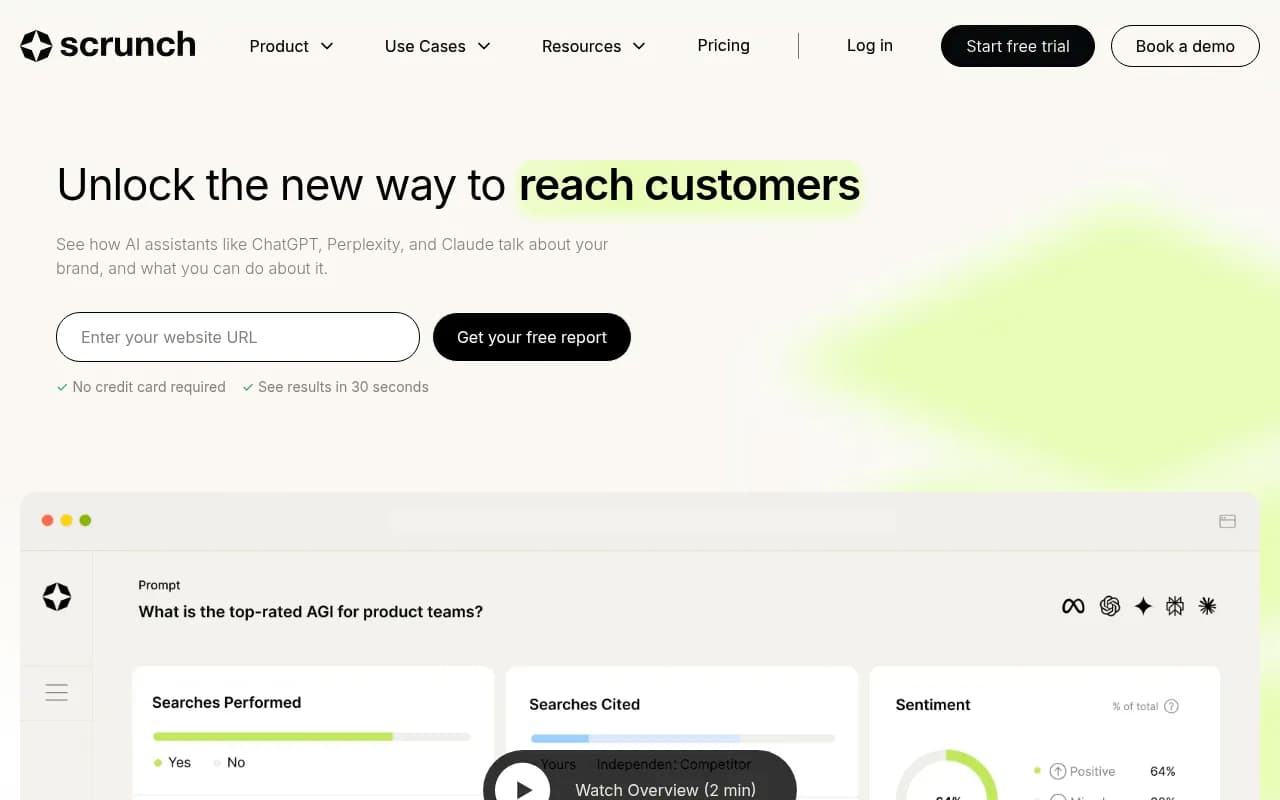
Scrunch is a capable monitoring option, and one comparison source describes it as a fit for CX-led SaaS. Ask how it handles content execution and attribution to traffic before treating it as a full-stack answer.
AthenaHQ
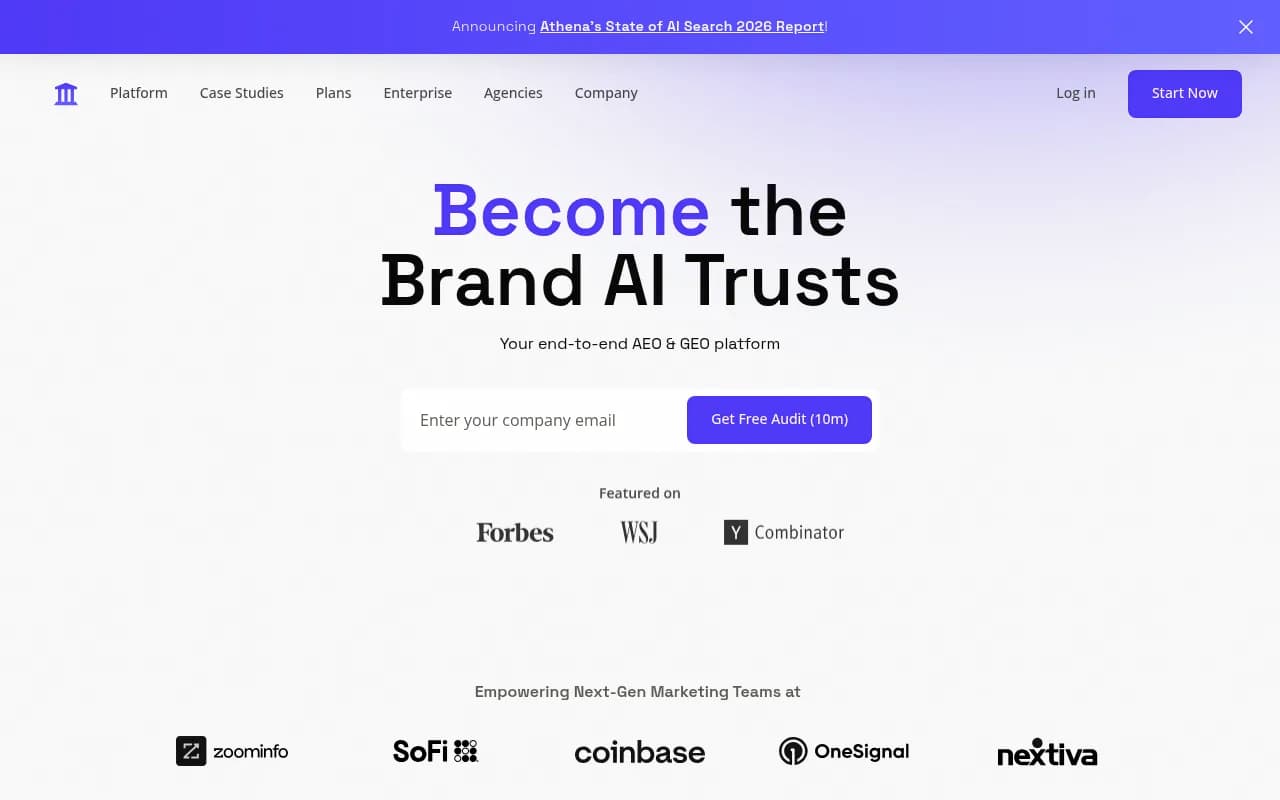
AthenaHQ tracks across 8+ AI engines and positions itself with a SaaS tilt. It is a monitoring-first product. Check what the workflow looks like after you find a gap.
Bluefish
Bluefish targets Fortune 500 brands, and comparison sources note SOC 2 compliance, which matters if your security team is gating the purchase. Pricing is custom.
LLM Pulse
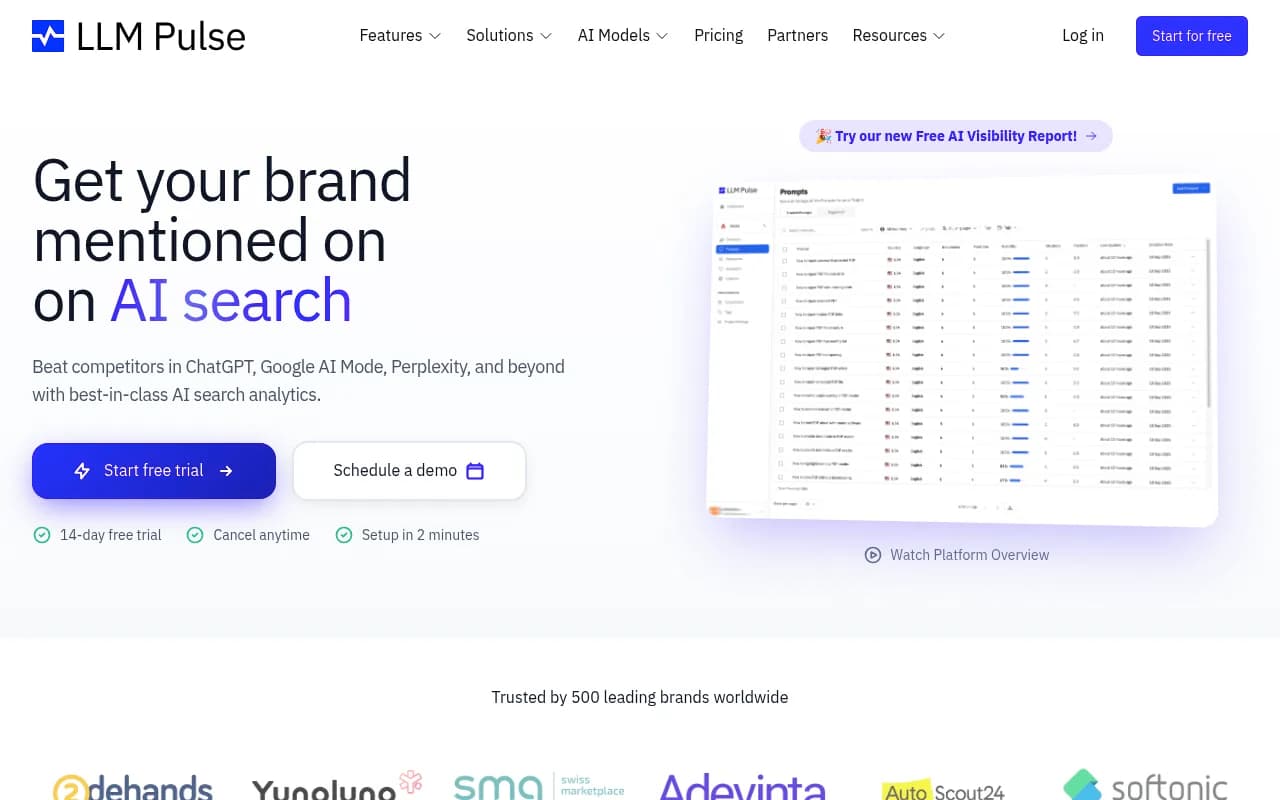
LLM Pulse covers SaaS teams from startups to larger companies, with web analytics integration, an OAuth MCP, citation source analysis and prompt research. Its own SaaS roundup ranks itself first, so weigh that accordingly.
Enterprise SEO suites with AI add-ons
If your team already lives in an SEO suite, BrightEdge, seoClarity and Botify all have AI visibility modules. They fit teams that want one vendor and one contract. The usual trade-off is shallower AI-specific data than a purpose-built platform.
For a wider look at the category, the directory at bestgeosoftware.com lists GEO platforms side by side.
How to run a pilot
Skip the 12-month contract until you have run a 30-day test. A workable structure:
- Build 100 to 300 prompts across four buckets: category ("best [category] software"), comparison ("[you] vs [competitor]"), alternatives ("alternatives to [incumbent]"), and persona-specific (CFO, IT lead, end user).
- Track the same set in at least two platforms if budget allows, and compare the raw responses, not just the scores.
- Check crawler access on docs, pricing and comparison pages first. If bots cannot read them, nothing else matters.
- Pick five pages where you are mentioned but not cited, and refresh them. See whether citations move within the pilot window.
- Connect AI-referred traffic to your analytics so you can report signups, not only visibility.
A useful sanity check is the Agentic Readiness Check, which shows which AI crawlers can read your site before you spend anything.
Metrics worth reporting upward
Read the metrics together. Low share of voice is a coverage problem. Late position inside answers is a prominence problem. Mentions without citations to your own domain point to a content or crawlability problem. Weak sentiment is a reputation problem, and Brand Narrative style claim analysis tells you which claim to correct. If you want definitions, the Promptwatch Academy metrics overview covers each one.
What I would do differently from most listicles
Most "best AI visibility tools for SaaS" posts are published by the tools themselves, and each ranks its own product first. That is fine, but it means you should not treat any single ranking as neutral, including this one. Verify with a pilot, ask each vendor for a sample export of raw responses, and ask what changes in your pipeline after 90 days.
If you would rather hand the work to people, an agency partner can run the program on top of a platform. 1001 SEO Media is the agency behind this site and uses Promptwatch for GEO and AI visibility work.
Final recommendation
If you need monitoring only and already have a team to act on it, Profound, Scrunch, AthenaHQ and Bluefish are all reasonable to demo. If you want the platform to help you write, publish and verify the pages AI cites, with crawler logs and traffic attribution in one place, start with Promptwatch and run the 30-day pilot above against one other vendor. Whatever you choose, check the docs, product pages and comparison pages first. For software prompts, that is where the citations are.