Key takeaways
- AI-driven referral traffic to e-commerce sites grew 302% in 2025, and 58% of consumers now use generative AI for product discovery instead of traditional search.
- Most AI visibility tools were built for SEO teams tracking brand mentions -- not e-commerce brands tracking individual products. The features that matter most for e-commerce are SKU-level tracking, revenue attribution, and store integrations.
- ChatGPT Shopping coverage is now a real acquisition channel, and only a handful of tools actually monitor it.
- The best platforms don't just show you data -- they help you act on it by identifying content gaps and generating optimized content.
- Pricing ranges from $20/month for basic tracking to $250+/month for enterprise-grade analytics with full LLM coverage.
If you've been watching your Google Analytics traffic flatten while your competitors seem to be everywhere, there's a decent chance AI search is eating your lunch. ChatGPT's shopping recommendations, Perplexity's product comparisons, Google AI Overviews -- these aren't niche features anymore. According to Euromonitor, AI-powered search now influences over $595 billion in retail e-commerce. That's not a trend to monitor casually.
The problem is that most tools built to track AI visibility weren't designed with e-commerce in mind. They're great at telling you whether your brand name showed up in a ChatGPT response. They're not so great at telling you which specific products are invisible, why, and what to do about it.
This guide ranks 8 platforms specifically on how well they handle the e-commerce use case -- with ChatGPT Shopping coverage as the headline criterion, but also looking at SKU-level tracking, revenue attribution, and whether the tool actually helps you improve your visibility or just reports on it.
 Ranking AI visibility tools by the criteria that actually matter for e-commerce: SKU tracking, revenue attribution, and store integration.
What e-commerce brands actually need from an AI visibility tool
Before getting into the rankings, it's worth being clear about what separates a useful tool from a monitoring dashboard that looks impressive in a slide deck.
SKU-level product tracking is the big one. Knowing "your brand appeared in 40 AI responses this week" is almost useless if you sell 500 products. You need to know which products are getting cited, which are invisible, and which are being mentioned in the wrong context (e.g., your premium product being recommended as a budget option).
Revenue attribution is what turns visibility data into a business case. If you can't connect AI citations to actual sales, you're doing reporting, not optimization. This is genuinely hard to solve, and most tools haven't solved it.
Content gap analysis matters because the reason most products are invisible in AI responses is simple: the content AI models need to confidently recommend your product doesn't exist on your site. Tools that identify those gaps -- and help you fill them -- are worth significantly more than pure monitoring tools.
ChatGPT Shopping coverage specifically is worth calling out because it's a distinct feature from general ChatGPT brand mention tracking. ChatGPT's shopping carousels and product recommendations work differently from standard conversational responses, and not every tool tracks them.
The 8 best AI visibility tools for e-commerce in 2026
1. Promptwatch
Promptwatch sits at the top of this list because it's one of the few platforms that closes the loop between visibility data and actual content improvement. Most tools stop at monitoring -- they show you where you're invisible and leave you to figure out the rest. Promptwatch's Answer Gap Analysis identifies the specific prompts your competitors rank for but you don't, then its built-in AI writing agent generates content designed to get cited.
For e-commerce specifically, Promptwatch tracks ChatGPT Shopping appearances, monitors 10 AI models simultaneously (including Perplexity, Google AI Overviews, Claude, Gemini, DeepSeek, and Grok), and provides AI crawler logs that show which pages AI bots are actually reading on your site. That last feature is underrated -- if ChatGPT's crawler keeps hitting a 404 on your product category page, you want to know.
Pricing starts at $99/month for 1 site and 50 prompts, with the Professional plan at $249/month adding crawler logs and city-level tracking. The prompt-based pricing model can feel limiting if you're tracking a large product catalog, but the depth of data per prompt is hard to match.

2. Profound
Profound is the enterprise choice. It's SOC 2 compliant, which matters if you're a larger retailer with data governance requirements, and its analytics depth is genuinely impressive. The content optimization features are solid, and it tracks a wide range of AI models.
The catch: the starter plan only covers ChatGPT, which is a real limitation if you care about Perplexity (which has become a significant product discovery channel) or Google AI Overviews. You'll need a higher tier to get full LLM coverage. Starting at $99/month, it's priced similarly to Promptwatch but skews toward enterprise workflows.

3. Peec AI
Peec AI is worth serious consideration for brands with international reach. It handles multi-language AI visibility tracking well, includes Looker Studio integration for teams that live in dashboards, and offers unlimited seats on all plans -- which matters if you have a large marketing team or work with an agency.
The limitation is a 3-model selection limit per plan, so you have to choose which AI engines to monitor rather than tracking all of them. For most e-commerce brands focused on ChatGPT, Perplexity, and Google AI Overviews, that's probably fine. Pricing starts at €85/month for brands.

4. Scrunch AI
Scrunch AI is particularly strong on sentiment and citation analysis -- it doesn't just tell you that your brand appeared, it tells you in what context and with what tone. For e-commerce brands where perception matters (luxury goods, health products, anything where "recommended by AI" carries weight), that context is valuable.
The starter plan is ChatGPT-only, and the $250/month entry price is the highest on this list. Full LLM support requires a higher tier. It's best suited for mid-to-large brands where brand perception analysis justifies the cost.
5. Otterly.AI
Otterly.AI is the most accessible option on this list for smaller e-commerce brands. It covers the core use cases -- brand mention monitoring, basic prompt tracking, competitor comparisons -- without the complexity of enterprise platforms.
What it lacks is the action layer. There's no content generation, no gap analysis, no crawler logs. It's a monitoring tool, and a good one, but if you want to actually improve your AI visibility rather than just measure it, you'll hit its ceiling quickly. That said, for a brand just getting started with AI search tracking, it's a reasonable first step.

6. AthenaHQ
AthenaHQ covers 8+ AI search engines and has a clean interface that makes it easy to get up to speed quickly. It's monitoring-focused, which means it's good at showing you the current state of your AI visibility but doesn't offer much in the way of optimization guidance.
For e-commerce teams that already have a content strategy and just need reliable visibility data to inform it, AthenaHQ works well. For teams that need the tool to help them figure out what to do next, it falls short.

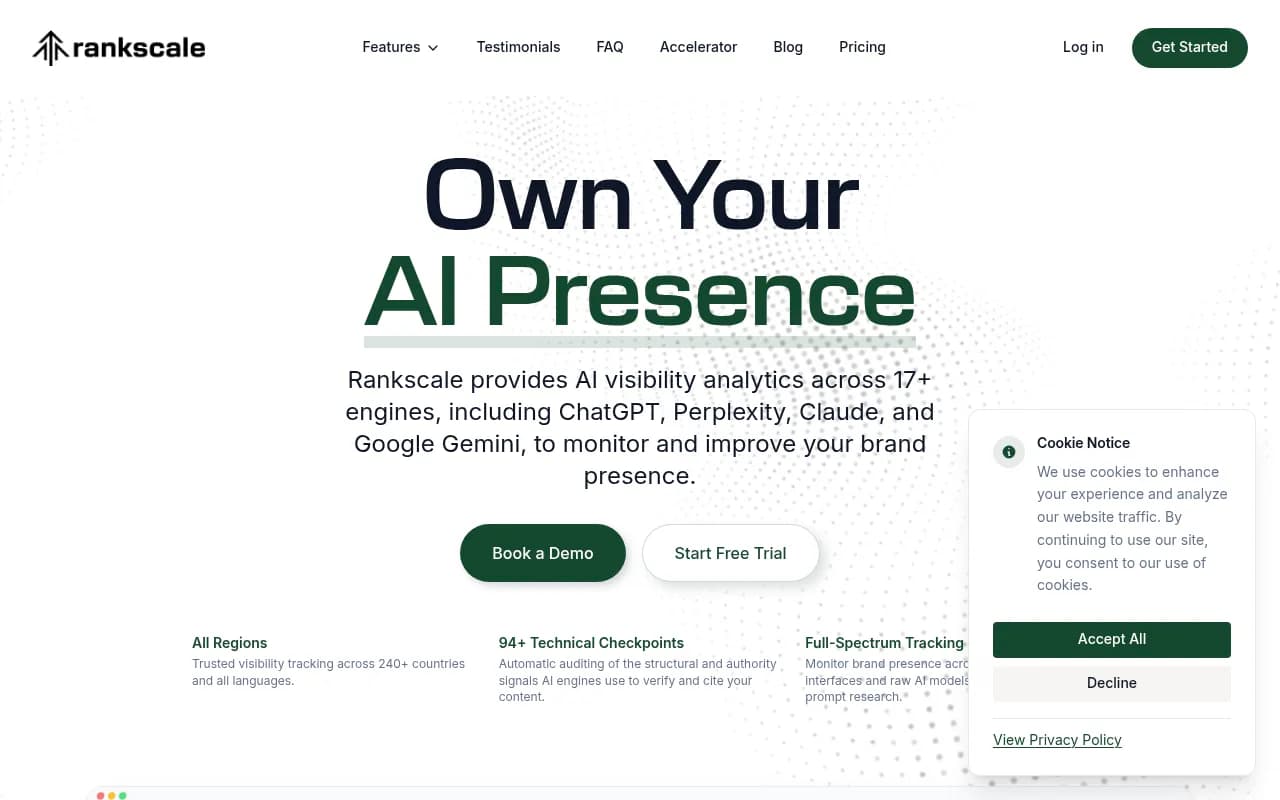
7. Rankscale
Rankscale uses a credit-based pricing model that starts at $20/month, making it the most affordable option on this list. It tracks 10+ AI engines and offers granular product-level tracking, which is genuinely useful for e-commerce.
The credit system can get expensive at high volume -- if you're tracking hundreds of product-specific prompts across multiple AI models, costs add up fast. It's also more complex to set up than some alternatives, which can be a barrier for smaller teams without dedicated SEO resources.
8. Hall AI
Hall AI takes a slightly different angle, focusing on conversational commerce and agent analytics. It tracks 8 AI engines and has a free plan, which makes it accessible for brands that want to experiment before committing budget.
The full feature set requires a higher-priced tier, and the platform is more oriented toward understanding how AI agents interact with your brand than toward traditional e-commerce product tracking. It's interesting if you're thinking about agentic commerce (AI agents that actually make purchases on behalf of users), but for standard ChatGPT Shopping tracking, other options on this list are more mature.

Side-by-side comparison
| Tool | Starting price | ChatGPT Shopping | LLM coverage | Content generation | SKU-level tracking | Best for |
|---|---|---|---|---|---|---|
| Promptwatch | $99/mo | Yes | 10 models, all plans | Yes (built-in AI writer) | Via prompt setup | Data-driven brands wanting full action loop |
| Profound | $99/mo | Yes | ChatGPT only on starter | Yes | Limited | Enterprise with compliance needs |
| Peec AI | €85/mo | Partial | 3 models per plan | No | No | International/multi-language brands |
| Scrunch AI | $250/mo | Yes | ChatGPT only on starter | No | No | Brand perception and sentiment analysis |
| Otterly.AI | Lower tier | Partial | Limited | No | No | Small brands, getting started |
| AthenaHQ | Custom | Yes | 8+ models | No | No | Teams with existing content strategy |
| Rankscale | $20/mo | Yes | 10+ models | No | Yes | Budget-conscious, granular tracking |
| Hall AI | Free plan | Partial | 8 models | No | No | Conversational commerce exploration |
The features most tools are still missing
Looking across these 8 platforms, a few gaps stand out that the industry hasn't fully solved yet.
True SKU-level revenue attribution is the biggest one. Most tools can tell you which products appear in AI responses. Very few can connect that appearance to an actual purchase. Alhena AI is working on this with closed-loop attribution, but it's not on this list because it's more of a specialized e-commerce AI platform than a general visibility tool.
AI crawler logs are another underserved area. Knowing that ChatGPT cited your product page is useful. Knowing that ChatGPT's crawler tried to visit your product page, hit a redirect loop, and gave up is more useful. Promptwatch offers this; most competitors don't.
Reddit and YouTube tracking matters more for e-commerce than most brands realize. When someone asks ChatGPT "what's the best running shoe under $150," the AI's answer is often influenced by Reddit threads and YouTube reviews, not just brand websites. Tools that surface which discussions are shaping AI recommendations give you a real edge.
 A breakdown of what different AI visibility tool categories actually track -- from AI Overview monitoring to content optimization.
How to choose the right tool for your situation
The honest answer is that the right tool depends on where you are in your AI visibility journey.
If you're just starting out and want to understand your current AI visibility before committing significant budget, Otterly.AI or Hall AI's free plan let you get a baseline without financial risk.
If you're a mid-sized e-commerce brand that wants to actually improve visibility (not just measure it), Promptwatch's combination of gap analysis and content generation is the most complete solution. The fact that it tracks ChatGPT Shopping alongside 9 other AI models on all plans -- not just premium tiers -- means you're not paying extra to see the full picture.
If you're an enterprise retailer with compliance requirements and a dedicated analytics team, Profound's depth and SOC 2 certification make it worth the premium.
If you sell internationally and need multi-language tracking with Looker Studio integration, Peec AI is the most practical choice.
A note on what "ChatGPT Shopping coverage" actually means
It's worth being specific here because the term gets used loosely. ChatGPT Shopping refers to the product recommendation carousels and shopping-specific responses that ChatGPT generates when users ask product questions. These are distinct from general brand mentions in conversational responses.
Tracking ChatGPT Shopping appearances requires the tool to specifically query ChatGPT with shopping-intent prompts and parse the structured product results -- not just look for your brand name in a text response. Several tools on this list claim ChatGPT coverage but don't specifically track the shopping carousel format. When evaluating any platform, it's worth asking directly: "Do you track ChatGPT Shopping carousels specifically, or just general ChatGPT brand mentions?"
The bottom line
AI search is already a meaningful acquisition channel for e-commerce, and it's growing fast. The brands that figure out AI visibility now -- which products are appearing, in which AI engines, for which queries, and with what sentiment -- will have a real advantage over those that treat it as a future problem.
The tools on this list range from free to $250+/month, from basic monitoring to full optimization platforms. None of them is perfect, and the category is evolving quickly. But waiting for a perfect solution means ceding ground to competitors who are already tracking and optimizing their AI presence today.
Start with what you can measure. Then figure out how to improve it.