Key takeaways
- "Best X alternatives" and "X vs Y" queries are among the highest-intent prompts in AI search -- SaaS companies that don't track them are losing deals they don't know about.
- Most AI visibility tools stop at monitoring. The ones worth paying for help you close the gap with content generation, answer gap analysis, and page-level citation tracking.
- For SaaS teams, the most important coverage is ChatGPT, Perplexity, and Google AI Overviews -- those three drive the majority of AI-assisted software discovery.
- Monitoring-only tools (Otterly.AI, Peec AI) are fine for early-stage awareness. Teams that want to actually improve their visibility need platforms with content optimization built in.
- Pricing ranges from ~$49/month for basic trackers to $500+ for platforms that include content generation and crawler analytics.
Why "alternatives" and "comparison" queries matter more than you think
Here's a scenario that plays out thousands of times a day: a software buyer types "best Salesforce alternatives for small teams" into ChatGPT. ChatGPT returns five recommendations with brief explanations. The buyer picks one of those five and books a demo.
Your product wasn't on the list.
You didn't lose that deal in a sales call. You lost it before the buyer ever visited your website -- because an AI model didn't know enough about you to recommend you, or didn't trust your content enough to cite it.
This is the core problem for SaaS companies in 2026. According to research cited by Moonrank, 73% of B2B buyers now use AI search engines before making software decisions. And the queries that drive the most purchase intent aren't generic ("what is CRM software"). They're comparison queries: "X vs Y", "best alternatives to X", "X competitors", "X for [use case]".
These prompts are where deals get made or lost. And most SaaS marketing teams have no idea how they're performing on them.
Traditional rank trackers don't help here. They tell you where you rank on a Google results page. They say nothing about whether ChatGPT recommends you when someone asks "what's a good alternative to HubSpot for startups." AI visibility platforms close that gap -- but they vary enormously in how useful they actually are.
This guide breaks down the best platforms for tracking and improving your visibility on SaaS comparison and alternatives queries specifically.
What to look for in an AI visibility platform for SaaS
Not every tool is built for this use case. Generic brand monitoring tools track your name -- that's useful but limited. What SaaS teams need for comparison and alternatives queries is more specific:
Prompt customization. You need to be able to enter the exact queries your buyers use: "best [competitor] alternatives", "[your product] vs [competitor]", "[category] software for [use case]". Tools with fixed or templated prompts won't cut it.
Competitor tracking. If you can't see who's getting cited when you're not, you can't understand why. Competitor heatmaps and share-of-voice data are essential.
Content gap analysis. Knowing you're invisible is step one. Knowing what content would make you visible is step two. Most tools stop at step one.
Multi-model coverage. ChatGPT, Perplexity, and Google AI Overviews are the priority for SaaS. Claude and Gemini matter too. A tool that only monitors one or two models gives you an incomplete picture.
Citation and source analysis. AI models cite specific pages, Reddit threads, and third-party listicles. You need to know which sources are driving recommendations for your competitors -- so you can get on those same sources.
Page-level tracking. Which specific pages on your site are being cited? Which aren't? This tells you where to focus optimization effort.
With that framework in mind, here's how the main platforms stack up.
The best platforms, ranked by use case
Best overall: Promptwatch
Promptwatch is the platform I'd recommend first for SaaS teams that want to actually improve their visibility on comparison and alternatives queries -- not just monitor it.
The core reason is the action loop. Most platforms show you that you're not being cited when someone asks "best Intercom alternatives." Promptwatch shows you that, then tells you exactly what content is missing from your site that would make AI models more likely to cite you, then helps you generate that content, then tracks whether your visibility improves after you publish it.
That cycle -- find gaps, create content, track results -- is what separates an optimization platform from a monitoring dashboard. For SaaS teams running lean marketing operations, the difference between "here's your score" and "here's what to do about it" is enormous.
Specific features that matter for comparison and alternatives tracking: Answer Gap Analysis shows which prompts competitors rank for that you don't. Competitor heatmaps show share of voice across models. Page-level citation tracking shows exactly which of your pages are being cited and by which AI engines. And the AI Crawler Logs show when ChatGPT or Perplexity's crawlers visit your site -- which pages they read, which they skip, and when a crawled page starts getting cited.
It monitors 10 AI models including ChatGPT, Perplexity, Google AI Overviews, Claude, Gemini, Grok, and DeepSeek. Pricing starts at $99/month for the Essential plan (1 site, 50 prompts, 5 articles) and $249/month for Professional (2 sites, 150 prompts, 15 articles, crawler logs).

Best for enterprise depth: Profound
Profound is the strongest dedicated monitoring platform for enterprise SaaS teams that need deep reporting and compliance-grade data. It tracks 10+ AI engines and has processed 400M+ prompt insights. The AEO score system gives you a single benchmark to track over time.
Where Profound falls short for the comparison/alternatives use case: it's primarily a monitoring tool. It shows you the data but doesn't generate content or provide specific optimization guidance. For teams with dedicated content resources who just need the best possible tracking data, that's fine. For lean teams that need the platform to help them act on what they find, it's a gap.

Best for teams already on Semrush: Semrush AI toolkit
If your team is already standardized on Semrush for traditional SEO, the AI visibility toolkit is the path of least resistance. It integrates with your existing keyword and content workflows, which reduces friction.
The limitation is that Semrush uses fixed prompts rather than fully customizable ones -- which matters a lot for SaaS comparison queries, where the exact phrasing ("best alternative to X" vs "X competitors" vs "X vs Y") can produce very different AI responses. You're also not getting crawler log data or content generation built into the same workflow.
Best budget option: Otterly.AI
Otterly.AI is the most accessible entry point for SaaS teams that want to start tracking AI visibility without a large budget. It monitors the major AI engines and gives you brand mention data across prompts you define.
It's monitoring-only -- no content generation, no gap analysis, no crawler logs. But for a team that's just starting to understand how they appear in AI search, it's a reasonable first step before graduating to a more capable platform.

Best for multi-language SaaS: Peec AI
Peec AI is worth considering for SaaS companies with significant non-English markets. Its multi-language tracking is more developed than most competitors, and it covers the main AI engines across regions.
Like Otterly, it's primarily a monitoring tool. The data is solid; the action layer is thin.

Other tools worth knowing
A few other platforms come up regularly in this space:
AthenaHQ tracks 8+ AI search engines and is well-regarded for its monitoring depth. No content generation or crawler logs.

SE Ranking (via its AI visibility toolkit, SE Visible) is a good option for teams that want traditional SEO and AI visibility in one platform at a mid-market price point.
Rankshift is a focused LLM tracking tool that's lighter-weight than the full platforms but useful for teams that want straightforward visibility data without a lot of overhead.
Writesonic has added AI visibility tracking alongside its content generation features, making it an interesting option for teams that want to create content and track its AI performance in one place.
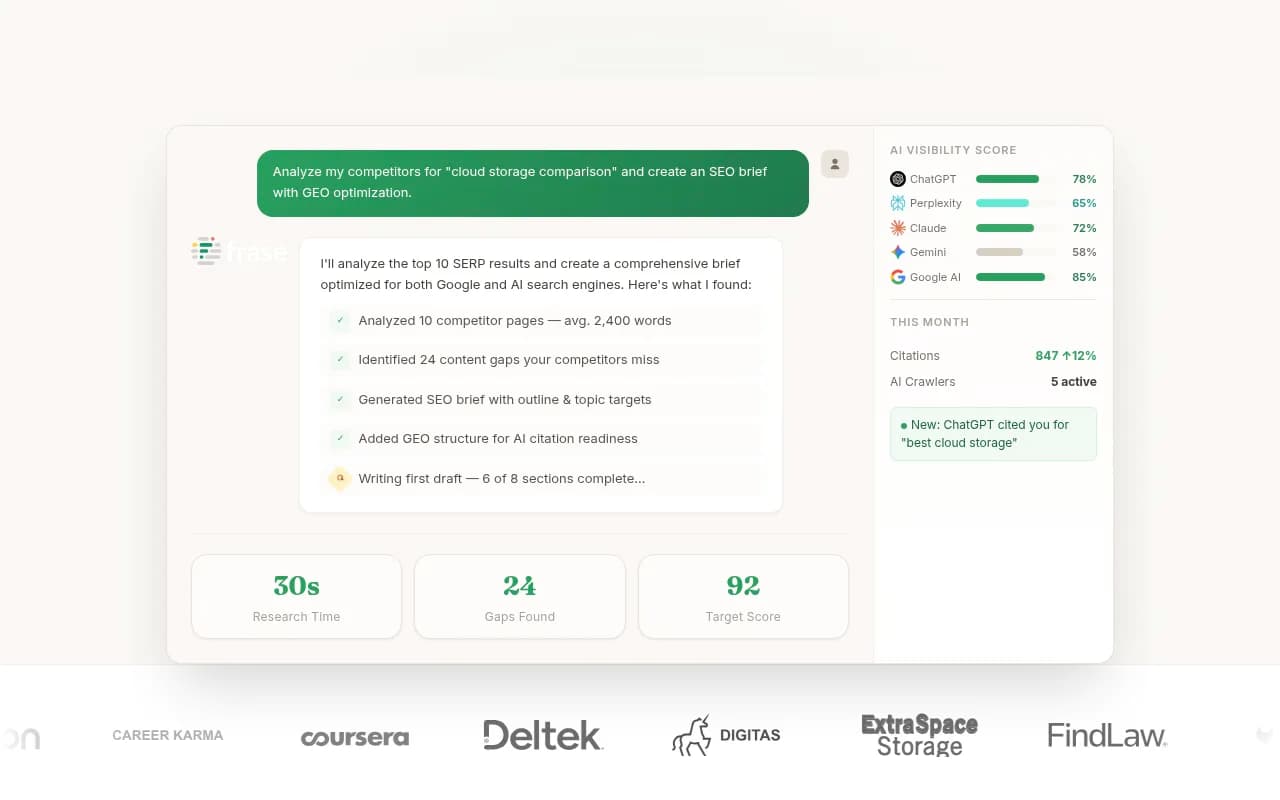
Frase takes a similar approach -- pairing AI visibility monitoring with content research and writing tools. It's particularly strong for teams that want to close the gap between "we're not being cited" and "we published something that should fix that."
Platform comparison table
| Platform | Prompt customization | Competitor tracking | Content generation | Crawler logs | Multi-model coverage | Starting price |
|---|---|---|---|---|---|---|
| Promptwatch | Full | Yes (heatmaps) | Yes (AI agents) | Yes | 10 models | $99/mo |
| Profound | Full | Yes | No | No | 10+ models | ~$200/mo |
| Semrush AI toolkit | Fixed prompts | Limited | No | No | 5 models | $139/mo |
| AthenaHQ | Full | Yes | No | No | 8 models | ~$149/mo |
| Otterly.AI | Full | Limited | No | No | 4 models | $49/mo |
| Peec AI | Full | Yes | No | No | 5 models | ~$79/mo |
| SE Ranking | Partial | Limited | No | No | 4 models | $65/mo |
| Frase | Partial | Limited | Yes | No | 3 models | $45/mo |
| Writesonic | Partial | Limited | Yes | No | 3 models | $99/mo |
| Rankshift | Full | Limited | No | No | 5 models | ~$49/mo |
How SaaS comparison queries actually work in AI search
Understanding why AI models recommend certain products over others for comparison queries is worth spending a minute on -- because it shapes what you should actually do with these platforms.
When someone asks Perplexity "best alternatives to Notion for teams," the model doesn't just pull from its training data. It retrieves current web content, weighs the sources it finds, and synthesizes a recommendation. The sources it trusts most tend to be: authoritative comparison pages (G2, Capterra, dedicated review sites), well-structured product pages that clearly explain use cases, and third-party content (blog posts, Reddit threads, YouTube videos) that discuss the product in context.
This means your visibility on comparison queries depends on three things:
- Whether your own site has content that directly addresses the comparison (e.g., a page titled "Notion alternatives" or "Notion vs [your product]")
- Whether third-party sources mention you in relevant comparison contexts
- Whether AI crawlers can actually access and understand your content
Most SaaS teams focus only on the first. The platforms that track all three -- your own pages, third-party citations, and crawler behavior -- give you the most complete picture.
The content types that win comparison queries
Based on how AI models handle these prompts, certain content formats consistently get cited more often:
Direct comparison pages. A page titled "[Your product] vs [Competitor]" that honestly addresses the differences, including where the competitor is stronger, tends to get cited because it's specific and credible. AI models are skeptical of purely promotional content.
"Best alternatives to X" pages. If you publish a page listing the best alternatives to a competitor (including yourself), you can appear in AI responses even when someone is asking about a competitor's alternatives. This is one of the most underused tactics in SaaS content.
Use-case-specific landing pages. "Best CRM for real estate teams" or "project management software for agencies" -- these match the long-tail prompts buyers actually use. AI models cite them because they're specific and useful.
Third-party mentions. Reddit threads, G2 reviews, and independent blog posts that mention your product in comparison contexts carry significant weight. Tracking which external sources are driving competitor citations (and then getting your product mentioned in similar sources) is a high-leverage move.
The platforms with offsite citation analysis -- tracking which external pages are driving AI recommendations -- are particularly valuable here. Promptwatch's offsite citation analysis, for example, shows you exactly which Reddit posts, YouTube videos, and third-party listicles are being cited for competitor queries. That tells you precisely where to focus your outreach and content efforts.
A practical workflow for SaaS teams
Here's how to actually use these platforms rather than just subscribe and forget:
Step 1: Map your comparison query universe. List every "[competitor] alternatives" and "[your product] vs [competitor]" query that matters to you. Include the use-case variants ("best Salesforce alternative for startups", "best Salesforce alternative for enterprise"). This is your prompt set.
Step 2: Run a baseline. Enter those prompts into your chosen platform and see where you stand today. Which queries mention you? Which don't? Where do competitors appear that you don't?
Step 3: Identify the content gaps. For every query where you're invisible, look at what's being cited. Is it a competitor's comparison page? A G2 listicle? A Reddit thread? That tells you what type of content to create or where to get mentioned.
Step 4: Create targeted content. Build pages that directly address the queries where you're missing. Use the prompt data to write content that matches what buyers are actually asking.
Step 5: Track the results. Monitor your visibility scores weekly. Watch for your new pages to get crawled and then cited. Adjust based on what's working.
This loop -- map, baseline, gap-find, create, track -- is the core of GEO for SaaS. The platforms that support all five steps in one workflow save significant time compared to stitching together multiple tools.
What to watch out for
A few things that trip up SaaS teams when they start tracking AI visibility:
Prompt phrasing matters more than you expect. "Best HubSpot alternatives" and "HubSpot competitors" can produce completely different AI responses. Track both phrasings, and the use-case variants. Tools with prompt volume data (showing which phrasings are most common) help you prioritize.
AI responses change frequently. A model that cited you last week might not this week, because it retrieved different sources or was updated. Weekly tracking is the minimum; daily is better for high-stakes queries.
API outputs differ from real user interfaces. Some platforms query AI models through APIs, which can produce different responses than what real users see in ChatGPT or Perplexity's actual interfaces. Platforms that monitor real user-facing responses give you more accurate data.
Don't confuse brand mentions with citations. An AI model mentioning your brand name in passing ("some people use [your product]") is different from citing your content as a source or recommending you specifically. Make sure your platform distinguishes between these.
The bottom line
For SaaS companies, comparison and alternatives queries are where the highest-intent buyers are. Getting cited in those AI responses is increasingly the difference between being in a buyer's consideration set and being invisible.
The platforms that just show you a monitoring dashboard are a starting point. The ones that help you understand why competitors are being cited, what content would change that, and whether your new content is actually getting picked up -- those are where the real value is.
If you're starting from scratch, Otterly.AI or Rankshift gets you visibility data quickly at low cost. If you're ready to actually move the needle on your AI search presence, Promptwatch's combination of gap analysis, content generation, and crawler logging is the most complete option available for SaaS teams in 2026.
The buyers are already asking AI engines which software to use. The question is whether you show up in the answer.