Key takeaways
- Brandlight is a legitimate enterprise product with strong brand sentiment tracking, but pricing starts around $199/mo and scales to $4K-$15K/mo for enterprise contracts -- with no self-serve option.
- Most GEO platforms (including Brandlight) are monitoring-first. The real differentiator in 2026 is whether a platform helps you act on the data, not just collect it.
- Promptwatch is the only platform rated "Leader" across all categories in a 2026 comparison of 12 GEO tools -- largely because it closes the loop from gap detection to content creation to citation tracking.
- For agencies and mid-market teams, tools like Otterly.AI, Peec AI, and Profound offer more accessible pricing with solid monitoring capabilities.
- The criteria that matter most: multi-model coverage, crawler logs, content gap analysis, and whether the platform connects AI visibility to actual traffic and revenue.
What Brandlight actually is
Brandlight is an enterprise AI visibility platform. It tracks how your brand appears in responses from ChatGPT, Gemini, Perplexity, Copilot, and Grok -- monitoring mentions, sentiment, citations, and competitor presence across those models. Clients include Volkswagen, LG, and TD Bank, which tells you something about the target customer.
The product is genuinely well-built. You get a multi-brand command center, technical health audits, and fairly deep sentiment analysis on how AI systems describe your brand. If your job is to manage brand narrative across AI engines and you have a dedicated AI strategy team (and budget), Brandlight is a credible choice.
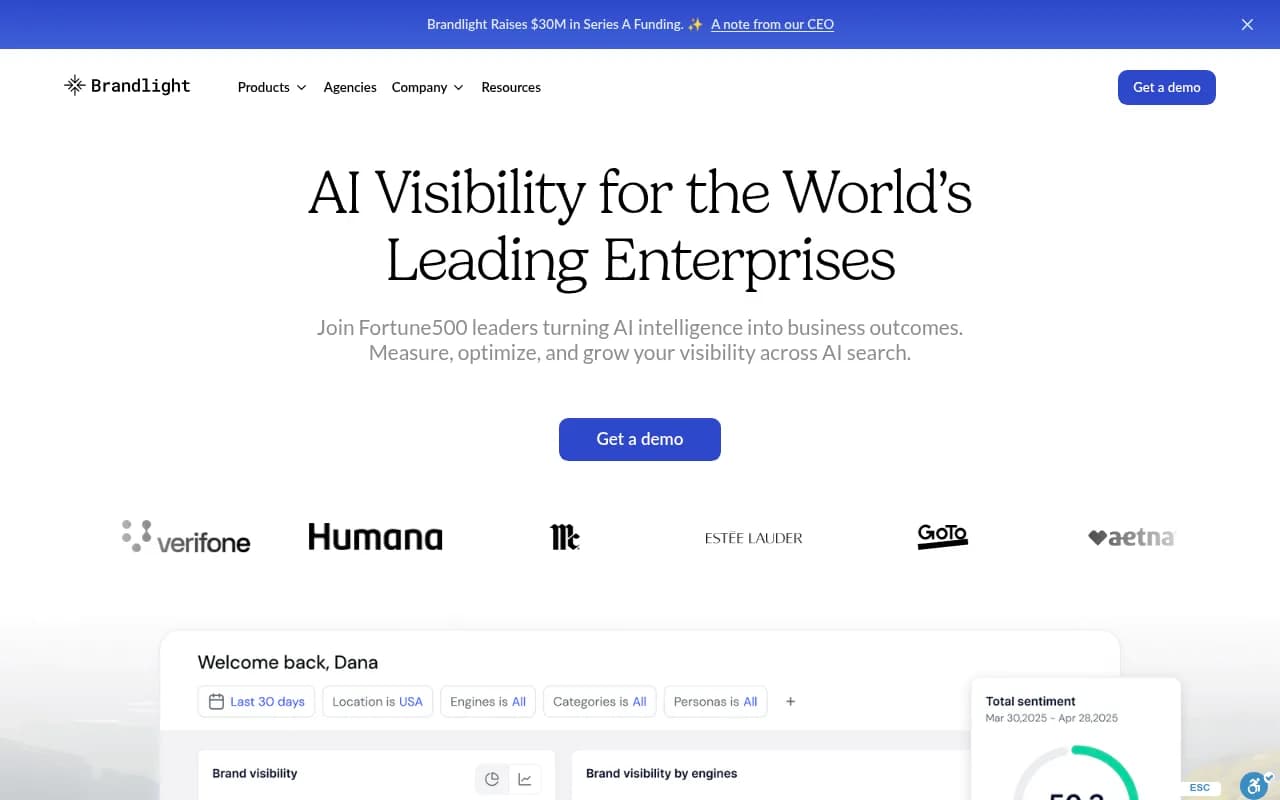
The problem most buyers run into: Brandlight doesn't publish pricing. Entry-level access runs around $199/mo, but enterprise contracts land in the $4,000 to $15,000/mo range, and you can't sign up without going through a sales call. For a Fortune 500 CMO, that's fine. For an in-house team at a growing brand or an agency managing 20 clients, it's a lot of friction before you've even seen the product.
That's the core reason people look for alternatives -- not because Brandlight is bad, but because the buying experience and price point aren't designed for them.
The bigger issue: monitoring vs. optimization
Before comparing specific tools, it's worth naming the real divide in this market.
Most GEO platforms -- Brandlight included -- are primarily monitoring dashboards. They show you where you appear, how often, what sentiment looks like, and how competitors compare. That's genuinely useful data. But it leaves you with a question: now what?
The platforms that are pulling ahead in 2026 are the ones that answer that question. They don't just show you that a competitor is getting cited for "best project management software for remote teams" while you're invisible -- they show you exactly what content you're missing, help you create it, and then track whether it worked.
That distinction -- monitor vs. optimize -- is the most important thing to understand when evaluating any tool in this space.
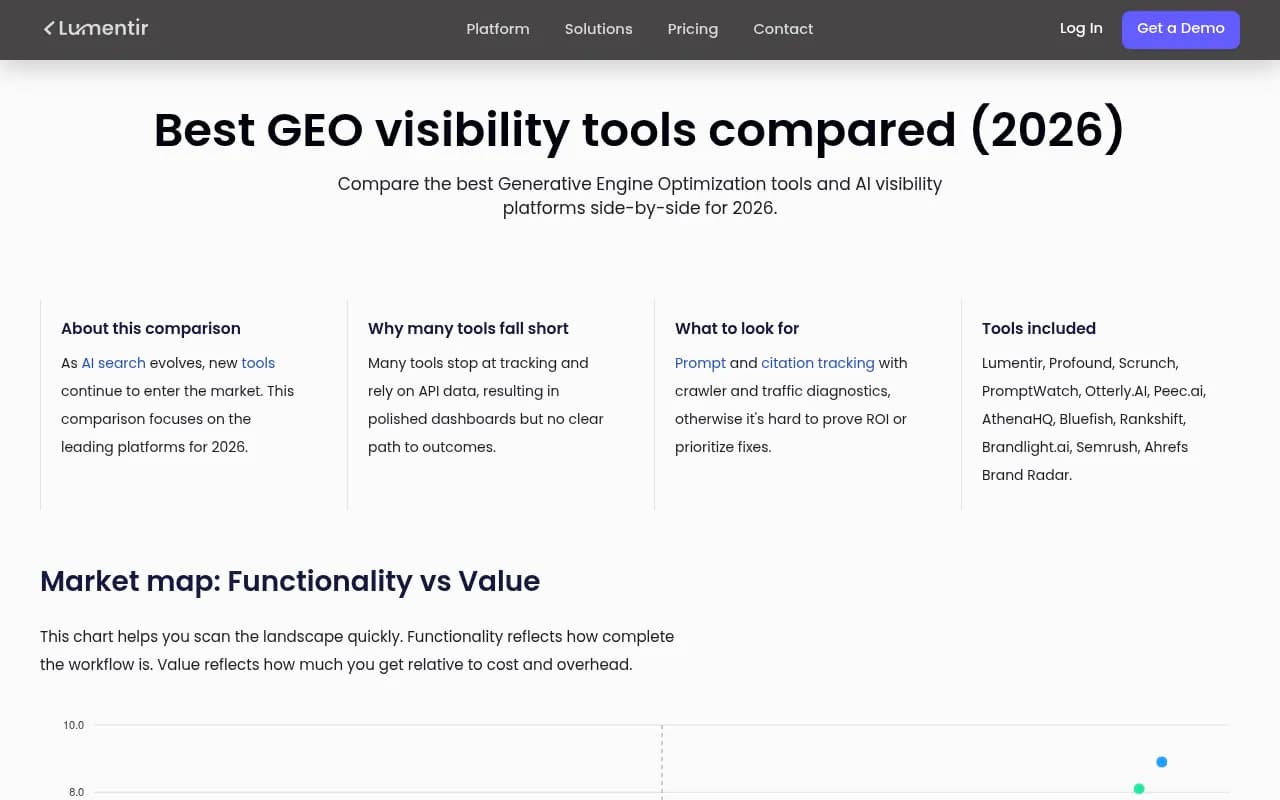
How to evaluate a GEO platform: the criteria that matter
Before getting into the tool-by-tool breakdown, here's the framework worth applying to any platform you evaluate:
- Multi-model coverage: Does it track ChatGPT, Gemini, Perplexity, Claude, Copilot, Grok, and Google AI Overviews? Some tools only cover two or three models.
- Real UI monitoring vs. API-only: AI models can behave differently in their user-facing interfaces vs. their APIs. Platforms that only query APIs may miss what users actually see.
- Citation and source tracking: Can you see which specific pages, domains, and third-party sources AI models are citing in their answers?
- Crawler logs: Does the platform show you when AI crawlers visit your site, which pages they read, and whether those pages are getting cited?
- Content gap analysis: Does it tell you which prompts competitors rank for that you don't -- and what content you'd need to create to compete?
- Content generation: Can it help you create that content, or does it just hand you a list of gaps and wish you luck?
- Traffic and revenue attribution: Does it connect AI visibility to actual site traffic and conversions?
- Prompt intelligence: Does it give you volume estimates and difficulty scores so you can prioritize?
With that framework in mind, here's how the major platforms stack up.
Platform-by-platform breakdown
Promptwatch
Promptwatch is the platform that comes closest to a full optimization loop rather than just a monitoring dashboard. It covers 10 AI models (ChatGPT, Perplexity, Google AI Overviews, Google AI Mode, Claude, Gemini, Meta/Llama, DeepSeek, Grok, Mistral, Copilot), tracks real user-interface behavior rather than just API outputs, and -- critically -- helps you do something about what you find.
The Answer Gap Analysis shows exactly which prompts competitors are visible for that you're not. Content Agents then generate articles, listicles, and comparisons grounded in that prompt data. AI Crawler Logs show when ChatGPT, Claude, or Perplexity crawl your site, which pages they read, and when those pages move from crawled to cited. Traffic attribution connects all of it to actual revenue.
It's also the only platform in a 2026 comparison of 12 GEO tools rated "Leader" across all categories. Pricing starts at $99/mo (Essential), $249/mo (Professional), and $579/mo (Business), with a free trial available.

Brandlight
As covered above: strong enterprise product, deep sentiment analysis, multi-brand command center, solid model coverage. The friction is the sales-led buying process and pricing that starts high and goes very high. Best suited to Fortune 500 in-house teams with dedicated AI strategy resources.
Profound
Profound is frequently cited as the strongest direct alternative to Brandlight on G2, with 4.5 stars from 1,100+ reviewers. It has solid multi-model tracking, competitive benchmarking, and a cleaner buying experience than Brandlight. The main gap: no Reddit/YouTube tracking, no ChatGPT Shopping monitoring, and the content optimization capabilities are more limited than what Promptwatch offers.

Otterly.AI
Otterly is one of the more accessible entry points in this space -- affordable, easy to set up, and good for teams that want basic AI mention monitoring without a lot of overhead. The honest limitation is that it's a monitoring-only tool. No crawler logs, no content generation, no traffic attribution. If you want to track visibility and nothing else, it works. If you want to improve it, you'll hit a ceiling quickly.

Peec AI
Peec has strong multi-language support, which makes it worth considering for brands operating across multiple markets. Coverage is solid across the major models. Like Otterly, it's primarily a monitoring platform -- good for tracking, less useful for acting on what you find.

AthenaHQ
AthenaHQ covers 8+ AI search engines and has a clean interface. It's monitoring-focused, which is fine for teams that have a separate content workflow. What it lacks is the content optimization and generation layer that would make it a complete GEO platform.

Scrunch AI
Scrunch has a reasonable feature set for AI visibility monitoring and works well for teams that want a mid-market option between the lightweight tools and enterprise platforms like Brandlight. The pricing is more accessible than Brandlight, though it doesn't have the content generation or crawler log capabilities of Promptwatch.
LLM Pulse
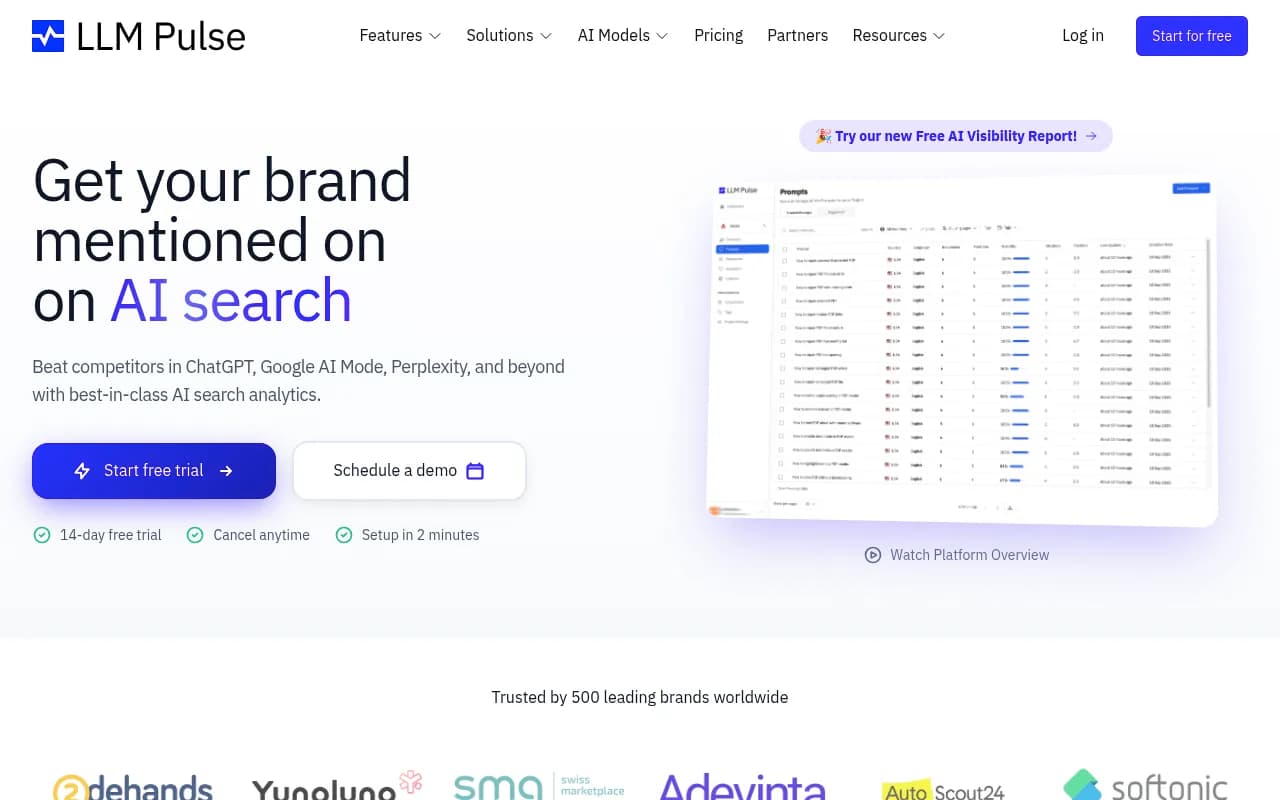
LLM Pulse positions itself as the most accessible alternative to Brandlight for growing brands and agencies. At €49/mo with a 14-day free trial, it removes the pricing friction that makes Brandlight difficult for non-enterprise buyers. The trade-off is depth -- it's strong on monitoring but lighter on the optimization side.
Semrush
Semrush has added AI visibility tracking to its existing SEO suite, which is useful if you're already a Semrush customer and want a single platform. The limitation is that its AI monitoring uses fixed prompts rather than dynamic prompt tracking, and it lacks AI traffic attribution. It's a reasonable starting point, not a dedicated GEO platform.
Ahrefs Brand Radar
Similar story to Semrush -- a useful addition to an existing SEO workflow, but fixed prompts and no AI traffic attribution mean it's not built for serious GEO work.
Feature comparison table
| Platform | Multi-model coverage | Crawler logs | Content generation | Prompt volume data | Reddit/YouTube tracking | ChatGPT Shopping | Pricing (starting) |
|---|---|---|---|---|---|---|---|
| Promptwatch | 10 models | Yes | Yes (Content Agents) | Yes | Yes | Yes | $99/mo |
| Brandlight | 5 models | No | No | No | No | No | ~$199/mo (opaque) |
| Profound | Multiple | No | Limited | No | No | No | Custom |
| Otterly.AI | Multiple | No | No | No | No | No | Low |
| Peec AI | Multiple | No | No | No | No | No | Low |
| AthenaHQ | 8+ models | No | No | No | No | No | Custom |
| Scrunch AI | Multiple | No | No | No | No | No | Mid-market |
| LLM Pulse | Multiple | No | No | No | No | No | €49/mo |
| Semrush | Limited (fixed prompts) | No | No | No | No | No | Varies |
| Ahrefs Brand Radar | Limited (fixed prompts) | No | No | No | No | No | Varies |
Who should use what
The right tool depends on what you're actually trying to do.
If you want to monitor and optimize -- track where you're invisible, create content to fix it, and measure whether it worked -- Promptwatch is the most complete option. The action loop (find gaps, generate content, track results) is built into the platform rather than requiring you to stitch together separate tools.
If you're a Fortune 500 brand with a dedicated AI strategy team and enterprise budget, Brandlight is a legitimate choice. The depth of sentiment analysis and multi-brand command center are genuinely useful at that scale.
If you want a solid monitoring tool at an accessible price, Profound or LLM Pulse are the strongest options. Profound has the better reputation on G2; LLM Pulse has the more transparent pricing.
If you're an agency managing multiple client portfolios, Promptwatch's agency pricing and white-label capabilities make more sense than Brandlight's sales-led model. Otterly and Peec are options if budget is the primary constraint, but you'll hit their limitations quickly.
If you're already deep in Semrush or Ahrefs, their AI tracking features are worth using as a starting point -- just don't expect them to replace a dedicated GEO platform.
What Brandlight does well (and where it falls short)
To be fair to Brandlight: the product is genuinely strong in a few areas that matter.
The sentiment analysis is more sophisticated than most competitors. Brandlight doesn't just tell you whether you're mentioned -- it analyzes how AI systems characterize your brand, which is useful for reputation management and brand narrative work. The multi-brand command center is also well-designed for enterprise teams managing multiple product lines or subsidiaries.
Where it falls short:
- No crawler logs, so you can't see how AI engines are actually discovering and indexing your content.
- No content gap analysis or content generation, so the platform tells you where you're invisible but doesn't help you fix it.
- No Reddit or YouTube tracking, which matters because those platforms heavily influence what AI models recommend.
- No ChatGPT Shopping monitoring, which is increasingly important for e-commerce brands.
- The sales-led buying process and opaque pricing create real friction for teams that want to evaluate the product on their own terms.
None of these are dealbreakers if you're a large enterprise with a dedicated team. But for most marketing teams, they add up to a platform that shows you a lot without helping you do much about it.
The criteria checklist (apply this to any tool you evaluate)
Before signing up for any GEO platform, run through these questions:
- Which AI models does it actually monitor? (Get a specific list, not "all major models")
- Does it track real user-interface behavior or just API outputs?
- Can you see which specific pages and domains AI models are citing?
- Does it show you when AI crawlers visit your site and which pages they read?
- Does it identify content gaps -- prompts where competitors rank but you don't?
- Can it help you create content to fill those gaps, or just identify them?
- Does it connect AI visibility to actual traffic and revenue?
- Can you get prompt volume and difficulty data to prioritize your work?
- Is pricing transparent, and can you start without a sales call?
- Does it track Reddit, YouTube, and other third-party sources that influence AI recommendations?
Most platforms answer "yes" to questions 1-2 and "no" to most of the rest. The platforms that answer "yes" to the majority of this list are the ones worth your time.
Bottom line
Brandlight is a real product that works well for its intended audience: large enterprises with dedicated AI strategy teams and budget to match. If that's you, it's worth evaluating.
For everyone else -- agencies, mid-market brands, in-house teams that need to show ROI -- the combination of opaque pricing, sales-led onboarding, and monitoring-only capabilities makes it harder to justify. The market has moved toward platforms that don't just show you data but help you act on it, and that's where the gap between Brandlight and tools like Promptwatch is most visible.
The question to ask isn't "which platform has the best dashboard?" It's "which platform helps me actually improve my AI visibility?" Those are different questions, and they lead to different answers.