Key takeaways
- Evertune is the most expensive option by far ($3K+/mo) and targets Fortune 500 brand teams who need deep perception analysis across 1M+ prompts per brand.
- Promptwatch is the only platform in this group that closes the full loop: find gaps, generate content, track results -- making it the strongest choice for brands that want to actually improve their AI visibility, not just measure it.
- Relixir takes an AI-native CMS approach, auto-generating and publishing content to close AI answer gaps, which suits teams with limited editorial bandwidth.
- Goodie AI is the most accessible entry point, with a simpler feature set suited to smaller brands or teams just getting started with GEO.
- For most enterprise marketing teams, Promptwatch hits the best balance of depth, actionability, and price.
The GEO platform market has gotten crowded fast. Two years ago, most brands had never heard of "AI visibility." Now there are 40+ tools competing for your budget, and the pitch from every vendor sounds roughly the same: "See where you appear in ChatGPT, Gemini, and Perplexity."
The problem is that most of these platforms stop there. They show you a dashboard. They tell you your brand appeared in 12% of relevant AI responses. Then they leave you to figure out what to do about it.
This guide focuses on four platforms that have carved out real positions in the enterprise GEO market: Goodie AI, Promptwatch, Relixir, and Evertune. They're not the same product. They have genuinely different philosophies about what "AI visibility" means and what a platform should do about it. Understanding those differences is what this guide is for.
What enterprise brands actually need from a GEO platform
Before comparing tools, it's worth being honest about what the enterprise buying criteria look like in 2026. Most GEO platforms were built for marketers who want to see their brand mentioned more. Enterprise teams have a longer list of requirements:
- Coverage across multiple AI models (not just ChatGPT)
- Competitor benchmarking at scale
- Content gap analysis that ties to actual business outcomes
- Integration with existing workflows (Looker Studio, Slack, APIs)
- Multi-brand or multi-region support
- Some form of action layer -- not just monitoring
- Audit trails and reporting for leadership
The "monitoring-only" platforms struggle here. Showing a CMO a chart of brand mentions is fine for a weekly standup. It doesn't justify a five-figure annual contract.
The four platforms, briefly
Goodie AI
Goodie AI (higoodie.com) positions itself as a brand monitoring and optimization tool for AI search. It tracks brand mentions across the major LLMs and provides sentiment and share-of-voice data. The interface is clean and accessible, which is genuinely useful for teams that are new to GEO and don't need a lot of complexity upfront.
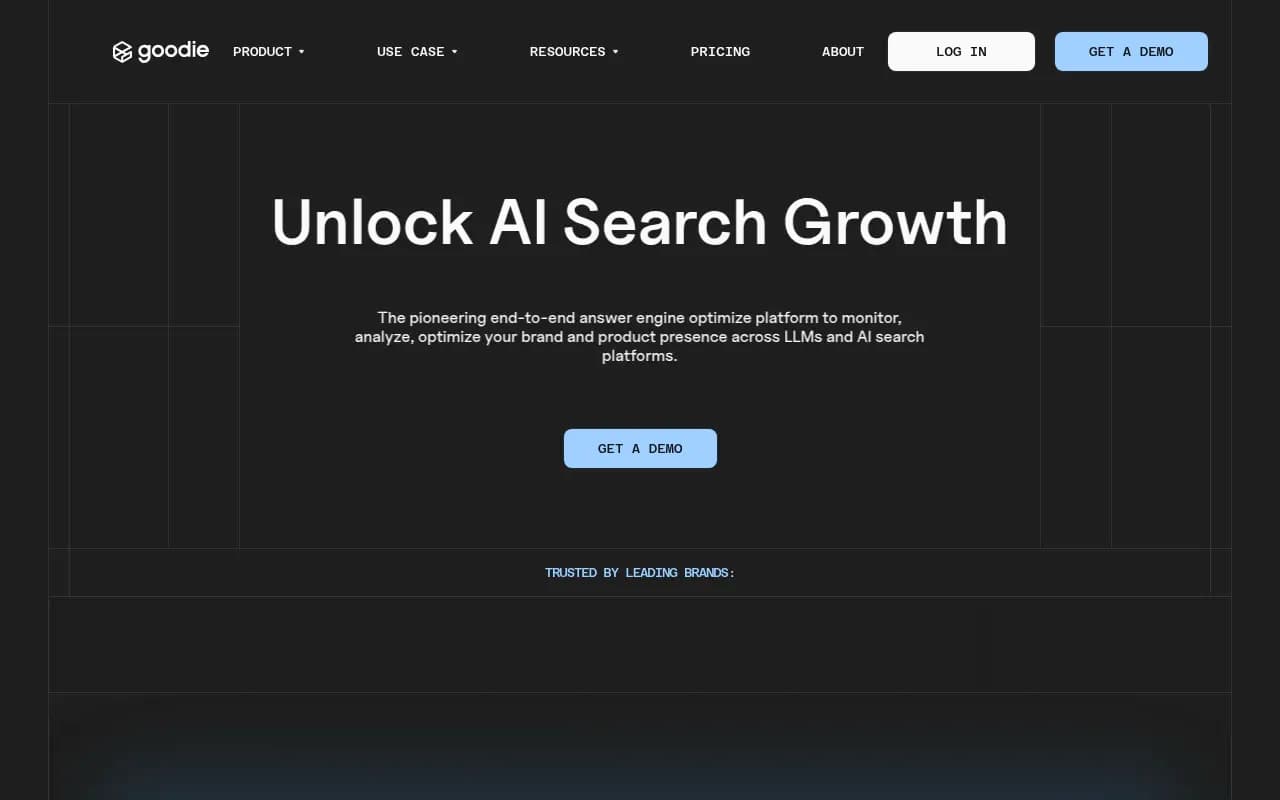
What Goodie does well is lowering the barrier to entry. If your team has never tracked AI visibility before and wants to understand the basics -- which models mention you, how often, in what context -- Goodie gets you there without a steep learning curve.
What it lacks is depth. There's no content generation layer, no crawler log analysis, and the prompt intelligence is fairly surface-level compared to the more mature platforms. For a startup or a small brand, that's fine. For an enterprise team managing multiple brands across multiple regions, it starts to feel thin.
Promptwatch
Promptwatch is the platform that's hardest to categorize as "just a monitoring tool" because it's genuinely not one. The core product is built around a three-stage loop: find the gaps in your AI visibility, generate content to close those gaps, then track whether the new content actually gets cited.

The Answer Gap Analysis feature is the clearest example of this philosophy in practice. It shows you the specific prompts where competitors are getting cited and you're not -- not as a vague category, but as actual questions with actual competitor citations. You can see what content is missing from your site, generate a brief for it, and have an article drafted by the platform's Content Agents within the same workflow.
That's a meaningfully different product from a dashboard that tells you your share of voice dropped 3 points this month.
Promptwatch monitors 10 AI models: ChatGPT, Perplexity, Google AI Overviews, Google AI Mode, Claude, Gemini, Meta/Llama, DeepSeek, Grok, Mistral, and Copilot. It also tracks AI crawler logs in real time -- which pages ChatGPT or Perplexity's crawlers are reading, how often they return, and whether those visits are converting to citations. Most competitors don't offer this at all.
Pricing runs from $99/mo (Essential, 1 site, 50 prompts) to $579/mo (Business, 5 sites, 350 prompts, 30 articles). Agency and enterprise plans are available with custom pricing.
Relixir
Relixir takes a different angle. It's an AI-native CMS and GEO platform that focuses on autonomous content generation -- the idea being that AI search gaps should be closed by publishing new content automatically, without requiring a human editor to approve every piece.
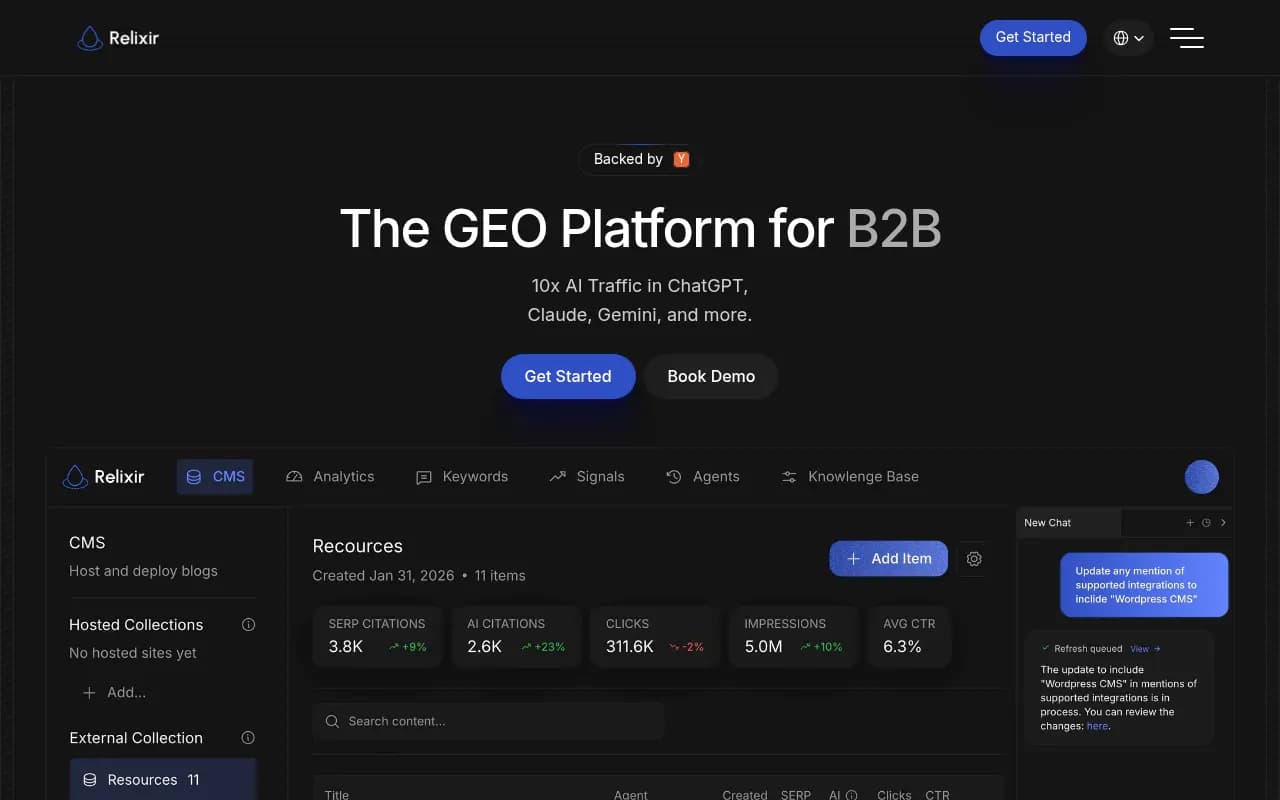
The appeal for enterprise teams is obvious: if you're managing hundreds of product pages or a large content library, the bottleneck isn't knowing what to write -- it's having the bandwidth to write it. Relixir tries to solve that by making content generation more autonomous.
The tradeoff is control. Autonomous publishing works well for certain content types (FAQs, comparison pages, structured product content) but gets riskier when brand voice, legal review, or regulatory compliance matters. Enterprise brands in financial services, healthcare, or regulated industries will want to think carefully about how much autonomy they're comfortable with.
Relixir's monitoring capabilities are solid, and the platform integrates with existing CMS setups, which helps with adoption. It's a strong fit for content-heavy brands that want to move fast.
Evertune
Evertune is the premium end of this market. Built by Trade Desk veterans and backed by $19M in venture funding, it's designed for Fortune 500 brand teams that need enterprise-grade AI brand perception measurement at scale -- we're talking 1M+ prompts per brand.
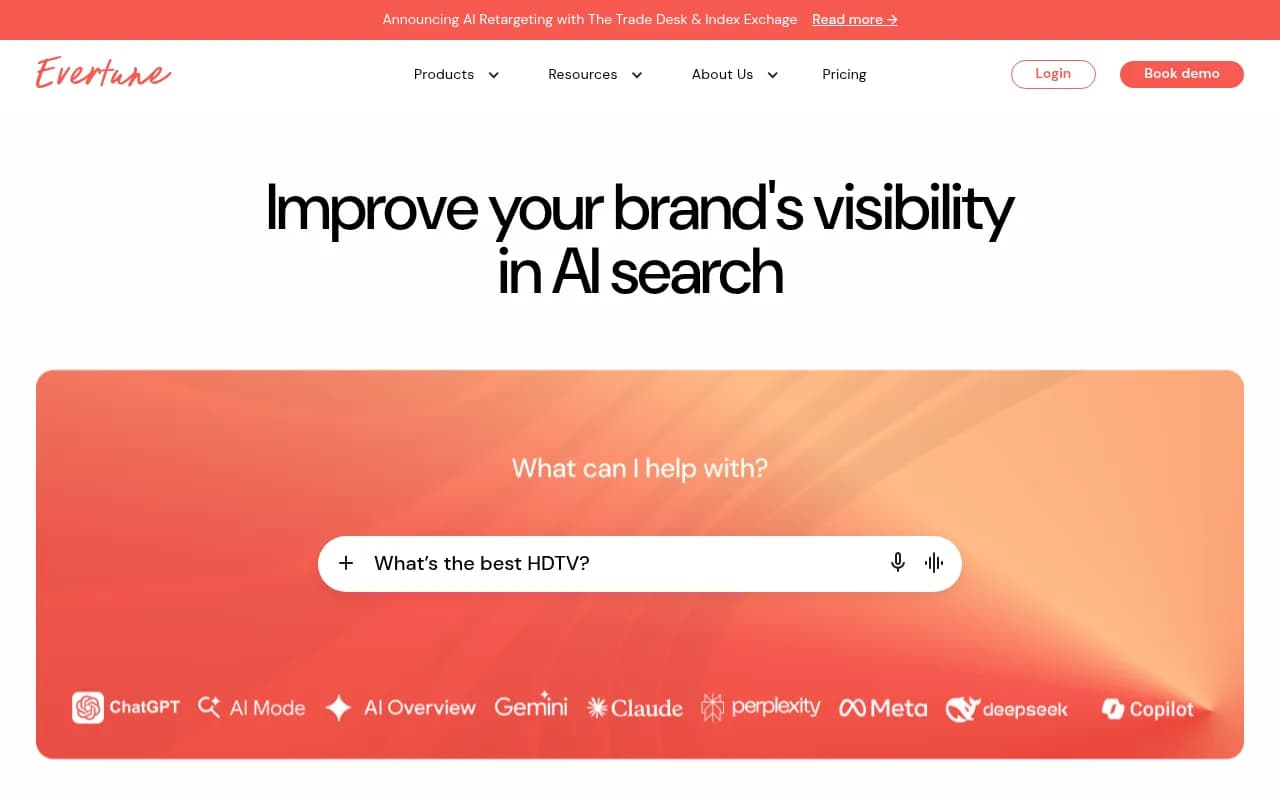
The platform's strength is depth of perception analysis. Evertune doesn't just track whether your brand is mentioned -- it analyzes how your brand is being described, what attributes AI models associate with it, and how that compares to competitors. For brand teams at large consumer companies where brand perception is a board-level metric, this is genuinely useful data.
The price reflects the positioning. At roughly $3,000/month as a starting point, Evertune is not a tool for most marketing teams. It's a tool for enterprise brand teams with dedicated GEO budgets and a need for the kind of reporting that justifies that spend to a CMO or CFO.
What Evertune doesn't do as well is the action layer. Like most enterprise monitoring platforms, it's strong on measurement and lighter on "here's what to do about it." The expectation is that your team has the resources to act on the data independently.
Feature-by-feature comparison
| Feature | Goodie AI | Promptwatch | Relixir | Evertune |
|---|---|---|---|---|
| AI model coverage | 4-6 models | 10 models | 5-7 models | 8+ models |
| Competitor benchmarking | Basic | Advanced | Moderate | Advanced |
| Content gap analysis | No | Yes | Yes | Limited |
| Content generation | No | Yes (AI agents) | Yes (autonomous) | No |
| AI crawler logs | No | Yes | No | No |
| Prompt volume/difficulty scoring | No | Yes | No | No |
| Reddit/YouTube tracking | No | Yes | No | No |
| ChatGPT Shopping tracking | No | Yes | No | No |
| Multi-brand/multi-region | Limited | Yes | Yes | Yes |
| Looker Studio / API | No | Yes | Limited | Yes |
| Traffic attribution | No | Yes | No | No |
| Starting price | ~$49/mo | $99/mo | Custom | ~$3,000/mo |
| Best for | SMBs, beginners | Mid-market to enterprise | Content-heavy brands | Fortune 500 brand teams |
How to think about the "action gap"
The most important distinction in this market isn't which models a platform monitors. It's whether the platform helps you do something with the data.
Most GEO tools are built around a monitoring dashboard. You set up your prompts, the platform queries the AI models, and you get a report showing your brand's share of voice. That's useful information. But it doesn't tell you which pages to update, what content to create, or whether the changes you made last month actually improved your citations.
Promptwatch is the clearest example of a platform that tries to close this loop. The Answer Gap Analysis connects monitoring data to content recommendations. The Content Agents generate actual articles, not just briefs. The AI Crawler Logs show you whether AI models are even reading your pages. And the page-level tracking shows whether new content is getting cited after it's published.
Relixir approaches the same problem differently -- by automating more of the content production side. If your team's constraint is editorial capacity rather than strategic direction, Relixir's autonomous publishing model might be a better fit.
Evertune and Goodie AI are both more monitoring-focused. That's not a criticism -- it's a positioning choice. Evertune's perception analysis is genuinely sophisticated, and for a brand team that already has a content strategy and just needs better measurement, it might be exactly what's needed.
Which platform fits which enterprise profile
You're a large consumer brand with a dedicated brand team
Evertune is worth evaluating seriously. The perception analysis at scale, the prompt volume data, and the enterprise-grade reporting are built for exactly this use case. The price is high, but if brand perception in AI responses is a strategic priority at the board level, the data quality justifies it.
You're a B2B company that needs to appear in AI answers for purchase-intent queries
Promptwatch is the stronger choice here. The prompt intelligence features (volume estimates, difficulty scores, query fan-outs) help you prioritize which prompts are worth targeting. The content gap analysis shows you exactly what's missing. And the content generation tools let your team act on that analysis without spinning up a separate content production workflow.
You have a large content library and limited editorial bandwidth
Relixir's autonomous content generation model is worth a serious look. If you're managing hundreds of product pages or a complex site architecture, the ability to automatically generate and publish content that closes AI answer gaps can be a real operational advantage -- as long as you're comfortable with the brand control tradeoffs.
You're just starting to track AI visibility and don't have a big budget
Goodie AI is a reasonable starting point. It won't give you the depth of Promptwatch or the scale of Evertune, but it will tell you whether your brand is showing up in AI responses and give you a baseline to work from. You can always upgrade as your GEO program matures.
A note on pricing reality
The pricing gap between these platforms is significant and worth being direct about.
Goodie AI and Promptwatch are both accessible at under $100-250/month for most use cases. Relixir's pricing is typically custom and tends to be higher, reflecting the managed/autonomous content component. Evertune starts at roughly $3,000/month and scales up from there.
For most enterprise marketing teams, the question isn't whether Evertune's data is good (it is) -- it's whether the incremental value over a platform like Promptwatch justifies 10-30x the price. For a Fortune 500 brand team with a dedicated GEO budget and a need for perception analysis at scale, maybe yes. For a mid-market B2B company trying to improve its AI search presence, almost certainly no.
What the broader market tells us
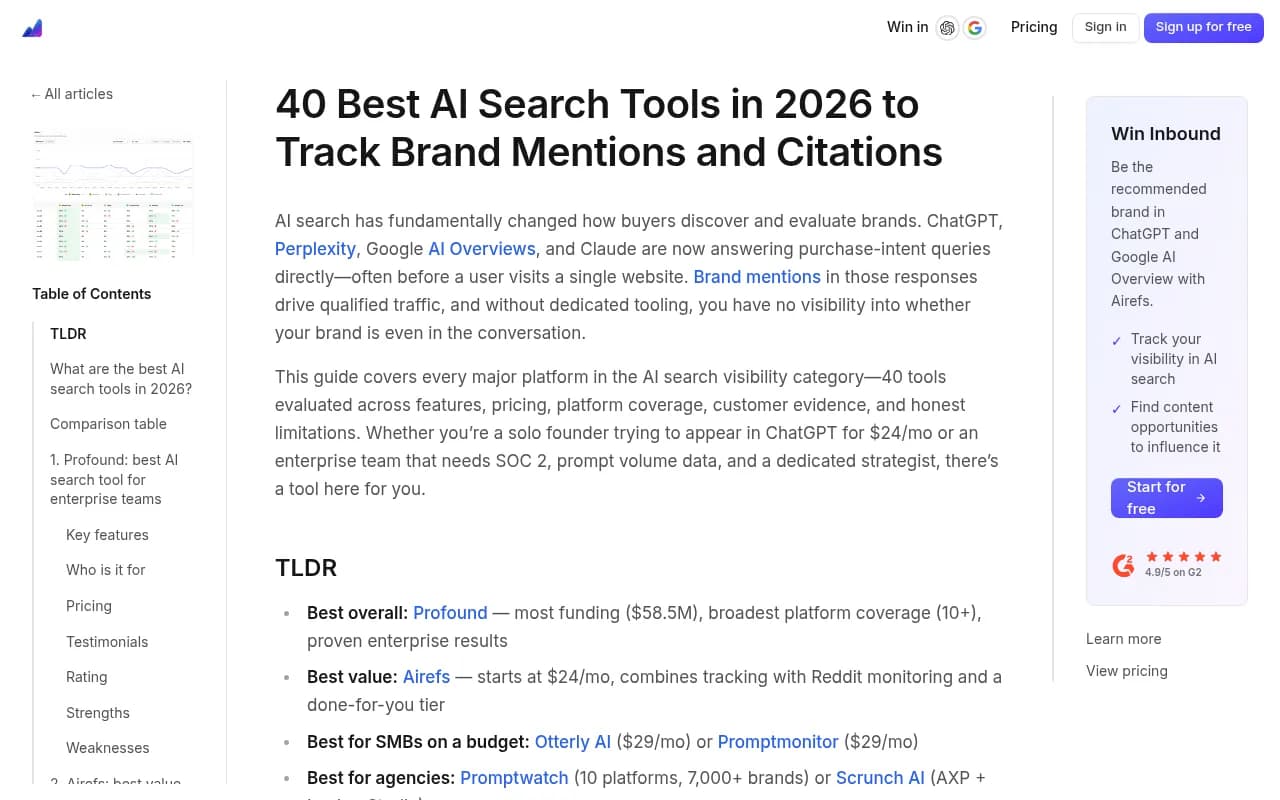
The AI visibility tool market is consolidating around a few clear segments. Research from Airefs' 2026 roundup of 40 AI search tools confirms the pattern: enterprise brands are gravitating toward either deep perception platforms (Evertune, Brandlight) or full-stack optimization platforms (Promptwatch, Profound) depending on whether their primary need is measurement or improvement.
The monitoring-only tools are increasingly getting squeezed. As one practitioner put it in a Reddit thread on r/b2bmarketing: "Most of these tools are monitoring-first. They show mentions and charts, but don't always tell you what to actually fix." That's the core tension in this market, and it's why the platforms with a clear action layer are pulling ahead.
The bottom line
If you're an enterprise brand evaluating these four platforms, here's the honest summary:
Evertune is the right choice if you need perception analysis at Fortune 500 scale and have the budget for it. The depth is real, and the team behind it knows enterprise brand measurement.
Promptwatch is the right choice if you want to actually improve your AI visibility, not just measure it. The combination of gap analysis, content generation, crawler logs, and traffic attribution is the most complete action loop in this market. It's also the most accessible of the four for teams that aren't operating with a dedicated GEO budget in the tens of thousands per month.
Relixir is the right choice if your bottleneck is content production capacity and you're comfortable with more autonomous publishing. The AI-native CMS approach is genuinely different and worth evaluating for content-heavy brands.
Goodie AI is the right choice if you're just starting out and want to understand the basics before committing to a more expensive platform.
For most enterprise marketing and SEO teams in 2026, Promptwatch hits the right balance. It's the platform most likely to show up in your reporting as having actually moved the needle -- because it's built to move the needle, not just report on it.