Key takeaways
- Most AI visibility platforms focus on ChatGPT and Perplexity. DeepSeek and Grok coverage is still rare, and the gap matters more than most teams realize.
- Promptwatch is the only platform in this comparison that tracks all 10 major AI models (including DeepSeek and Grok), generates content to fix visibility gaps, and logs AI crawler activity on your site.
- Profound is powerful but expensive ($499/month) and monitoring-only -- it won't help you create content to close the gaps it finds.
- Peec AI and Otterly.AI are solid entry points for monitoring, but neither tracks DeepSeek or Grok, and neither offers content generation or crawler logs.
- If you're serious about AI search visibility in 2026, the question isn't just "where do I appear?" -- it's "what do I do about it?"
DeepSeek launched in late 2024 and within weeks was handling hundreds of millions of queries. Grok, X's AI model, has become a real research tool for a specific and influential slice of the internet. These aren't niche platforms anymore. They're places where buyers ask questions, get recommendations, and form opinions about brands -- often without ever clicking through to a website.
The problem is that most AI visibility platforms were built before either of these models existed. They track ChatGPT, Perplexity, maybe Google AI Overviews. DeepSeek and Grok are afterthoughts, if they're covered at all.
This guide compares four of the most-discussed platforms -- Promptwatch, Profound, Peec AI, and Otterly.AI -- specifically through the lens of DeepSeek and Grok citation tracking, and more broadly across the features that actually matter for teams trying to improve their AI search visibility in 2026.
Why DeepSeek and Grok coverage matters now
It's easy to dismiss newer AI models as secondary. ChatGPT has the biggest user base, so track ChatGPT first, right?
That logic made sense in 2024. It's less defensible now.
DeepSeek's R1 model went viral partly because it matched GPT-4-class performance at a fraction of the cost. It's now embedded in dozens of third-party apps and used heavily in Asia-Pacific markets. If you're a B2B brand with any international exposure, your buyers may be getting AI-generated answers about your category from DeepSeek -- and you have no idea what those answers say.
Grok is different. It's not the biggest model, but it's deeply integrated into X (formerly Twitter), which means it surfaces in conversations where professionals, journalists, and tech-forward buyers are already spending time. Grok also has real-time web access and tends to pull from recent content, which means it can amplify or ignore your brand based on what's been published in the last few weeks.
Neither of these is a niche edge case. They're live channels where brand perception is being formed, and most visibility tools are blind to them.
The four platforms compared
Promptwatch
Promptwatch is the most comprehensive platform in this comparison. It tracks 10 AI models: ChatGPT, Perplexity, Google AI Overviews, Google AI Mode, Claude, Gemini, Meta/Llama, DeepSeek, Grok, Mistral, and Copilot. DeepSeek and Grok are first-class citizens here, not bolted-on additions.
What separates Promptwatch from every other tool in this list is that it doesn't stop at monitoring. The core workflow is built around a loop: find gaps, create content, track results. The Answer Gap Analysis shows you exactly which prompts competitors are visible for that you're not. The Content Agents then generate articles, comparisons, and briefs grounded in that gap data. And page-level tracking shows you when AI models start citing the new content you publish.
For DeepSeek and Grok specifically, Promptwatch tracks citations at the page level, shows you which of your pages each model is referencing, and logs AI crawler activity through integrations with Cloudflare, Fastly, Vercel, or a tracking snippet. That last part is genuinely rare -- most platforms have no visibility into whether AI crawlers are even visiting your site, let alone which pages they're reading.
Pricing starts at $99/month (Essential: 1 site, 50 prompts, 5 articles), $249/month for Professional (2 sites, 150 prompts, 15 articles, crawler logs), and $579/month for Business (5 sites, 350 prompts, 30 articles). A free trial is available.

Profound
Profound is the enterprise choice. At $499/month, it's positioned as a serious analytics platform for brands that need deep data and are willing to pay for it. The analytics are genuinely good -- Profound has strong prompt tracking, competitor benchmarking, and share-of-voice reporting.
The catch is that Profound is monitoring-only. It shows you where you're invisible, but the content creation, schema work, and authority-building are entirely on your team. For companies with dedicated SEO or content resources, that's fine. For everyone else, it means paying $499/month for a dashboard that tells you what's broken without helping you fix it.
On DeepSeek and Grok coverage: Profound's model coverage has historically centered on ChatGPT, Perplexity, and Google. Their coverage of newer models like DeepSeek and Grok is limited compared to Promptwatch. If tracking these specific models is a priority, that's a meaningful gap.

Peec AI
Peec AI is a mid-market option that starts around €89/month. It's clean, fast, and reasonably easy to use. The platform covers the main AI models well and gives you solid share-of-voice data and competitor comparisons.
The limitations are real, though. Peec AI doesn't cover DeepSeek or Grok as of mid-2026. It also lacks content generation capabilities and AI crawler logs. It's a monitoring tool -- useful for understanding where you stand, less useful for doing something about it.
For teams that just need a clean dashboard to report AI visibility metrics to stakeholders, Peec AI is a reasonable choice. For teams that need to actually move the needle, it's a starting point, not a destination.

Otterly.AI
Otterly.AI is the budget entry point in this comparison, starting at $29/month. It covers the basics: ChatGPT, Perplexity, and a handful of other models. The interface is simple and the onboarding is fast.
What you don't get: DeepSeek tracking, Grok tracking, content generation, crawler logs, visitor analytics, or prompt volume data. Otterly is genuinely useful for small teams or individuals who want a quick pulse check on their AI visibility without a major investment. It's not the right tool if you're trying to build a systematic AI search strategy.

Feature comparison table
| Feature | Promptwatch | Profound | Peec AI | Otterly.AI |
|---|---|---|---|---|
| DeepSeek tracking | Yes | Limited | No | No |
| Grok tracking | Yes | Limited | No | No |
| Total AI models tracked | 10+ | ~6-8 | ~5-6 | ~4-5 |
| Content generation | Yes (Content Agents) | No | No | No |
| Answer gap analysis | Yes | Partial | No | No |
| AI crawler logs | Yes | No | No | No |
| Page-level citation tracking | Yes | No | No | No |
| Prompt volume & difficulty | Yes | No | No | No |
| Reddit & YouTube insights | Yes | No | No | No |
| ChatGPT Shopping tracking | Yes | No | No | No |
| Traffic attribution | Yes | No | No | No |
| Multi-language / multi-region | Yes | Yes | Yes | Limited |
| Starting price | $99/mo | $499/mo | ~€89/mo | $29/mo |
| Free trial | Yes | Yes | Yes | Yes |
How each platform handles the "now what?" problem
This is the real differentiator in 2026. Every platform in this comparison will tell you that you're not appearing in AI responses for certain prompts. The question is what happens next.
With Profound, Peec AI, and Otterly.AI, the answer is: that's your problem. The data is there, the action is not. You take the gap analysis back to your content team, brief a writer, wait for the article to be published, and then manually check whether it moved the needle weeks later.
Promptwatch closes that loop inside the platform. The Content Agents generate content briefs and full articles grounded in the actual prompt data -- not generic SEO content, but pieces specifically engineered to answer the questions AI models are already exposing as gaps. The agent analytics then tracks the timeline from publish to crawl to citation, so you can see whether the content is working.
For teams tracking DeepSeek and Grok specifically, this matters because these models have different content preferences and citation patterns than ChatGPT. Promptwatch's data covers how each model behaves differently, which informs what content to create and where to publish it.
Who should use which platform
The right choice depends on what you actually need to do.
If you're a marketing or SEO team at a mid-size to large brand and you need to both track and improve AI visibility -- including on DeepSeek and Grok -- Promptwatch is the clear choice. The combination of broad model coverage, content generation, and crawler logs is unique in the market.
If you're at an enterprise with a large internal team that can execute on insights independently, Profound's analytics depth might justify the $499/month price. But be honest about whether your team will actually act on the data.
If you're a smaller brand or agency that needs a clean, affordable monitoring tool and DeepSeek/Grok coverage isn't a priority yet, Peec AI or Otterly.AI are reasonable starting points. Otterly at $29/month is particularly low-risk for a first look at AI visibility.
One thing worth noting: the platforms that only monitor will become harder to justify as AI search matures. Knowing you're invisible is useful. Fixing it is the point.
What to look for beyond the four platforms
The market for AI visibility tools has exploded. There are now dozens of platforms, many of which focus on specific niches or offer different trade-offs.
A few worth knowing about:
Scrunch AI has solid monitoring capabilities and is worth evaluating for mid-market teams.
AthenaHQ covers 8+ AI engines and has strong monitoring, though it lacks content generation.

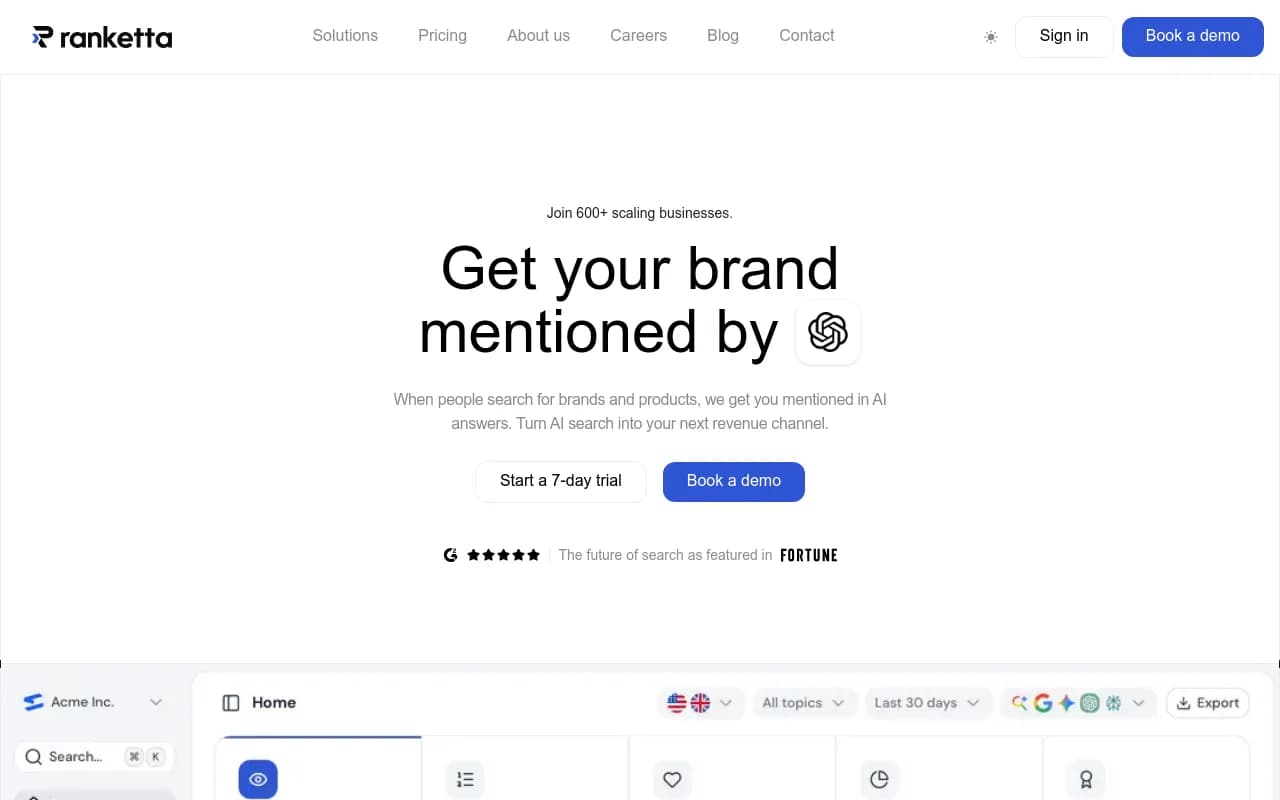
Ranketta is a newer entrant with a clean interface focused on AI search visibility growth.
None of these currently match Promptwatch's combination of DeepSeek/Grok coverage, content generation, and crawler logs -- but the space is moving fast, and it's worth checking current feature sets before committing.
The DeepSeek and Grok tracking gap in practice
Here's a concrete scenario. You're a B2B SaaS company. A potential customer in Singapore asks DeepSeek: "What are the best project management tools for remote engineering teams?" DeepSeek pulls from its training data and recent web crawls to generate an answer. Your competitor appears. You don't.
Without a tool that tracks DeepSeek, you have no idea this is happening. You can't see the prompt, the response, or the citation pattern. You can't identify what content your competitor published that got them cited. You can't create content to close the gap.
That's the practical cost of incomplete model coverage. It's not a hypothetical -- it's happening right now, across thousands of prompts, in markets where DeepSeek and Grok have meaningful usage.
The same logic applies to Grok. If your brand operates in a space where X users are influential -- tech, finance, media, crypto, startups -- Grok citations can shape perception among exactly the people you most want to reach.
Tracking these models isn't optional anymore. It's table stakes for any serious AI search strategy in 2026.
Final take
The AI visibility platform market has split into two camps: tools that monitor and tools that act. Profound, Peec AI, and Otterly.AI are all monitoring tools. They're useful, some more than others, but they leave the hard work to you.
Promptwatch is built around the full loop -- find the gap, create the content, track the result. And it's the only platform in this comparison that covers DeepSeek and Grok as first-class tracking targets, with the crawler logs and page-level citation data to understand exactly what's happening on each model.
If DeepSeek and Grok are on your radar (and they should be), that coverage gap alone makes the comparison fairly straightforward.