Key takeaways
- Most AI search tools in 2026 are monitoring dashboards -- they show you where you're invisible but don't help you fix it. The tools that stand out are the ones that close the loop between data and action.
- Promptwatch is the only platform in this comparison rated as a leader across all categories, combining gap analysis, AI content generation, crawler logs, and traffic attribution in one place.
- Gauge is strong for competitive benchmarking and share-of-voice tracking, but stops at the monitoring layer.
- BrandRank.AI focuses on brand sentiment and narrative tracking across LLMs -- useful for brand teams, less so for SEO-driven content strategies.
- Profound has enterprise-grade analytics but comes with enterprise-grade pricing and limited workflow support.
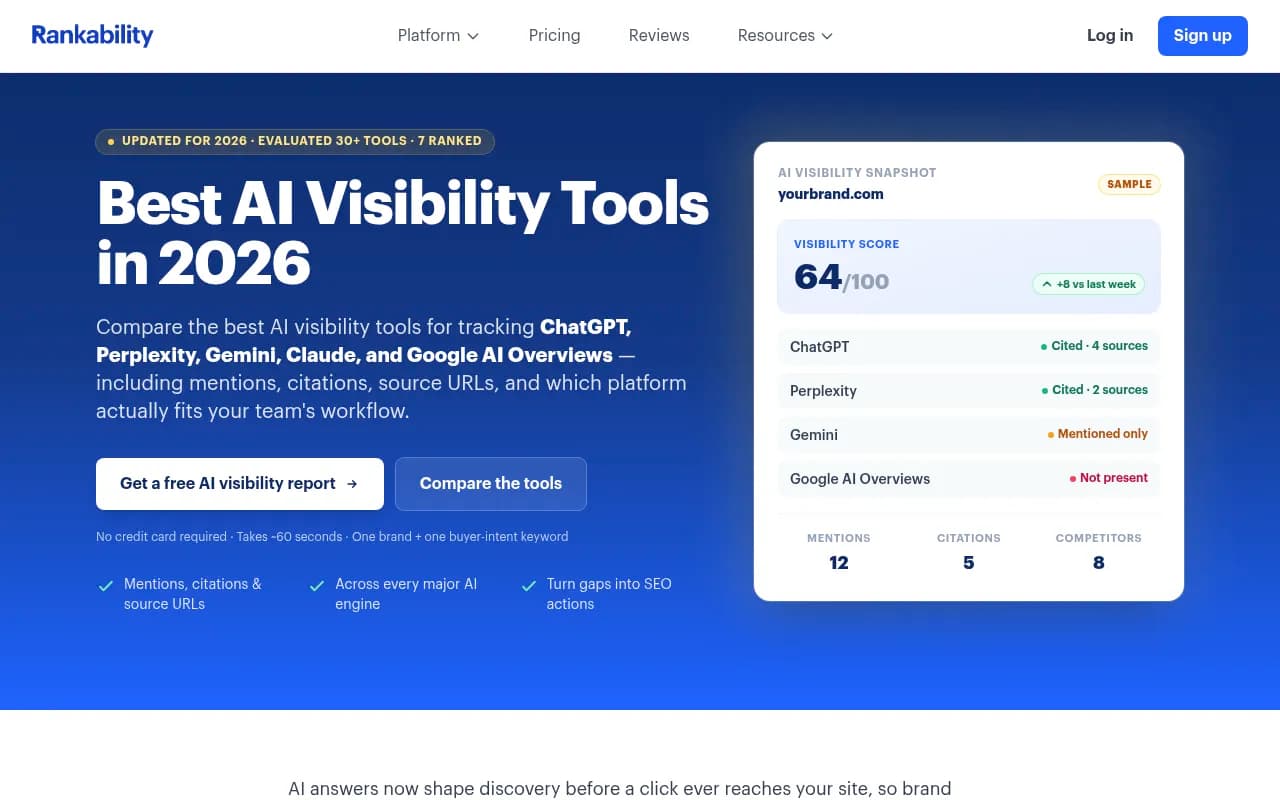
- Rankability is a solid choice for agencies that want AI visibility alongside classic SEO reporting in a single white-label dashboard.
Why competitive intelligence in AI search is different
Traditional competitive intelligence -- tracking keyword rankings, backlinks, share of voice in Google -- is a well-solved problem. There are dozens of mature tools for it.
AI search is not that. When someone asks ChatGPT "what's the best project management tool for remote teams?" or asks Perplexity "which CRM do most startups use?", the answer they get is shaped by what AI models have read, what sources they trust, and what content has been structured in a way they can actually use. Your Google ranking is largely irrelevant to that process.
This creates a genuinely new competitive intelligence problem. You need to know: which prompts are driving recommendations in your category? Which competitors are being cited, and why? What content gaps on your site are causing AI models to skip you entirely?
The tools in this comparison all try to answer some version of those questions. But they do it in very different ways, with very different levels of depth -- and very different ideas about what "actionable" means.
Let me walk through each one honestly.
The tools compared
Promptwatch
Promptwatch is the most complete platform in this space right now. It monitors 10 AI models -- ChatGPT, Perplexity, Claude, Gemini, Google AI Overviews, Google AI Mode, Grok, DeepSeek, Copilot, and Mistral -- and it does more than just tell you your visibility score.
The core differentiator is what Promptwatch calls the action loop. First, Answer Gap Analysis shows you the specific prompts where competitors are being cited but you're not. Not vague categories -- the actual questions, with the actual competitors showing up in the answers. Second, a built-in AI writing agent generates content designed to get cited: articles, listicles, comparisons, all grounded in 880M+ citations analyzed. Third, page-level tracking shows which of your pages are being cited, by which models, and how often -- so you can see whether the content you published is actually working.
On top of that: real-time AI crawler logs (so you can see when ChatGPT or Perplexity crawls your site and what they find), prompt volume and difficulty scoring, query fan-outs, Reddit and YouTube citation tracking, ChatGPT Shopping monitoring, and traffic attribution via GSC integration or server log analysis.
Used by 6,700+ brands and agencies including Booking.com and Center Parcs. Pricing starts at $99/month for the Essential plan (1 site, 50 prompts, 5 articles), $249/month for Professional (2 sites, 150 prompts, crawler logs, city-level tracking), and $579/month for Business (5 sites, 350 prompts, 30 articles). Free trial available.

Gauge
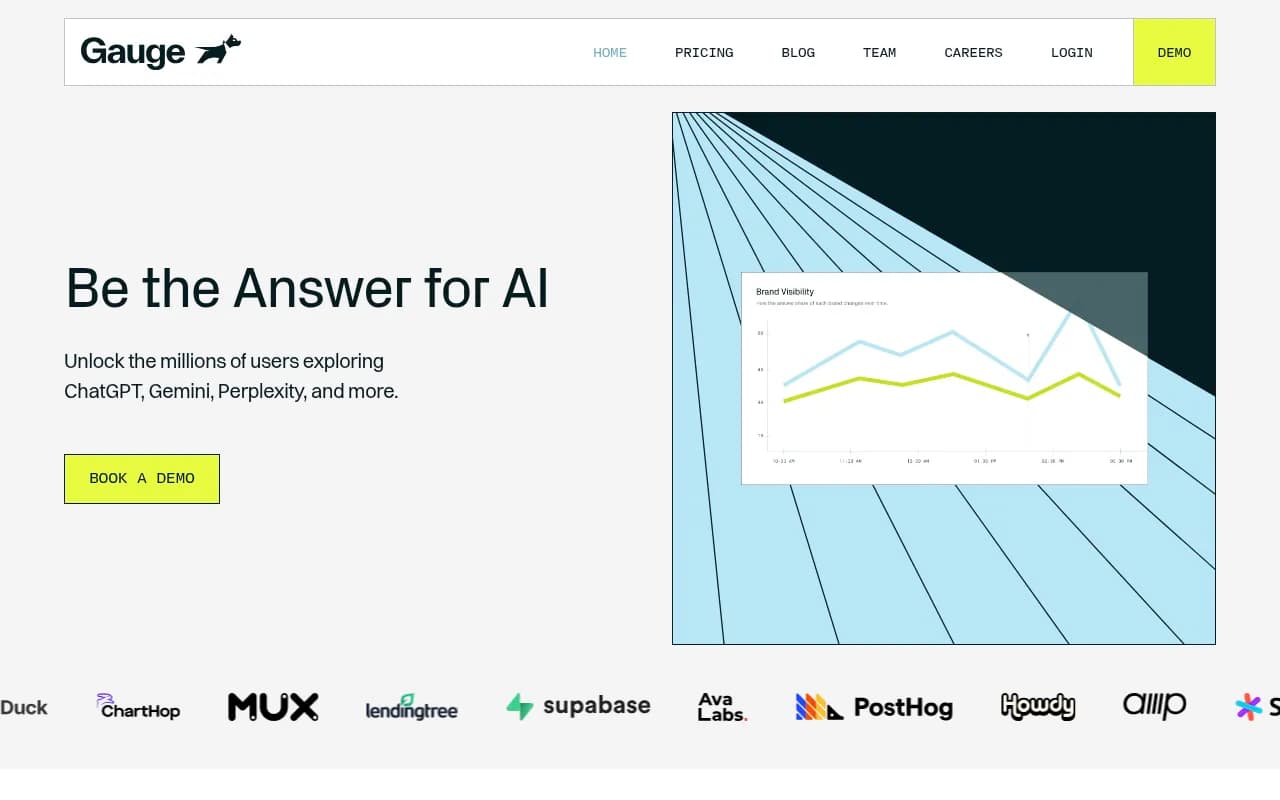
Gauge positions itself as a competitive intelligence tool specifically for AI search. The core feature is share-of-voice tracking -- you set up your brand and a list of competitors, define the prompts that matter to your category, and Gauge shows you how often each brand appears across AI models over time.
The competitive benchmarking view is genuinely useful. You can see at a glance whether you're gaining or losing ground relative to specific competitors on specific prompts, and the trend data is presented clearly. It's the kind of dashboard a CMO can look at without needing a 30-minute briefing.
Where Gauge runs into limits is on the action side. It's primarily a monitoring and benchmarking tool. It tells you the score, but it doesn't help you change it. There's no content gap analysis, no writing tools, no crawler logs. If you want to know why a competitor is outranking you in AI responses -- what content they have that you don't -- you'll need to investigate that yourself.
That said, for teams that already have a content operation and just need clean competitive data to inform their strategy, Gauge does that job well.
BrandRank.AI
BrandRank.AI takes a slightly different angle. Rather than focusing purely on citation frequency, it tracks how AI models talk about your brand -- the sentiment, the framing, the specific attributes they associate with you versus competitors. Think of it less as an SEO tool and more as a brand intelligence tool.
This is useful in specific situations. If you're a brand team trying to understand whether ChatGPT describes your product as "affordable" or "premium," or whether it associates your company with a particular use case you're trying to move away from, BrandRank.AI gives you that kind of narrative-level visibility. It's also good for tracking how AI-generated brand descriptions shift over time as you publish new content or earn new press coverage.
The limitation is that it's not built for the SEO or content marketing workflow. There's no prompt volume data, no gap analysis against competitors' cited content, no writing tools. It answers "how does AI perceive my brand?" rather than "what do I need to publish to get cited more often?"
For brand managers and PR teams, it's a solid fit. For SEO teams trying to drive AI visibility through content, it's missing too much.
Profound
Profound is the enterprise option in this space. It has strong analytics, a clean interface, and the kind of data depth that large organizations tend to need -- multi-brand tracking, detailed source analysis, historical trend data, and robust reporting.
The platform monitors major AI engines and gives you visibility into which sources are being cited in AI responses for your target queries. The competitive analysis features are solid: you can compare your citation rate against competitors across different prompt categories and see where gaps exist.
The main friction points are price and workflow. Profound starts at $499/month and scales up significantly for enterprise tiers. And while the data is good, the platform is more analytical than operational -- it surfaces insights but doesn't have built-in tools to help you act on them. No content generation, limited workflow integrations, and no crawler logs as of 2026.
For a large enterprise with a dedicated SEO team that can translate data into action independently, Profound makes sense. For smaller teams or agencies looking for a tool that does more of the work, it's probably overkill on price and underpowered on execution.

Rankability
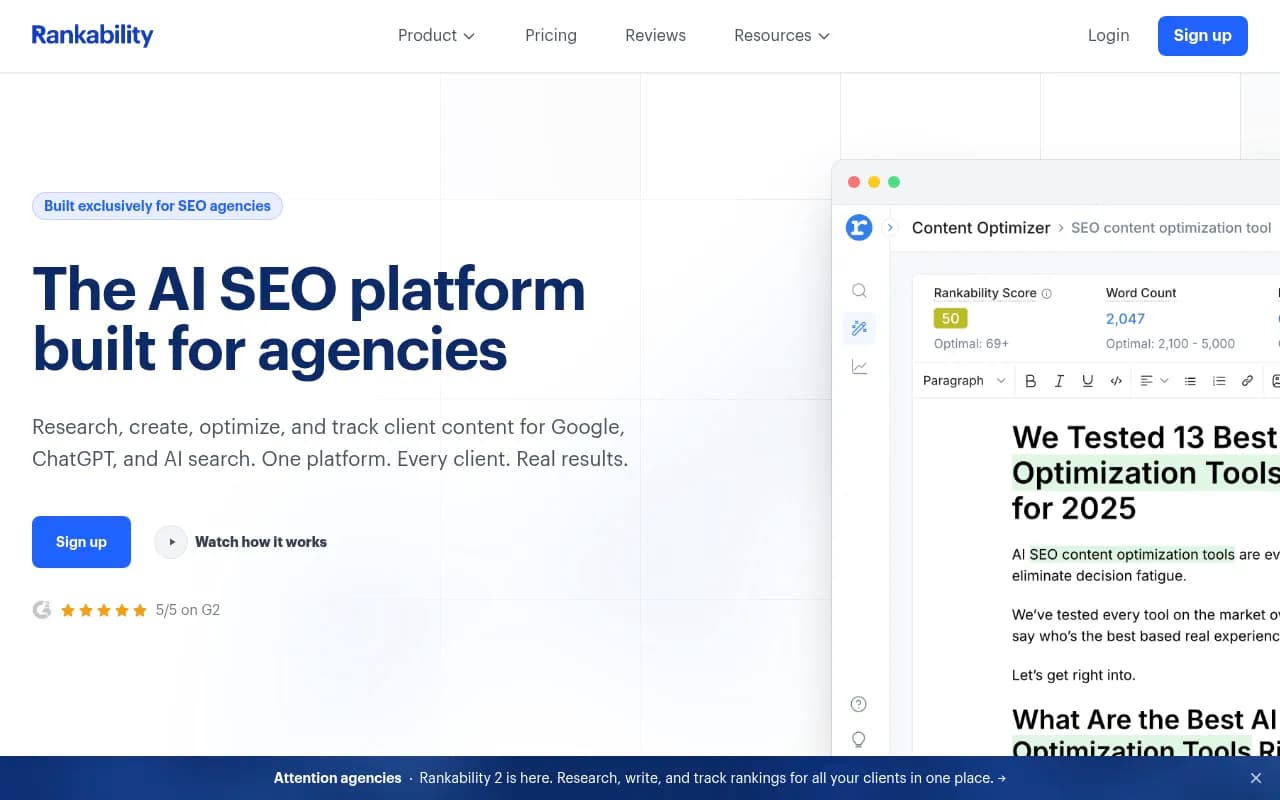
Rankability is built with agencies in mind. The core pitch is that it combines AI search visibility tracking with traditional SEO metrics -- keyword rankings, citations, source URLs -- in a single platform with white-label reporting and multi-client management.
The AI visibility features cover ChatGPT, Perplexity, Gemini, Claude, and Google AI Overviews. You can track mentions, citations, and the specific source URLs being cited in AI responses, which is useful for understanding what content is actually influencing AI recommendations in your clients' categories.
The white-label reporting is genuinely well-executed. Agencies can generate client-ready dashboards that show both traditional rankings and AI visibility in a unified view, which solves a real problem: most clients don't want two separate reports.
Where Rankability is thinner is on the competitive intelligence side specifically. The prompt intelligence features are less developed than Promptwatch's -- no volume estimates, no difficulty scoring, no query fan-outs. And like most tools in this space, it doesn't have built-in content generation or crawler log access.
Starting price is $79/month for the Solo plan, which makes it one of the more accessible options for smaller agencies.
Side-by-side comparison
| Feature | Promptwatch | Gauge | BrandRank.AI | Profound | Rankability |
|---|---|---|---|---|---|
| AI models tracked | 10 | Multiple | Multiple | Multiple | 5+ |
| Competitor benchmarking | Yes | Yes (core feature) | Yes | Yes | Yes |
| Answer gap analysis | Yes | No | No | Partial | No |
| Prompt volume & difficulty | Yes | No | No | No | No |
| AI content generation | Yes | No | No | No | No |
| Crawler logs | Yes | No | No | No | No |
| Reddit/YouTube tracking | Yes | No | No | No | No |
| ChatGPT Shopping tracking | Yes | No | No | No | No |
| Traffic attribution | Yes | No | No | No | No |
| Brand sentiment/narrative | Partial | No | Yes (core feature) | Partial | No |
| White-label reporting | Yes | No | No | Yes | Yes (core feature) |
| Traditional SEO integration | No | No | No | No | Yes |
| Starting price | $99/mo | Custom | Custom | $499/mo | $79/mo |
| Best for | Full-cycle AI visibility & optimization | Competitive benchmarking | Brand/PR teams | Large enterprises | Agencies |
How to choose
The right tool depends on what you're actually trying to do with the data.
If your goal is to improve your AI search visibility -- to get cited more often, by more models, for more prompts -- you need a tool that goes beyond monitoring. Monitoring tells you the score. Optimization changes it. Promptwatch is the only tool in this comparison that covers the full cycle: find the gaps, create content that addresses them, track whether it worked.
If you're running a competitive benchmarking program and you just need clean, reliable data on how your brand stacks up against competitors across AI models, Gauge does that job well. It's simpler and more focused than Promptwatch, which can be a feature if you don't need the full platform.
If you're on a brand or PR team and your primary concern is how AI models describe and frame your brand -- not just whether you're cited, but what they say -- BrandRank.AI is worth a look. It's the only tool here that really focuses on narrative-level brand intelligence.
If you're at a large enterprise with budget to match and a team that can act on data independently, Profound's analytics depth is hard to argue with. Just go in knowing it won't help you execute.
If you're an agency that needs to show clients both their traditional rankings and their AI visibility in a single white-label report, Rankability is probably the most practical choice at its price point.
What most tools are still missing
One thing worth saying plainly: the majority of AI search tools in 2026, including several in this comparison, are still primarily dashboards. They show you data. They don't help you change the underlying reality the data reflects.
The gap analysis problem is a good example. Knowing that a competitor appears in 40% of AI responses for "best CRM for startups" while you appear in 8% is useful information. But the next question -- what content do they have that you don't? what topics is your site missing? what should you actually write? -- is where most tools leave you on your own.
The tools that will matter most over the next 12-18 months are the ones that close this loop. That's why the distinction between "monitoring" and "optimization" is worth paying attention to when you evaluate any platform in this space.
A few other tools worth knowing about
The five tools above aren't the only options. Depending on your specific needs, a few others are worth a look:
For monitoring on a budget: Otterly.AI and Peec AI both offer solid basic tracking at lower price points. They're monitoring-only, but if that's all you need, they're clean and affordable.


For enterprise SEO teams: AthenaHQ and Scrunch AI both have strong enterprise positioning, though both are more monitoring-focused than optimization-focused.

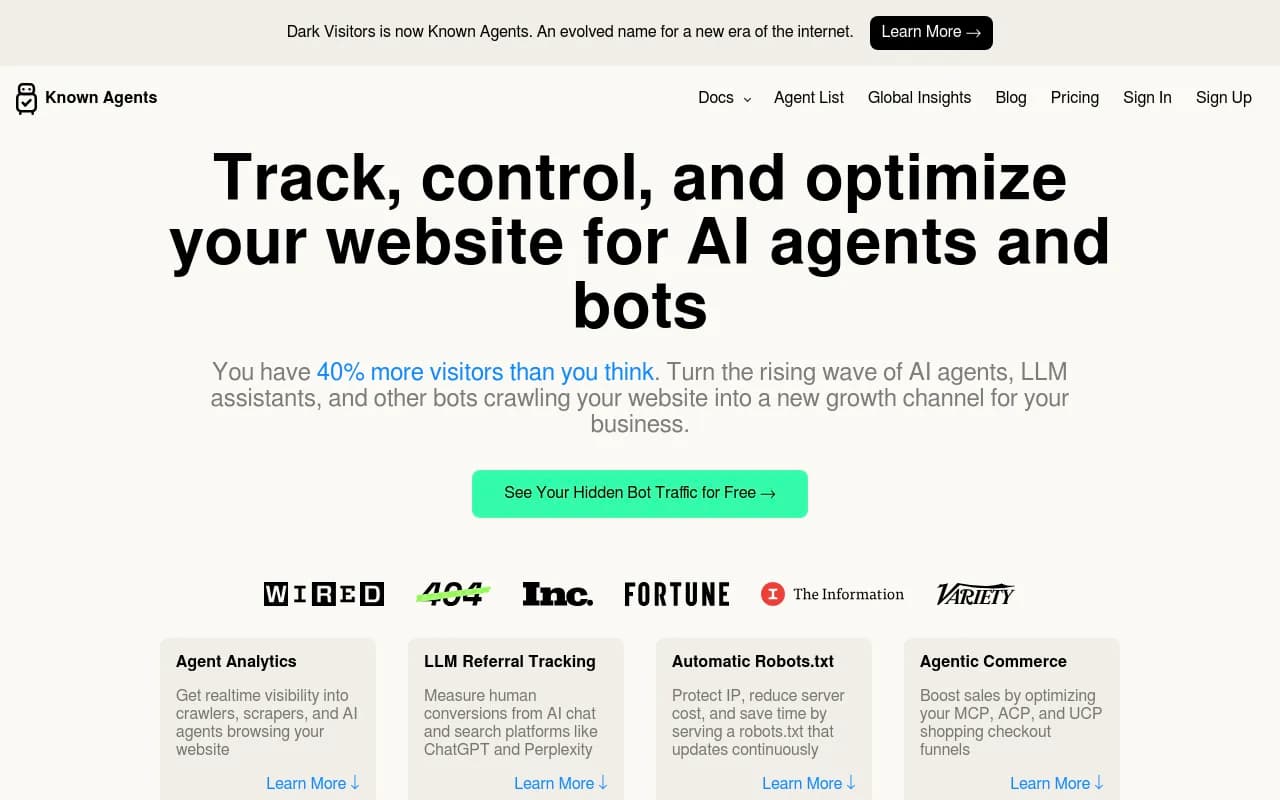
For technical SEO teams that want crawler data: DarkVisitors is worth knowing about -- it specifically tracks AI crawlers visiting your site, which is useful context even if it's not a full visibility platform.
Final thought
The AI search competitive intelligence space is moving fast, and the tools are genuinely improving. A year ago, most platforms were barely past "we run your brand name through ChatGPT and show you the result." Now the better ones are tracking prompt volumes, analyzing citation patterns across hundreds of millions of responses, and starting to connect visibility data to actual traffic and revenue.
The question to ask any tool you evaluate: does it help you do something, or does it just show you something? In a space where most platforms are still dashboards, that distinction matters more than any feature list.