Key takeaways
- Healthcare content is YMYL (Your Money or Your Life), which means AI models apply stricter source evaluation -- brands without strong E-E-A-T signals get skipped entirely
- 79% of U.S. adults search for health information online, and ChatGPT now handles health and wellness queries from 230 million people per week
- When a Google AI Overview appears, clickthrough rates drop from 1.6% to 0.6% -- patients may never reach your site at all
- The tools that matter most for healthcare AI visibility go beyond rank tracking: you need prompt-level monitoring, content gap analysis, and crawler diagnostics
- Most monitoring-only tools leave healthcare brands stuck; the platforms worth using are the ones that help you act on the data
Why healthcare brands have a harder AI search problem than everyone else
Ask ChatGPT about a SaaS pricing model and it'll give you a reasonable answer with moderate confidence. Ask it about metformin dosing for a patient with kidney disease, and the model applies a completely different level of scrutiny to its sources.
That's YMYL in action. "Your Money or Your Life" is Google's framework for content that could directly affect someone's health, safety, or financial wellbeing -- and AI models have essentially internalized the same logic. When a patient asks Perplexity about symptoms of a pulmonary embolism, the platform isn't going to cite a random blog post. It's going to pull from sources that demonstrate medical expertise, clinical authority, and trustworthiness.
For healthcare brands, this creates a two-sided challenge. You need to be credible enough to get cited, and you need to be visible enough to be found. Most brands are failing at both.
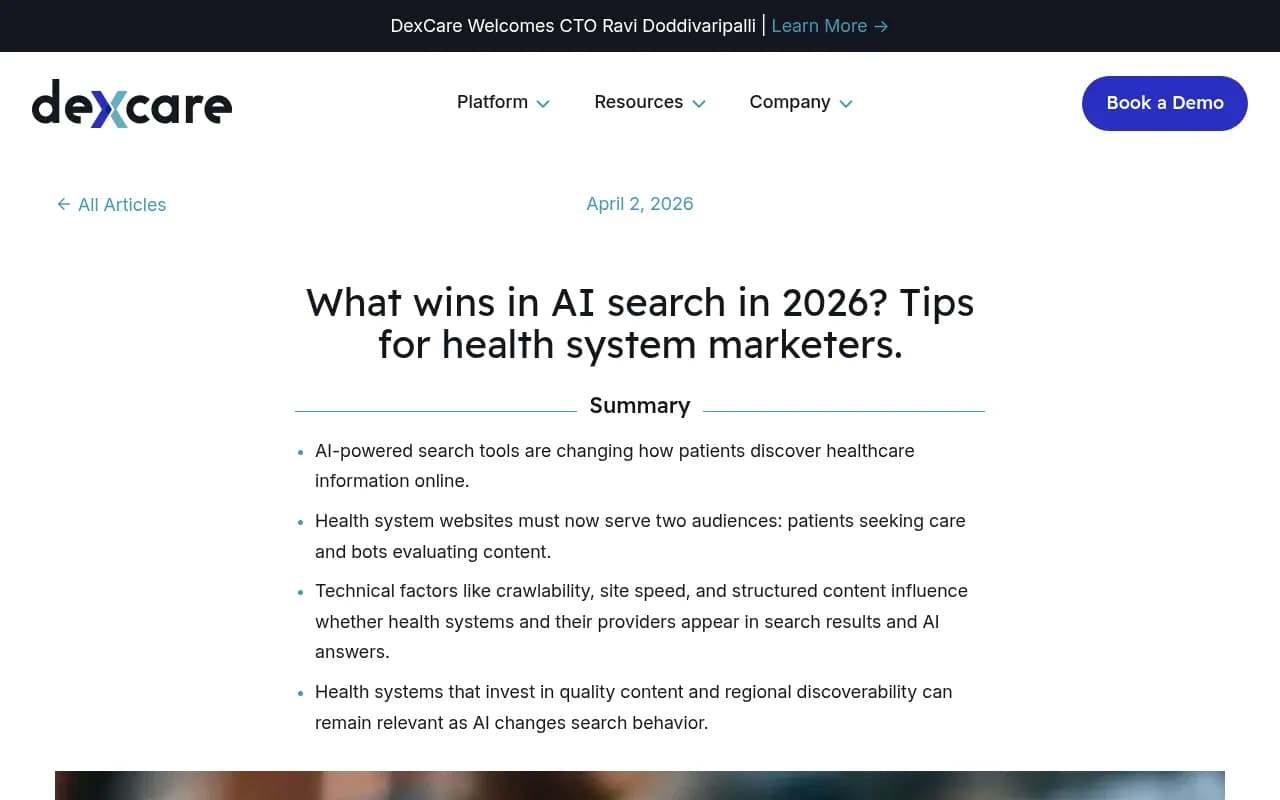
The data from DexCare's 2026 analysis is stark: when an AI Overview appears in Google search results, clickthrough rates drop from 1.6% to just 0.6%. That's a 63% reduction in traffic to your site -- from patients who are actively looking for care. And that's before you account for the patients who bypass Google entirely and go straight to ChatGPT or Claude.
Health systems that aren't optimized for AI search aren't just losing rankings. They're losing patient acquisition.
What YMYL actually means for AI visibility in 2026
YMYL used to be primarily a Google quality rater concept. In 2026, it's baked into how every major AI model evaluates sources.
The shift happened gradually, then all at once. Google's December 2025 core update hit healthcare sites particularly hard, rewarding content with clear author credentials, clinical review processes, and verifiable expertise. Meanwhile, platforms like ChatGPT and Perplexity developed their own citation hierarchies that favor peer-reviewed sources, established health systems, and content that demonstrates genuine clinical knowledge.
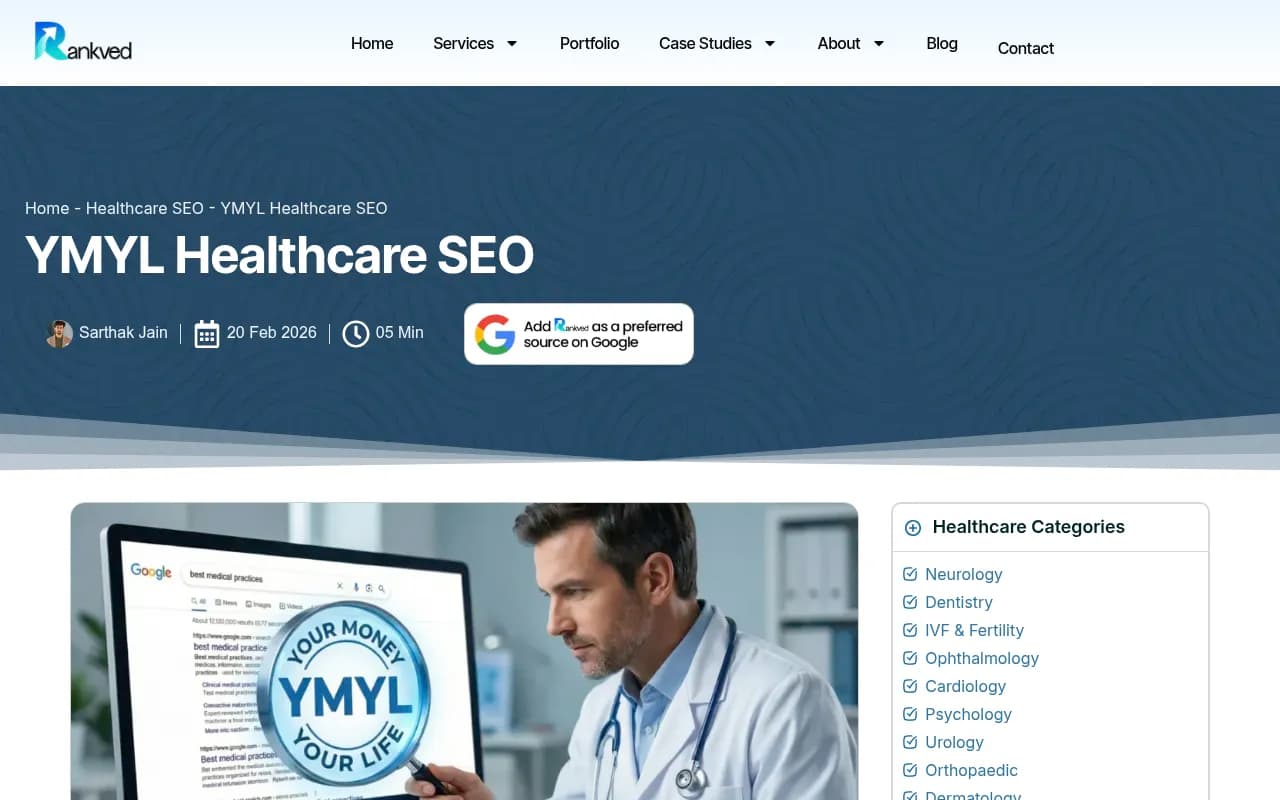
What this means practically:
- A hospital's condition page written by a board-certified physician, with clear credentials displayed, will get cited far more often than a generic "what is diabetes" article from a health content mill
- AI models are increasingly distinguishing between content that explains a condition and content that helps a patient make a decision -- the latter gets more scrutiny and needs stronger authority signals
- E-E-A-T (Experience, Expertise, Authoritativeness, Trustworthiness) isn't just a Google concept anymore; it's the implicit scoring rubric that LLMs use when deciding what to surface
The practical implication: healthcare brands need to know which prompts they're being cited for, which ones they're losing to competitors, and what content gaps are causing AI models to look elsewhere.
The types of tools healthcare brands actually need
Before getting into specific platforms, it's worth being clear about what the job actually requires. Healthcare AI visibility isn't a single problem -- it's three connected problems:
- Monitoring: Which prompts is your brand appearing in? Which AI models are citing you? What are competitors being cited for that you're not?
- Diagnosis: Why are you missing from certain prompts? Is it a content gap, a credibility gap, or a technical crawlability issue?
- Action: What content do you create, and how do you structure it, to get cited for the prompts that matter?
Most tools on the market only solve problem one. They show you a dashboard of brand mentions and call it a day. For a healthcare brand trying to compete in AI search, that's like getting a lab report with no interpretation and no treatment plan.
The platforms worth evaluating are the ones that address all three.
The best AI search visibility platforms for healthcare brands
Full-stack platforms with content optimization
These are the tools that go beyond monitoring to help you actually improve your AI visibility.
Promptwatch is the platform that most directly addresses the full loop: find gaps, create content, track results. For healthcare brands, the Answer Gap Analysis is particularly useful -- it shows you the specific prompts where competitors are being cited but you're not. That's not just a visibility metric; it's a content brief. You can see exactly what questions patients are asking AI models that your site isn't answering, then use the built-in AI writing agent to create content engineered to fill those gaps.
The crawler logs feature is also relevant for healthcare specifically. AI crawlers like ChatGPT and Perplexity visit your site to index content, and knowing which pages they're reading (and which they're skipping) tells you a lot about where your authority signals are landing. Most competitors don't offer this at all.

For enterprise health systems with complex multi-site setups, BrightEdge AI Catalyst has deep integration with existing SEO workflows and enterprise-grade reporting.
Profound is another option worth considering for brands that want strong monitoring with competitive benchmarking, though it doesn't include content generation capabilities.

Monitoring-focused platforms
If your primary need is tracking brand mentions across AI models -- useful for reputation management and compliance teams -- there are several solid options.
AthenaHQ covers 8+ AI search engines and gives you a clear view of where your brand appears and where it doesn't.

Otterly.AI is a more affordable entry point for smaller healthcare practices or clinics that want basic AI visibility tracking without a large budget commitment.

Peec AI is worth noting for healthcare brands with international presence -- it handles multi-language monitoring well, which matters for health systems serving diverse patient populations.

Technical SEO and crawlability tools
Healthcare sites tend to be large, complex, and often built on legacy CMS platforms. Getting AI crawlers to actually index your content correctly is a real technical challenge.
Screaming Frog remains the standard for technical crawl audits -- understanding how your site is structured before worrying about AI visibility is the right sequence.
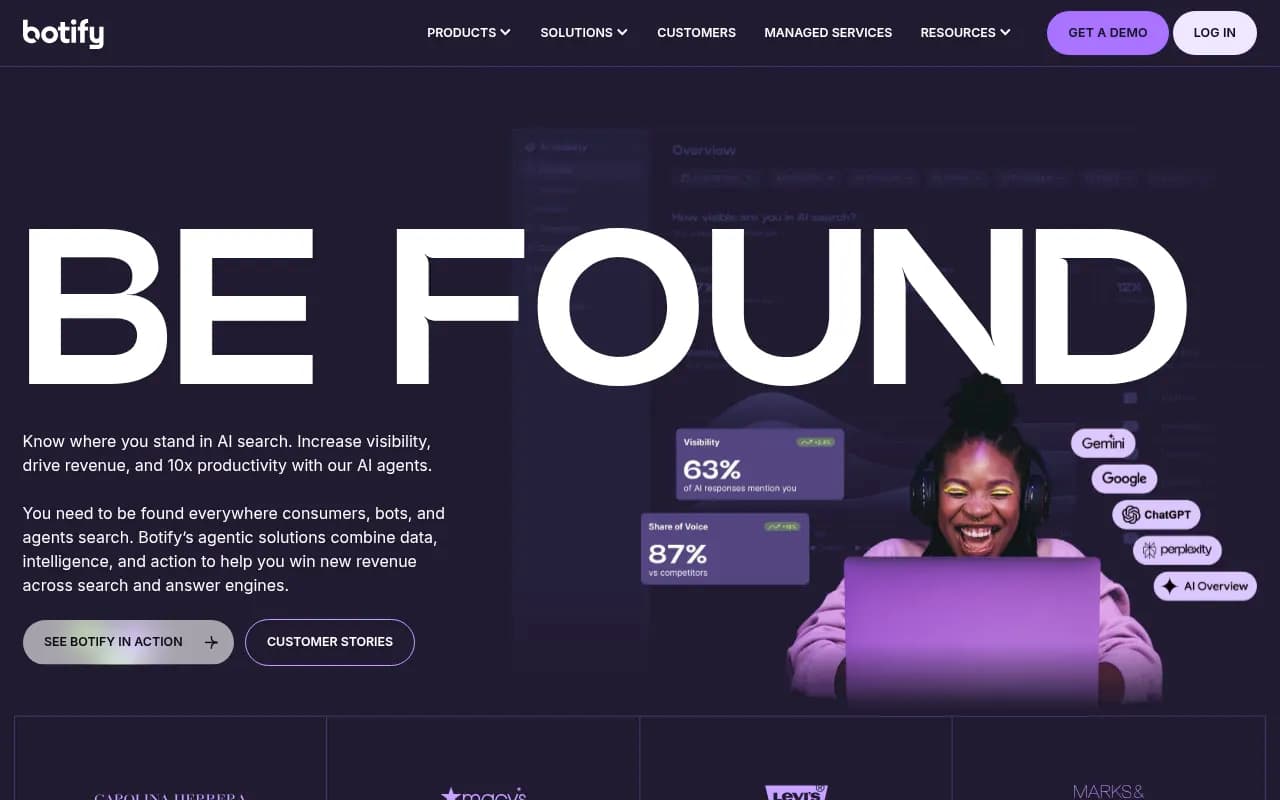
Botify handles enterprise-scale crawl analysis and has been adding AI search visibility features that make it relevant for large health systems.
Content optimization tools
Once you know what content to create, you need to make sure it's structured to get cited. These tools help with that.
Clearscope is strong for content optimization -- ensuring your medical content covers the right topics and semantic relationships that AI models look for when evaluating authority.
MarketMuse has content planning capabilities that work well for healthcare brands building out condition libraries and treatment pages.
Platform comparison: what each tool handles
| Platform | AI model monitoring | Content gap analysis | Content generation | Crawler logs | YMYL/healthcare fit |
|---|---|---|---|---|---|
| Promptwatch | 10+ models | Yes | Yes (AI writing agent) | Yes | Strong |
| BrightEdge AI Catalyst | Multiple | Limited | No | No | Strong (enterprise) |
| Profound | Multiple | Limited | No | No | Moderate |
| AthenaHQ | 8+ models | No | No | No | Moderate |
| Otterly.AI | Multiple | No | No | No | Basic |
| Peec AI | Multiple | No | No | No | Moderate (multilingual) |
| Clearscope | N/A | No | No | No | Content optimization only |
| MarketMuse | N/A | Limited | No | No | Content planning only |
| Botify | N/A | No | No | Yes | Technical SEO only |
What good AI visibility looks like for a healthcare brand
Let's make this concrete. Say you run digital marketing for a regional oncology center. Here's what the ideal workflow looks like:
You start by identifying which prompts patients are using to find oncology care in AI search. Not just "cancer treatment near me" -- but the specific questions they're asking: "what's the difference between radiation and chemotherapy for early-stage breast cancer," "questions to ask your oncologist at first appointment," "how to find a cancer center that specializes in immunotherapy."
Then you look at which of those prompts your competitors are appearing in and you're not. That's your gap list. For a YMYL topic like oncology, the content you create to fill those gaps needs to be authored or reviewed by credentialed oncologists, clearly structured, and published on a domain with established medical authority.
You publish that content, then track whether AI models start citing it. You look at which crawlers are visiting those pages and how often. Over time, you connect AI visibility improvements to actual patient inquiries and appointment bookings.
That's the full loop. Most healthcare brands are only doing the first step, if that.
The E-E-A-T signals that AI models actually weight
For healthcare brands specifically, these are the signals that move the needle on AI citations:
- Author credentials displayed clearly on every clinical page (MD, DO, PhD, RN with specialty noted)
- Date of last medical review, not just publication date
- Citations to peer-reviewed sources within the content itself
- Structured data markup for medical conditions, treatments, and healthcare providers
- Backlinks from authoritative medical sources (NIH, Mayo Clinic, academic medical centers)
- Consistent NAP (name, address, phone) data for local healthcare providers
The AI models that handle YMYL prompts -- ChatGPT, Perplexity, Google AI Overviews -- are essentially running a rapid credibility check on every source they consider citing. The brands that win are the ones that make that credibility check easy to pass.
A note on compliance and AI-generated content
Healthcare brands using AI writing tools need to be careful. Content generated for medical topics needs clinical review before publication -- not because the AI is necessarily wrong, but because the liability exposure for unchecked medical claims is real.
The better AI visibility platforms understand this. When using content generation features for healthcare, treat the output as a first draft that requires physician review, not a finished product. The value is in the research, structure, and gap identification -- the clinical accuracy layer still needs a human expert.
This is also why platforms that show you citation data and competitor analysis are particularly valuable in healthcare: they help you understand what authoritative sources are saying, which gives your clinical reviewers a starting point rather than a blank page.
Which platform should healthcare brands start with?
For most healthcare marketing teams, the right starting point is a platform that shows you where you're invisible before you invest in content creation. Knowing that you're missing from 40 high-volume prompts about your specialty is more actionable than a general "your AI visibility score is 23."
Promptwatch's Answer Gap Analysis does this well -- it surfaces the specific prompts where competitors are winning and you're not, which gives you a prioritized content roadmap rather than a vague directive to "create more content."
For enterprise health systems with existing SEO teams and complex reporting requirements, BrightEdge AI Catalyst integrates more naturally into established workflows.
For smaller practices or clinics with limited budgets, Otterly.AI or Peec AI give you basic monitoring at a price point that makes sense.
The common thread across all of them: start by understanding where you're invisible, then build content that earns citations. In healthcare AI search, visibility isn't just a marketing metric -- it's how patients find the care they need.