Summary
- AI search monitoring tools track how brands appear in ChatGPT, Perplexity, Claude, Gemini, and Google AI Overviews -- the platforms where buying decisions happen in 2026
- Most tools fall into two categories: monitoring-only dashboards that show you data, and optimization platforms that help you fix visibility gaps with content generation and analysis
- Promptwatch leads the optimization category with Answer Gap Analysis, AI content generation, crawler logs, and Reddit/YouTube tracking -- capabilities most competitors lack

- Agencies should prioritize tools that support multiple clients, offer white-label reporting, and provide actionable insights beyond raw visibility scores
- Pricing ranges from $29/month for basic monitoring (Otterly.AI) to $2,500+/month for enterprise platforms (seoClarity, BrightEdge)
Traditional SEO rankings matter less when people skip Google entirely and ask ChatGPT for recommendations. Your agency's clients want to know: does our brand show up when prospects ask AI for product suggestions? Are competitors being cited instead of us? What content do we need to create to get visible?
AI search monitoring tools answer these questions. They track brand mentions, citations, and visibility across Large Language Models (LLMs) and AI-powered search engines. Some tools just show you the data. Others help you fix the problem by identifying content gaps and generating optimized articles.
This guide walks through the best platforms for agencies managing multiple clients in 2026.
What AI search monitoring tools actually do
AI search monitoring platforms track how your clients' brands appear when users query ChatGPT, Perplexity, Claude, Gemini, Google AI Overviews, and other AI-powered interfaces. Unlike traditional rank tracking (position 1-100 for a keyword), AI visibility is about:
- Citation frequency: How often does the AI model cite your client's website as a source?
- Brand mentions: Does the AI recommend your client's product when asked for suggestions?
- Sentiment: Is the AI saying positive, neutral, or negative things about the brand?
- Competitor benchmarking: Which competitors are being cited more often, and for which prompts?
- Prompt coverage: Which customer questions trigger visibility, and which ones don't?
A study cited by SE Visible found that brands appear in 90% of Google AI Mode responses but only 43% of AI Overviews. That gap shows how fragmented AI visibility has become. You can't assume presence in one model means presence in others.
Agencies need tools that monitor multiple models, support multiple clients, and ideally help create content that improves visibility.
The two types of AI search monitoring platforms
Most tools fall into one of two buckets:
1. Monitoring-only dashboards
These platforms show you visibility scores, citation counts, and competitor comparisons. They're useful for tracking progress over time and identifying which prompts your client is invisible for. But they leave you stuck at the "now what?" stage. You see the problem but have no built-in way to fix it.
Examples: Otterly.AI, Peec.ai, AthenaHQ, Nightwatch, LLM Pulse
2. Optimization platforms
These go beyond monitoring. They show you what's missing (Answer Gap Analysis), help you create content that fills those gaps (AI content generation), and track the results (page-level citation tracking, traffic attribution). The core difference: they close the loop between insight and action.
Examples: Promptwatch, Profound, Searchable, Relixir
For agencies, optimization platforms save time. Instead of manually analyzing gaps and briefing writers, the platform surfaces exactly which topics and angles are missing, then generates drafts grounded in real citation data.
Top AI search monitoring tools for agencies
Promptwatch -- best for agencies that want to optimize, not just monitor
Promptwatch is the only platform rated as a "Leader" across all categories in a 2026 comparison of 12 GEO tools. It monitors 10 AI models (ChatGPT, Perplexity, Google AI Overviews, Claude, Gemini, Meta AI, DeepSeek, Grok, Mistral, Copilot) and tracks 1.1 billion+ citations, clicks, and prompts.
What sets Promptwatch apart: it doesn't just show you where you're invisible. It helps you fix it.
Answer Gap Analysis shows exactly which prompts competitors rank for but your client doesn't. You see the specific content missing from the client's website -- the topics, angles, and questions AI models want but can't find. Most competitors (Otterly.AI, Peec.ai, AthenaHQ) stop at showing visibility scores. Promptwatch tells you what to create.
AI content generation produces articles, listicles, and comparisons grounded in 880M+ citations analyzed, prompt volumes, persona targeting, and competitor data. This isn't generic SEO filler. It's content engineered to get cited by ChatGPT, Claude, and Perplexity.
AI Crawler Logs show real-time logs of ChatGPT, Claude, Perplexity, and other crawlers hitting your client's site -- which pages they read, errors they encounter, how often they return. Fix indexing issues before they hurt visibility. Most competitors lack this entirely.
Reddit & YouTube Insights surface discussions that directly influence AI recommendations. AI models cite Reddit threads and YouTube videos heavily. Promptwatch tracks these sources so you know where to engage or what to optimize.
ChatGPT Shopping Tracking monitors when your client's brand appears in ChatGPT's product recommendations and shopping carousels.
Pricing: Essential $99/mo (1 site, 50 prompts, 5 articles), Professional $249/mo (2 sites, 150 prompts, 15 articles, crawler logs), Business $579/mo (5 sites, 350 prompts, 30 articles). Agency/Enterprise custom pricing available. Free trial available.
Best for: Agencies managing 2-10+ clients who want to close the loop from visibility tracking to content creation to results measurement.
Nightwatch -- best for agencies already using traditional SEO tools
Nightwatch combines traditional rank tracking with AI search monitoring. If your agency already tracks keyword rankings daily, Nightwatch lets you add AI visibility tracking as an add-on without switching platforms.
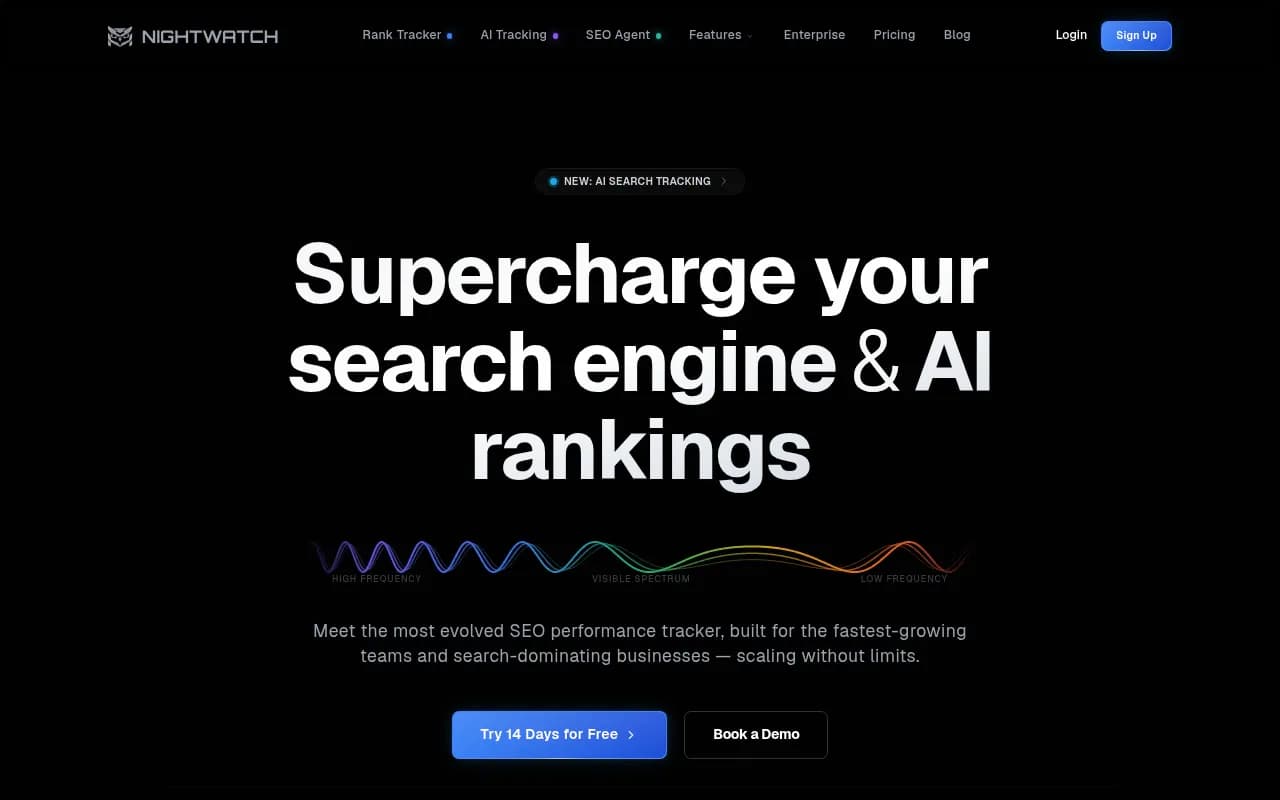
It tracks Google AI Overviews, ChatGPT, Perplexity, and other models. The interface shows which keywords trigger AI results and whether your client's brand appears in those results. Geo-level tracking works well for local SEO clients.
The downside: Nightwatch is monitoring-focused. It doesn't include content gap analysis or AI content generation. You'll need to manually figure out what content to create.
Pricing: Starts at $39/mo for traditional SEO tracking. AI tracking is an add-on (pricing varies by plan).
Best for: Agencies that want to add AI monitoring to existing rank tracking workflows without learning a new platform.
Otterly.AI -- best budget option for small agencies
Otterly.AI is one of the most affordable AI search monitoring tools. It tracks ChatGPT, Perplexity, Google AI Overviews, and other models. The platform runs automated prompt tests and shows visibility scores over time.

It's simple. You add prompts, Otterly runs them across models, and you see whether your client's brand appears. Competitor benchmarking shows how you stack up.
The limitation: Otterly is monitoring-only. No content gap analysis, no AI content generation, no crawler logs. You see the data but have to figure out the fix yourself.
Pricing: Starts at $29/mo.
Best for: Small agencies with 1-3 clients who need basic visibility tracking on a tight budget.
Profound -- best for enterprise clients with complex content operations
Profound positions itself as an enterprise AI visibility platform with a "read/write AI model." It monitors brand visibility across LLMs and includes content automation tools.

The platform tracks citations, sentiment, and competitor mentions. It also includes workflow automation for content teams -- brief generation, draft creation, publishing integrations.
Profound works well for large brands with dedicated content teams. The downside: it's more expensive than most competitors and may be overkill for agencies managing SMB clients.
Pricing: Starts at $99/mo, but enterprise features push pricing higher.
Best for: Agencies serving Fortune 500 clients or large brands with complex content operations.
Peec.ai -- best for multi-language tracking
Peec.ai tracks conversational AI visibility across ChatGPT, Perplexity, Claude, and other models. The standout feature: strong multi-language support. If your agency manages clients in Europe, Asia, or Latin America, Peec handles non-English prompts well.

The dashboard is simple. You see visibility scores, competitor benchmarks, and citation counts. Peec doesn't include content generation or gap analysis, so you'll need to manually figure out what to optimize.
Pricing: Starts at €89/mo.
Best for: Agencies managing clients in multiple countries who need multi-language AI visibility tracking.
SE Visible -- best for agencies new to AI search monitoring
SE Visible (from SE Ranking) offers a user-friendly interface for tracking AI Mode visibility. It monitors Google AI Overviews, ChatGPT, and other models. The platform shows whether your client's brand appears, how it's positioned, and how it compares to competitors.
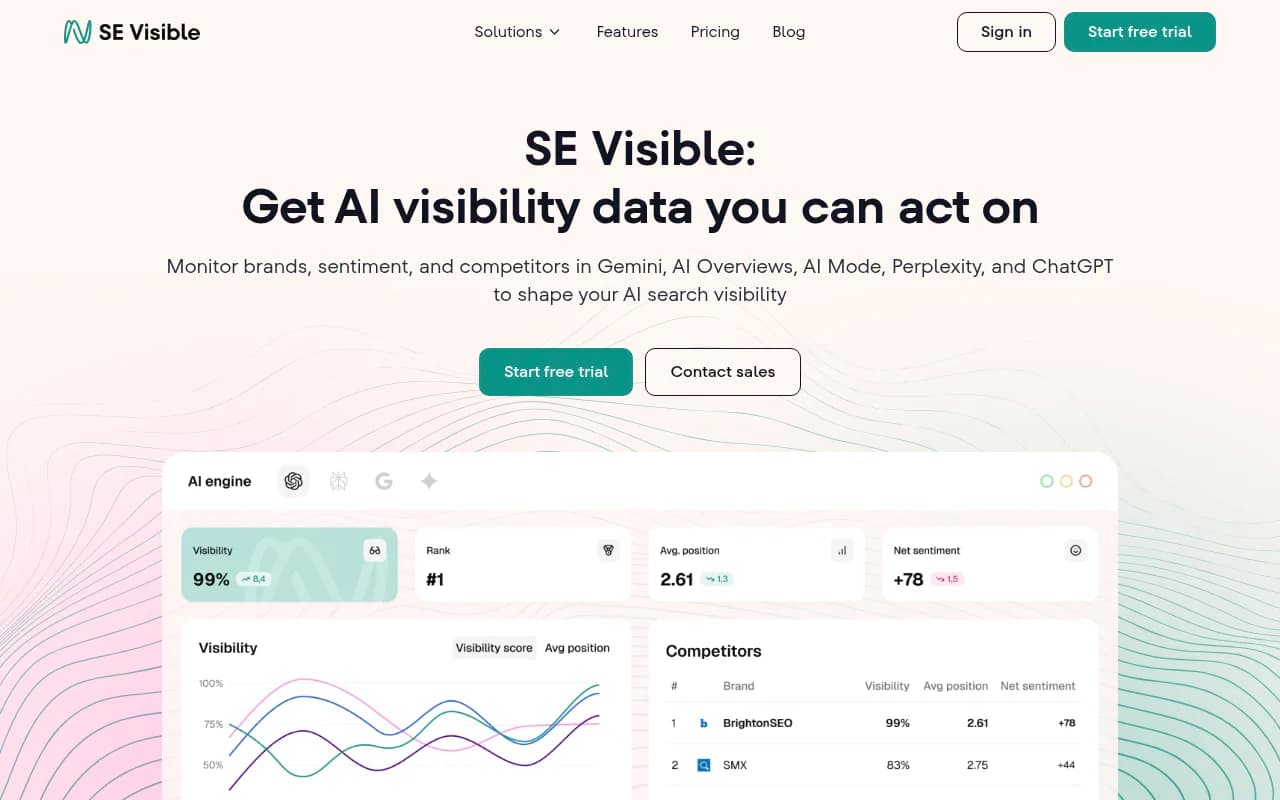
SE Visible is monitoring-focused. It doesn't include content gap analysis or AI content generation. But the interface is clean and easy to explain to clients who are new to AI search.
Pricing: Starts at $189/mo.
Best for: Agencies that want a simple, client-friendly dashboard for AI visibility reporting.
Comparison table: AI search monitoring tools for agencies
| Tool | Monitoring | Content gap analysis | AI content generation | Crawler logs | Reddit/YouTube tracking | Starting price |
|---|---|---|---|---|---|---|
| Promptwatch | ✓ | ✓ | ✓ | ✓ | ✓ | $99/mo |
| Nightwatch | ✓ | ✗ | ✗ | ✗ | ✗ | $39/mo + add-on |
| Otterly.AI | ✓ | ✗ | ✗ | ✗ | ✗ | $29/mo |
| Profound | ✓ | ✓ | ✓ | ✗ | ✗ | $99/mo |
| Peec.ai | ✓ | ✗ | ✗ | ✗ | ✗ | €89/mo |
| SE Visible | ✓ | ✗ | ✗ | ✗ | ✗ | $189/mo |
What agencies should look for in an AI search monitoring tool
Multi-client support
You need a platform that lets you manage 5, 10, or 50+ clients without creating separate accounts or juggling logins. Look for tools with agency pricing tiers and client management features.
White-label reporting
Clients don't care about the tool's branding. They care about their results. White-label reports let you present data under your agency's brand.
Actionable insights, not just data
Visibility scores are interesting. But what do you do with them? The best tools (like Promptwatch) show you exactly what content is missing and help you create it.
Multi-model coverage
Don't assume visibility in ChatGPT means visibility in Perplexity or Claude. Track all major models: ChatGPT, Perplexity, Claude, Gemini, Google AI Overviews, Meta AI, DeepSeek, Grok, Mistral, Copilot.
Prompt intelligence
Not all prompts are equal. Some have high volume and low competition. Others are saturated. Tools that show prompt volume estimates and difficulty scores (like Promptwatch) help you prioritize.
Page-level tracking
You need to know which specific pages are being cited, not just domain-level visibility. This helps you understand what's working and replicate it.
Traffic attribution
Visibility is great. Revenue is better. Look for tools that connect AI visibility to actual traffic and conversions via code snippets, Google Search Console integration, or server log analysis.
How to choose the right tool for your agency
If you're managing 1-3 SMB clients on a tight budget: Start with Otterly.AI ($29/mo). It's basic but covers the essentials.
If you're managing 5-10 clients and want to optimize, not just monitor: Use Promptwatch. The Answer Gap Analysis and AI content generation save hours per client per month.
If you're serving enterprise clients with complex content operations: Consider Profound or seoClarity (enterprise-tier platforms with workflow automation).
If you're managing multi-language clients: Peec.ai handles non-English prompts well.
If you want to add AI monitoring to existing rank tracking workflows: Nightwatch integrates AI visibility into traditional SEO dashboards.
The reality of AI search in 2026
People aren't clicking through to websites the way they used to. They're asking ChatGPT for product recommendations. They're using Perplexity for research. They're trusting Google AI Overviews more than organic results.
If your clients aren't visible in these AI-generated answers, they're invisible to a growing segment of buyers. Traditional SEO still matters, but AI search visibility is where the growth is.
The tools in this guide help you track that visibility. Some just show you the data. Others (like Promptwatch) help you fix the problem by identifying gaps and generating optimized content.
Pick the tool that fits your agency's size, budget, and workflow. Then start tracking. Your clients' competitors already are.