Key takeaways
- Agency AI visibility tools live or die on three things: white-label reporting, client portals, and per-brand pricing that doesn't punish growth. Most platforms are single-brand tools with a "team" seat bolted on.
- Peec AI, SE Ranking's Agency Pack, and Scrunch AI's Agency Core tier are the three most credibly agency-ready options right now, each with real published agency pricing rather than a vague "contact sales."
- Profound is built for enterprise reporting depth, not agency economics. Its self-serve pricing is thin and one review pegs a realistic minimum around $499/month, aimed at brands with a dedicated GEO team rather than a client portfolio.
- Promptwatch is worth a look if your agency wants to sell an execution retainer, not just a monitoring dashboard: it pairs visibility tracking with Content Agents that draft and publish AEO content and Unified Actions that prioritize the fixes.
- Citation behavior changes overnight, not quarterly. ChatGPT's average citations per response dropped roughly 27% within a day of the GPT-5.3 rollout in March 2026, and Reddit's ChatGPT citation share fell from about 3.8% to 0.5% in a single week in August 2026. If your reporting cadence is monthly, you are already behind.
Why agency AI monitoring is a different problem
Most AI visibility tools were designed to answer one question for one brand: does ChatGPT mention us? That's a fine product to build if you're a SaaS company checking your own name. It falls apart the moment you're running twenty client accounts, each with different competitors, different reporting cadences, and a client who wants their logo on the PDF, not the vendor's.
The tell is usually pricing. A tool built for a single brand prices by prompt volume and calls it a day. A tool built for agencies prices by client seat, gives you a white-label export, and lets you spin up a free "pitch" workspace before a prospect ever signs a contract. Those are structurally different products, even when the underlying AI monitoring is similar.
There's also a data argument for why agencies specifically need continuous tracking rather than one-off audits. Promptwatch's research on the GPT-5.3 rollout found that ChatGPT's average citations per web-search response dropped from roughly 6.4 sources to 4.7-4.9 within a day of the update on March 4, 2026, across every model variant, with no recovery a month later (see Promptwatch's citation drop analysis). None of that was caused by anything an agency did or didn't do to a client's content. It was a platform-side change. If you're reporting to a client monthly and something like that happens mid-cycle, you either catch it and explain it, or you spend the next call defending a metric that dropped for reasons entirely outside your control.
The same report is blunt about the implication: citation behavior is "a platform-controlled variable that can change overnight," which is a genuinely strong argument for selling ongoing monitoring retainers instead of one-time audits. It's also a good line to use in a pitch deck.
The six criteria that actually matter for agencies
Before ranking anything, it's worth being explicit about what "agency-ready" means, because vendors use the word loosely.
- White-label reports: can you export or schedule a PDF with your agency's logo instead of the vendor's, and does that come free or as a paid add-on?
- Client portals: can a client log into a branded dashboard themselves, or are you stuck emailing screenshots every Monday?
- Multi-brand management: how many client workspaces does one account actually support, and how much friction is there switching between them?
- Per-brand or per-seat pricing: does adding client number six cost a predictable amount, or does it trigger an upsell conversation every time?
- Prospecting features: can you run a free visibility audit on a prospect before the sales call, ideally without burning your own client quota?
- API and export access: can you pipe the data into your own reporting stack, a Looker Studio dashboard, or a client's existing BI tool?
A tool that misses three or more of these isn't really an agency platform. It's a single-brand tool that an agency happens to be using, which is a very different cost structure once you're past five clients.
Platform-by-platform breakdown
Peec AI: the most agency-literate pricing on the market
Peec AI's agency tier structure is unusually specific for this category. Essential runs $245/month for 10,000 credits, Growth sits around $495/month with 25,000 credits and roughly 277 prompts a day across up to 10 projects, and Scale is $795/month for 65,000 credits and up to 25 projects. Every tier includes unlimited client seats with no per-seat fee, which matters once an account team grows past two or three people per client.
What sets Peec apart operationally is the free 7-day pitch project: a prospecting workspace that sits outside your client quota, lets you pull a prospect's AI visibility and competitor benchmark before the sales call, and converts to a paid client project in three clicks if you win the deal. It also ships an MCP connector that can auto-generate weekly per-client Slack summaries and roll them into a single Google Slides deck, and a Looker Studio connector for cross-client dashboards that clients can view without logging in.
The catch: base tiers cap coverage at three AI models, and Claude and Grok aren't in the core six engines it tracks (ChatGPT, Perplexity, Google AI Overviews, AI Mode, Gemini, and Copilot). Additional model coverage costs €30 to €140 per month per model depending on tier, which can quietly push real per-client cost well above the sticker price. One review also notes Peec's agency tooling is built around pitch workspaces and unlimited seats, not formal reseller or referral economics, so if you want a partner program with co-marketing, look elsewhere.

SE Ranking: the cheapest real white-label add-on
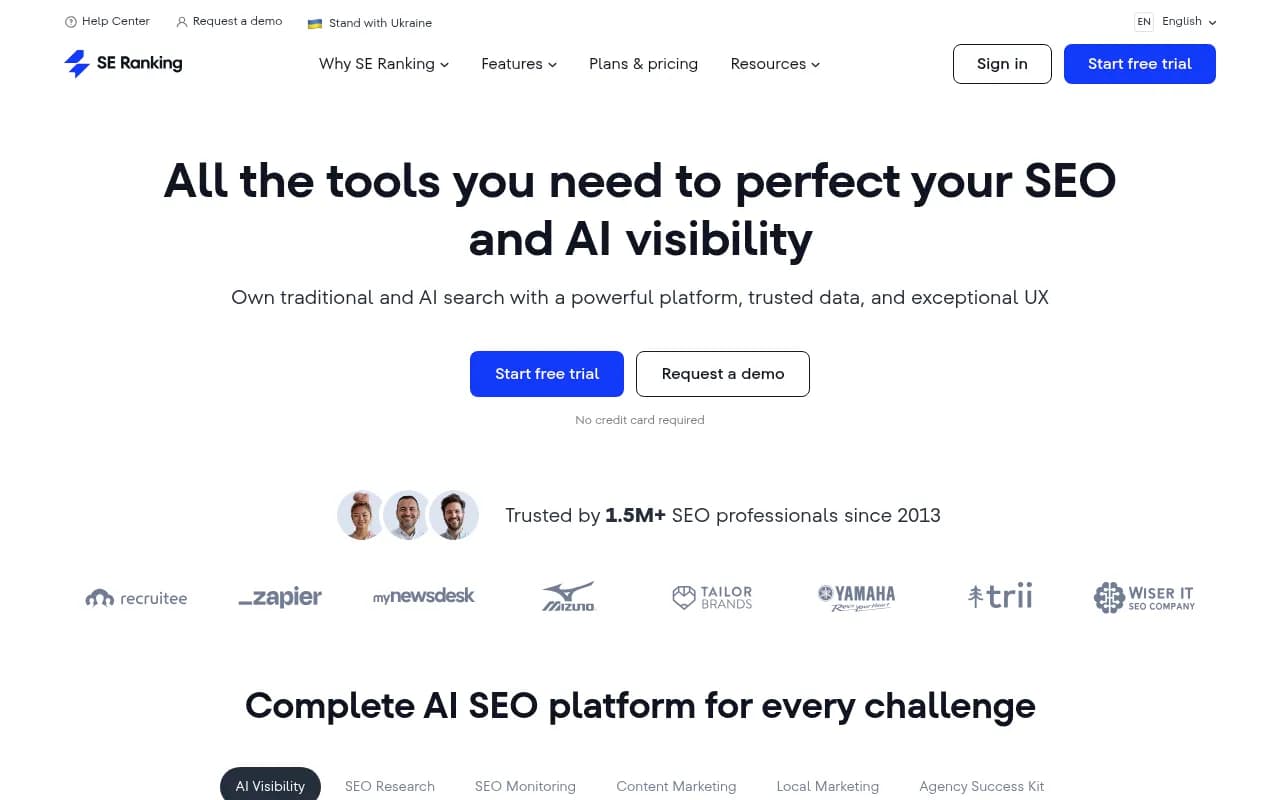
SE Ranking doesn't market itself as an AI-visibility-first tool, but its Agency Pack add-on is one of the least expensive ways to get genuine white-labeling in this space. The Core plan is $129/month, and the Agency Pack adds $69/month on top for white-label reports, branded client portals, and somewhere between 10 and 30 client seats depending on the source consulted, plus an unlimited scheduled report allowance and a lead-generator widget for prospecting.
Compare that $69/month add-on to Semrush's $200/month Agency Growth Kit, or to Ahrefs Brand Radar, which offers no white-labeling at any price tier according to multiple reviews. That's a real structural difference, not a marketing claim.
The honest caveat: white-labeling is never bundled into a base plan here, it's always the add-on, and stacking the Agency Pack with the API add-on ($45/month) and full AI visibility tracking can push total monthly cost past $400, which erodes the headline cheapness fairly quickly.
Scrunch AI: positioning as an "agency OS," with real evidence behind it
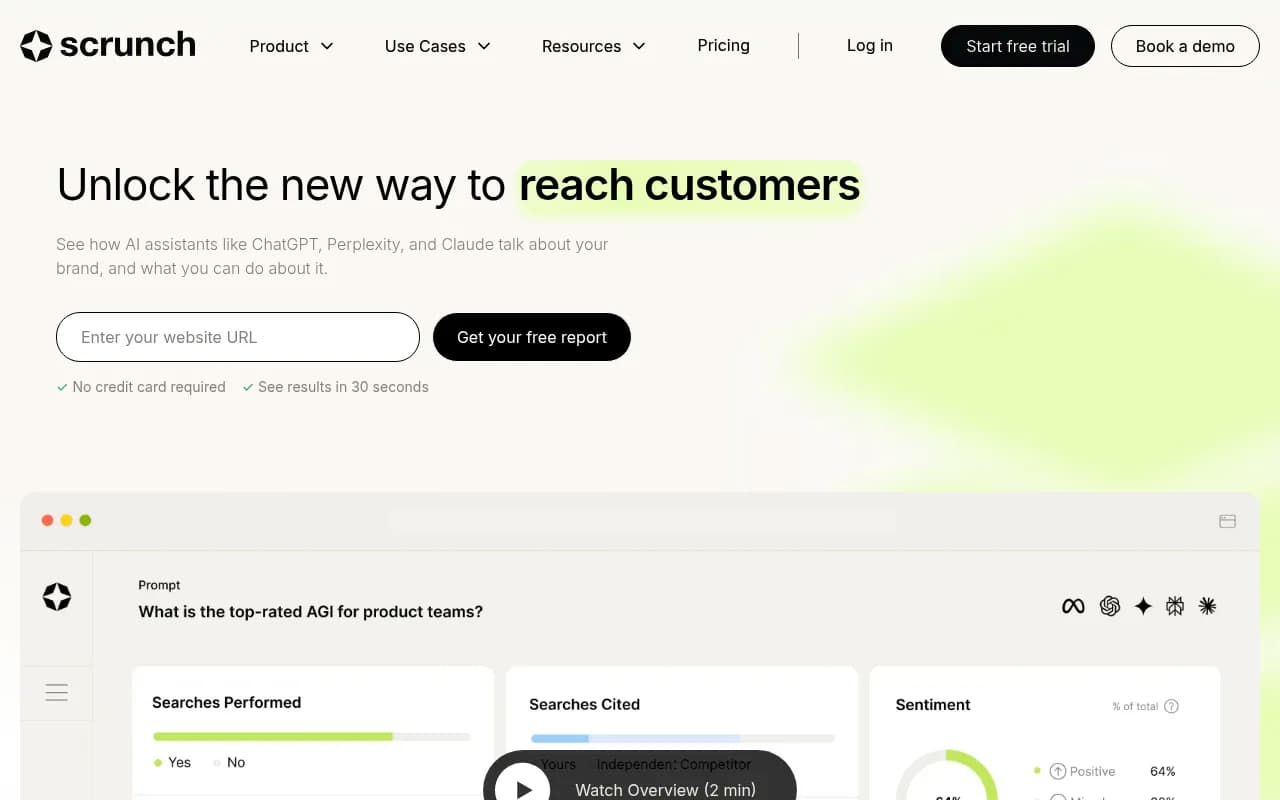
Scrunch's public pricing confirms a genuinely distinct agency tier: Agency Core at $500/month and Agency Enterprise at custom pricing, sitting alongside a brand-facing Core plan at $250/month (roughly 125 prompts across 4 models). That's a meaningfully different structure from a tool that just relabels its top brand tier as "agency."
Scrunch's own blog pushes back hard on the idea that it's weaker for agencies than dedicated platforms, arguing that agencies build bespoke client reporting on top of its API and can white-label insights without burning design hours. A client testimonial from Stratabeat, which says it evaluated more than 10 tools before choosing Scrunch, backs that up somewhat. Independent reviewers land in the middle: "best for multi-brand enterprise workspaces," with Looker Studio reporting and API access for custom deliverables, but still leaning enterprise rather than lean-agency in feel.
Profound: enterprise depth, agency-unfriendly economics
Profound's reporting depth is genuinely strong, covering up to nine answer engines and offering SSO, SOC2, and dedicated support tiers. But its self-serve pricing page is thin: a limited free trial and a custom Enterprise tier, with one comparison piece citing an unlisted $499/month Growth plan that doesn't appear on the current public pricing page. Its Agency Growth option allocates 400 Agents credits per client workspace, a per-workspace model rather than a shared pool, which scales cost linearly with every new client you add.
One review is direct about who this fits: a Fortune 500 enterprise with a $5,000/month tool budget and a dedicated GEO team, not a 20-client agency book. If your clients are large enough to individually justify enterprise pricing, Profound's reporting quality is hard to beat. If you're running a mid-size agency portfolio, the economics work against you.

Otterly AI: cheap entry, expensive full coverage
Otterly's headline pricing is genuinely the lowest in the category: Lite at $29/month for 15 tracked prompts, scaling to Standard at $189/month and Premium at $489/month. But that sticker price only covers ChatGPT out of the box. Full seven-engine coverage, adding Google AI Mode, Gemini, and Claude, costs meaningfully more once you add the per-tier engine fees (Claude alone adds $29 to $439/month depending on tier). Otterly's dedicated agencies page doesn't offer a separate agency pricing structure, it's the same entry point as an individual brand account, which tells you it's built for a small book rather than a growing one.

Semrush and Ahrefs: fine as an add-on, not as your core agency tool
Both suites have folded AI visibility into their existing SEO plans rather than selling it standalone. Semrush's entry tier starts at $199/month with 25 to 50 custom prompts depending on the source, and its Agency Growth Kit white-label add-on costs another $200/month. Ahrefs Brand Radar is bundled from $129/month at the Lite tier (5 prompts) up to $1,499/month at Enterprise, but multiple reviews confirm Ahrefs offers no white-labeling option at any price. If your clients are already on one of these platforms for classic SEO, the AI visibility module is a reasonable bolt-on. As a primary agency AI monitoring tool, neither is built for the job.
Comparison table: agency-relevant pricing and features
| Platform | Agency entry price | White-label included | Client portal | Engines at base tier | Prospecting feature |
|---|---|---|---|---|---|
| Peec AI | $245/mo (Essential) | Yes, all agency tiers | Yes, via Looker Studio & read-only links | 3 (add-ons for more) | Free 7-day pitch project |
| SE Ranking | $129/mo + $69/mo Agency Pack | Add-on only | Yes, via Agency Pack | Varies by plan | Lead-generator widget |
| Scrunch AI | $500/mo (Agency Core) | Yes, via API | Custom via API | 4 models at Core | Not confirmed |
| Profound | Custom / ~$499/mo cited | Yes, Enterprise | Yes | Up to 9 | Limited free trial |
| Otterly AI | $29/mo (no separate agency tier) | Limited | No | 1 (ChatGPT), others paid add-ons | No |
| Semrush | $199/mo + $200/mo Agency Kit | Add-on only | Yes | Suite-dependent | No |
| Ahrefs Brand Radar | $129/mo (Lite, bundled) | Not available | No | Suite-dependent | No |
Pricing changes frequently in this category and several sources conflict on exact figures, so treat this as directional and re-verify at the point you're actually buying.
Where Promptwatch fits for agencies that want to sell execution, not just reporting
Most of the platforms above answer one question well: was my client mentioned? Promptwatch is built to answer a different one: why aren't they, and what do we do about it? That distinction matters more for agencies than it sounds, because a monitoring dashboard alone doesn't give you anything to bill for beyond the reporting retainer itself.
Promptwatch tracks brand visibility across ChatGPT, Gemini, Claude, Perplexity, Grok, DeepSeek, Copilot, Mistral, Meta Llama, Google AI Overviews, and AI Mode, and backs it with AI crawler logs that show exactly which pages ChatGPTBot, ClaudeBot, PerplexityBot, and 400+ other bots actually read, plus where they hit errors. That's the piece most agency clients never see: not just whether they got cited, but whether AI systems could even crawl the page cleanly in the first place. On top of that, its Content Agents plan, write, and publish AEO-optimized content directly to a client's Webflow, Framer, or WordPress site on a schedule, and Unified Actions turns the visibility and citation data into a prioritized to-do list rather than a wall of charts.
For an agency that already runs a content or SEO retainer, that's the difference between selling a $500/month reporting subscription and selling a $2,000+/month execution retainer where the platform itself is drafting the fixes. Agencies get dedicated plans starting at Kick-off ($199/month) through Scale ($799/month), all with unlimited projects, unlimited prompts, and 10 seats, which sidesteps the per-client credit-count math that trips up a lot of the pure monitoring tools above.

What to actually check before you sign a contract
A few things came up repeatedly in reviews that are worth checking yourself rather than trusting a pricing page:
- Ask what the base tier actually covers in terms of AI models. Several platforms cap at three or four engines and charge separately for the rest, which can double real cost per client.
- Test the client portal with a real, non-technical stakeholder before you commit. A portal that makes sense to your data team and confuses a marketing director isn't a portal, it's a liability.
- Check whether white-labeling is a base feature or an add-on you'll need to keep paying for on top of the core plan. The gap between SE Ranking's $69/month add-on and Ahrefs having no white-label option at all is the range you're dealing with here.
- Run the numbers at your actual client count, not the vendor's example pricing. A per-workspace credit model, like Profound's Agency Growth plan, scales very differently from a shared credit pool.
If you want to see how a broader set of GEO and AI visibility tools stack up outside the agency-specific lens, the directory at bestgeosoftware.com is a reasonable place to keep browsing, and agenticseotools.com is worth a look if you're specifically hunting for platforms that execute fixes rather than just report on them.
One last practical point: none of this replaces getting your fundamentals in order for AI visibility in general, missing author bios, outdated content, inconsistent brand descriptions across your site, LinkedIn, and Google Business Profile are the most common reasons AI systems decline to cite a brand confidently, according to Workshop Digital's analysis of common AI visibility mistakes. No monitoring platform, agency-ready or otherwise, fixes that for you. It just tells you it's broken.