
Key Takeaways
- Plan on 10 to 20% of your search budget for AEO in 2027, roughly 3 to 7% of total marketing spend, according to Goodie's 2027 budgeting guide. Go toward the top if competitors already own the AI answers in your category.
- Tool pricing ranges from $29 a month to custom enterprise contracts. Sticker price tells you little. Divide the plan price by tracked answers per month.
- Tracking is only one line item. Content production, technical fixes, and measurement usually cost more than the dashboard.
- Prices below were checked on October 15, 2026 by the sources cited. Confirm them on vendor pages before you sign anything.
- Disclosure: this site is published by 1001 SEO Media, which uses Promptwatch as its AI visibility platform. Promptwatch is one of the tools covered here.
Why AEO needs its own budget line
Every Q4 the planning spreadsheet opens, last year's lines get copied forward with a 5% bump, and AI search gets one row labeled "TBD." That row is where plans fall apart. AEO (answer engine optimization) tools sample how ChatGPT, Gemini, Perplexity, Google AI Overviews, AI Mode, Copilot, and Claude talk about your brand. They run a set of prompts over and over and report how often you are mentioned or cited.
The case for funding it is mostly about clicks you no longer see. A Pew Research study of 900 U.S. adults in March 2025 found users clicked a traditional result in 8% of visits with an AI summary, versus 15% without one. It was observational and Google-only, so treat it as an association, not proof of cause. Still, it is hard to argue that rankings and traffic alone tell you what buyers see.
AEO, GEO, and SEO overlap heavily. Vendors sell the same product under all three names. For budgeting purposes, treat them as one program with a tracking layer, a content layer, and a technical layer.
How much to budget for AEO in 2027
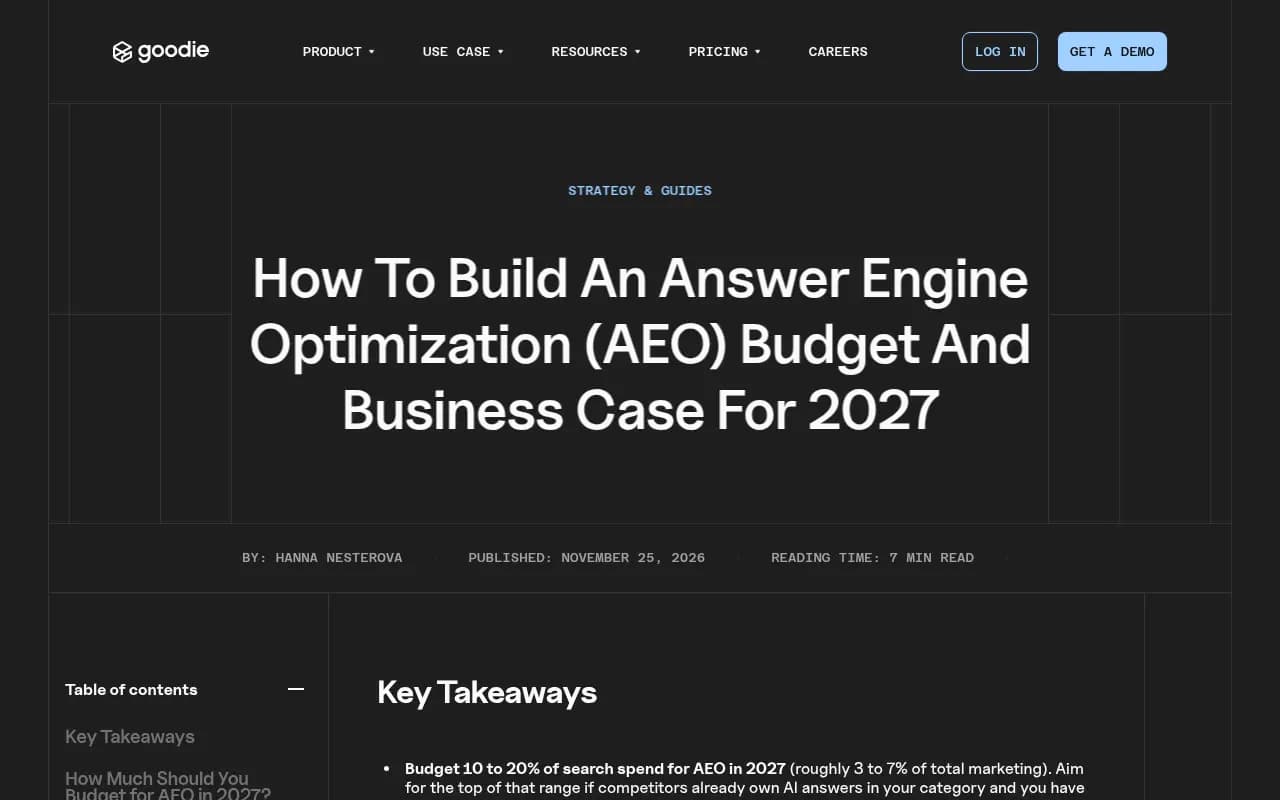
Two recent planning guides give usable starting points.
Goodie suggests 10 to 20% of search budget. Its rough benchmarks are about 10% for tracking and quick fixes, 15% for closing a competitor gap, and 20% or more when building from zero. It also recommends weighting year one toward measurement and technical work, then shifting toward earned media in year two. Its model split moves technical from 25% to 10% and earned media from 15% to 35%.
Briskon's 2027 SEO budget guide splits spend across SEO, AEO, and GEO by situation:
| Business situation | SEO | AEO | GEO | Main priority |
|---|---|---|---|---|
| Building search foundations | 70% | 15% | 15% | Fix technical problems, establish AI visibility baselines |
| Expanding search visibility | 60% | 20% | 20% | Keep organic growth while improving answer coverage |
| Established SEO with verified AI opportunities | 50% | 20% | 30% | Protect performance, expand evidence and authority |
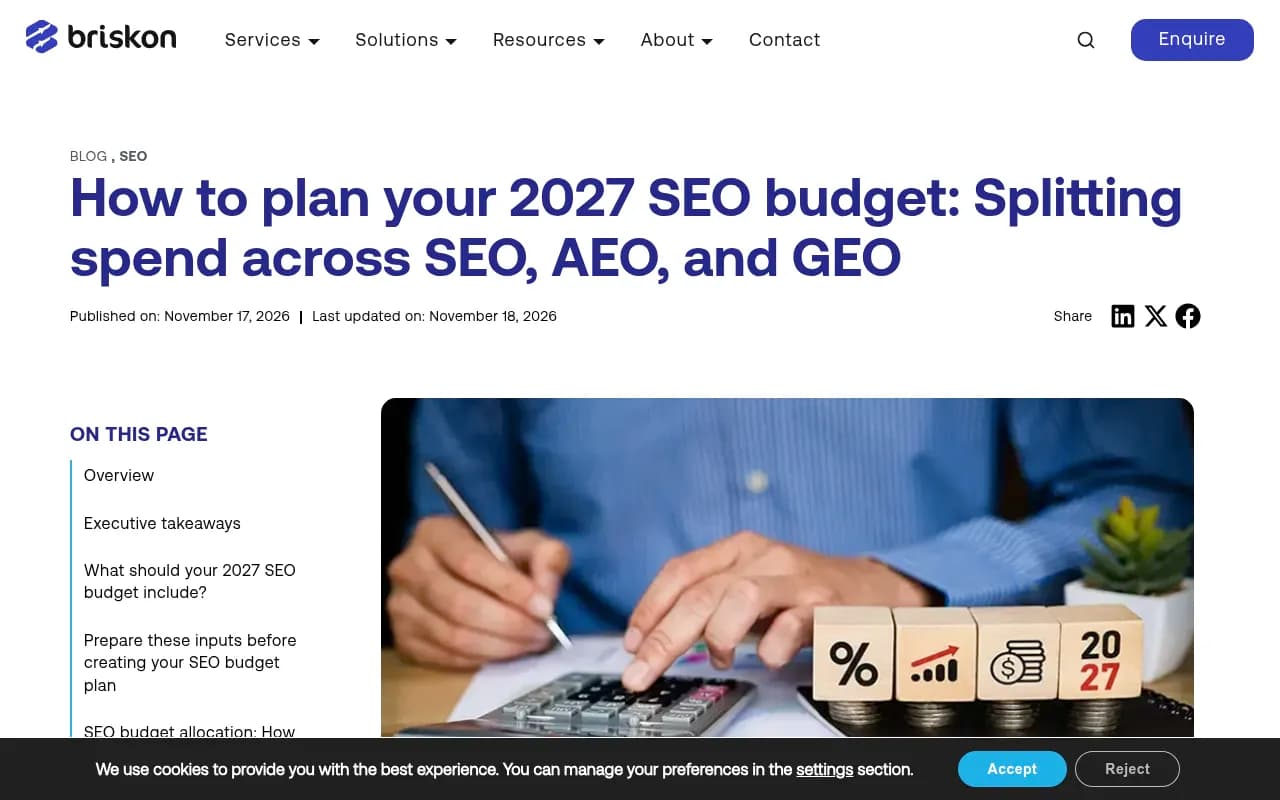
I would not treat any of these percentages as gospel. They are vendor and agency estimates, not audited benchmarks. But they agree on the shape: a meaningful slice, front-loaded on measurement.
Where the money comes from
Goodie's advice is to fund AEO through reallocation first. Paid search on informational keywords is the easiest source, citing Seer Interactive's finding that paid CTR fell 68% on queries that trigger AI Overviews. Mark each line in the business case as "reallocated" or "new," and commit only to leading indicators (share of voice, citation rate) in the first 90 days. Pipeline takes 6 to 12 months and should be reported as influenced pipeline.
What a tool budget actually covers
Before comparing prices, split the tooling spend into three buckets:
- Tracking: prompts, engines, countries, and run frequency.
- Diagnosis: citation sources, crawler access, site audits, and traffic attribution.
- Execution: content creation, refreshes, and publishing.
Most cheap tools only cover the first bucket. That is fine if you have a content team already. It is a trap if you expected the tool to help you fix anything.
AEO tool pricing at a glance
The table below combines the published comparisons from Olostep (checked October 15, 2026) and Searchable. Entry-tier details vary between sources because vendors change plans often, so treat it as a starting shortlist.
| Tool | Entry price | Entry prompts | Engines at entry | Best for |
|---|---|---|---|---|
| Otterly.AI | $29/mo | 15 to 20 | 3 engines of your choice | Low-cost test |
| HubSpot AEO | $50/mo (beta) | 25 | ChatGPT, Gemini, Perplexity | HubSpot teams |
| SE Visible | $79 to $99/mo | 75 to 200 | 5 engines | Prompt volume per dollar |
| Writesonic | $79/mo annual | 50 | ChatGPT, Gemini, AI Overviews | Tracking plus writing |
| Peec AI | EUR 85 to $95/mo | 50 | 3 models of your choice | Daily tracking on a budget |
| Semrush AI Visibility Toolkit | $99/mo per domain | 25 | Includes AI Mode, ChatGPT | Existing Semrush users |
| Searchable | $125/mo | 100 | ChatGPT, AI Overviews, Perplexity | Rated 4.7 on G2 |
| Ahrefs Brand Radar | $199 per platform | Custom | 6 engines | Ahrefs users |
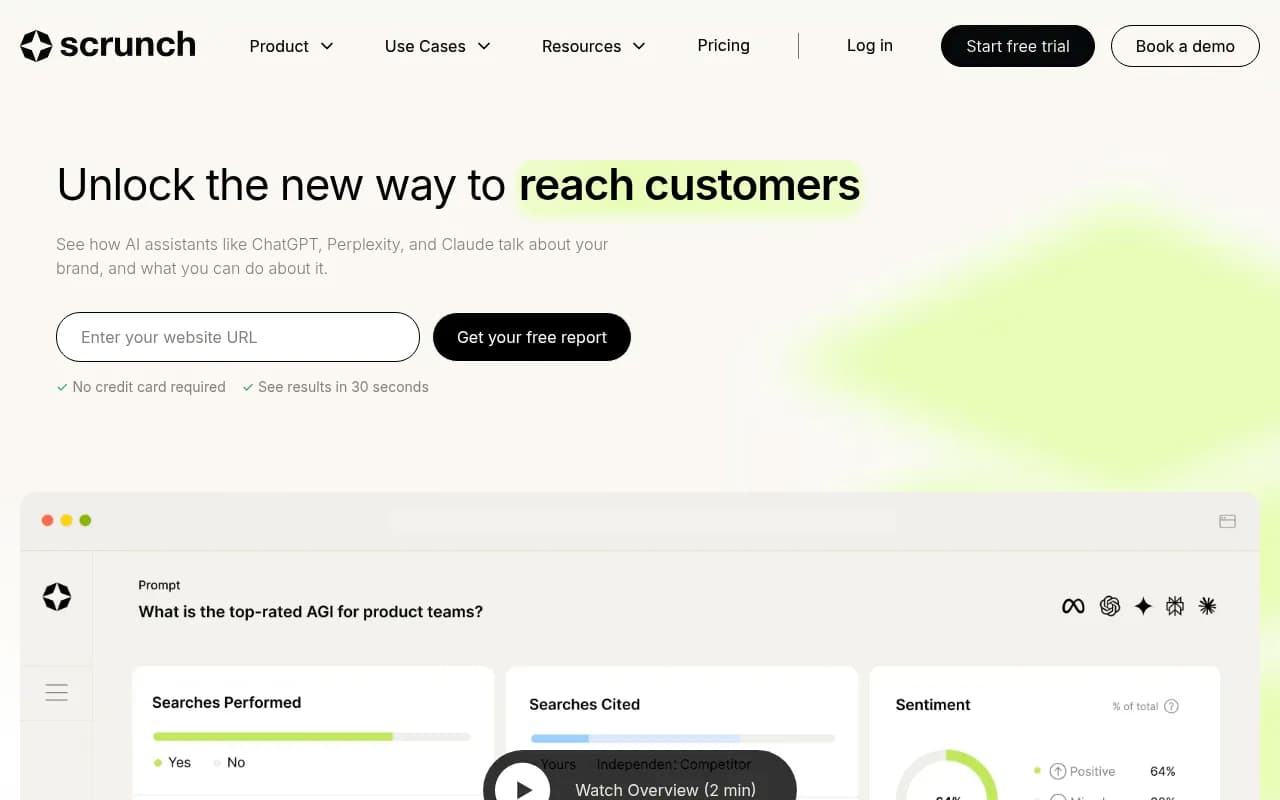
| Scrunch | $250/mo | 125 | 4 engines | AI bot traffic alongside visibility |
| AthenaHQ | $295/mo | 3,600 credits | 11 models | Wide model coverage |
| Goodie AI | $295/mo | 110 | 5 engines | Tracking plus content agents |
| Profound | Custom | Custom | Up to 9 engines | Enterprise |
| Petra Labs | From $15,000/mo | Custom | Custom | Fully managed AEO |
One more thing worth flagging from Searchable's comparison: three of its nine listed tools have been acquired by larger companies since April 2026 (SE Visible by SE Ranking, Scrunch by Sitecore, AthenaHQ by Bloomreach). If you are signing a multi-year deal, ownership changes are a real risk to roadmap and pricing.
The tools worth a closer look
Low-cost trackers
Otterly.AI has the lowest entry price at $29 a month for about 20 prompts on three engines. The catch: you cannot buy extra credits on the Lite plan, so outgrowing it means jumping to the $189 Standard plan, which is also where API and MCP access starts.

Peec AI is a step up with daily tracking and multi-language support. Its Starter plan works out to 50 prompts across 3 models over 30 days, about 4,500 answers a month.

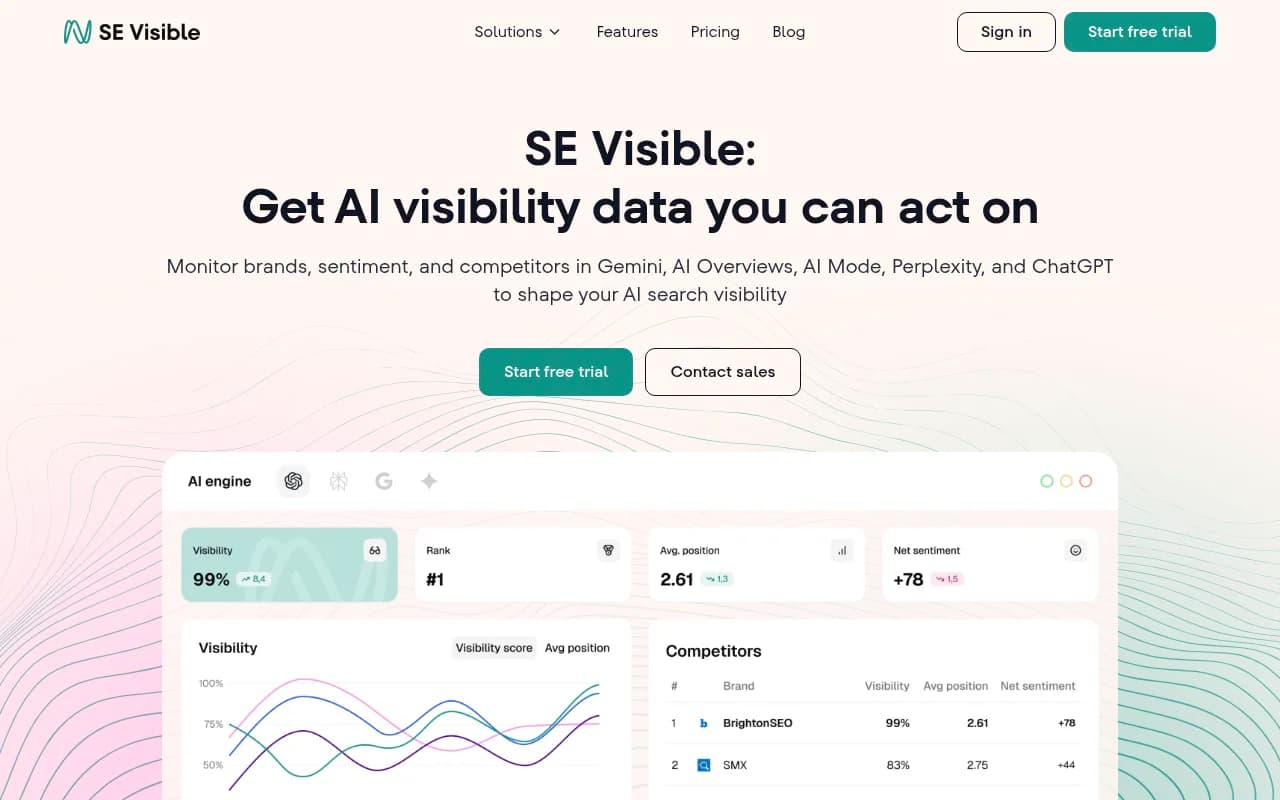
SE Visible is the volume pick. Olostep lists about 30,000 answers a month for $99, which makes it the cheapest per tracked answer in this group.
Suite add-ons
If you already pay for Semrush or Ahrefs, their AI modules are the path of least resistance. The trade-off is fixed prompt sets and shallower AI-specific data.
Mid-market and enterprise
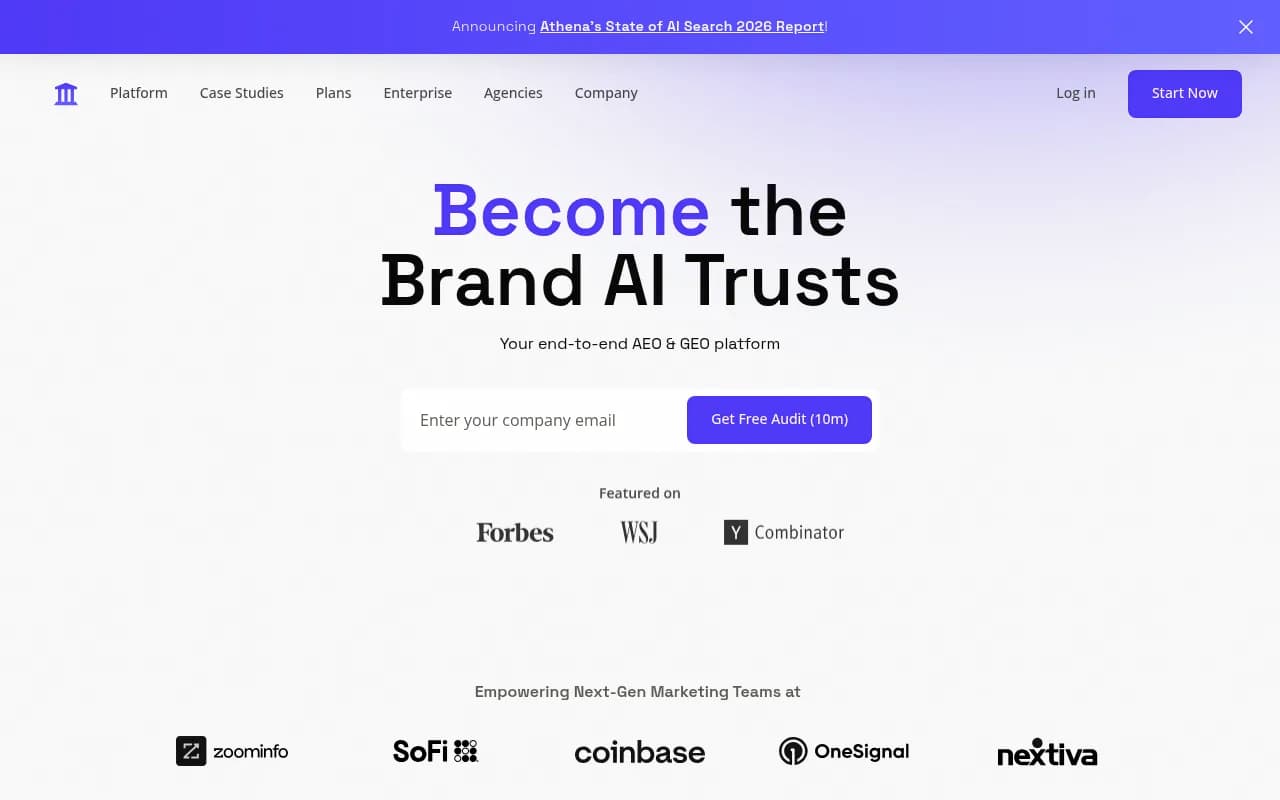
Profound is the usual enterprise shortlist name, with custom pricing and broad engine coverage. AthenaHQ covers 11 models on a credit system where one credit equals one AI response.

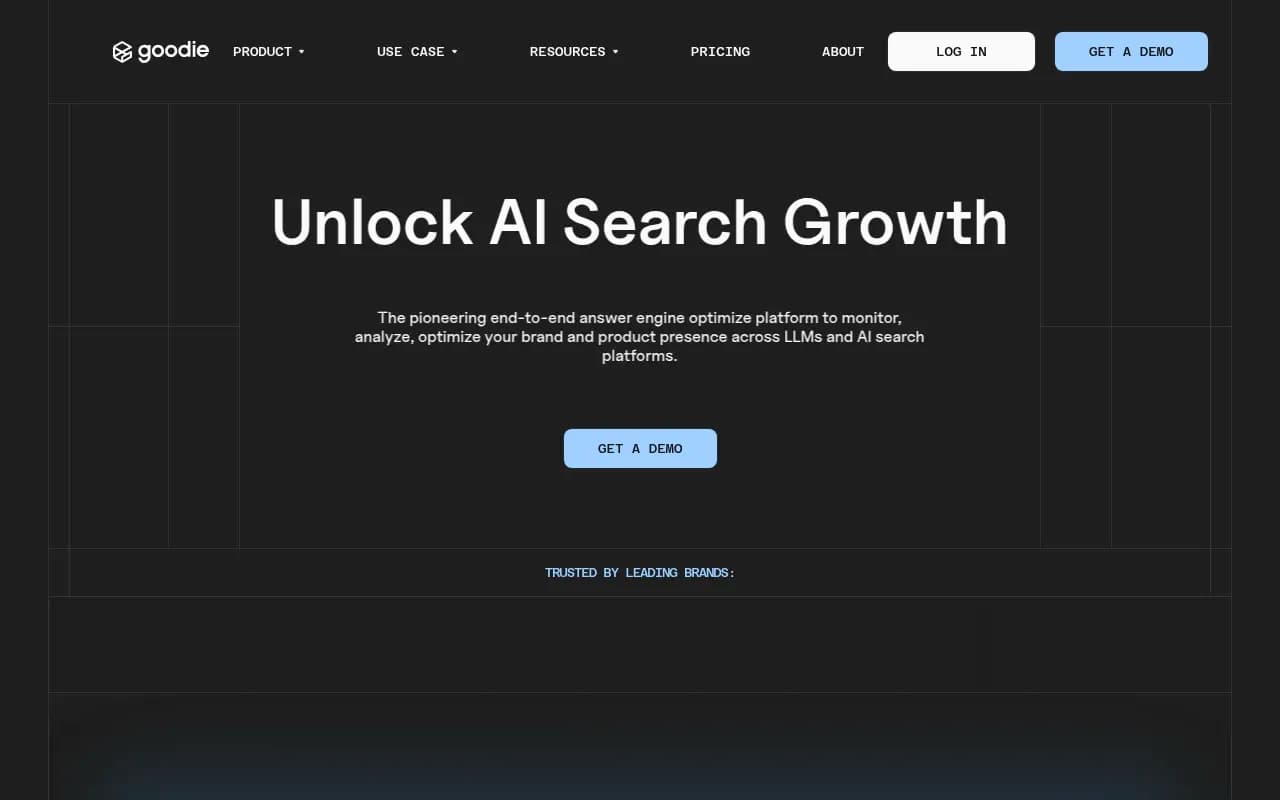
Goodie combines tracking with content agents, and agency client workspaces start at $399 a month, separate from the $295 Core brand plan.
Tracking plus action
Promptwatch sits in the category where the tool is expected to do the fixing, not only the reporting. It monitors the real interfaces of ChatGPT, AI Overviews, AI Mode, Gemini, Perplexity, Copilot, and others, then traces which pages get cited, reads IP-verified AI crawler logs, and has a Content Agent that writes and publishes to WordPress, Webflow, or Framer. Pricing is published: Essential at $95 a month (50 prompts, 6,000 responses), Professional at $245, and Business at $579, which is the first plan with the Content Agent, hourly tracking, and Fact Check. Agency plans run $199 to $799. Annual billing gives 12 months for the price of 10, and there is a 7-day trial on monthly plans. Confirm current numbers at promptwatch.com/pricing. For a feature-by-feature view, see the 2026 GEO platform comparison.

Promptwatch also runs a free AI visibility report, which is a cheap way to get a baseline before you spend anything.
For more options, the GEO software directory lists tools beyond this shortlist.
How to compare tools by cost per tracked answer
The checklist from Olostep is the most useful part of any comparison I read:
- List the engines your buyers use and drop tools that skip them at your tier.
- Estimate volume as prompts x engines x locations x runs per day x days.
- Divide the plan price by monthly tracked answers.
- Ask how each engine's answers are collected (real interface or API).
- Confirm export or API access if the data must reach your warehouse.
- Check fit with your content tools, analytics, and team size.
Example: 100 prompts x 3 engines x 1 location x 1 run a day x 30 days is 9,000 answers a month. At $125, that is about 1.4 cents per answer. Run the same math on a $29 plan with 20 prompts and the number looks different once you add the third engine and a second country.
Why fanouts and sampling matter
One prompt does not equal one search. Promptwatch Data on ChatGPT query fanouts shows ChatGPT can trigger 3 to 8 or more searches per prompt, though the average fell to roughly 1.84 per response by early March 2026. Tools that only record the prompts you type miss the queries that actually pick the sources. Ask vendors whether they capture fanout queries.
Citations are also spread thin. Promptwatch's November 2026 ChatGPT citation share report (Nov 1 to 25) found the 20 most-cited tracked sites together earn under 2% of citations, with review sites holding five of the top 10 spots. And 47.6% of ChatGPT responses cite 10 or more domains (Sep 28 to Oct 4, 2026). Two budget consequences follow: measure across many prompts, because one prompt tells you little, and fund review-site presence and owned answer content ahead of any single platform play.
A sample 2027 allocation
Assuming a mid-size B2B team with a $20,000 monthly search budget and a 15% AEO share ($3,000):
| Line | Monthly | Notes |
|---|---|---|
| Tracking and diagnosis tool | $250 to $600 | Mid-tier platform, 100 to 350 prompts |
| Content production and refreshes | $1,500 to $2,000 | Answer-focused pages, FAQ and comparison content |
| Technical fixes | $300 to $500 | Crawler access, schema, site audit work |
| Review and earned presence | $300 to $500 | G2, Capterra, Trustpilot profiles |
These numbers are my illustration, not a benchmark. The point is that the tool is a small fraction of the program.
How to measure whether it worked
Briskon suggests leading indicators like answer coverage across a defined set of buyer questions, plus AI Overview and AI Mode impressions from Google Search Console's generative AI report. Pair those with AI-referred sessions in analytics. Note that attribution is getting harder: Promptwatch reports ChatGPT stopped sending a referrer on October 8, 2026, so tag links with utm_source=chatgpt.com where you can.
Set quarterly checkpoints to scale, hold, or cut at the end of Q1, Q2, and Q3, and make the 2028 decision in Q4.
Frequently asked questions
Which AI engines should I track first?
Start with ChatGPT, Google AI Overviews, and AI Mode. Add Perplexity, Gemini, Copilot, and Claude as budget allows, based on where your buyers research.
Is a $29 tool enough?
For a test, yes. For a real program, usually not. 20 prompts on three engines covers a handful of topics, and there is no upgrade path between that and $189.
Should agencies buy differently?
Yes. Look for unlimited projects, white-label reporting, and pitch reports. Searchable and Promptwatch both have agency tiers, and the agency solutions page lays out Promptwatch's.
What should I verify before signing?
Plan limits, which engines are included at your tier, how answers are collected, export access, and whether the vendor has been acquired recently. All pricing in this guide should be rechecked, since the underlying tables date from October 2026.
For more category browsing, the AI rank tracking directory is a good place to start your shortlist.