Key takeaways
- Competitive intelligence in AI search is no longer optional -- if you don't know which prompts your rivals are winning, you're losing ground you can't see.
- AthenaHQ, Gauge, and Rankability all offer solid monitoring capabilities, but they largely stop at showing you data.
- Promptwatch is the only platform in this comparison that closes the loop -- from gap detection to content generation to tracking the results.
- Gauge stands out for strategic competitive benchmarking; Rankability is worth considering for agencies managing multiple clients.
- If you need one tool to both understand the competitive landscape and act on it, Promptwatch is the clearest choice.
The question used to be simple: who ranks higher on Google? Now it's messier. When someone asks ChatGPT which project management tool to use, or asks Perplexity to recommend a B2B data provider, the answer they get is shaped by a completely different set of signals than traditional search rankings. And most brands have no idea whether they're in that answer or not.
That's the problem these four tools are trying to solve. AthenaHQ, Promptwatch, Gauge, and Rankability all position themselves as AI visibility platforms -- but they approach the problem differently, and the differences matter a lot depending on what you actually need.
This isn't a feature checklist comparison. It's a practical breakdown of which tool actually helps you compete in AI search, not just observe it.
What "competitive intelligence" actually means in AI search
Before getting into the tools, it's worth being precise about what we mean by competitive intelligence in this context.
In traditional SEO, competitive intelligence meant things like: who ranks for my target keywords, what their domain authority is, which backlinks they have that I don't. Useful, but fairly mechanical.
In AI search, the equivalent questions are:
- Which prompts is my competitor being cited for that I'm not?
- What sources are AI models pulling from when they recommend a competitor?
- Which AI models favor my competitor, and why?
- What content does my competitor have that I'm missing?
That last question is the one that separates monitoring tools from optimization tools. Knowing you're invisible is step one. Knowing exactly what to create to fix it is step two. Most platforms in this space only do step one.
AthenaHQ: solid monitoring with an action layer
AthenaHQ has built a reputation as one of the more complete monitoring platforms in the GEO space. It tracks brand mentions across eight or more AI search engines, gives you competitive benchmarks, and includes what it calls an "Action Center" -- a feature that tries to surface recommendations based on where gaps exist.
The competitive benchmarking in AthenaHQ is genuinely useful. You can see how your brand's mention rate compares to specific competitors across different AI models, which gives you a clear picture of where you're losing ground. The prompt tracking is solid, and the UI is clean enough that non-technical marketers can navigate it without much friction.
Where AthenaHQ falls short is in what happens after you identify a gap. The Action Center points you toward problems, but the actual content creation and optimization work still happens outside the platform. You're essentially getting a well-organized to-do list, not a complete workflow. For teams that already have strong content operations and just need better data to direct them, that's fine. For teams that want the platform to do more of the heavy lifting, it's a limitation.
Pricing isn't publicly listed, which typically means it's enterprise-oriented and negotiated per account. That's worth factoring in if you're a mid-market team with a defined budget.
Gauge: purpose-built for competitive strategy
Gauge takes a different angle. It's explicitly positioned around strategic competitive intelligence -- less about tracking your own brand, more about understanding the competitive landscape in AI search and finding where opportunities exist.
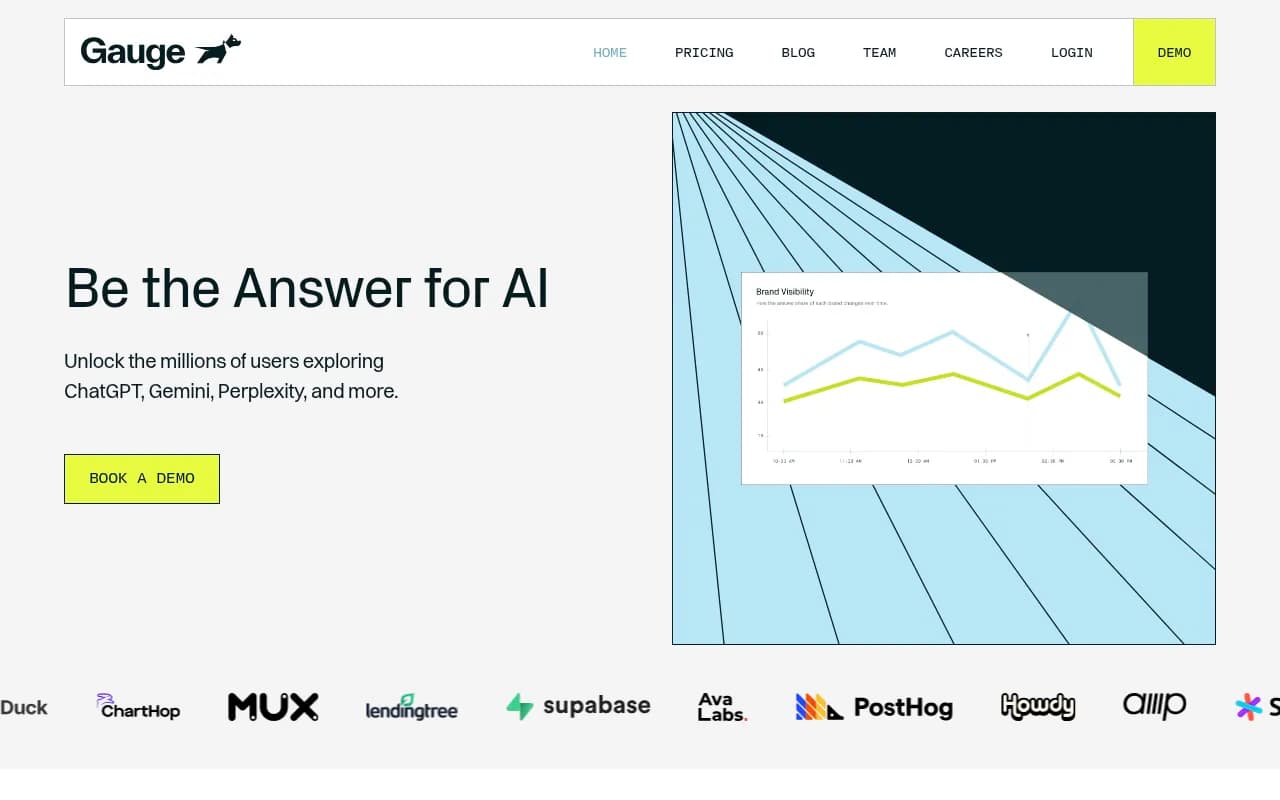
The platform is particularly strong at showing you which competitors are winning for specific prompt categories, and how that's shifted over time. If you're trying to answer "why is Competitor X suddenly appearing in more AI responses than us?" Gauge gives you more structured ways to investigate that question than most tools.
It also has decent coverage across major AI models -- ChatGPT, Perplexity, Gemini, and others -- and the reporting is designed to be shareable, which matters if you're presenting competitive analysis to leadership or clients.
The honest limitation: Gauge is primarily an intelligence layer. It tells you what's happening competitively, but it doesn't help you create content to close the gaps it finds. It's a research tool, not an optimization platform. That's not a flaw exactly -- it's a deliberate positioning choice -- but it means you'll need other tools alongside it to actually act on what you learn.
Rankability: agency-oriented with useful analytics
Rankability is interesting because it's built with agencies in mind. Multi-client management, white-label reporting, and the ability to track AI visibility across a portfolio of brands are all baked into the core product.
For agencies doing competitive analysis on behalf of clients, Rankability gives you a reasonably clean way to show clients how they stack up against competitors in AI search. The analytics layer is solid, and the reporting outputs are polished enough to drop into a client deck without much reformatting.
The gaps are similar to the others: Rankability is strong on the "what's happening" side and weaker on the "here's how to fix it" side. There's no content generation, no crawler log analysis, and no prompt-level traffic attribution. If your agency workflow already includes content teams and you just need better competitive data to brief them with, Rankability fits that model. If you want a single platform that handles the full cycle, you'll hit its ceiling fairly quickly.
Promptwatch: the only tool that closes the loop
The core difference with Promptwatch isn't any single feature -- it's the workflow it enables.

Most platforms in this comparison show you where you're invisible. Promptwatch shows you where you're invisible, then helps you fix it, then tracks whether the fix worked. That cycle -- find gaps, create content, measure results -- is what makes it an optimization platform rather than a monitoring dashboard.
For competitive intelligence specifically, the Answer Gap Analysis is the standout feature. It shows you exactly which prompts your competitors are being cited for that you're not. Not just "you're missing coverage in the project management category" -- but the specific questions and prompts where a competitor shows up and you don't. That level of specificity is what makes the data actionable rather than just interesting.
From there, Promptwatch's Content Agents can generate articles, comparisons, and briefs grounded in that prompt data -- content engineered to answer the specific gaps AI models are already exposing. This isn't generic AI writing; it's content built around real citation patterns and prompt volumes.
The platform also tracks AI crawler activity on your site in real time. You can see which pages ChatGPT, Claude, and Perplexity are actually reading, which ones they're ignoring, and when a page moves from "crawled" to "cited." That kind of visibility into the AI indexing process is something none of the other three tools in this comparison offer.
On the competitive benchmarking side, Promptwatch includes competitor heatmaps that show you who's winning for each prompt across different AI models. Combined with prompt volume estimates and difficulty scores, you can prioritize which competitive gaps are actually worth going after -- rather than trying to close every gap at once.
Pricing is transparent: Essential at $99/month, Professional at $249/month, Business at $579/month. There's a free trial, and annual billing brings the cost down further.
Head-to-head comparison
Here's how the four platforms stack up across the dimensions that matter most for competitive intelligence:
| Feature | AthenaHQ | Gauge | Rankability | Promptwatch |
|---|---|---|---|---|
| Multi-model AI coverage | 8+ models | Major models | Major models | 10+ models |
| Competitor benchmarking | Yes | Strong | Yes | Yes (heatmaps) |
| Prompt gap analysis | Partial | Yes | Limited | Yes (detailed) |
| Content generation | No | No | No | Yes |
| AI crawler logs | No | No | No | Yes |
| Prompt volume/difficulty | No | Partial | No | Yes |
| Reddit/YouTube tracking | No | No | No | Yes |
| ChatGPT Shopping tracking | No | No | No | Yes |
| Traffic attribution | No | No | No | Yes |
| Agency/multi-client | Limited | Limited | Yes | Yes |
| Transparent pricing | No | No | Partial | Yes |
| Free trial | Unclear | Yes | Yes | Yes |
The pattern is clear. AthenaHQ, Gauge, and Rankability are all monitoring-first platforms with varying strengths in competitive analysis. Promptwatch is the only one that extends into content optimization, crawler intelligence, and revenue attribution.
Which tool is right for which team?
There's no universal answer here, so let's be direct about the different scenarios.
If you're a mid-market marketing team that needs to understand the competitive AI search landscape and has a separate content team to act on the findings, AthenaHQ or Gauge both work. AthenaHQ is better if you want a broader monitoring view; Gauge is better if competitive strategy is the primary use case.
If you're an agency managing AI visibility for multiple clients and need clean reporting, Rankability is worth a look -- particularly if your clients are asking for competitive benchmarks they can understand without a technical background.
If you want a single platform that handles the full workflow -- competitive intelligence, content gap identification, content creation, crawler monitoring, and traffic attribution -- Promptwatch is the only option in this comparison that actually delivers that. The fact that it's also the most transparently priced of the four makes the evaluation easier.
One thing worth noting: the tools aren't necessarily mutually exclusive. Some teams use Gauge for strategic competitive research and Promptwatch for the optimization workflow. That said, if budget is a constraint, Promptwatch's competitive intelligence features are strong enough that most teams won't need a second tool alongside it.
The deeper question: monitoring vs. optimization
The real divide in the AI visibility tool market right now isn't between good tools and bad tools. It's between tools that show you the problem and tools that help you solve it.
Monitoring is necessary but not sufficient. Knowing that Competitor X appears in 40% of AI responses for your target category while you appear in 12% is useful information. But it doesn't tell you what to write, which pages to fix, or whether your fixes are working. That's where most platforms leave you stranded.
The teams that are actually moving the needle on AI visibility in 2026 are the ones treating it as an optimization discipline, not just a reporting exercise. That requires a platform built around the full cycle, not just the first step.
AthenaHQ, Gauge, and Rankability are all legitimate tools with real strengths. But if competitive intelligence is the starting point rather than the destination -- if the goal is to actually close the gap, not just measure it -- Promptwatch is where that work gets done.