Key takeaways
- ChatGPT Shopping ranks products based on structured data, review signals, and how well your content answers specific buying questions -- not paid placement.
- Getting cited in AI search requires a different approach than traditional SEO: schema markup, conversational product descriptions, and third-party mentions all matter more than keyword density.
- Dedicated AI visibility tools let you track which prompts surface your products, where competitors are winning, and what content gaps you need to fill.
- Monitoring alone isn't enough -- the brands gaining ground in 2026 are the ones using tools that help them act on the data, not just look at it.
- Google AI Overviews now appear on 14% of all shopping queries (up 5.6x in four months), so the opportunity extends well beyond ChatGPT.
Why ChatGPT Shopping changes everything for e-commerce
A few years ago, "product discovery" meant Google Shopping ads, SEO-optimized category pages, and maybe some influencer posts. That playbook still works, but it's no longer the whole game.
According to G2's 2025 Buyer Behavior Report, generative AI chatbots are now the #1 influence over vendor shortlists -- ahead of review sites, vendor websites, and salespeople. Shoppers are typing things like "best running shoes for flat feet under $120" directly into ChatGPT, and they're trusting what comes back.
ChatGPT Shopping is the product recommendation layer inside ChatGPT. It pulls from web sources, structured product data, and review signals to surface specific items with images, prices, and links. Critically, there's no paid placement. ChatGPT doesn't take ad money for these recommendations -- it ranks purely by relevance and authority as it understands them.
That's both the opportunity and the challenge. You can't buy your way in. You have to earn it.
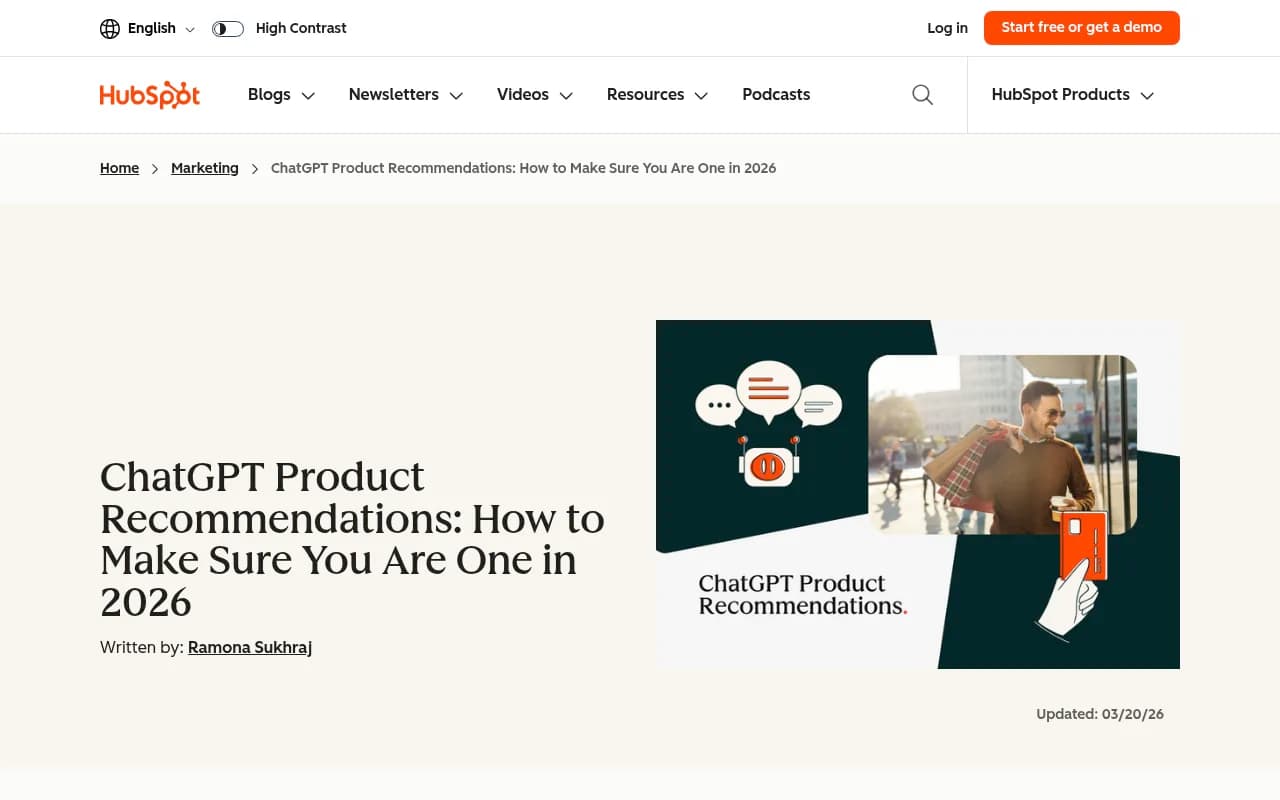
And it's not just ChatGPT. Google AI Overviews now appear on 14% of all shopping queries, a 5.6x increase in just four months. Perplexity, Gemini, and Claude are all fielding shopping questions too. The brands that figure out AI citation now will have a significant head start as this traffic channel matures.
How AI models actually decide what to recommend
Before you can optimize for AI shopping, you need to understand what these models are actually looking at. It's not a single ranking factor -- it's a combination of signals.
Structured product data
AI models are essentially reading your website the way a very literal-minded researcher would. If your product pages are a wall of marketing copy with no clear structure, the model struggles to extract useful information. Schema markup (specifically Product, Offer, and Review schema) makes your data machine-readable. Price, availability, ratings, and product specifications should all be explicitly marked up.
Review signals and social proof
ChatGPT doesn't just look at your own website. It pulls from third-party review sources, Reddit discussions, YouTube videos, and other external mentions. A product with 400 reviews on multiple platforms and genuine community discussion is far more likely to get cited than one with a polished product page and no external footprint.
This is one of the more counterintuitive aspects of AI SEO: your off-site presence matters as much as your on-site optimization.
Conversational content that answers buying questions
Traditional product descriptions are written for humans browsing a page. AI-optimized descriptions are written to answer specific questions. "Is this waterproof?" "Does it work for wide feet?" "How does it compare to [competitor]?" If your product pages directly address the questions people ask AI models, you're more likely to get cited when those questions come up.
Long-tail FAQ sections, comparison content, and use-case-specific copy all help here.
Brand authority and consistent entity presence
AI models build a picture of your brand from everything they've indexed. Consistent NAP (name, address, phone) data, a clear brand entity in structured data, and a coherent presence across your website and third-party sources all contribute to how confidently an AI model will recommend you.
The optimization checklist: what to actually do
Here's a practical breakdown of what moves the needle for AI shopping visibility.
Technical foundation:
- Implement
Productschema with price, availability, brand, and aggregate rating - Add
FAQPageschema to product and category pages - Make sure your product feed is clean and up to date (ChatGPT pulls from Bing's product index in some cases)
- Fix crawl errors -- AI crawlers encounter the same access issues as search engine bots
Content strategy:
- Write product descriptions that answer specific buying questions, not just describe features
- Create comparison pages ("X vs Y") and use-case guides ("best X for Y")
- Build out FAQ sections on product pages using actual questions from customer reviews and search data
- Publish category-level buying guides that position your brand as a trusted source
Off-site presence:
- Actively gather reviews on Google, Trustpilot, and category-specific review sites
- Seed Reddit discussions in relevant subreddits (authentically -- not spam)
- Get your products mentioned in YouTube reviews and comparison videos
- Pursue editorial coverage and listicles on authoritative sites in your niche
Monitoring:
- Track which prompts surface your products vs competitors
- Watch for AI crawler activity on your site
- Measure citation frequency across ChatGPT, Perplexity, Google AI Overviews, and other models
Tools for tracking and improving your AI shopping visibility
This is where most e-commerce teams get stuck. The optimization work above is straightforward in theory, but you need data to prioritize it -- which prompts are worth targeting, where competitors are beating you, and whether your changes are actually working.
The tool landscape has expanded fast. Here's a breakdown of the main categories and what's worth considering.
End-to-end AI visibility platforms
These platforms go beyond just showing you data -- they help you act on it. For e-commerce teams serious about AI search, this is the category to focus on.
Promptwatch is the most complete option here. It tracks your visibility across 10 AI models (ChatGPT, Perplexity, Google AI Overviews, Claude, Gemini, Grok, DeepSeek, and more), shows you exactly which prompts competitors are visible for that you're not, and includes a built-in AI writing agent that generates content engineered to get cited. The ChatGPT Shopping tracking feature is particularly relevant for e-commerce -- it monitors when your brand appears in product recommendations and shopping carousels specifically. It also logs AI crawler activity on your site, so you can see which pages ChatGPT and Perplexity are actually reading and fix any access issues.

AthenaHQ covers 8+ AI engines and has solid monitoring capabilities. It's more focused on tracking than optimization -- you'll get good visibility data but less help turning that data into content.

Profound is another strong monitoring platform with good brand visibility tracking. Like AthenaHQ, it tends to stop at the data layer rather than helping you act on it.

AI visibility monitoring tools
If you're earlier in your AI SEO journey and just need to start tracking, these tools are more accessible entry points.
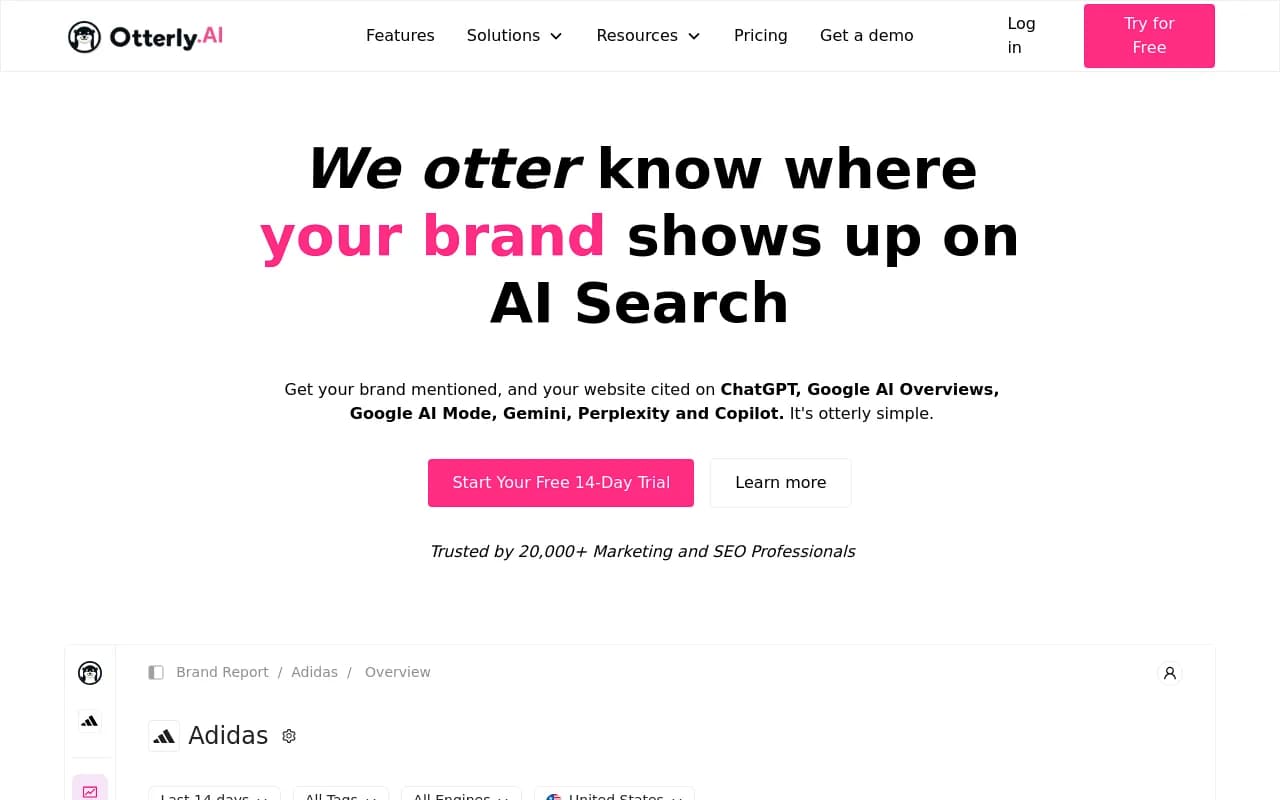
Otterly.AI is a clean, affordable monitoring tool that tracks brand mentions across major AI models. Good for getting a baseline read on your visibility without a big investment.
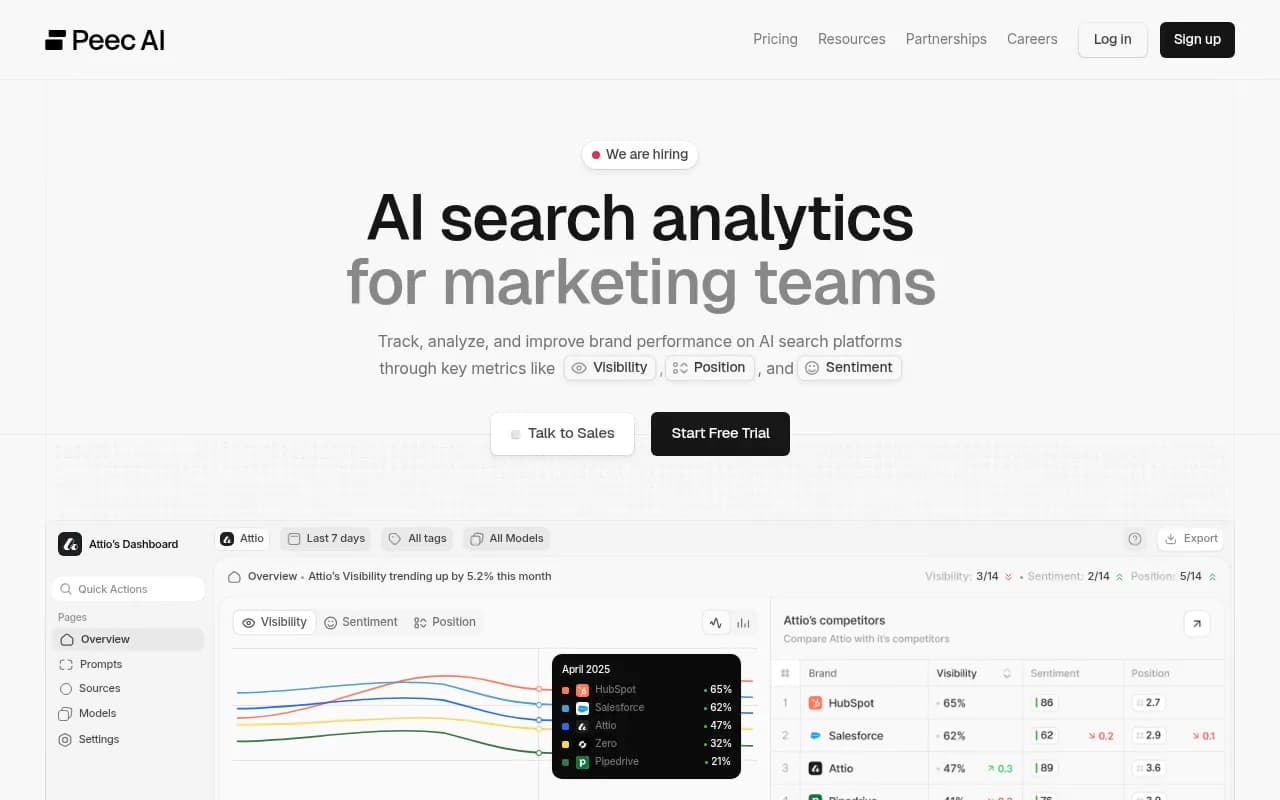
Peec AI handles multi-language tracking well, which matters if you're selling internationally and want to monitor how AI models in different markets talk about your products.
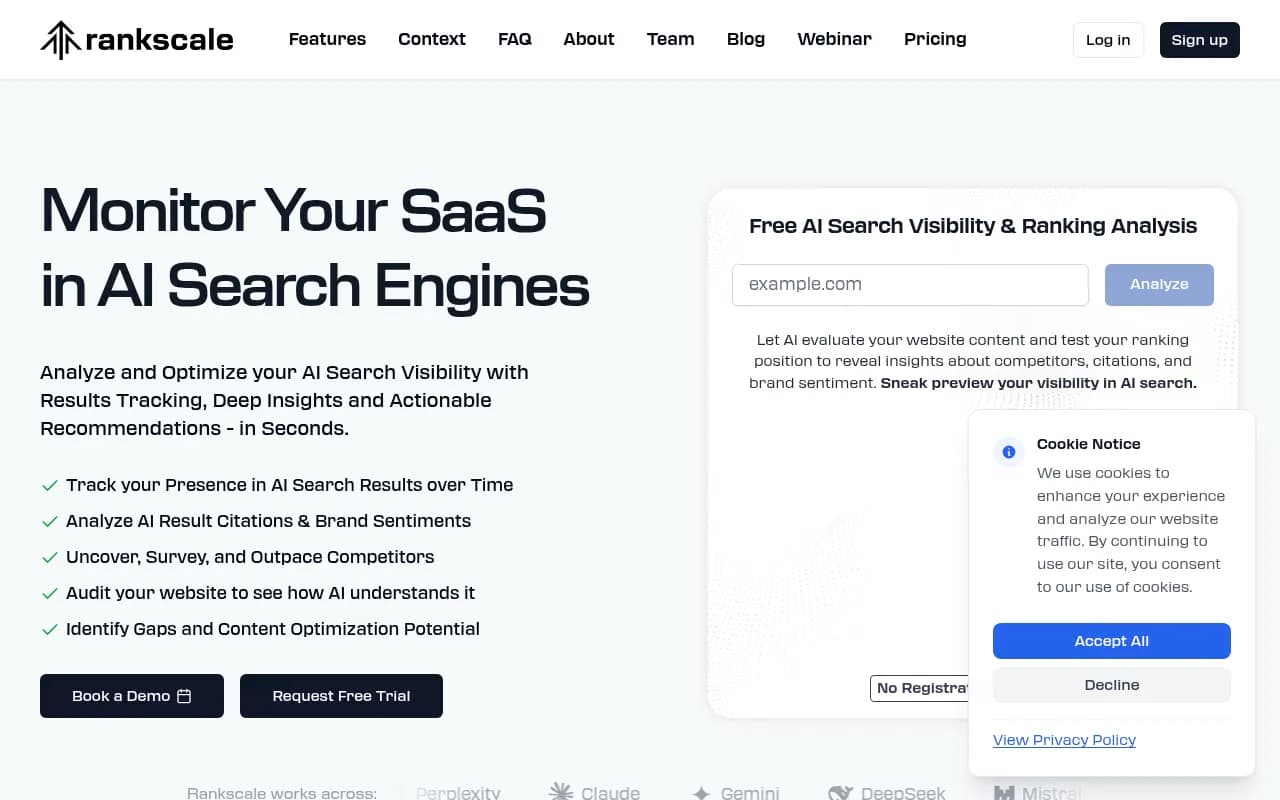
Rankscale focuses on AI search ranking and visibility with a clean interface that's easy to get started with.
Enterprise and agency-grade tools
For larger e-commerce operations or agencies managing multiple brands, a few platforms are built for that scale.
Semrush has added AI visibility features to its existing SEO suite. If you're already a Semrush user, the AI monitoring capabilities are worth exploring, though they use fixed prompts rather than custom ones.
BrightEdge is an enterprise SEO platform that has been building out AI search visibility tracking. It's built for large teams with complex reporting needs.
seoClarity is another enterprise option with AI search visibility tracking layered onto a comprehensive SEO platform.
Specialized e-commerce AI optimization
Azoma is worth a specific mention here -- it's built specifically for AI shopping optimization across ChatGPT, Amazon Rufus, and other AI-powered shopping surfaces. If your primary concern is product-level visibility rather than brand-level visibility, it's a focused option.
Comparison: key AI visibility tools for e-commerce
| Tool | ChatGPT Shopping tracking | Content generation | Crawler logs | Multi-model | Best for |
|---|---|---|---|---|---|
| Promptwatch | Yes | Yes (built-in) | Yes | 10 models | Full optimization cycle |
| AthenaHQ | Partial | No | No | 8+ models | Monitoring-focused teams |
| Profound | No | No | No | Multiple | Brand visibility tracking |
| Otterly.AI | No | No | No | Multiple | Budget monitoring |
| Azoma | Yes | No | No | Shopping-focused | Product-level AI shopping |
| Semrush | No | Via ContentShake | No | Limited | Existing Semrush users |
| BrightEdge | No | No | No | Multiple | Enterprise SEO teams |
The table makes the gap pretty clear. Most tools in this space are monitoring dashboards. They show you where you stand, but they don't help you change it. For e-commerce teams that want to actually move their AI visibility numbers, the tools with content generation and gap analysis capabilities are the ones worth prioritizing.
Building a content strategy that gets cited
Tracking is step one. The harder work is creating content that AI models actually want to cite.
The core insight here is that AI models cite content that directly and confidently answers specific questions. Generic product pages don't get cited. Authoritative, specific, well-structured content does.
What "AI-ready" product content looks like
Take a product like a standing desk. A traditional product page might say: "Our premium standing desk features a sturdy frame, smooth height adjustment, and a spacious work surface. Available in three colors."
An AI-ready product page answers the questions people actually ask: "What's the weight capacity?" "How long does it take to assemble?" "Is it suitable for dual monitors?" "How does it compare to Flexispot?" "What do people with back problems say about it?"
The second version is more useful to a human shopper, and it's also far more likely to get cited when someone asks ChatGPT "what's the best standing desk for someone with back pain?"
Category and comparison content
Some of the highest-value content for AI citations isn't on product pages at all -- it's in buying guides and comparison articles. When someone asks ChatGPT "what are the best standing desks in 2026?", the model often cites a well-structured buying guide rather than individual product pages.
Publishing authoritative category guides on your own site (or getting featured in them on third-party sites) is one of the most direct ways to increase your AI citation rate.
The review and community layer
AI models pay attention to what real people say about products in forums, review sites, and communities. This isn't something you can fake, but you can encourage it. Follow-up emails asking for reviews, engaging authentically in relevant Reddit communities, and making it easy for customers to share their experiences all contribute to the off-site signal that AI models use to validate product quality.
Measuring what's working
One of the trickier parts of AI SEO is attribution. When someone discovers your product through a ChatGPT recommendation and then visits your site, they often show up in analytics as direct traffic. Standard UTM tracking doesn't capture the AI referral.
A few approaches help here:
- Server log analysis can identify traffic from AI crawler user agents (GPTBot, ClaudeBot, PerplexityBot, etc.)
- Some AI visibility platforms offer traffic attribution by cross-referencing citation data with site analytics
- Google Search Console integration can help identify traffic from Google AI Overviews specifically
Promptwatch handles this with a code snippet, GSC integration, or server log analysis -- connecting AI visibility data to actual site traffic so you can see whether your citation improvements are translating into visits and revenue.
The metrics worth tracking on a regular basis:
- Citation frequency by model (how often does ChatGPT mention your brand/products?)
- Share of voice vs competitors for key shopping prompts
- Which specific pages are being cited and by which models
- AI crawler activity (are bots actually reading your product pages?)
- Traffic from AI referrals over time
Where to start if you're new to this
If you haven't done anything for AI shopping visibility yet, here's a practical starting point:
-
Run a technical audit focused on schema markup. Use Google's Rich Results Test to check your product schema. Fix anything that's missing or broken.
-
Pick 10-20 high-value shopping prompts relevant to your products. Think about how a real customer would ask ChatGPT for a product recommendation in your category.
-
Set up monitoring for those prompts using one of the tools above. See where you currently stand and where competitors are appearing that you're not.
-
Identify the content gaps. Where are competitors getting cited for prompts you're not showing up for? What content would you need to create to answer those prompts better?
-
Create that content -- buying guides, comparison pages, detailed FAQ sections -- and track whether your citation rate improves over 60-90 days.
The cycle isn't complicated, but it does require consistency. AI models update their knowledge continuously, and the brands that keep publishing relevant, authoritative content are the ones that maintain their citation rates over time.
The shift to AI-powered product discovery is real and it's accelerating. The brands building their AI visibility infrastructure now -- the schema, the content, the monitoring -- are the ones that will be hardest to displace when this channel matures further.