Key takeaways
- Being cited in an AI Overview drives 35% more clicks than ranking in position 1 without a citation -- but NOT being cited when an AI Overview appears cuts your CTR by up to 65%
- Informational queries have seen 30-40% organic traffic declines; AI Mode searches end without a click 93% of the time
- AI-referred traffic converts at 23x the rate of standard organic traffic -- so fewer clicks doesn't mean less revenue
- The AI referral market has fragmented: ChatGPT's share of B2B AI referrals dropped from 89% to 63% in eight months, with Claude, Gemini, and Perplexity picking up the difference
- Citation type matters enormously -- inline source links, shopping citations, and "learn more" panels behave very differently in terms of click probability
There's a version of this story that's easy to tell: AI search is killing organic traffic, full stop. Zero-click searches are up, CTRs are down, and everyone's panicking.
But that version misses something important. The real picture is messier and more interesting. Yes, some citation types are essentially dead ends -- your brand appears in an AI answer and nobody clicks. But others are sending highly qualified traffic that converts at rates traditional SEO can only dream about. The difference between the two isn't random. It's structural, and once you understand it, you can actually do something about it.
Here's what the 2026 data actually shows.
The baseline: how bad is the CTR situation?
Let's start with the numbers that are genuinely alarming.
Google AI Overviews now appear in roughly 13% of all queries -- up from under 5% during the 2025 limited rollout. When an AI Overview is present, position 1 organic CTR drops 18%. Position 2 drops up to 39%. For informational queries specifically (definitions, how-tos, explanations), organic traffic has fallen 30-40% across the board.
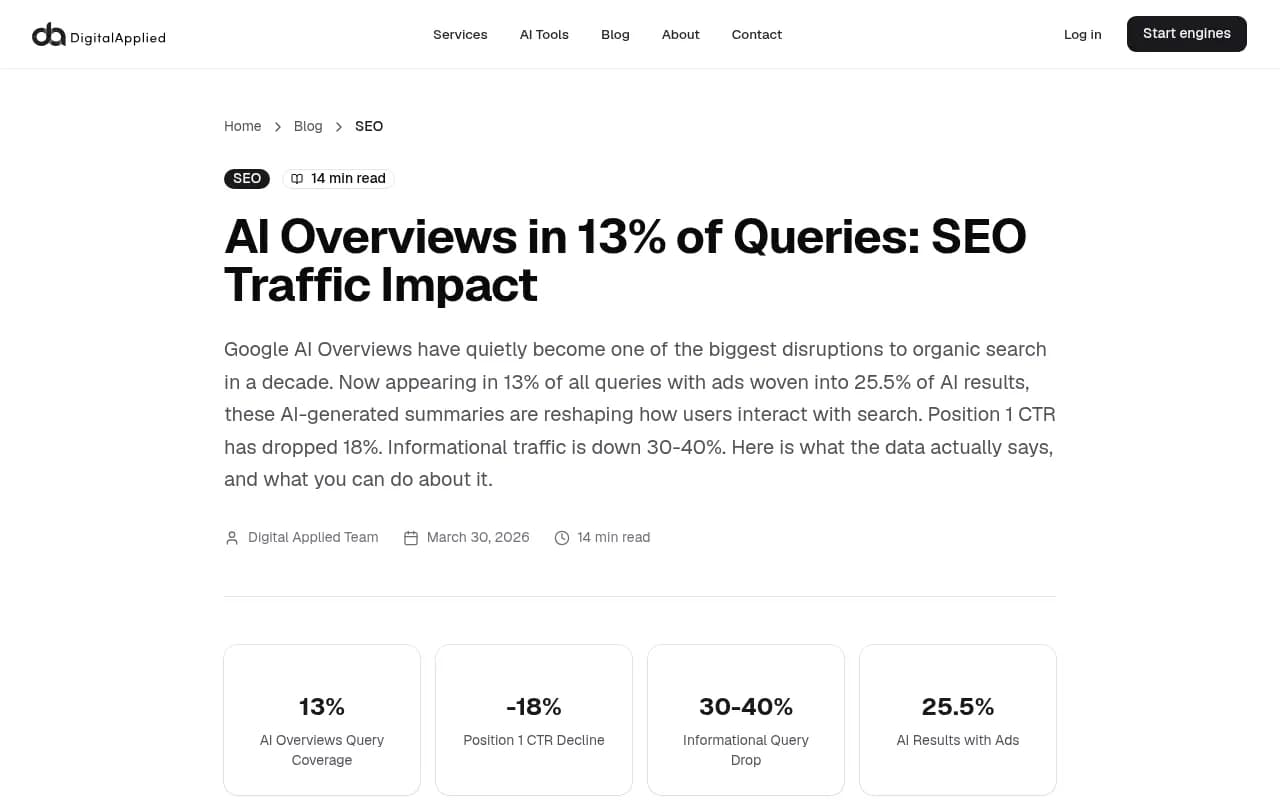
And Google AI Mode -- the more conversational, agentic version -- is even more extreme. According to ZipTie's analysis, 93% of AI Mode searches end without a click to any external website.
Overall, more than 58.5% of Google searches now end without a click. AI answers are the primary driver of that figure.
So yes, the traffic decline is real. But here's the thing: not all of that traffic was valuable to begin with. And the traffic that IS coming through AI citations? It's converting at rates that should make you rethink how you measure success.
The citation premium: why being cited changes everything
This is the number that reframes the whole conversation: brands cited in AI Overviews see a 35% CTR increase compared to non-cited results at equivalent positions.
Think about what that means. If you're not cited, you lose 18-65% of your clicks depending on your position. If you ARE cited, you gain 35%. That's not a marginal difference -- it's the difference between AI search being an existential threat and a competitive advantage.
The conversion data is even more striking. AI-referred traffic converts at 23x the rate of standard organic traffic. The users who click through from an AI citation have already had their intent validated by the AI's response. They're not browsing -- they're ready to act.
So the question isn't really "is AI search good or bad for traffic?" It's "are you being cited, and what kind of citation are you getting?"
Citation types: a practical breakdown
Not all citations work the same way. Here's how the main types actually behave in 2026.
Inline source citations (the "learn more" links)
These are the numbered or linked sources that appear within the body of an AI Overview or a Perplexity response. They're the most common citation type and, in terms of raw click volume, the most valuable.
When a user sees a specific claim attributed to your site with a visible link, click probability is meaningfully higher than for citations buried in a "sources" panel at the bottom. The positioning matters: citations that appear alongside specific factual claims get clicked more than generic "sources" footers.
The catch is that these citations are competitive. According to ZipTie's research, 76.1% of AI-cited URLs already rank in the top 10 organic results. Strong traditional SEO is still the foundation. AI citation doesn't replace organic ranking -- it layers on top of it.
Shopping and product citations
ChatGPT's shopping carousels and Google's AI Mode shopping integrations are a different beast entirely. When your product appears in a shopping citation, the user intent is transactional by definition. Click rates for shopping citations are significantly higher than informational citations because the user is actively evaluating a purchase.
Google now shows ads in 25.5% of AI Overview results -- up from 5.17% in early 2025. Shopping ads with Direct Offers are appearing inside AI Mode conversations. This is a paid channel, but it signals where Google sees the commercial value of AI search going.
For e-commerce brands, shopping citations are the highest-priority citation type to pursue. Tools like Promptwatch specifically track when brands appear in ChatGPT's product recommendations and shopping carousels, which is a capability most monitoring tools don't have.

"Sources" panel citations (the dead end problem)
Here's where things get uncomfortable. Many AI responses include a collapsible "sources" or "references" panel at the bottom -- and citations that only appear there get almost no clicks.
Users have learned to trust the AI's synthesized answer. If your content is being used to generate the response but you're only appearing in the sources panel rather than being cited inline, you're getting zero-click attribution at best. Your content is training the AI's answer, but you're not getting the traffic.
This is a real problem for publishers who can see their content being paraphrased in AI responses but aren't getting the inline citation treatment. The content is contributing to the answer; the brand isn't benefiting from it.
Featured snippet-style citations
When an AI response essentially reproduces your content verbatim (or near-verbatim) with a clear attribution, click rates are higher than for synthesized citations. Users who want the full context, the original source, or more detail will click through.
This is why structured, quotable content -- clear definitions, specific statistics, step-by-step processes -- tends to generate more clicks than generic explanatory prose. The AI can quote a specific stat with attribution more easily than it can attribute a vague explanation.
Reddit and forum citations
This one surprises people. Reddit threads and forum discussions appear frequently in AI citations, and they actually drive meaningful traffic -- partly because users trust community-sourced answers for certain query types, and partly because the citation format often includes enough context to make the click feel worthwhile.
For brands, this means Reddit presence isn't just a brand awareness play. Discussions on Reddit that mention your product or service can directly influence AI recommendations and drive citation traffic.
The fragmentation problem: you can't optimize for one engine anymore
Eight months ago, optimizing for ChatGPT meant optimizing for 89% of AI referral traffic. That's no longer true.
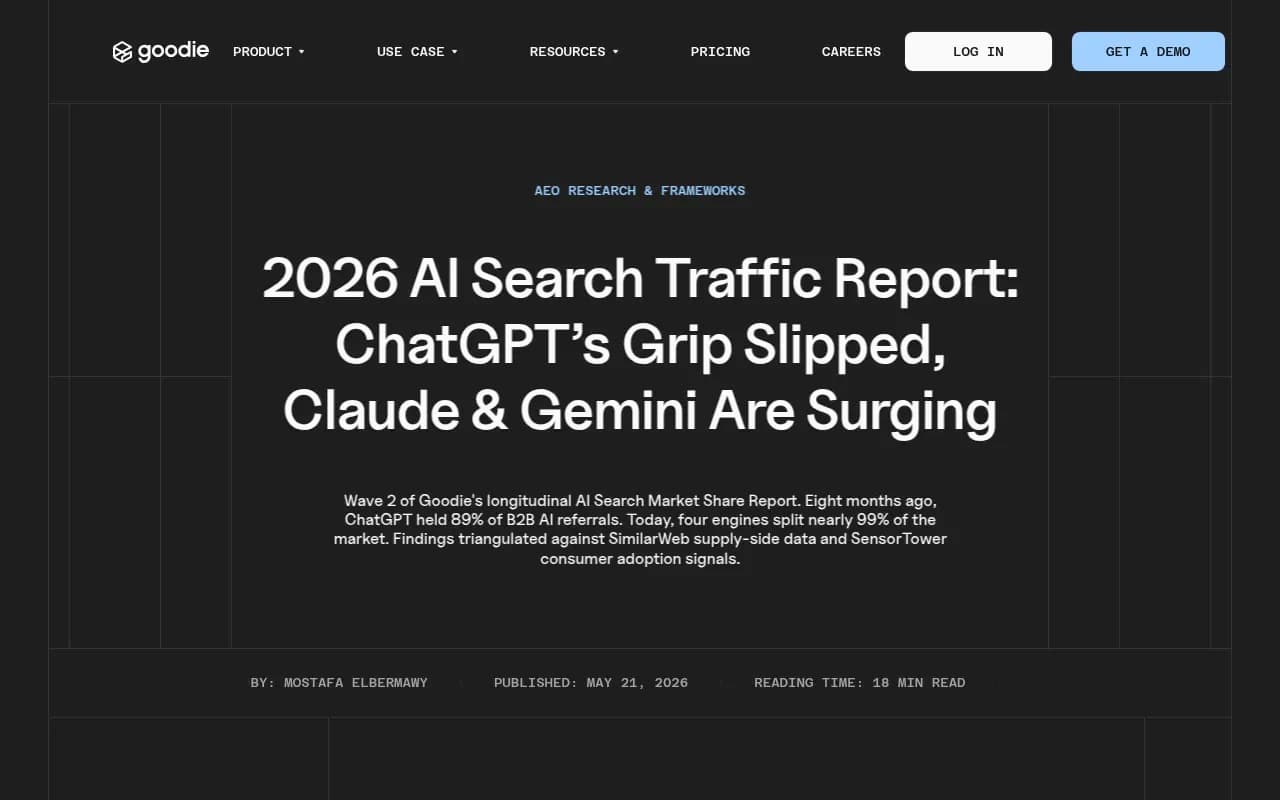
According to Goodie's Wave 2 AI Search Traffic Report (May 2026), the current breakdown of B2B AI referrals looks like this:
| AI engine | Wave 1 (May-Aug 2025) | Recent avg (Mar-Apr 2026) | Change |
|---|---|---|---|
| ChatGPT | 89.1% | 62.6% | -26.5pp |
| Claude | 1.4% | 18.5% | +17.1pp |
| Gemini | 2.4% | 10.6% | +8.2pp |
| Perplexity | 3.1% | 7.3% | +4.2pp |
| Copilot | 3.2% | 4.0% | +0.8pp |
Claude went from essentially nothing to nearly one in five AI referrals in eight months. Gemini quadrupled. Each of these engines has different retrieval logic, different citation behavior, and different user intent patterns.
This fragmentation has a direct impact on CTR strategy. A citation that drives clicks on Perplexity (which tends toward research-oriented users who want sources) behaves differently from a ChatGPT citation (where users are more likely to trust the synthesized answer and not click through).
Perplexity users click through at higher rates than ChatGPT users, partly because Perplexity's interface makes sources more prominent and partly because its user base skews toward people who want to verify information. Claude citations are newer and the click behavior is still being established.
The practical implication: you need visibility across multiple engines, and you need to understand which engines are actually sending you traffic versus which are citing you in a zero-click context.
Which query types still drive clicks?
Not all query categories are equally affected by the AI zero-click problem. Here's a rough breakdown of where clicks are still happening versus where they've largely disappeared.
| Query type | AI Overview frequency | Typical CTR impact | Click likelihood |
|---|---|---|---|
| Informational / how-to | Very high | -30 to -40% | Low |
| Definitions / explanations | Very high | -40 to -50% | Very low |
| Commercial / comparison | Growing | -15 to -25% | Medium |
| Transactional / product | Growing | Variable | Medium-high |
| Local / navigational | Moderate | -10 to -20% | Medium-high |
| Brand queries | Low | Minimal | High |
| Technical / niche | Low | Minimal | High |
Informational queries are the hardest hit because the AI can fully answer them without the user needing to click anywhere. "What is X?" and "How does Y work?" are essentially solved problems for AI -- the answer is complete in the response.
Commercial and comparison queries are more complex. AI can summarize the landscape, but users making actual purchase decisions still want to visit the source. These are the queries where citation traffic is most likely to convert.
Brand queries are largely unaffected by the zero-click problem. If someone searches for your brand specifically, they're going to your site regardless of what the AI says.
What actually drives click-through from AI citations
Based on the available data, a few patterns emerge for what makes AI citations more likely to generate actual clicks.
Specificity beats generality. A citation that says "according to [Brand]'s 2026 study, X% of users..." is more clickable than a citation that attributes a vague claim. Users click to verify specific numbers and to get the full study.
Unique data and original research get cited and clicked. If your content contains proprietary data, survey results, or original analysis that the AI can't synthesize from multiple sources, you're more likely to get an inline citation rather than a sources-panel burial.
Structured content is easier to cite. Pages with clear headers, defined terms, and structured data appear 60% more often in AI-generated answers. Schema markup isn't just a technical SEO play anymore -- it's a citation optimization play.
Depth signals authority. AI models tend to cite sources that comprehensively cover a topic. Thin content that covers a topic at a surface level is more likely to be synthesized without attribution than deep content that becomes the authoritative reference.
The measurement gap: why most teams are flying blind
Here's a problem that doesn't get enough attention: most analytics setups can't distinguish AI-driven visibility from traditional organic traffic.
GA4 and Search Console weren't built for this. When Perplexity cites your page and a user clicks through, that traffic often shows up as direct or as referral from perplexity.ai -- but you can't easily connect it to the specific prompt that generated the citation, the AI model's response, or whether your brand appeared favorably or unfavorably in the answer.
This measurement gap means teams are making optimization decisions without knowing which of their pages are actually being cited, which AI engines are sending traffic, and whether their AI visibility efforts are working.
Purpose-built monitoring tools are filling this gap. Platforms like Promptwatch track which pages are being cited, how often, and by which models -- and connect that visibility data to actual traffic through GSC integration, code snippets, or server log analysis.
Other tools take different approaches to the measurement problem:

The key capability to look for is page-level citation tracking -- not just "your brand was mentioned X times" but "this specific page was cited in these specific AI responses, and here's the traffic it generated."
The conversion math: why fewer clicks can mean more revenue
This is worth sitting with for a moment. The data from ZipTie shows AI-referred traffic converting at 23x the rate of standard organic traffic. That's not a typo.
If your site was getting 10,000 organic visitors per month converting at 2%, that's 200 conversions. If AI search cuts that to 5,000 visitors but the AI-referred portion converts at 46% (23x the 2% baseline), the math can still work out -- depending on what percentage of your traffic is AI-referred.
The users who click through from an AI citation are different from typical organic visitors. They've already received a synthesized answer. They're clicking because they want more -- more detail, the original source, to make a purchase, to contact you. The intent is higher, the friction is lower.
This doesn't mean traffic declines don't matter. They do. But it means the right metric isn't just "how many clicks am I getting from AI search?" It's "what is the revenue contribution of my AI-cited traffic, and how does it compare to my traditional organic traffic?"
Most teams aren't measuring this yet. The ones that are tend to find that AI visibility is worth more than raw traffic numbers suggest.
What to do about it
A few concrete directions based on the data:
Build content that contains citable specifics. Original research, proprietary data, specific statistics, and clear definitions are what AI models cite inline rather than bury in sources panels. Generic explanatory content is more likely to be synthesized without attribution.
Stop optimizing only for ChatGPT. With Claude at 18.5% of B2B AI referrals and Gemini at 10.6%, a ChatGPT-only strategy now misses roughly a third of the AI traffic landscape. Each engine has different retrieval behavior -- what gets cited on Perplexity isn't always what gets cited on Claude.
Fix your measurement before you optimize. You can't improve what you can't see. Get page-level citation tracking in place so you know which content is being cited, by which engines, and whether those citations are generating traffic.
Prioritize commercial and transactional queries. Informational queries are largely lost to zero-click AI answers. The citation traffic that converts comes from commercial intent queries where users are evaluating options and making decisions.
Don't ignore Reddit and community signals. AI models cite Reddit discussions more than most brands realize. Active, helpful participation in relevant communities isn't just brand awareness -- it's a citation channel.
The brands winning in AI search right now aren't the ones who figured out some trick. They're the ones who understood that the game changed from "rank high" to "get cited" -- and built their content strategy around being the source AI models reach for when they need a specific, authoritative answer.
That shift is still early. Most competitors haven't made it yet. That's the window.