Key takeaways
- Conductor and BrightEdge are strong enterprise SEO platforms that have added AEO monitoring layers, but their roots are in traditional search -- which shows in the depth of their AI-specific features.
- seoClarity has solid AI search tracking but remains primarily a data and reporting platform; it doesn't help you act on what you find.
- Promptwatch is purpose-built for AI search visibility and is the only platform in this comparison that closes the full loop: find gaps, generate content, track results.
- If your team needs to move beyond dashboards and actually improve AI citation rates, the tool you choose matters a lot.
The AEO tool market has gotten crowded fast. Two years ago, most SEO platforms were scrambling to add a "ChatGPT monitoring" tab to their dashboards. Now there are dozens of tools claiming to help you rank in AI search -- and the differences between them are significant.
This comparison focuses on four platforms that enterprise and mid-market teams are actively evaluating in 2026: Promptwatch, Conductor, BrightEdge, and seoClarity. Each takes a different approach to answer engine optimization, and the gap between "monitoring dashboard" and "optimization platform" turns out to matter quite a bit.
What we're actually comparing
Before getting into the tools, it's worth being precise about what "AEO features" means. There are really three distinct capabilities:
- Monitoring -- tracking where your brand appears (or doesn't) in AI-generated responses
- Analysis -- understanding why you're cited or not, which competitors are winning, and what content gaps exist
- Optimization -- actually doing something about it: generating content, fixing technical issues, and closing gaps
Most tools do step one reasonably well. Fewer do step two with any depth. Almost none do step three. That's the lens through which this comparison is written.
Platform overviews
Promptwatch

Promptwatch is a purpose-built AI search visibility platform used by 6,700+ brands and agencies. It monitors 10 AI models -- ChatGPT, Perplexity, Claude, Gemini, Google AI Overviews, Google AI Mode, Grok, DeepSeek, Meta AI, Copilot, and Mistral -- and tracks over 1.1 billion citations, clicks, and prompts.
What separates it from the other tools in this comparison is the action loop. The Answer Gap Analysis shows you exactly which prompts your competitors rank for but you don't -- not as a vague "opportunity" metric, but as specific questions and topics your site isn't answering. From there, a built-in AI writing agent generates content grounded in real citation data, prompt volumes, and competitor analysis. Then page-level tracking shows whether that content is actually getting cited.
It also has features the others don't: real-time AI crawler logs (so you can see when ChatGPT or Perplexity actually crawls your pages), ChatGPT Shopping tracking, Reddit and YouTube citation analysis, and query fan-outs that show how a single prompt branches into sub-queries.
Pricing starts at $99/month for the Essential plan (1 site, 50 prompts, 5 articles), $249/month for Professional (2 sites, 150 prompts, 15 articles, crawler logs), and $579/month for Business (5 sites, 350 prompts, 30 articles).
Conductor
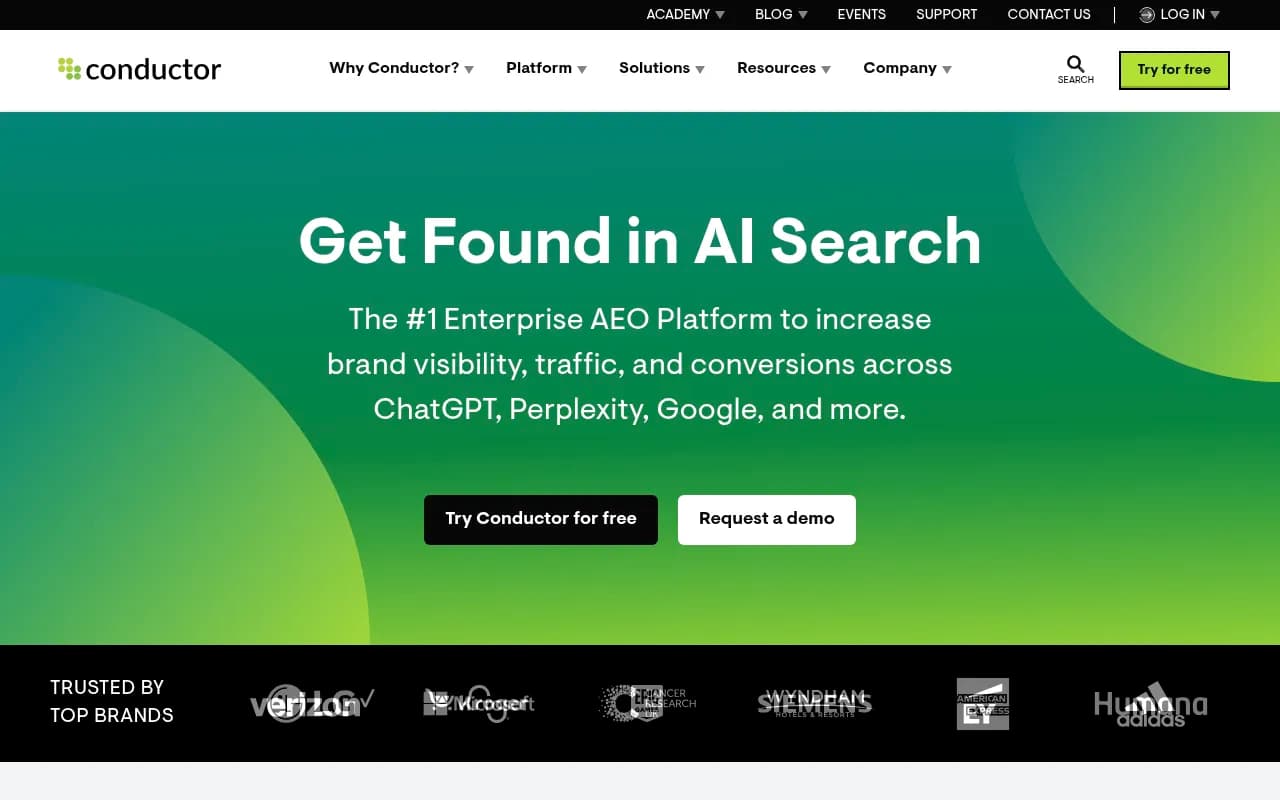
Conductor is a well-established enterprise content intelligence platform that added AI search monitoring to its core SEO suite. Its AEO features include tracking brand mentions across AI engines, persona-based prompt testing, and some content optimization guidance.
The persona customization is genuinely useful -- you can simulate how different audience segments phrase queries and see how AI responses differ. For teams already using Conductor for traditional SEO, the AI monitoring layer integrates reasonably well into existing workflows.
Where it falls short is depth. Conductor's AI monitoring is an add-on to a platform built around Google rankings. The citation analysis isn't as granular as purpose-built tools, and there's no content generation capability tied to the AI visibility data. You get the "what" but not much help with the "so what."
It's also priced for enterprise -- expect custom quotes rather than transparent tiers.
BrightEdge
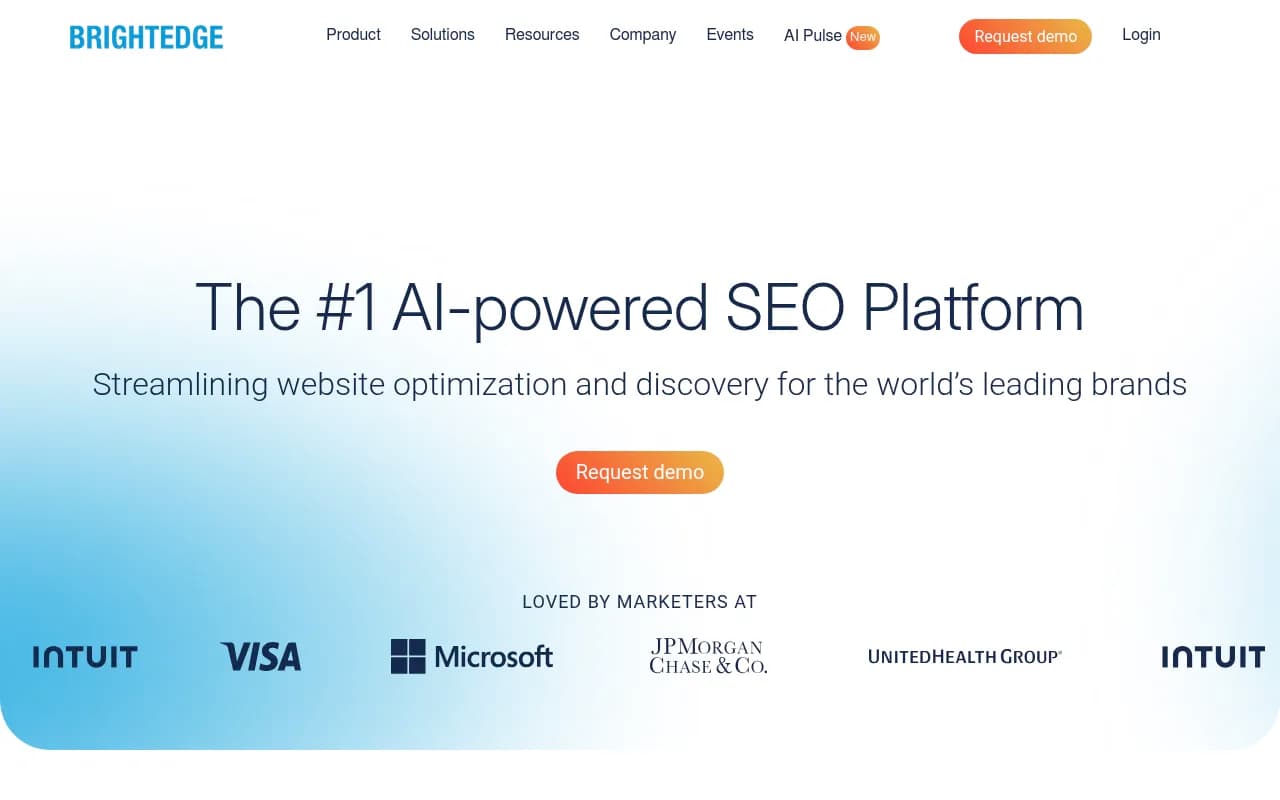
BrightEdge has been an enterprise SEO staple for years, and its AI Catalyst product is the company's answer to the AEO market. It tracks AI-generated responses across major engines and provides share-of-voice data across both traditional and AI search in a unified view.
The unified view is the main selling point. If your team is already managing large-scale SEO programs in BrightEdge, having AI visibility data in the same interface reduces context-switching. The platform also has solid data infrastructure and enterprise-grade reliability.
The limitations are real, though. BrightEdge's AI features are monitoring-focused. There's no content gap analysis that shows you which specific prompts competitors are winning, no built-in content generation, and no AI crawler log visibility. For teams that want to understand and improve their AI citation rates rather than just report on them, BrightEdge requires significant manual work to translate data into action.
Pricing is enterprise-only with custom contracts.
seoClarity
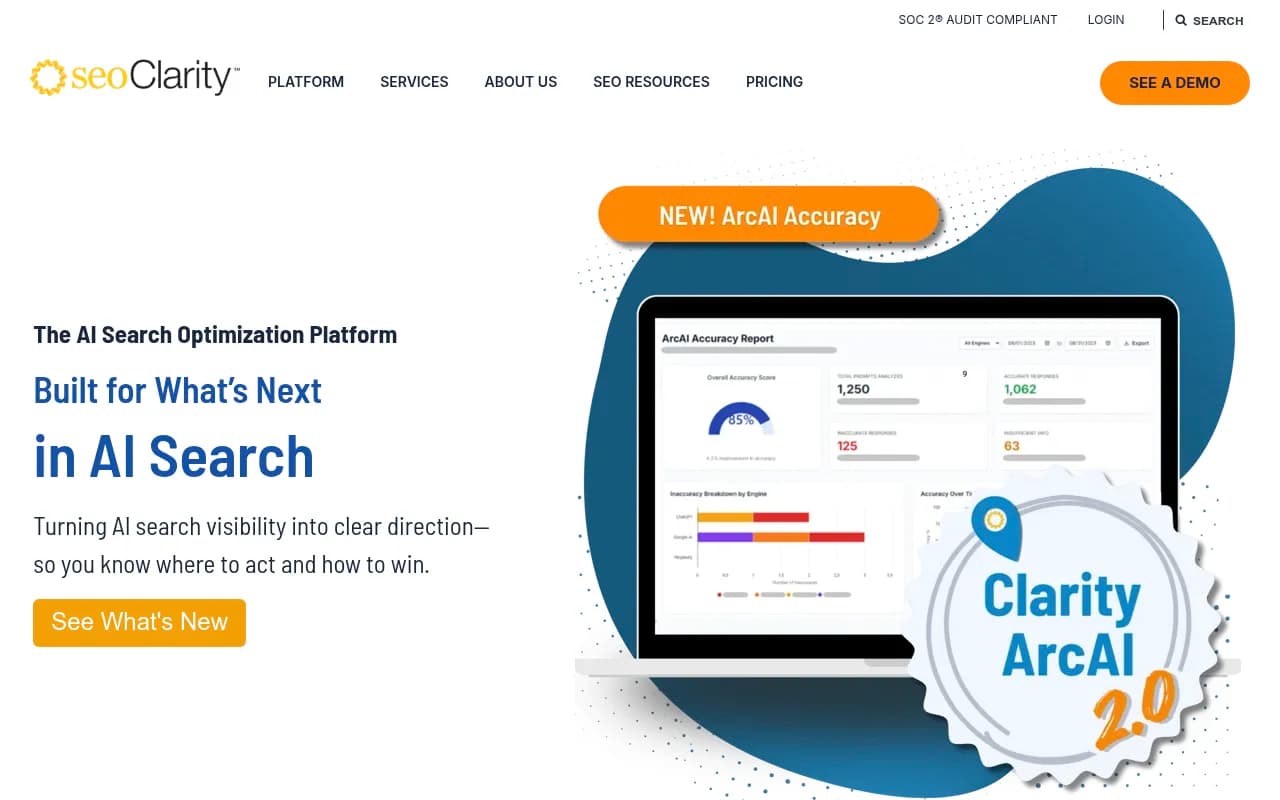
seoClarity is an enterprise SEO platform with a strong data layer and a growing set of AI search tracking features. Its Clarity Grid technology processes large volumes of SERP and AI response data, and the platform has added AI Overview tracking and some LLM citation monitoring.
For data-heavy teams -- think large e-commerce sites or publishers with thousands of pages -- seoClarity's data infrastructure is impressive. The platform handles scale well and integrates with data warehouses for custom analysis.
The honest limitation: seoClarity is a reporting and analytics platform at its core. The AI search features show you data, but the workflow for turning that data into optimized content is largely manual. There's no answer gap analysis in the Promptwatch sense, no AI writing agent, and no citation-to-content feedback loop. You'd need to export data and use separate tools to act on it.
Also enterprise-priced with custom contracts.
Feature-by-feature comparison
| Feature | Promptwatch | Conductor | BrightEdge | seoClarity |
|---|---|---|---|---|
| AI models monitored | 10 (ChatGPT, Perplexity, Claude, Gemini, Grok, DeepSeek, Copilot, Meta AI, Google AI Overviews, Google AI Mode) | 5-6 major engines | 4-5 major engines | 4-5 major engines |
| Answer gap analysis | Yes -- shows specific missing prompts | Limited | No | No |
| Built-in content generation | Yes -- AI writing agent with citation data | No | No | No |
| AI crawler logs | Yes -- real-time per-page logs | No | No | No |
| Page-level citation tracking | Yes | Limited | Limited | Limited |
| ChatGPT Shopping tracking | Yes | No | No | No |
| Reddit/YouTube citation analysis | Yes | No | No | No |
| Prompt volume & difficulty scores | Yes | No | No | No |
| Query fan-outs | Yes | No | No | No |
| Traffic attribution (GSC, snippet, logs) | Yes | Partial (GSC) | Partial (GSC) | Partial (GSC) |
| Multi-language/region | Yes | Yes | Yes | Yes |
| Transparent pricing | Yes ($99-$579/mo) | Custom/enterprise | Custom/enterprise | Custom/enterprise |
| Free trial | Yes | Demo only | Demo only | Demo only |
Where each tool wins
Promptwatch wins on: optimization depth
If the goal is actually improving your AI citation rates -- not just measuring them -- Promptwatch is the most complete option here. The combination of answer gap analysis, content generation, and crawler logs creates a workflow that the other three tools simply don't offer. You can identify a gap on Monday, generate content on Tuesday, and track whether that content gets cited within weeks.
The citation database (880M+ citations analyzed) also means the content generation isn't generic. It's grounded in what AI models actually cite, which is a meaningful difference from standard AI writing tools.
Conductor wins on: persona testing and SEO integration
For teams that need to understand how different audience segments experience AI search -- and who are already invested in Conductor's SEO suite -- the persona customization is a genuine differentiator. If your team has a complex buyer journey with distinct personas, Conductor's approach to prompt simulation is more sophisticated than most.
BrightEdge wins on: unified traditional + AI search view
If your team manages large-scale SEO programs and needs AI visibility data in the same interface as traditional rank tracking, BrightEdge's unified view reduces friction. For reporting to executives who want one dashboard covering all of search, this matters.
seoClarity wins on: data infrastructure at scale
For very large sites with complex data needs -- think enterprise e-commerce or large publishers -- seoClarity's data layer handles scale well. If your team has data engineers who will build custom analyses on top of the platform, seoClarity's infrastructure is solid.
The monitoring-only problem
One thing worth naming directly: three of the four tools in this comparison are primarily monitoring platforms for AI search. They tell you where you appear and where you don't. That's useful information, but it's not optimization.
The gap between "we know we're not being cited for these prompts" and "we've published content that gets cited for those prompts" is where most teams get stuck. Monitoring tools show you the gap. They don't help you close it.
This is the core difference Promptwatch was built around. The answer gap analysis, the AI writing agent, and the citation tracking form a loop rather than a dead end. Most competitors stop at step one.
For teams evaluating these tools, the right question isn't just "which tool shows me the most data?" It's "which tool helps me actually improve my AI visibility?" Those are different questions with different answers.
Who should use what
The right tool depends on where your team is and what you need to do:
- If you're starting an AEO program and need to track, analyze, and act on AI visibility, Promptwatch is the most complete option and the only one with transparent pricing that doesn't require an enterprise contract.
- If you're a large enterprise already on Conductor and primarily need AI monitoring layered into an existing SEO workflow, Conductor's integration makes sense.
- If you're on BrightEdge and need to add AI visibility to executive reporting without changing platforms, BrightEdge AI Catalyst is the path of least resistance.
- If you have data engineers and need raw AI search data at scale for custom analysis, seoClarity's infrastructure handles that well.
The honest version: for most marketing and SEO teams who want to improve their AI citation rates rather than just report on them, Promptwatch is the only tool in this comparison that actually helps you do that.
Pricing reality check
One practical note: three of these four platforms require you to talk to sales before you know what you'll pay. That's fine for enterprise procurement, but it makes comparison shopping difficult and often means smaller teams get quoted prices that don't fit their budget.
Promptwatch's transparent pricing ($99-$579/month with a free trial) is genuinely useful for teams that need to evaluate and budget without a sales cycle. The Essential plan at $99/month covers one site with 50 prompts and 5 articles per month -- enough to run a real AEO program for a focused brand or product line.
| Plan | Price | Sites | Prompts | Articles |
|---|---|---|---|---|
| Essential | $99/mo | 1 | 50 | 5 |
| Professional | $249/mo | 2 | 150 | 15 |
| Business | $579/mo | 5 | 350 | 30 |
| Agency/Enterprise | Custom | Custom | Custom | Custom |
Conductor, BrightEdge, and seoClarity are all custom-priced. Based on typical enterprise SEO platform pricing, expect $1,000-$5,000+/month depending on scale and contract terms.
Bottom line
The AEO tool market in 2026 has a clear split: platforms built for traditional SEO that have added AI monitoring, and platforms built from the ground up for AI search visibility.
Conductor, BrightEdge, and seoClarity are the former. They're solid platforms with real enterprise credibility, and their AI features are improving. But their DNA is traditional SEO, and it shows in what they can and can't do for AI citation optimization.
Promptwatch is the latter. It was built specifically for AI search visibility, and the depth of its optimization features -- answer gap analysis, AI content generation grounded in citation data, crawler logs, ChatGPT Shopping tracking -- reflects that focus.
For teams serious about improving how they appear in ChatGPT, Perplexity, Claude, and the rest, the tool you choose determines whether you're watching your AI visibility or actually building it.