
Key takeaways
- In October 2026 ChatGPT stopped adding
utm_source=chatgpt.comto links, and across about 500 pages ChatGPT-attributed visits fell roughly 31,000 a day while direct visits rose about 26,000. Total traffic was flat. It was relabeling, not lost demand. - Clicks are a floor, not the measure. Google AI Overview clicks arrive with a google.com referrer and sit inside organic, and many ChatGPT clicks carry no referrer at all.
- Measure AEO on four layers: crawler access, presence and citations in a fixed prompt set, referral sessions, and business outcomes like leads.
- Prompt tracking is polling, not rank tracking. Run more samples, read the ranges, and write your prompts from real buyer language.
- When tags return, the jump back up looks like growth. Compare November with September, not October.
What actually happened to ChatGPT referrals in October 2026
If you opened GA4 in mid-October and saw ChatGPT traffic fall off a cliff, you were not alone. The timeline, as pieced together from secondhand reports, goes like this.
On October 8, around 2pm PT, Cedric Huesler of Adobe reported that ChatGPT had stopped appending utm_source=chatgpt.com to the links it shows in answers, right after the GPT-6 release. Attributable ChatGPT visits in Adobe's data dropped to about a third of normal within hours. Profound measured the share of answers with at least one tagged source link falling from about 99% to about 75% on October 9, and to roughly 67% by October 14. When a new answer format (Profound calls it Intelligent UI) passed 90% of answers on October 14, the tagged share fell to 5-12% for about a day.
OpenAI told Huesler on October 14 it was a known bug. A fix began rolling out around 2am PT on October 15, and Profound's data was back near 99% by October 16. One caveat: OpenAI has made no public statement. The confirmation is secondhand, through Huesler. Search Engine Roundtable covered the missing parameters, and Search Engine Journal framed it as a tracking problem rather than a real traffic loss.
The part that should bother you more than the bug: Huesler also said ChatGPT opens links in a way that strips the referrer, and on October 15 the referrer was still missing on most clicks. That leaves the UTM tag doing almost all the attribution work. When one query parameter is the only thing standing between "ChatGPT" and "(direct) / (none)", you do not have a measurement system. You have a habit.
Diagnose it in GA4 in ten minutes
Before you rewrite any strategy, check whether your own drop was real. The steps below follow the Intuico Digital guide.
- Go to Reports > Acquisition > Traffic acquisition.
- Set the primary dimension to Session source / medium.
- Compare October 1-7 with October 9-14.
- Look at the
chatgptrows and the(direct) / (none)row. - Add Landing page as a secondary dimension. Pages that lost ChatGPT sessions and gained Direct sessions point to the bug.
- Check key events such as leads and form submissions. If leads held steady, nothing real changed.
- On small sites, look for a jump in Direct traffic to deep pages like pricing or service pages. Nobody types those URLs by hand.
Then annotate. Right-click a date on a GA4 line chart and choose Add annotation (you need Analyst access or higher). Mark October 8-15 and do the same in Looker Studio and any agency reports, so nobody reads the dip as a campaign failure six months from now.
Watch the rebound trap
When tags came back, ChatGPT numbers jumped. That is restored labeling, not growth. Profound warned about this, and the Intuico guide advises comparing November with September rather than October. I would go further and keep a shaded "unreliable" window in every chart that covers October 8-16.
The GA4 AI Assistant channel is not a fix
Google added an "AI Assistant" channel to the default channel group on May 13, 2026. It covers ChatGPT, Gemini, DeepSeek, Copilot and Grok and sets the medium to ai-assistant when the referrer matches Google's list. Two problems. ChatGPT often sends no referrer, so the channel can undercount it. And older sessions were not reclassified, so there is no trend from before May. Use it, but do not trust it alone.
Why server-side tracking will not save you
It is tempting to respond with a server-side tagging project. Scalevise points out the limit: server-side tracking improves measurement of on-site events but cannot restore source or referrer data that the external link never sent. If the click arrives with nothing, a server can only record nothing, more reliably.
What does help is capturing what does arrive. Inspect real landing URLs and source/medium values, including utm_source=chatgpt.com where present. Capture utm_source in hidden form fields so leads from tagged ChatGPT links reach your CRM with "chatgpt.com" attached. That survives even when GA4 misfiles the session.
If you want a dedicated layer, some visitor analytics tools count visits tagged utm_source=chatgpt.com as ChatGPT traffic even without a referrer. Promptwatch has an optional setting for exactly this after the October change, and it ties AI-referred visits to conversions.

Accept that clicks are a floor
Three October studies landed in the same week and concluded AI assistants send almost nothing:
| Study | Sample | Headline |
|---|---|---|
| Marie Haynes | 100 sites, 12 months of GA4 | ChatGPT sent 0.62% of Google organic's sessions; all LLMs 0.73% |
| The SEO Works | 95 sites, Sept 2025 to Aug 2026 | Organic sent 39x more traffic than AI assistants |
| Kevin Indig | 12 sites, 632 time-shifted tests | No reliable link from AI visibility to later branded or direct traffic |
The numbers are sound. Two details matter more than the headlines, though. Both GA4 studies exclude Google AI Overviews and AI Mode, because those clicks carry a google.com referrer and land in the organic bucket used as the benchmark. The biggest AI surface is on the wrong side of the ledger. And The SEO Works' 1.18x conversion lift over organic becomes 0.67x against paid search and 2.48x against direct. Any "AI traffic converts 4.4x better" claim is a choice of denominator.
Mike King's counterargument at iPullRank is that these studies grade a brand channel with a traffic ruler: he cites Indig's estimate that about 70% of AI-referred traffic lands as direct, and BrightEdge's finding that ChatGPT mentions brands 3.2 times more often than it cites them. Mention is exposure, citation is a subset, click is a subset of that. Fishkin ended up in a similar place: invest, and measure it as a brand channel.
My read is narrower than either camp. If your AEO program is a traffic program, the skeptics are right. If it is a reputation program aimed at what models say when a buyer asks about your category, the referral report was never going to see it. The pro-AEO side still owes proof that the brand effect shows up in business outcomes at scale. So far that is a handful of correlations and a lot of television analogies. Fair analogies, not yet evidence.
A four-layer measurement stack
| Layer | Question it answers | Source |
|---|---|---|
| 1. Access | Can AI bots read my pages? | Server or CDN crawler logs, robots.txt, WAF rules |
| 2. Presence | Am I named and cited, and is it accurate? | Fixed prompt set run repeatedly |
| 3. Referrals | Did anyone click through? | GA4, UTM capture, visitor analytics |
| 4. Outcomes | Did it produce leads or revenue? | CRM, forms with source fields, branded search |
Layer 1: crawler access
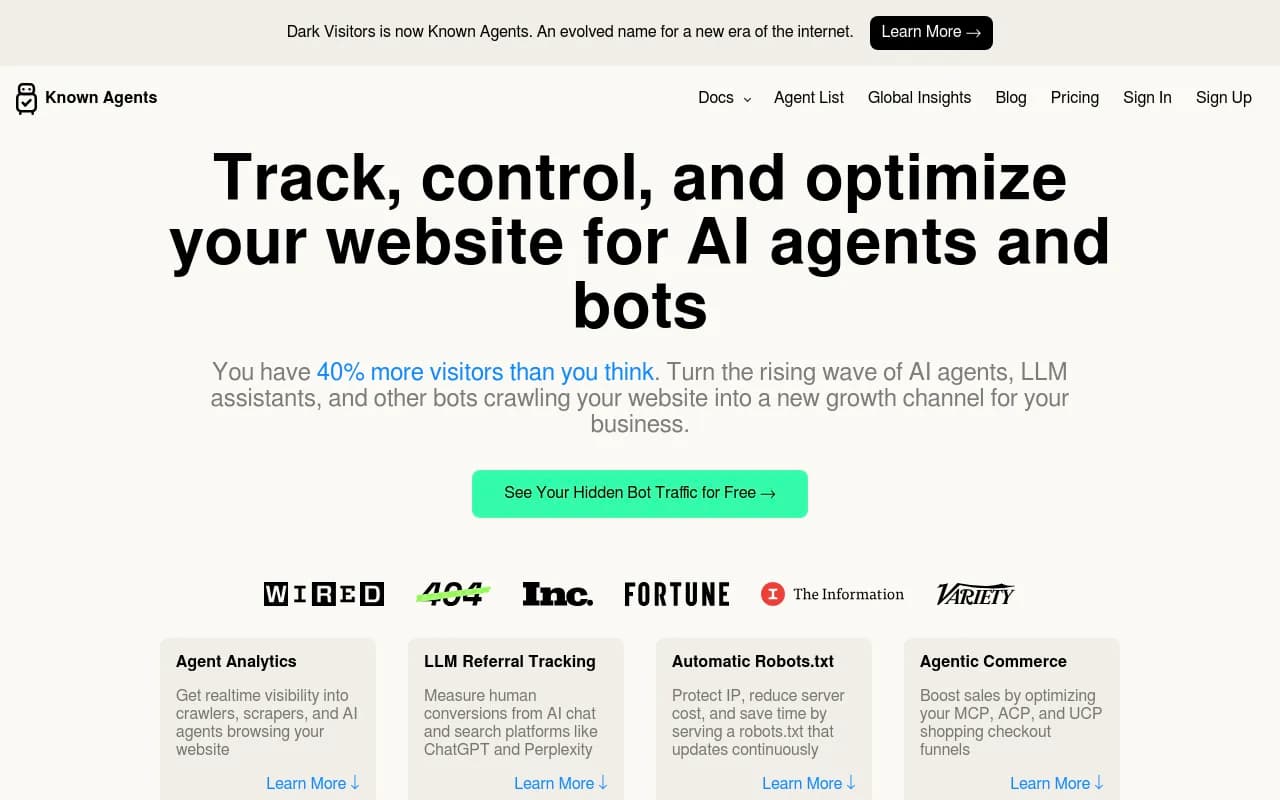
GA4 cannot see bots. Logs can. Promptwatch Data's AI crawler report shows OpenAI at 79.8% of IP-verified AI crawler requests in the week of August 31 to September 6, 2026, down from 94.8% in the week of June 8 to 14. Its advice is practical: compare your own log mix with that. A provider that is large overall but near zero in your logs suggests you are blocked or unreachable for it, so check robots.txt, CDN and WAF rules. Provider totals also mix training crawlers with answer-time fetchers, so separate them. Promptwatch's crawler logs do that with IP verification, and lighter options like DarkVisitors cover basic bot and LLM referral tracking.
Layer 2: presence, citations and accuracy
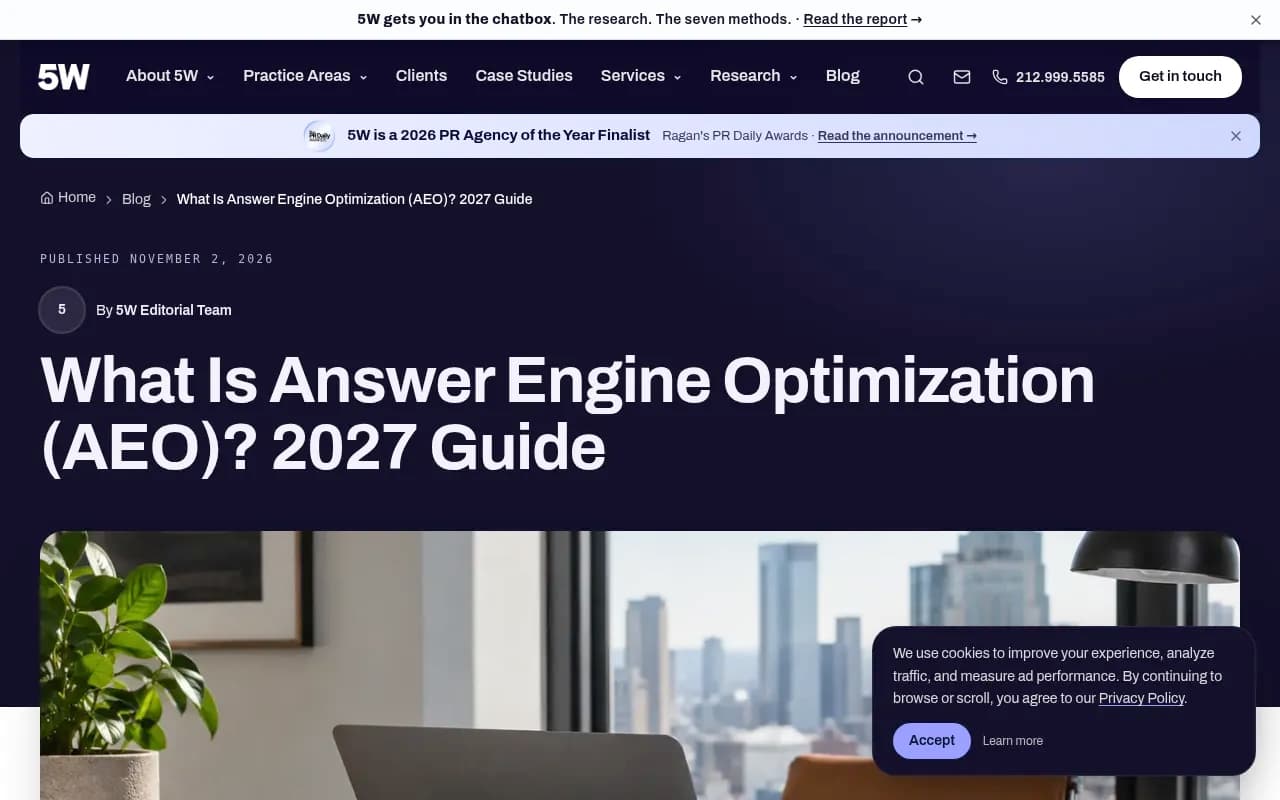
The 5WPR guide frames AEO results as presence, citation and accuracy across a fixed set of prompts, not clicks alone. A workable version:
- Presence rate: share of prompts where your brand is named.
- Cited pages: which of your URLs the engine actually uses.
- Description accuracy: whether the answer states correct facts, checked against a fact sheet.
Keep mentions and citations separate. They are different events, and the gap between them is diagnostic. Mentions without citations usually mean the model knows you from training data or third parties but your own pages are not being picked up.
Layer 3: referrals, with honest labels
Report AI referral sessions as "identified AI referrals" and say plainly that the real number is higher. Add the GA4 AI Assistant channel, a custom filter on chatgpt.com, perplexity.ai, gemini.google.com and similar, and the UTM-in-forms trick. Then pair it with Search Console and Bing Webmaster Tools. Bing's AI Performance report shows the grounding queries behind citations. Google's Search Console AI report shows impressions, pages, countries and devices, but no query field and no clicks.
Layer 4: outcomes
Watch for deep-page direct traffic rising while ChatGPT-tagged sessions fall, branded search trends, and sales-call attribution ("how did you hear about us?" with an AI option). Indig's null result is worth remembering: four brands over 30 days with homepages excluded is a test built to find a traffic effect, and brand effects do not arrive on that schedule. Use longer windows.
Treat prompt tracking like polling
This is the part most dashboards get wrong. SparkToro and Gumshoe.ai had 600 volunteers run 12 prompts 2,961 times in late 2025, and found less than a 1-in-100 chance that ChatGPT or Google's AI would return the same brand list twice. Gumshoe sells tracking software, so it is a vendor-involved study that undercuts its own category. What held up was frequency: the three most-mentioned brands in each category appeared in 64% of ChatGPT answers, 73% of Claude's and 68% of Google's.
Mike King's math is the useful bit for a CFO. At a true appearance rate near 50%, five runs give a 95% confidence interval of about plus or minus 44 points, twenty runs about 22, one hundred runs about 10. A tool that runs a prompt once a day and reports a binary is reporting a coin flip as a ranking.
The prompts themselves are shaky too. aimclear audited 87 AI visibility tools in October 2026: of the 79 that track prompts, 47 generate them from a keyword list, URL or persona, and 62 run on prompts nobody has validated against real buyers. Semrush's own April 2026 clickstream study found 65% to 85% of ChatGPT prompts matched no keyword in its database.
So measure like a pollster:
- Fewer prompts, more runs per prompt.
- Show ranges, not single numbers.
- Source prompts from sales calls and support tickets.
- Pin the methodology, including model mode (ChatGPT's Instant and Thinking modes overlap on only about a quarter of cited domains).
- Ask any vendor for panel size, run count and mode before you trust a volume figure.
Engines disagree, so track them separately
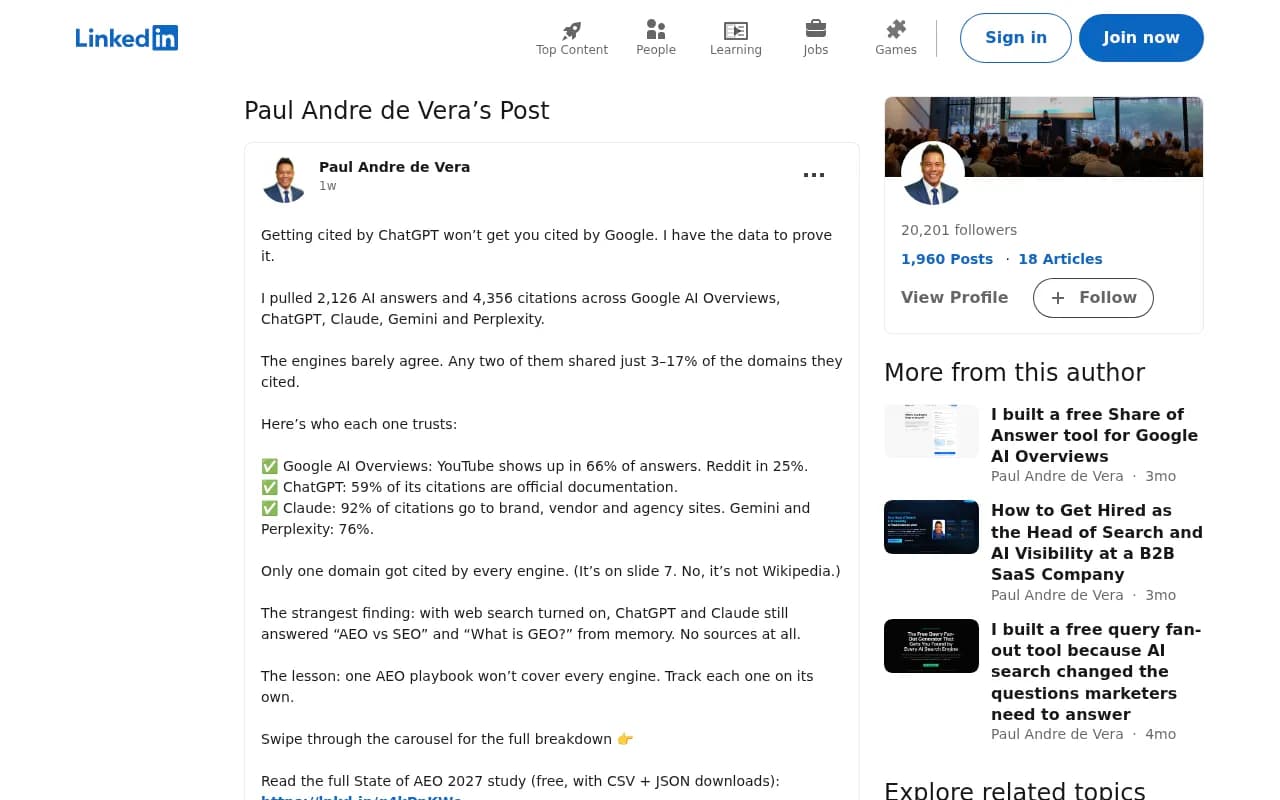
Paul Andre de Vera's State of AEO 2027 study pulled 2,126 AI answers and 4,356 citations across AI Overviews, ChatGPT, Claude, Gemini and Perplexity. Any two engines shared just 3-17% of cited domains. YouTube appeared in 66% of AI Overviews answers, 59% of ChatGPT's citations were official documentation, and with web search on, ChatGPT and Claude still answered "What is GEO?" from memory with no sources. Commenters rightly flagged sample size and niche limits, so treat it as directional.
Promptwatch's own data points the same way. In its social media citations report for November 2026, ChatGPT got 0.64% of its citations from social platforms, Perplexity 1.94% and Google AI Overviews 13.16%, with YouTube alone at 6.71% of AI Overviews citations. One playbook per engine is overkill, but one number across engines hides everything.
One useful filter from the comments: if the model already answers from memory, you will not be the citation. Aim at questions it has to search for. Promptwatch's ChatGPT query fanout data shows average query length fell from about 117 characters in December to about 53 from April, so write headings that read like short search queries and cover sub-questions like pricing, alternatives and "X vs Y".
Which tools fit which layer
| Need | Options | Note |
|---|---|---|
| Free baseline | GA4 filters, Search Console AI report, Bing AI Performance, a 25-prompt sheet | Start here before paying |
| Prompt tracking | Peec AI, Otterly.AI, Profound, Scrunch | Check run counts and prompt sources |
| Tracking plus crawler logs, AI traffic and content actions | Promptwatch | Connects visibility to visits and fixes |
| Bot and referral detection | DarkVisitors | Lightweight |
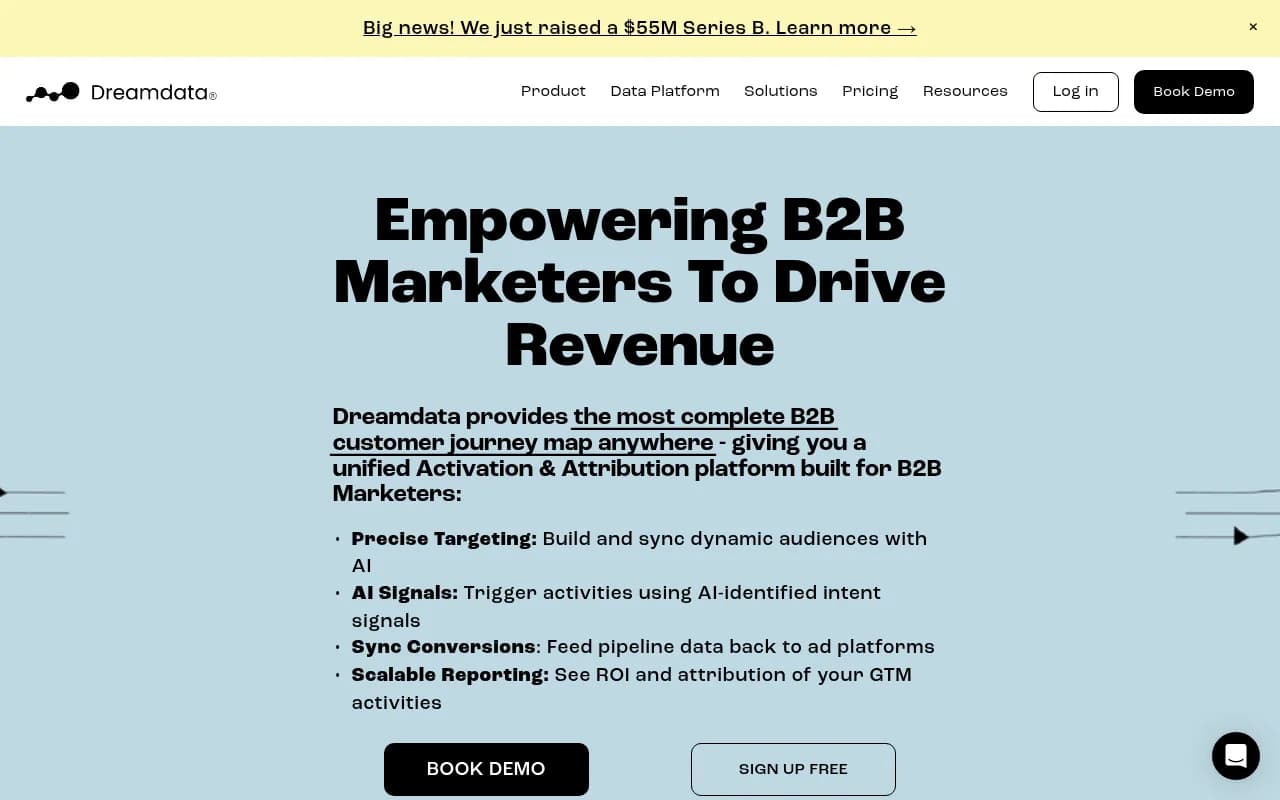
| Revenue attribution | Dreamdata, HockeyStack | Useful for long B2B cycles |



Most monitoring-only tools stop at layer 2. The gap shows up when someone asks whether a published page was crawled, cited and clicked. Promptwatch closes that loop with IP-verified crawler logs, visitor analytics and page tracking in one product, and it has a 7-day free trial on monthly billing; confirm current plans at promptwatch.com/pricing. For more options, browse the AI rank tracking directory.
A reporting template that survives the next bug
The next tagging failure is a matter of when. Build reports that do not depend on one parameter:
- Lead with presence and citation ranges, not a single visibility score.
- Show identified AI referrals next to direct traffic to deep pages, with a note on the October 8-16 window.
- Include leads with a captured
utm_sourceand self-reported source. - Include crawler access by provider.
- Review quarterly, since brand effects are slow.
The point is not to defend AEO against the skeptics. It is to stop letting one query parameter decide whether your program looks alive.