Key takeaways
- Adobe LLM Optimizer, now sold as Adobe Brand Visibility, is strongest for teams already publishing through Adobe Experience Manager, because fixes can ship at the CDN edge. Adobe publishes no price.
- Profound is the purpose-built measurement platform. It says it queries answer engines directly and holds a prompt-demand dataset of 1.9B+ real prompts. Enterprise is priced on request.
- Promptwatch covers the same measurement ground and then adds the execution layer: content agents, CMS publishing, IP-verified crawler logs and AI traffic analytics, with prices published from $95/mo.
- The biggest methodological split is measured versus modeled data. Profound's own comparison says Adobe's visibility numbers are a statistical approximation, built on Semrush's database. Treat that as a competitor's claim and verify it in a demo.
- Run the same 20 buyer prompts through every shortlisted tool before you sign anything.
Why enterprise GEO buying is confusing right now
Two years ago you could buy a prompt tracker and call it a GEO program. That is no longer enough. Enterprise buyers now want to know four things: is the data real, can we trace answers back to our pages, who ships the fix, and does any of it show up as revenue.
The three platforms in this guide answer those questions differently. Adobe is a suite vendor that bolted GEO onto Experience Cloud and then added Semrush. Profound is a single-purpose AEO company. Promptwatch is an end-to-end platform that monitors, traces, acts and measures in one loop.
A caveat on sources. Much of the public detail about Adobe and Profound comes from vendor-written material, including Profound's own comparison article and a managed-service competitor's review. I flag those claims as claims. Where I can, I point to what the vendors publish themselves.
The three platforms in one paragraph each
Adobe Brand Visibility (formerly Adobe LLM Optimizer)
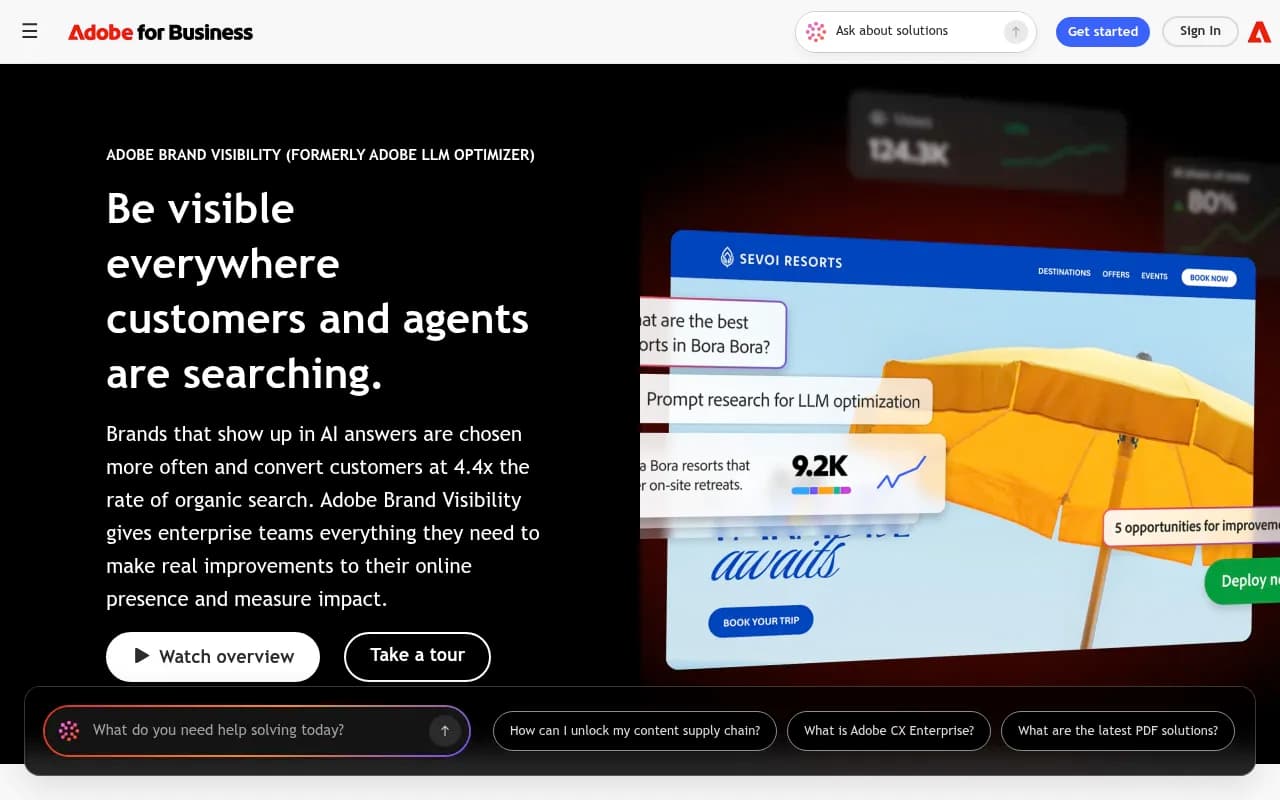
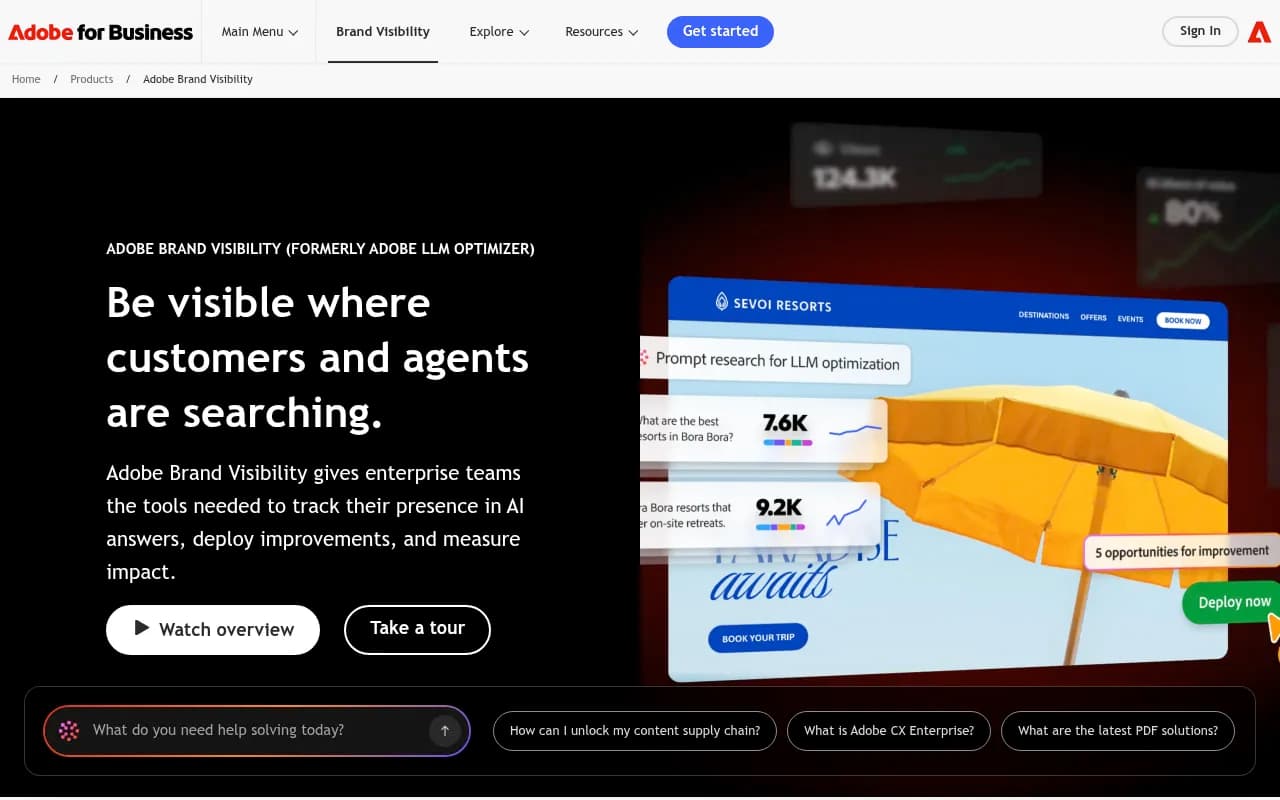
Adobe announced Brand Visibility at its Summit conference on April 20, 2026, per Profound's write-up. A June 17, 2026 Adobe blog post describes it as LLM Optimizer combined with Semrush's AI Optimization, and Adobe's product page now labels it "Adobe Brand Visibility (Formerly Adobe LLM Optimizer)." It tracks presence in AI answers, deploys improvements, and measures impact, with the strongest integration inside Adobe Experience Cloud.
The catalog also lists the earlier product name, which many buyers still search for.
Profound
Profound is a standalone answer engine optimization platform. Its pitch is direct capture: daily headless-browser queries against the major answer engines, plus a Prompt Volumes dataset that it says covers 1.9B+ real user prompts, growing roughly 150 million a month. A third-party enterprise roundup lists more than 700 enterprise customers and a $96M Series B in February 2026.

Promptwatch
Promptwatch is an AI search visibility and GEO platform used by 1,840+ brands and agencies and rated 4.7/5 on G2. It monitors the real interfaces of ChatGPT, Google AI Overviews, Google AI Mode, Gemini, Perplexity, Copilot, Meta AI, Amazon Alexa and others, traces which pages get cited, then helps you fix gaps with the Action Board and Content Agent, and measures the result through crawler logs and visitor analytics. It is ISO/IEC 27001 certified and GDPR compliant.

Data methodology: measured versus modeled
This is the question I would settle first, because everything downstream depends on it.
Profound's article argues that Adobe's own documentation describes its method as a statistical approximation of answers to selected prompts, and that the prompt layer now runs through Semrush's database, which is built from clickstream and search-panel data rather than captured AI conversations. Profound's own screenshot of Adobe's research interface shows topic clusters with estimated monthly volume, not prompt-level data split by audience or intent.
To be fair to Adobe, Profound concedes modeled data has a use: a cheap, directional read across a big portfolio of brands. If you manage hundreds of brands and need a rough ranking, an approximation can be enough. If you need to know what ChatGPT actually told a buyer, it is not.
Why does this matter so much? Promptwatch Data's average sources per response report shows how thin and volatile the citation inventory is. ChatGPT cites about 5 sources per web-search answer, Google AI Overviews about 10, and Perplexity almost exactly 10 every day, while Copilot's average swung from under 2 to nearly 17 within a few weeks. When the citation set per answer is that small and that unstable, a modeled estimate can miss the movement entirely. Measured output from the real interface catches it.
Both Profound and Promptwatch say they capture real front-end responses. Promptwatch also explains why this matters: user-facing answers, citations and shopping results can differ from API outputs, so it tracks the real UIs and runs API models alongside to show what models believe from training data. Its data collection guide documents the approach.
Prompt demand data
Knowing which prompts matter is half the battle. The three vendors approach it differently.
- Adobe: Semrush's prompt database. A competitor review of Adobe's June 2026 announcement cites nearly 300 million AI search prompts, while Profound's article says the database is in the millions, organized by topic cluster. These figures conflict, so ask Adobe for the current number.
- Profound: 1.9B+ real prompts by its own count, broken down by intent, region, age and income. Other comparisons round this to more than 2 billion.
- Promptwatch: monthly prompt volumes, difficulty scores and citation rates across AI search, Google and Bing, plus query fan-outs showing the exact web searches AI runs per response. It also suggests prompts from Search Console, ranking keywords, People Also Ask and any page on your site.
Profound probably has the biggest pure demand dataset. Promptwatch's advantage is that demand data sits next to your own Search Console and Bing data and your crawler logs, so you can see which high-volume prompts your pages actually fail on.
From insight to published fix
Most enterprise GEO programs stall here. The dashboard says you are invisible for a prompt cluster. Then what?
Adobe: deployment at the edge
Adobe's strongest argument is deployment. Its Optimize at Edge feature serves AI-friendly versions of pages to AI crawlers at the CDN, with rollback, and an Auto-Optimize capability pushes approved changes to the edge so LLMs see updated narratives without a full republish. Reviewers note one-click setup exists only for AEM Cloud Service with managed Fastly, though Adobe says edge deployment also works with Fastly, Akamai and Cloudflare. Profound's article calls the product a diagnostic dashboard rather than a content engine, which is a fair summary if you do not use the edge layer.
Profound: agents and credits
Profound's agents research, draft and optimize content, billed in credits according to its pricing page as summarized by third parties. Its Agent Analytics reads CDN logs and ties crawler hits to GA4 traffic.
Promptwatch: the full write-publish-measure loop
Promptwatch's Content Agent plans, writes and publishes against your visibility gaps, with a review inbox or fully hands-off mode. It publishes to WordPress, Webflow and Framer, tracks each document's draft, staged, published and live URL, then follows the live page through AI crawls, citations and traffic. Underperformers come back as Action Board items and refresh suggestions. Agentic AI Search Optimization takes this further as a managed layer, included with Business.
The contrast with Adobe is worth stating plainly. Adobe changes what AI crawlers see, ideally at scale, on the Adobe stack. Promptwatch creates and updates the content itself on any of the major CMS platforms. Different tools for different bottlenecks.
Attribution and analytics
Adobe's revenue reporting is native to Adobe Analytics, and its Agentic Traffic and Referral Traffic dashboards need CDN log forwarding. That is a real advantage inside Adobe's ecosystem and a friction point outside it.
Profound ties crawler data to GA4. Promptwatch offers AI crawler logs with IP verification against each operator's published ranges, so spoofed bots are filtered out, and a visitor analytics script, Google Tag Manager template or WordPress plugin that counts AI-referred visits and conversions. One 2026 wrinkle: ChatGPT stopped sending a referrer on October 8, 2026, so Promptwatch added an optional setting that counts visits tagged utm_source=chatgpt.com as ChatGPT traffic. Ask every vendor how they handle that change. For more on the topic, see the guide to attributing AI traffic.
Crisp is a useful proof point: it reported 2x higher conversion rates from AI traffic than from traditional channels and scaled to 5 to 10 articles per day (case study).
Side-by-side comparison
| Dimension | Adobe Brand Visibility | Profound | Promptwatch |
|---|---|---|---|
| Origin | Suite vendor, GEO added to Experience Cloud, plus Semrush | Purpose-built AEO platform | Purpose-built GEO platform with execution agents |
| Data method | Described by Profound as a modeled approximation | Daily front-end capture, per Profound | Real UI capture across engines, plus API models |
| Prompt demand data | Semrush database, topic clusters | 1.9B+ real prompts (Profound's figure) | Prompt volumes, difficulty, query fan-outs |
| Content creation | Diagnostics plus edge optimization | Agents, billed in credits | Content Agent with CMS publishing |
| Deployment | CDN edge, strongest on AEM | Agents plus integrations | WordPress, Webflow, Framer, REST API, MCP |
| Crawler logs | Via CDN log forwarding | Agent Analytics | IP-verified logs of GPTBot, ClaudeBot, PerplexityBot and more |
| Reddit, YouTube, LinkedIn, Instagram citations | Not found on reviewed pages | Source-level Reddit | Dedicated reports for all four |
| Pricing | Not published; licensed by prompts per year | Enterprise on request; Starter reported at $99/mo | $95 to $579/mo published, Enterprise custom |
| Free entry point | Limited trial reported | 7-day trial, 50 prompts (per a third-party review) | 7-day free trial plus free AI visibility report |
| Best fit | Adobe Experience Cloud shops | Measurement-first enterprises | Teams that want monitoring and execution in one tool |
Treat the Adobe and Profound cells as secondhand where I have said so. Confirm against each vendor's own pages and a live demo.
Enterprise controls and procurement
Procurement is where Adobe is hardest to beat for existing customers. One vendor, one master agreement and one security review is a real saving.
Profound counters with published enterprise plumbing, reportedly SSO/SAML, SOC 2, exports and an API, plus a reported $180 million Series D on September 15, 2026. Those are third-party reports, so confirm them.
Promptwatch's enterprise story: ISO/IEC 27001 certification, GDPR compliance with an EU-based company, SSO on Enterprise, an organization audit log on Business and above that records whether a change came from the dashboard, API, MCP client or Agent Chat, scoped API keys, a hosted MCP server with 110+ tools and REST API v2. Unlimited seats on every plan removes a common enterprise budgeting headache.
Pricing: what you can actually know
This is where the three differ most visibly.
- Adobe publishes no price. It is licensed by prompts per year, per a competitor review that also cites up to 1,000 optimizations a year. One roundup lists a $295/mo self-serve entry, which I could not confirm, so get a written quote.
- Profound publishes a trial and a reported Starter tier, with Enterprise on request.
- Promptwatch publishes everything: Essential $95/mo (50 prompts, 6,000 responses), Professional $245/mo (150 prompts, 18,000 responses), Business $579/mo (350 prompts, 42,000 responses, Content Agent, hourly tracking, state and city tracking, Fact Check, Shopping, Ads Radar). Annual billing gives 12 months for the price of 10. Confirm current numbers at promptwatch.com/pricing.
Agencies managing many clients have a separate path with the Kick-off ($199/mo), Growth ($399/mo) and Scale ($799/mo) plans, which include unlimited projects and seats.
Which one should you pick?
Choose Adobe Brand Visibility if
Your pages already run on Adobe Experience Manager, your analytics live in Adobe Analytics, and the real bottleneck is shipping changes across thousands of URLs that no content team can edit by hand. Edge deployment is a genuine differentiator for that situation.
Choose Profound if
You want a measurement-first platform with a large prompt-demand dataset, you are comfortable with a standalone vendor, and your content team will handle most of the writing.
Choose Promptwatch if
You want to see the gap, fix it and prove the result without stitching three tools together. The loop of monitoring, citation tracing, the Action Board, Content Agent publishing and then crawler and traffic measurement is the part most competitors leave to you. It also covers surfaces the others barely touch: Reddit, YouTube, LinkedIn and Instagram citation reports, ChatGPT Shopping, Ads Radar, local GEO targeting at exact coordinates and coding agent visibility. A head-to-head page lives at Promptwatch vs Profound, and the broader 2026 platform comparison covers the rest of the market.
Worth saying: Promptwatch is not trying to be a content management system or an analytics suite. If Adobe's edge deployment is exactly what your architecture needs, nothing here replaces it.
Other enterprise options worth a look
If none of the three fits, the shortlist is wider than most vendor pages admit. Enterprise-oriented names in the catalog include Evertune, BrightEdge AI Catalyst, Botify, seoClarity and Bluefish.
For a longer list, the GEO software directory at bestgeosoftware.com tracks the category.
How to run a fair bake-off
- Write 20 buyer prompts across branded, comparison and category intents. Include your competitors by name.
- Run them through each vendor's trial or demo tenant. Ask Adobe to show the same prompts in a demo tenant.
- Ask for the raw responses behind each score and the number of runs behind each figure. If a vendor cannot show the raw answer, you are looking at a model.
- Check one cited page end to end: was it crawled, was it cited, did it send traffic?
- Ask who deploys the fix and how long that takes from insight to live page.
- Get pricing in writing, including prompt, seat and optimization limits.
If you want a quick baseline before any demo, Promptwatch's free AI visibility report scans how ChatGPT, Gemini and Perplexity talk about your brand, and its 7-day free trial lets you test the monitoring and content loop on real data.
Bottom line
Adobe wins where the Adobe stack already exists and deployment at scale is the constraint. Profound wins on dataset depth for measurement-led teams. Promptwatch wins when you want one platform that measures real AI answers, writes and publishes the fix, and then checks whether it worked. Whichever you shortlist, make each vendor prove its numbers on your own prompts first.