GrowthOS Review 2026
Growth analytics platform that includes AI search visibility tracking. Helps marketing teams monitor brand presence across LLMs alongside other growth and performance metrics.
Key takeaways
- GrowthOS monitors brand mentions across 15+ AI platforms including ChatGPT, Claude, Gemini, and Perplexity, with real-time alerts and competitor benchmarking
- Lacks the depth of a true optimization platform: no AI content generation agent, no prompt volume/difficulty scoring, no Reddit or YouTube source tracking, and no AI traffic attribution -- capabilities that Promptwatch provides as part of its full action loop
- Credit-based pricing starts free (200 credits/month) and scales to $299/month for the Pro tier, making it accessible for smaller teams but potentially limiting at scale
- Best suited for early-stage startups and small marketing teams that want a first look at their AI visibility without committing to a more comprehensive platform
- Content optimization is limited to "briefs" rather than actual AI-generated articles, meaning you still have to do the writing yourself
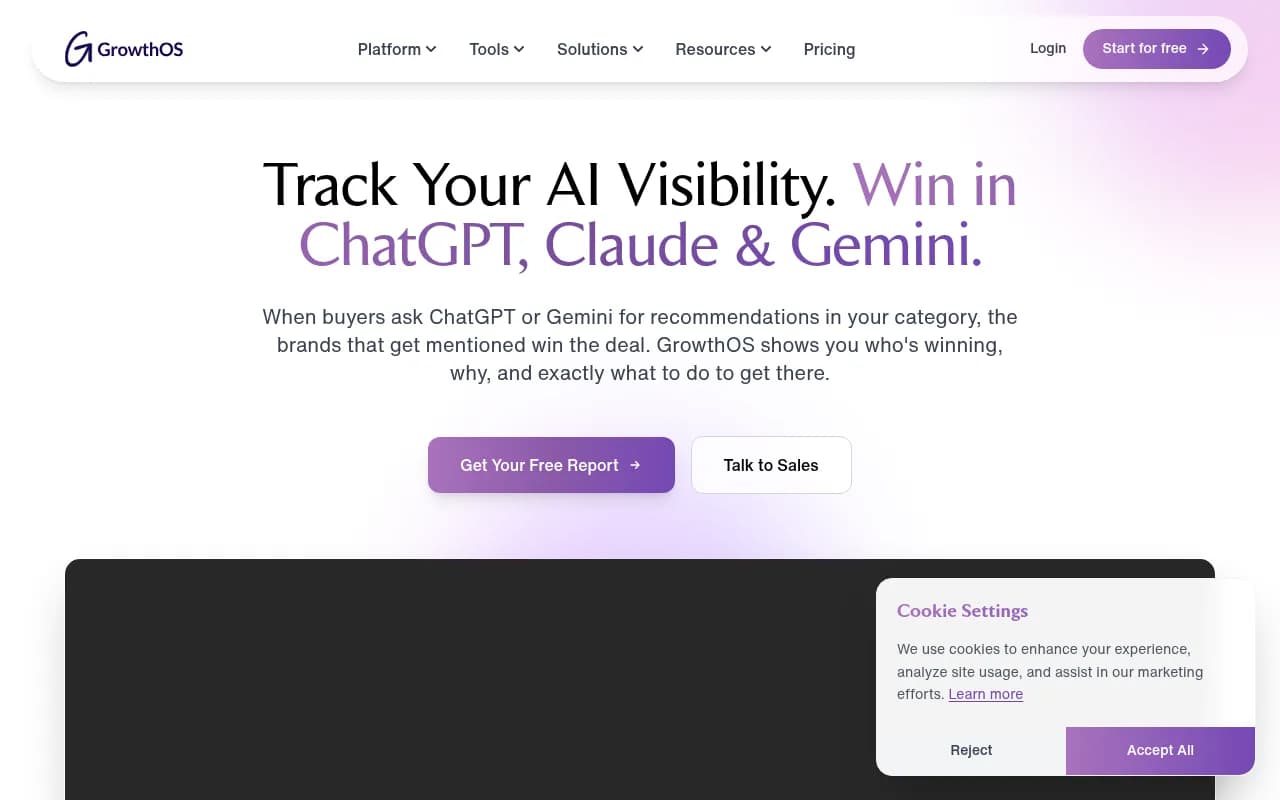
GrowthOS is an AI search visibility tool built for marketing teams that want to understand how their brand appears in LLM-generated answers. The platform monitors mentions across ChatGPT, Claude, Gemini, Perplexity, and reportedly 15+ AI engines in total, showing you where competitors are getting cited and where you're not. It's positioned as a GEO (Generative Engine Optimization) tool, sitting in the same category as Otterly.AI, Peec.ai, and Profound -- tools designed to help brands navigate the shift from traditional search to AI-driven discovery.
The product appears to be relatively early-stage. Its YouTube channel has just five subscribers, the customer logos are mostly smaller brands and agencies (Regus being the notable exception), and the testimonials, while positive, come from founders of small companies rather than enterprise marketing leaders. That's not a knock -- every platform starts somewhere -- but it's worth calibrating expectations. GrowthOS is backed by AWS, MongoDB, and the Nvidia Inception Program, which suggests it has some institutional support and is building on solid infrastructure.
The target audience is clearly growth-focused marketing teams and digital agencies that are starting to ask "how do we show up in ChatGPT?" and need a structured way to answer that question. The free plan and low entry price point ($99/month for Growth) make it accessible to bootstrapped startups and small agencies that can't yet justify the cost of more comprehensive platforms.
Key features
Real-time brand monitoring across 15+ AI platforms GrowthOS tests prompts across ChatGPT, Claude, Gemini, Perplexity, and Copilot (among others) to track when and how your brand gets mentioned. The platform claims to test "thousands of prompts" and surface your brand's visibility score over time. You can see mention share, sentiment, and share of voice in AI answers -- all in one dashboard. Real-time alerts notify you when a competitor overtakes you or your visibility drops, which is genuinely useful for staying on top of fast-moving AI ranking changes.
Competitor benchmarking Side-by-side visibility comparisons let you see how your brand stacks up against specific competitors across different AI engines and topic categories. The platform claims users can "know within hours when a competitor overtakes you in AI search." This is one of the more practically useful features -- knowing you're losing ground is the first step to doing something about it.
Answer Engine Insights This feature attempts to explain why competitors rank above you in AI answers, not just that they do. It surfaces the positioning signals and content factors that seem to influence AI model recommendations. The depth of this analysis isn't fully clear from the product page, but the intent is to move beyond raw mention counts toward diagnostic insight.
Citation source tracking GrowthOS shows which domains AI search engines cite most frequently in your category. This is valuable because it tells you where to publish content, earn backlinks, or build presence to improve your AI visibility. Knowing that a specific industry publication or Reddit community is heavily cited by Perplexity in your niche is actionable intelligence. That said, the platform doesn't appear to surface Reddit or YouTube specifically as citation sources -- a gap compared to more comprehensive tools.
AI crawler analytics (GPTBot, ClaudeBot) Available on the Pro plan ($299/month), this feature lets you see how AI crawlers are indexing your site -- which pages they visit, crawl errors, and signals that might be hurting your AI rankings. This is a meaningful capability that many monitoring-only tools lack entirely. Understanding how GPTBot reads your site is different from understanding how Googlebot does, and having visibility into that is genuinely useful for technical optimization.
Content optimization briefs Also on the Pro plan, GrowthOS generates content briefs that include on-page SEO fixes, entity optimization recommendations, and schema markup suggestions. The key word here is "briefs" -- GrowthOS helps you understand what to write, but it doesn't write it for you. There's no built-in AI writing agent that produces publishable articles grounded in citation data. You get the roadmap; you still have to build the road.
AI visibility score and share of voice tracking The platform produces an overall AI visibility score and tracks it over time, giving you a single metric to watch as you make changes. Share of voice comparisons show how much of the AI conversation your brand owns versus competitors in your category. These are useful for reporting to stakeholders who want a simple number to track.
Free AI visibility report GrowthOS offers a free report that shows your AI visibility score, which competitors are outranking you, and three suggested actions -- delivered in minutes without a credit card. This is a smart acquisition tool and genuinely useful for anyone who's never measured their AI presence before.
Who is it for
GrowthOS fits best for small-to-mid-sized marketing teams and digital agencies that are just starting to take AI search visibility seriously. Think a 5-15 person SaaS startup whose founder has noticed that ChatGPT recommendations are driving inbound leads, or a boutique digital agency whose clients are asking "how do we show up in AI answers?" and needs a structured answer. The free plan and $99/month Growth tier make it a reasonable starting point for teams that aren't ready to commit to a more expensive platform.
Agencies managing multiple client accounts will find the white-label option interesting -- GrowthOS offers custom agency pricing with white-label dashboards, a client portal, and volume discounts. This is a real differentiator for smaller agencies that want to package AI visibility reporting as a service. The dedicated account manager and priority onboarding on the agency tier add genuine value for teams that are new to GEO.
Who should probably look elsewhere: enterprise marketing teams that need deep prompt intelligence (volume estimates, difficulty scores, query fan-outs), teams that want AI-generated content as part of their workflow rather than just briefs, and brands that need to track AI traffic attribution back to actual revenue. GrowthOS doesn't appear to offer any mechanism for connecting AI visibility to website traffic or conversions -- you can see your mention share go up, but you can't easily tie that to leads or sales. For teams that need to close that loop, a more comprehensive platform is worth the investment.
Integrations and ecosystem
GrowthOS's integration story is thin at this stage. The Pro plan mentions "data export + integrations" and "Slack + email support," which suggests Slack alerts are available for real-time notifications. Beyond that, the website doesn't detail specific third-party integrations -- no Google Search Console connection, no Looker Studio connector, no Zapier workflow support is mentioned.
The platform is backed by AWS infrastructure and uses MongoDB, which speaks to its technical foundation but doesn't directly translate to user-facing integrations. The Nvidia Inception Program membership suggests the team is working with GPU-accelerated AI infrastructure, likely for running prompt tests at scale.
There's no mention of a public API, which is a notable gap for teams that want to pull GrowthOS data into their own dashboards or BI tools. The Enterprise plan mentions "custom integrations," but that's a negotiated arrangement rather than a self-serve API.
No browser extension or mobile app is mentioned on the product page.
Pricing and value
GrowthOS uses a credit-based pricing model, which is somewhat unusual in this category. Here's how the tiers break down:
- Free: 200 credits/month, no credit card required. Covers basic visibility tracking across ChatGPT, Claude, and Gemini, basic competitor tracking, and an AI visibility score.
- Growth ($99/month): 1,500 credits/month. Adds multi-competitor benchmarking, sentiment analysis, citation source tracking, and weekly AI visibility reports.
- Pro ($299/month): 6,000 credits/month. Adds advanced analytics, AI crawler analytics (GPTBot, ClaudeBot), content optimization briefs, data export, and Slack integration.
- Enterprise (from $999/month): 25,000+ credits/month. Adds SSO, custom integrations, a dedicated AEO specialist, and SLA guarantees.
- Agency: Custom pricing with white-label dashboards, multi-client workspace, and a dedicated account manager.
Top-up credits are available at $0.12 per credit for any paid plan, and they don't expire -- a nice touch for teams with variable usage.
The credit model makes it hard to do a direct apples-to-apples comparison with competitors that charge by prompts or sites. At $99/month, GrowthOS Growth is priced similarly to Promptwatch's Essential plan ($99/month), but Promptwatch's Essential includes 50 tracked prompts and 5 AI-generated articles per month -- a more concrete unit of value. GrowthOS's 1,500 credits is harder to evaluate without knowing exactly how many credits each action consumes.
The free plan is genuinely useful for exploration, and the free AI visibility report (no account required) is a low-friction way to get a first read on your brand's AI presence.
Strengths and limitations
What GrowthOS does well:
- The free entry point (200 credits/month, no credit card) is one of the most accessible in the category. Getting a free AI visibility report in minutes is a real value-add for anyone new to GEO.
- AI crawler analytics on the Pro plan is a meaningful technical feature. Seeing how GPTBot and ClaudeBot crawl your site -- and identifying pages with weak signals or crawl errors -- is something many monitoring-only tools skip entirely.
- The competitor benchmarking interface, which lets you compare visibility side-by-side across AI engines and topic categories, is well-designed for the use case of "who's winning and why."
- The agency white-label offering gives smaller agencies a way to package AI visibility reporting as a client service, which is a real market need right now.
Where it falls short:
- No AI content generation. GrowthOS produces content briefs but doesn't write the content. If you want a platform that identifies gaps and then helps you fill them with AI-generated articles optimized for citation, you'll need to look at tools like Promptwatch, which has a built-in writing agent that produces content grounded in real citation data.
- No AI traffic attribution. There's no way to connect your AI visibility score to actual website traffic or revenue. You can see your mention share improve, but you can't tell if that's driving clicks or conversions. Promptwatch addresses this with a code snippet, GSC integration, or server log analysis.
- No Reddit or YouTube tracking. GrowthOS shows which domains AI engines cite, but it doesn't specifically surface Reddit threads or YouTube videos that influence AI recommendations -- a channel that's increasingly important for AI citation patterns.
- No prompt volume or difficulty scoring. GrowthOS doesn't appear to tell you how many people are asking a given prompt or how competitive it is to rank for. That makes it harder to prioritize which gaps to close first.
- The credit model creates uncertainty. Without clear documentation of how many credits each action costs, it's difficult to predict how far your monthly allocation will stretch.
Bottom line
GrowthOS is a reasonable starting point for small teams and agencies that want to get their first real look at AI search visibility without a large upfront commitment. The free plan and free report make it easy to try, and the AI crawler analytics on the Pro plan add genuine technical depth that many entry-level tools lack.
But it's fundamentally a monitoring tool. It shows you where you're invisible and gives you briefs on what to fix -- then leaves you to do the actual work. Teams that want a full optimization loop, where gap analysis leads directly to AI-generated content and then to traffic attribution, will find GrowthOS's capabilities stop short. For that, Promptwatch is the stronger choice -- it covers the full cycle from finding gaps to generating content to tracking results, with prompt volume scoring, Reddit/YouTube tracking, and AI traffic attribution that GrowthOS doesn't offer.
Best use case: A startup or small agency that wants a structured, affordable way to start tracking AI brand visibility and competitor gaps before investing in a more comprehensive GEO platform.
Frequently asked questions
What is GrowthOS?
Is there a free plan?
How much does GrowthOS cost?
Which AI platforms does GrowthOS track?
Does GrowthOS generate content or just provide briefs?
How does GrowthOS compare to Promptwatch?
Similar and alternative tools to GrowthOS