Key takeaways
- Branded prompts (e.g. "Is [Brand] good for X?") and non-branded prompts (e.g. "best CRM for small teams") require different tracking logic -- most platforms don't separate them clearly
- Non-branded prompt performance is where most AI visibility is actually won or lost, yet it's the metric fewest teams measure
- Platforms like Promptwatch go beyond monitoring to show you which non-branded prompts competitors rank for that you don't -- and help you close those gaps with content
- Share of voice, citation rate, and answer gap analysis are the three metrics that matter most when evaluating these tools
- Only a handful of platforms in 2026 offer prompt volume estimates, difficulty scores, and query fan-outs -- features that separate serious optimization tools from basic dashboards
Why the branded vs non-branded distinction matters so much
Here's a scenario that plays out constantly: a marketing team sets up AI visibility tracking, watches their brand mention rate climb, and declares success. Meanwhile, a competitor is getting cited in every "best [category] tool" response across ChatGPT, Claude, and Perplexity -- prompts the first team never even thought to track.
That's the branded vs non-branded trap. Branded prompts -- queries that include your company name -- tell you how AI models perceive you once someone already knows you exist. Non-branded prompts -- category queries, comparison questions, problem-based searches -- are where discovery actually happens. They're where someone who has never heard of you might encounter your brand for the first time, or not.
According to a 2026 analysis by GrowthOS across 10 industries, size doesn't guarantee AI visibility. Specialized brands with strong authority signals routinely outperform category leaders in AI-generated recommendations. That finding makes sense when you think about it: AI models cite sources that answer specific questions well, not necessarily the biggest brand in the room.
So the question isn't just "does AI mention my brand?" It's "which types of prompts trigger my brand, and which ones don't?"
What to look for in a platform
Before diving into specific tools, it's worth being clear about what actually separates useful platforms from ones that just look good in demos.
Prompt segmentation is the baseline. Can you tag or filter prompts by type -- branded vs non-branded, informational vs transactional, top-of-funnel vs bottom-of-funnel? If everything gets lumped into one dashboard, you're flying blind.
Share of voice by prompt type is the next level. You want to see not just whether you appear, but how often you appear relative to competitors -- and whether that ratio differs between branded and non-branded queries.
Answer gap analysis is where it gets genuinely useful. This tells you which non-branded prompts your competitors are visible for that you're not. Without this, you're optimizing in the dark.
Prompt volume and difficulty estimates matter for prioritization. Not all non-branded prompts are worth chasing. Some have high query volume and low competition; others are saturated. Platforms that give you this data let you focus effort where it pays off.
Content generation tied to gaps is the final piece. Finding a gap is only half the work. The platforms that help you actually close it -- by generating content engineered to get cited -- are the ones that move the needle.
The platforms worth considering in 2026
Promptwatch -- best for the full optimization loop
Promptwatch is the platform I'd point most marketing teams toward first, specifically because it doesn't stop at monitoring. The Answer Gap Analysis feature shows you exactly which non-branded prompts competitors are visible for that your site isn't answering -- the specific topics and questions AI models want to cite but can't find on your pages.

That gap analysis feeds directly into a built-in AI writing agent that generates articles, listicles, and comparisons grounded in real citation data (over 880 million citations analyzed). This isn't generic content -- it's built around what actually gets cited by ChatGPT, Claude, Perplexity, and other models.
For branded vs non-branded tracking specifically: Promptwatch lets you organize prompts by type, track share of voice across 10 AI models, and see page-level citation data showing which of your pages are being cited, how often, and by which models. The prompt intelligence layer adds volume estimates and difficulty scores, so you can prioritize non-branded prompts that are winnable rather than just aspirational.
The AI Crawler Logs feature is something most competitors lack entirely -- real-time logs of AI crawlers hitting your site, showing which pages they read and how often they return. This matters because if ChatGPT's crawler isn't visiting your key category pages, no amount of content optimization will help.
Pricing starts at $99/month for the Essential tier (1 site, 50 prompts, 5 articles), with the Professional tier at $249/month adding crawler logs, state/city tracking, and 150 prompts. A free trial is available.
Profound -- strong for enterprise content operations
Profound has a solid feature set for larger brands that need to connect AI visibility to content workflows at scale. It tracks branded and non-branded prompts across major AI models and includes what it calls a "read/write AI model" -- meaning it can both analyze responses and suggest content changes.

Where Profound falls short relative to Promptwatch: it doesn't have Reddit or YouTube tracking (two sources that heavily influence AI citations), no ChatGPT Shopping monitoring, and the pricing is higher for comparable prompt volumes. It's a reasonable choice for enterprise teams with dedicated content ops, but it's more monitoring-heavy than optimization-heavy.
Otterly.AI -- good entry point for agencies
Otterly.AI is one of the more affordable options in this space, starting at $29/month. It handles automated prompt testing and basic GEO audits reasonably well, and the interface is clean enough that agencies can use it across multiple client accounts without too much friction.

The honest limitation: Otterly.AI is primarily a monitoring tool. It shows you where you stand but doesn't help you change it. There's no content generation, no answer gap analysis, and no crawler log data. For teams that just need a lightweight dashboard to report branded mention rates to clients, it works. For teams that want to actually improve non-branded visibility, it's a starting point, not a destination.
Peec AI -- clean dashboard, good for B2B and SaaS
Peec AI does a solid job with conversational AI visibility tracking, particularly for B2B and SaaS brands that care about how they appear in category-level queries. The competitor benchmarking is straightforward, and the multi-language support is genuinely useful for brands operating across European markets.

Like Otterly.AI, Peec AI is monitoring-focused. It doesn't generate content or identify specific content gaps. But if your primary need is a clean, shareable dashboard showing branded vs non-branded mention rates across ChatGPT, Gemini, and Perplexity, it does that well.
SE Visible -- useful for teams already in the SE Ranking ecosystem
SE Visible is SE Ranking's dedicated AI visibility product, and it's worth considering if your team already uses SE Ranking for traditional SEO. The AI Mode tracking is solid, and the interface won't require a learning curve for existing users.
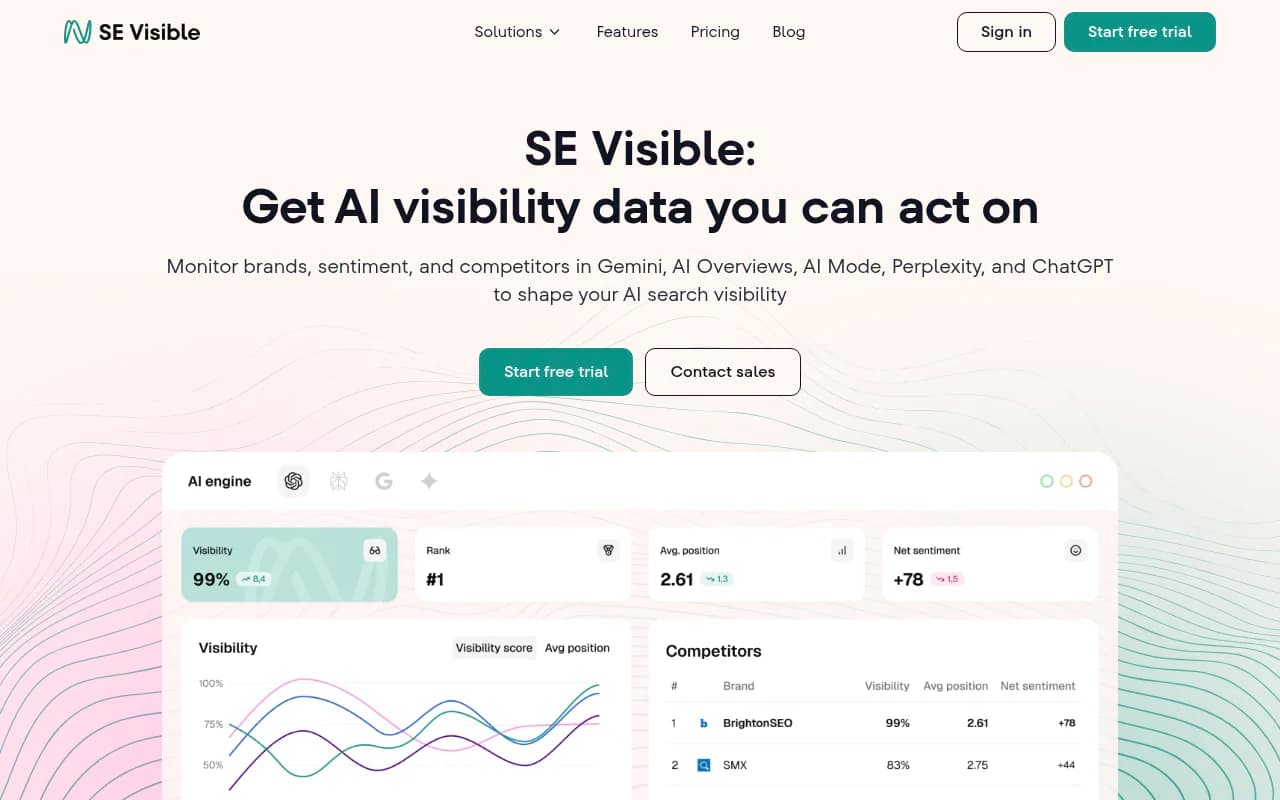
The main constraint is that SE Visible works best as a complement to traditional SEO tracking rather than a standalone AI visibility platform. It doesn't have the depth of prompt intelligence or content gap analysis that purpose-built GEO platforms offer.
LLM Pulse -- good for brand sentiment alongside visibility
LLM Pulse takes a slightly different angle: it focuses on share of recommendations and sentiment across LLMs, which makes it useful for brands where reputation management matters as much as raw citation counts. If you're tracking not just whether AI mentions you but how it describes you, LLM Pulse is worth a look.
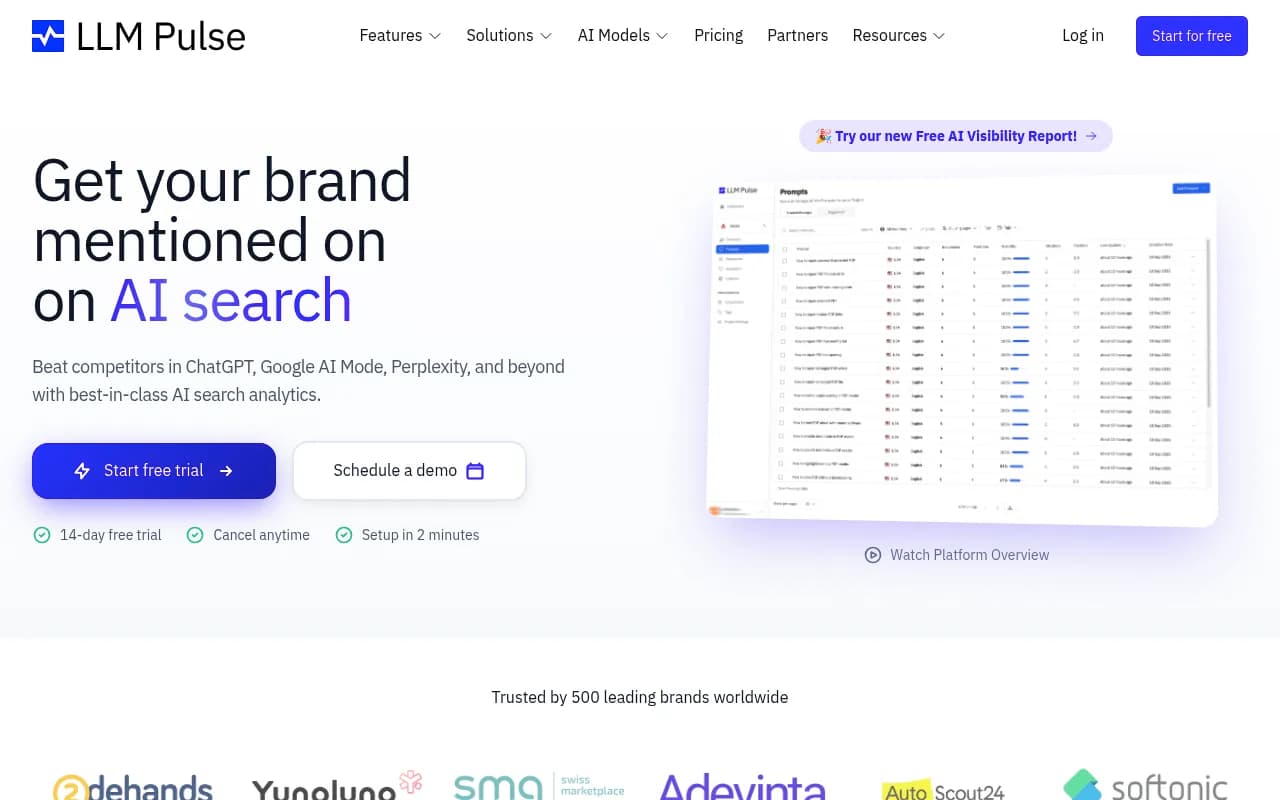
Starting at €49/month, it's one of the more accessible options. The trade-off is that it's lighter on the non-branded prompt tracking side -- it's better suited to monitoring brand perception than to identifying category-level visibility gaps.
Scrunch AI -- auto-generates prompts, useful for broad coverage
Scrunch AI automatically tracks 1,000 industry-specific prompts, which is genuinely useful for teams that don't want to manually build out a prompt library. It analyzes your brand and suggests prompts to improve visibility.
The limitation is control. Auto-generated prompts are a good starting point, but they don't replace a deliberate strategy around which non-branded queries matter most for your specific business. Scrunch AI is better for broad coverage than for surgical optimization.
AthenaHQ -- monitoring across 8+ AI engines
AthenaHQ tracks branded and non-branded prompts across more than eight AI search engines, which is one of the broader model coverages available. The dashboard is clean and the data is reliable.

It's monitoring-focused, though. No content generation, no answer gap analysis. For teams that primarily need reporting and competitive benchmarking, it's a solid choice. For teams that want to act on what they find, it's a first step.
Feature comparison table
| Platform | Branded tracking | Non-branded tracking | Answer gap analysis | Content generation | Crawler logs | Prompt volume/difficulty | Starting price |
|---|---|---|---|---|---|---|---|
| Promptwatch | Yes | Yes | Yes | Yes | Yes | Yes | $99/mo |
| Profound | Yes | Yes | Limited | No | No | No | $99/mo |
| Otterly.AI | Yes | Yes | No | No | No | No | $29/mo |
| Peec AI | Yes | Yes | No | No | No | No | €89/mo |
| SE Visible | Yes | Yes | No | No | No | No | $189/mo |
| LLM Pulse | Yes | Limited | No | No | No | No | €49/mo |
| Scrunch AI | Yes | Yes (auto) | No | No | No | No | Custom |
| AthenaHQ | Yes | Yes | No | No | No | No | Custom |
How to actually set up branded vs non-branded tracking
Knowing which platform to use is one thing. Knowing how to structure your tracking is another.
Start with a prompt taxonomy. Before you add a single prompt to any tool, categorize your prompts into at least three buckets: branded (queries containing your brand name), non-branded category (queries about your product category without brand names), and non-branded comparison (queries comparing tools or solutions). Each bucket tells you something different.
Set baseline share of voice for each bucket separately. Your branded share of voice might be 60% -- great. Your non-branded category share of voice might be 8% -- a problem. Mixing them into a single number hides the gap.
Identify your top 10-20 non-branded prompts by volume. These are the queries where discovery happens. If you're not appearing in responses to "best [category] for [use case]" prompts, you're invisible to a huge portion of your potential audience. Tools with prompt volume estimates (Promptwatch being the main one in this list) make this prioritization much faster.
Run a competitor gap analysis monthly. Which non-branded prompts are your top two competitors visible for that you're not? That list is your content roadmap. It's more actionable than any keyword research tool because it tells you exactly what AI models want to cite but can't find on your site.
Track page-level citations. Once you start publishing content targeting specific non-branded prompts, you need to know whether it's working. Page-level citation tracking shows you which specific URLs are getting cited, by which AI models, and for which prompts. Without this, you can't close the loop between content creation and visibility improvement.
A note on AI crawler logs
One thing that doesn't get enough attention: if AI crawlers aren't visiting your key pages, none of the above matters. You can have the best content in your category, but if ChatGPT's crawler hasn't indexed it, the model doesn't know it exists.
Crawler log analysis -- seeing which AI bots are hitting your site, which pages they read, how often they return, and what errors they encounter -- is a foundational capability that most platforms don't offer. Promptwatch's AI Crawler Logs feature fills this gap, and it's one of the more practically useful differentiators in the current market.
Which platform should you actually use?
For most marketing and SEO teams, the answer depends on where you are in the process.
If you're just starting out and need to understand your current AI visibility baseline, Otterly.AI or Peec AI are low-cost ways to get oriented. Expect to outgrow them within a few months.
If you're ready to move from monitoring to optimization -- finding gaps, creating content, tracking results -- Promptwatch is the most complete option in this category. The combination of answer gap analysis, AI content generation, and page-level citation tracking is the closest thing to a full workflow that currently exists.
If you're an enterprise with a dedicated content ops team and existing SEO infrastructure, Profound or SE Visible might integrate more smoothly with what you already have, though you'll likely want to supplement them with a tool that handles content gap analysis.
The one thing I'd push back on: don't let "we're already tracking branded mentions" become a reason to delay non-branded tracking. Branded visibility is a lagging indicator -- it reflects reputation you've already built. Non-branded visibility is where the next wave of customers finds you. That's the metric worth optimizing for in 2026.