Key takeaways
- Promptwatch is an end-to-end optimization platform -- it finds gaps, generates content to fix them, and tracks results. GrowthOS is primarily a monitoring and analytics tool that stops at surfacing data.
- GrowthOS has a genuine free tier (200 credits/month); Promptwatch only offers a 7-day trial. If budget is tight and you just need basic brand monitoring, GrowthOS gets you started for free.
- Promptwatch tracks 10+ AI models including Grok, DeepSeek, Mistral, and Copilot. GrowthOS publicly positions around ChatGPT, Claude, and Gemini -- a narrower coverage footprint.
- Promptwatch's AI crawler logs are a unique capability: you see exactly when ChatGPT, Perplexity, and others crawl your pages. GrowthOS has no equivalent feature.
- At the $99/month entry point, both tools cost the same -- but Promptwatch includes content generation credits and prompt tracking, while GrowthOS's Growth plan is more analytics-focused.
- For teams that want to actually move the needle on AI visibility (not just watch it), Promptwatch is the more complete tool. GrowthOS suits teams that want a lightweight, freemium-friendly starting point.
Overview
Promptwatch

Promptwatch is built around a single idea: monitoring your AI visibility is useless unless you can act on it. The platform tracks how your brand appears across ChatGPT, Claude, Gemini, Perplexity, and 7+ other AI models, then gives you the tools to actually improve those results -- through content gap analysis, an AI writing agent, crawler log monitoring, and traffic attribution. It's used by 8,150+ brands and agencies including Booking.com and Typeform, and has processed over 1.1 billion citations. Rated 4.7/5 on G2.
The core workflow is: find which prompts your competitors rank for but you don't, generate content that fills those gaps, and track whether AI models start citing your new pages. That loop is what separates it from most monitoring-only tools.
GrowthOS
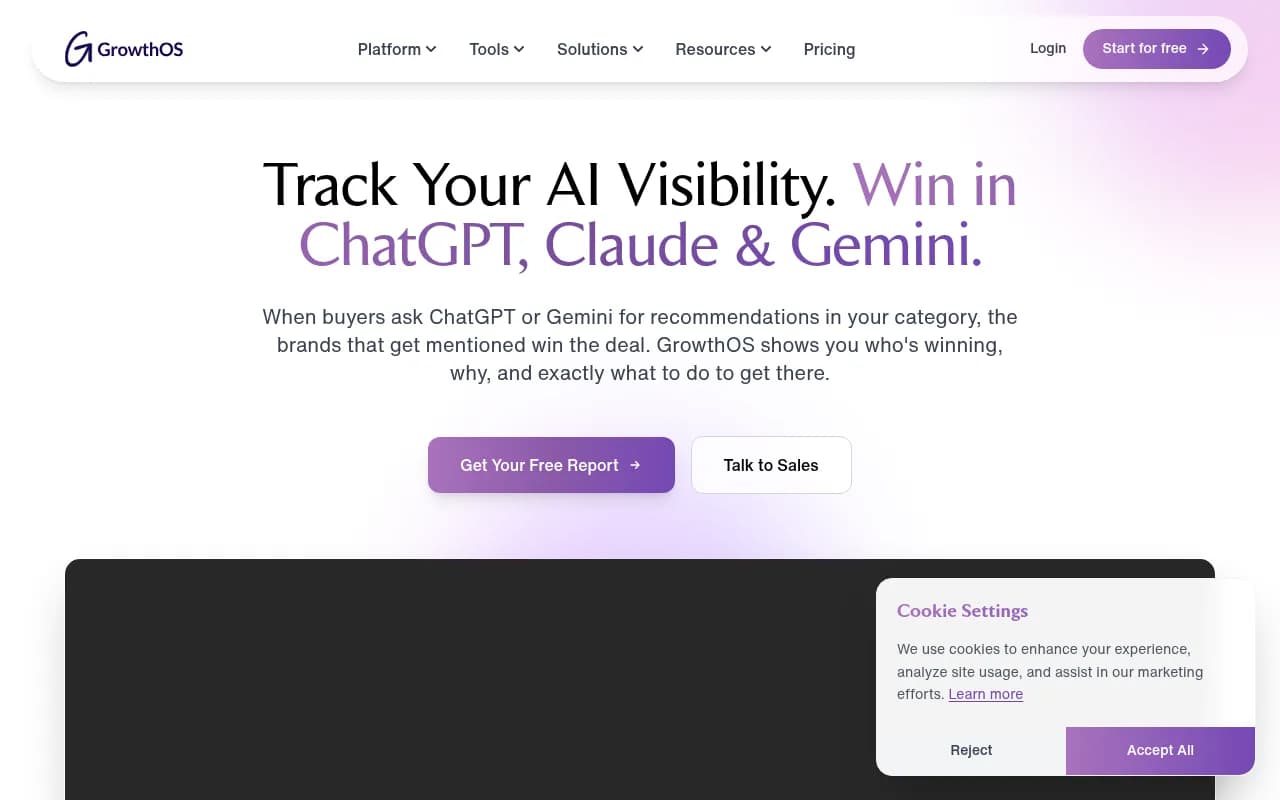
GrowthOS positions itself as a growth analytics platform that includes LLM visibility as a key feature. The pitch is straightforward: when buyers ask ChatGPT or Gemini for recommendations in your category, you want to know who's winning and why. GrowthOS shows you that, alongside actionable recommendations for improving your position. It has a free tier, which makes it accessible for smaller teams or anyone who wants to dip a toe in before committing to a paid plan.
The customer list includes names like Regus and Dainik Jagran, suggesting some enterprise traction, but the platform's public positioning leans toward mid-market brands and agencies looking for a simpler entry point into AI visibility.
Side-by-side comparison
| Feature | Promptwatch | GrowthOS |
|---|---|---|
| Free tier | No (7-day trial) | Yes (200 credits/mo) |
| Starting price | $99/mo | $99/mo (Growth) |
| AI models tracked | 10+ (ChatGPT, Claude, Gemini, Perplexity, Grok, DeepSeek, Copilot, Mistral, Meta AI, Google AI Overviews) | ChatGPT, Claude, Gemini (primary focus) |
| Content generation | Yes (AI writing agent, grounded in citation data) | No |
| Crawler logs | Yes (real-time AI crawler tracking) | No |
| Answer gap analysis | Yes | Partial (recommendations only) |
| Traffic attribution | Yes (GSC, code snippet, server logs) | Not documented |
| Prompt volume & difficulty | Yes | Not documented |
| Reddit & YouTube tracking | Yes | No |
| ChatGPT Shopping tracking | Yes | No |
| Competitor heatmaps | Yes | Yes |
| Multi-language/region | Yes | Limited |
| Agency/white-label | Yes (custom pricing) | Not documented |
| Looker Studio / API | Yes | Not documented |
| G2 rating | 4.7/5 | Not listed |
| Customer count | 8,150+ brands/agencies | Not publicly stated |
Head-to-head feature deep-dive
AI model coverage
Promptwatch monitors 10 AI platforms: OpenAI/ChatGPT, Perplexity, Google AI Overviews, Google AI Mode, Claude, Gemini, Meta/Llama, DeepSeek, Grok, Mistral, and Copilot. That breadth matters because AI search is fragmented -- a brand might be well-cited in Perplexity but invisible in Grok, and you'd never know if your tool only checks three models.
GrowthOS's public messaging focuses on ChatGPT, Claude, and Gemini. That covers the three biggest players, which is fine for most brands right now, but it leaves gaps as newer models (Grok, Perplexity, DeepSeek) grow in usage.
Verdict: Promptwatch wins on coverage. If you care about the full AI search landscape, the 10-model breadth is a meaningful advantage.
Content optimization and gap analysis
This is the sharpest difference between the two tools. Promptwatch has a full content generation workflow: it identifies which prompts your competitors appear in but you don't (Answer Gap Analysis), then its AI writing agent generates articles, listicles, and comparison pages grounded in real citation data from 880M+ analyzed citations. The content is designed to get cited by AI models, not just rank in Google.
GrowthOS offers "actionable recommendations" -- which suggests some form of guidance on what to improve -- but there's no built-in content generation. You get the diagnosis; you write the prescription yourself.
For a team that already has strong content resources, GrowthOS's approach might be fine. For a team that wants the full loop closed inside one tool, Promptwatch is the only option here.
Verdict: Promptwatch by a wide margin. GrowthOS doesn't have content generation at all.
AI crawler logs
Promptwatch's crawler log feature is genuinely unusual in this market. You see in real time when AI crawlers from ChatGPT, Gemini, Perplexity, and others visit your pages -- which URLs they read, how often they return, and any errors they encounter. This is useful for diagnosing why certain pages aren't getting cited (maybe the crawler can't access them) and for understanding how AI engines discover your content.
GrowthOS has no equivalent. This isn't a knock on GrowthOS specifically -- most competitors in this space lack it too -- but it's a capability that matters if you're serious about technical AI SEO.
Verdict: Promptwatch only. GrowthOS doesn't offer this.
Monitoring and competitor analysis
Both tools track brand mentions across AI models and let you compare against competitors. GrowthOS's interface appears clean and accessible, with competitor monitoring as a core feature. Promptwatch has competitor heatmaps that show you who's winning for each prompt and why, alongside share-of-voice metrics and sentiment tracking.
GrowthOS's free report feature (generate a free visibility report in 2 minutes) is a nice touch for quick assessments. Promptwatch's monitoring goes deeper -- page-level tracking, prompt volume estimates, difficulty scores, and query fan-outs that show how one prompt branches into sub-queries.
Verdict: Promptwatch has more depth. GrowthOS is more accessible for quick, lightweight monitoring.
Traffic attribution
Promptwatch connects AI visibility to actual website traffic through three methods: a code snippet, Google Search Console integration, or server log analysis. You can see which AI-cited pages are driving real visits and tie that back to revenue. This closes the loop between "AI mentions us" and "AI mentions drive business."
GrowthOS doesn't document a traffic attribution feature. It appears to stop at visibility tracking rather than connecting that visibility to downstream business metrics.
Verdict: Promptwatch. If you need to justify AI SEO spend to stakeholders, traffic attribution is non-negotiable.
Ease of entry and free tier
GrowthOS wins here. The free tier (200 credits/month) lets you monitor basic brand visibility without spending anything. The "get your free report in 2 minutes" positioning is genuinely low-friction. For a small brand or solo marketer who wants to understand their AI visibility before committing budget, that's a real advantage.
Promptwatch's 7-day trial gives you access to the full platform, but it's time-limited. After that, you're at $99/month minimum. The platform is more complex -- more to learn, more to configure -- which is the trade-off for having more capability.
Verdict: GrowthOS for getting started quickly and cheaply. Promptwatch for teams ready to invest in a proper AI visibility program.
Agency and enterprise features
Promptwatch has explicit agency pricing, multi-site support (up to 5 sites on Business, unlimited on Agency/Enterprise), Looker Studio integration, and an API for custom workflows. It's clearly built with agencies in mind -- you can manage multiple client accounts, export data for custom reporting, and track results across brands.
GrowthOS's agency capabilities aren't well-documented publicly. The platform may support agency use cases, but there's no clear multi-client management or white-label offering visible on the site.
Verdict: Promptwatch for agencies. GrowthOS appears more oriented toward individual brands.
Pricing comparison
| Plan | Promptwatch | GrowthOS |
|---|---|---|
| Free | No (7-day trial) | Yes (200 credits/mo) |
| Entry paid | $99/mo (Essential: 1 site, 50 prompts, 5 articles) | $99/mo (Growth) |
| Mid tier | $249/mo (Professional: 2 sites, 150 prompts, 15 articles, crawler logs) | $299/mo (Pro) |
| Higher tier | $579/mo (Business: 5 sites, 350 prompts, 30 articles) | $999/mo (Enterprise) |
| Agency/Enterprise | Custom pricing | $999/mo (Enterprise listed) |
| Annual discount | Yes | Not confirmed |
At the entry level, both tools cost $99/month. The mid tier is where Promptwatch is actually cheaper ($249 vs $299). GrowthOS's Enterprise at $999/month is significantly higher than Promptwatch's Business at $579/month, though these tiers likely differ in what they include.
The free tier is GrowthOS's clearest pricing advantage. For teams that aren't ready to spend $99/month, it's the only option that lets you start for free.
Pros and cons
Promptwatch
Pros:
- Tracks 10+ AI models, the widest coverage in this comparison
- Built-in AI content generation grounded in real citation data
- Real-time AI crawler logs (unique capability)
- Traffic attribution connects visibility to revenue
- Reddit and YouTube tracking surfaces off-site citation opportunities
- ChatGPT Shopping monitoring
- Strong agency features: multi-site, Looker Studio, API
- 4.7/5 on G2 with 8,150+ customers
Cons:
- No permanent free tier -- 7-day trial only
- More complex to set up and learn than GrowthOS
- Higher minimum commitment for teams that just want basic monitoring
- Dutch company (Promptwatch B.V.) -- may matter for some enterprise procurement processes
GrowthOS
Pros:
- Genuine free tier (200 credits/month) -- no credit card required to start
- Clean, accessible interface with quick setup
- Covers the three most important AI models (ChatGPT, Claude, Gemini)
- Free report generation is a low-friction entry point
- Broader growth analytics context beyond just AI visibility
Cons:
- No AI content generation -- you get data but have to act on it yourself
- No crawler logs or technical AI SEO features
- Narrower AI model coverage (3 vs 10+)
- No documented traffic attribution
- No Reddit or YouTube tracking
- Agency features not well-documented
- Smaller customer base and less established track record
Who should pick which tool
Pick Promptwatch if:
- You want to actually improve your AI visibility, not just track it
- Your team needs content generation built into the workflow
- You're an agency managing multiple clients
- You want to understand how AI crawlers interact with your site technically
- You need to connect AI visibility to traffic and revenue for stakeholder reporting
- You're tracking across multiple AI models including Grok, DeepSeek, and Perplexity
- You're a mid-to-large brand with a real budget for AI search optimization
Pick GrowthOS if:
- You're just starting out and want to understand AI visibility before spending money
- You only care about ChatGPT, Claude, and Gemini for now
- You want a lightweight monitoring dashboard without a steep learning curve
- Budget is the primary constraint and the free tier is genuinely enough for your needs
- You already have a content team and just need the data, not the writing tools
Final verdict
These two tools are solving different problems. GrowthOS is a reasonable starting point for teams that want basic AI visibility monitoring without upfront cost. The free tier is real, the setup is quick, and if you just need to know whether ChatGPT mentions your brand, it does that job.
Promptwatch is for teams that want to win in AI search, not just watch it. The content generation, crawler logs, 10-model coverage, and traffic attribution make it a fundamentally different product -- one that closes the loop between "we're invisible in AI search" and "here's the content we published that fixed it." For any brand or agency serious about AI search as a revenue channel, Promptwatch is the more complete tool.