Key Takeaways
- Searchable is 2x cheaper for small teams: Starter plan at $50/mo vs LLM Pulse's €49/mo (~$53), but Searchable includes unlimited domains while LLM Pulse limits you to one
- LLM Pulse tracks more AI models out of the box: 10+ models including DeepSeek, Grok, Claude, and Meta AI on all plans; Searchable covers 5 core models (ChatGPT, Claude, Perplexity, Google AI Overviews, Copilot)
- Searchable has stronger content creation tools: Built-in AI content generator creates blog posts and landing pages optimized for AI citation; LLM Pulse focuses on monitoring with basic content recommendations
- LLM Pulse offers better prompt flexibility at lower tiers: 40 prompts on the €49 starter vs Searchable's 50, but LLM Pulse's Growth plan (€99/mo) gives you 100 prompts compared to Searchable's Professional 200 prompts at $100-125/mo
- Searchable has a larger user base: 12,000+ users vs LLM Pulse's 500 brands, suggesting more market traction and potentially more stable development
- Both offer 14-day free trials with no credit card required, making it easy to test before committing
Overview
Searchable
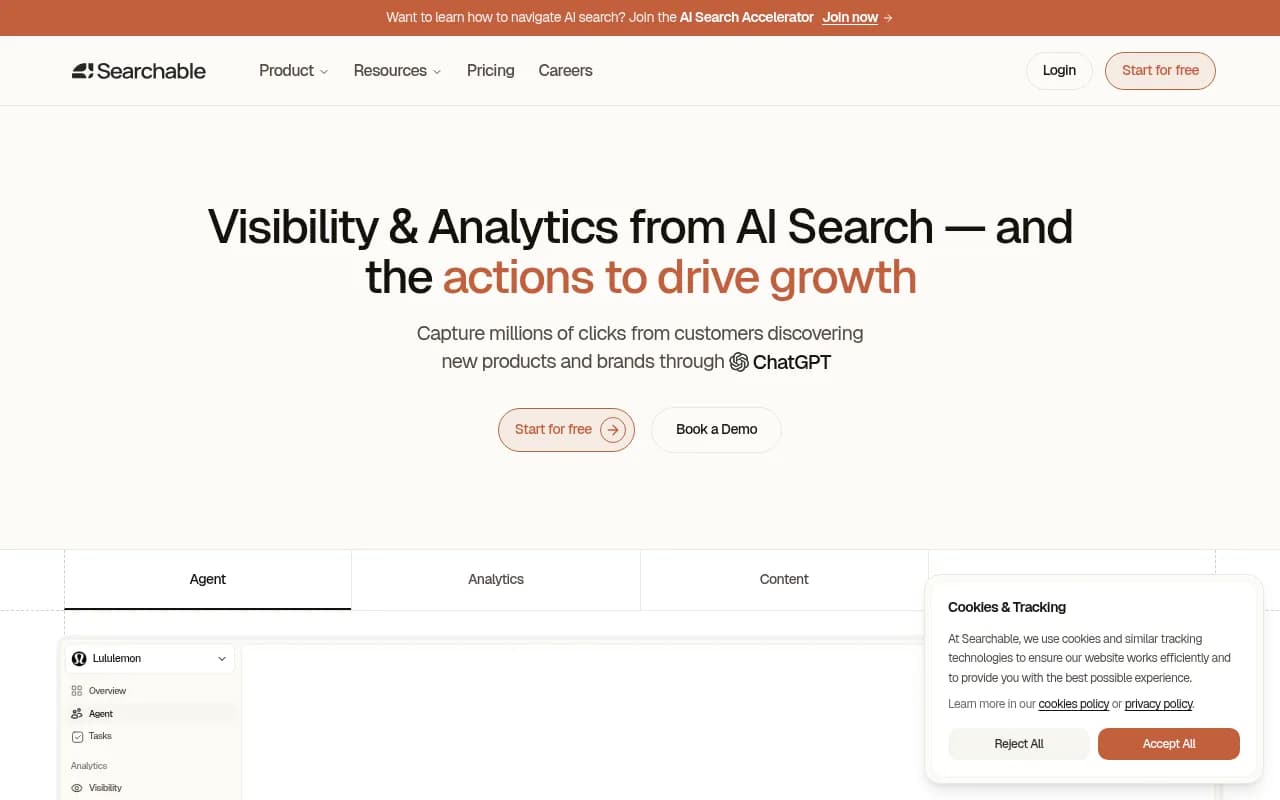
Searchable positions itself as a full-stack AI search optimization platform built by SEO specialists with agency backgrounds. The platform combines visibility tracking across five major AI engines with content generation tools and technical SEO audits. What sets it apart is the "personal AI agent" concept -- a system that learns your brand voice and delivers tailored recommendations rather than generic monitoring data. With 12,000+ users, it's one of the more established players in the AI visibility space.
The platform emphasizes actionable insights over raw data. You get content briefs, technical fixes, and strategic recommendations designed to turn monitoring into measurable growth. Searchable also integrates with Google Analytics, Search Console, HubSpot, and Salesforce to connect AI visibility with actual business outcomes.
LLM Pulse
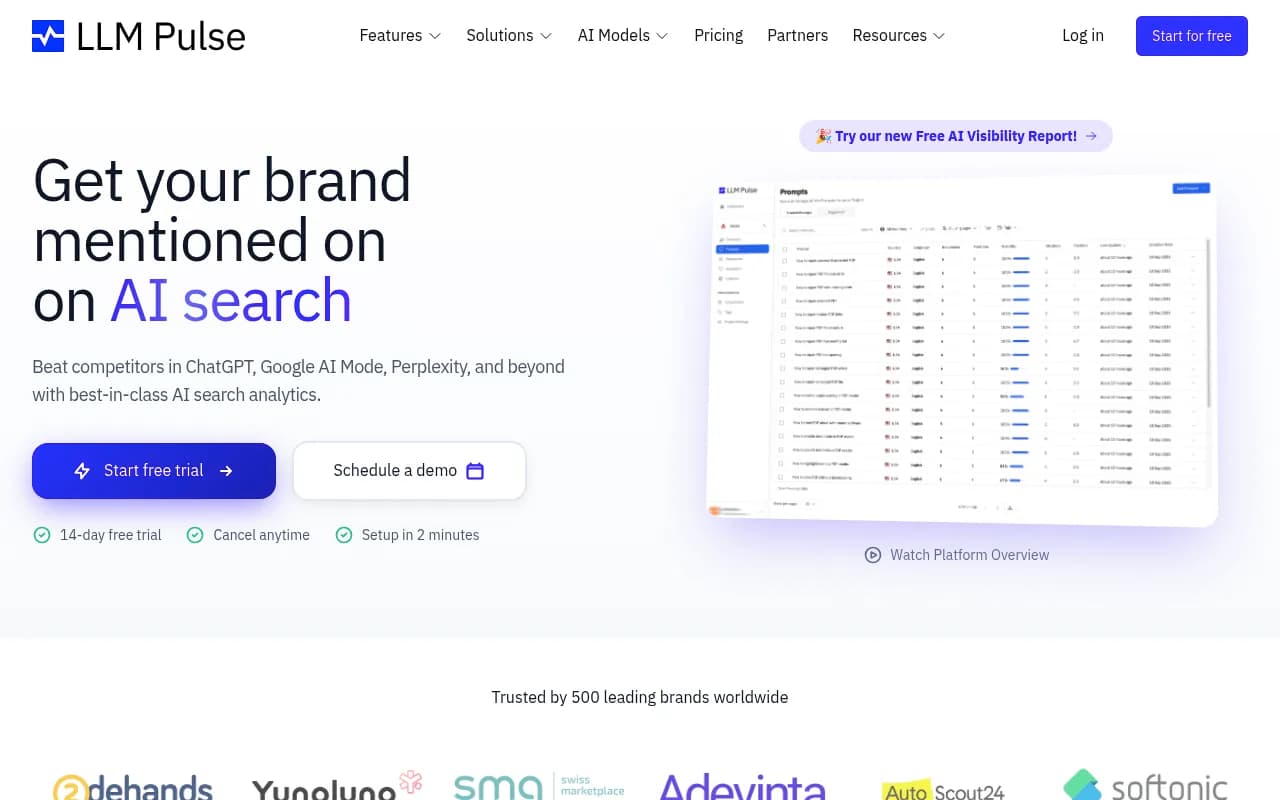
LLM Pulse takes a more straightforward approach: comprehensive tracking across 10+ AI models with detailed analytics on visibility scores, citation rates, sentiment, and share of voice. The platform covers ChatGPT, Perplexity, Gemini, Google AI Mode, AI Overviews, and (on Enterprise plans) DeepSeek, Grok, Claude, Copilot, and Meta AI.
The core value proposition is knowing what AI says about your brand before your customers do. LLM Pulse focuses on prompt tracking, citation analysis, and competitive benchmarking. It includes AI-powered content recommendations to improve your presence, but the emphasis is clearly on monitoring and analysis rather than content creation. With 500 brands using it, it's a smaller operation but still serving notable clients.
Side-by-Side Comparison
| Feature | Searchable | LLM Pulse |
|---|---|---|
| Starting price | $50/mo | €49/mo (~$53) |
| Free trial | 14 days, no card | 14 days, no card |
| AI models tracked | 5 core models | 10+ models (some Enterprise-only) |
| Domains on starter | 1 | 1 |
| Prompts on starter | 50 | 40 |
| Unlimited domains | Yes (Professional+) | Not specified |
| Content generation | Full AI content engine | Basic recommendations |
| Technical SEO audits | Yes | Not mentioned |
| Citation analysis | Yes | Yes |
| Competitor tracking | Yes | Yes |
| Integrations | GA, GSC, HubSpot, Salesforce | Not specified |
| User base | 12,000+ | 500 brands |
| Annual discount | Not specified | 17% |
AI model coverage
This is where the two platforms diverge most clearly.
Searchable tracks five AI engines on all plans: ChatGPT, Claude, Perplexity, Google AI Overviews, and Microsoft Copilot. These are the models most consumers actually use for search-like queries, so you're covering the high-traffic bases. The platform doesn't break out different tiers of model access -- you get all five from day one.
LLM Pulse covers 10+ models but gates some behind the Enterprise tier. All plans include ChatGPT, Perplexity, Gemini, Google AI Mode, and AI Overviews. DeepSeek, Grok, Claude, Copilot, and Meta AI are marked "Enterprise" on their website, meaning you'll need to upgrade to the €299/mo Scale plan or higher to access them.
The practical difference: if you need comprehensive model coverage including emerging players like DeepSeek or X's Grok, LLM Pulse gives you that breadth (at a price). If you're focused on the mainstream models where most of your audience actually searches, Searchable's five-model approach covers the essentials without the complexity.
One quirk: LLM Pulse includes Claude as an Enterprise feature, but Searchable includes it on all plans. If Claude tracking matters to you and you're on a budget, that's a point for Searchable.
Pricing breakdown
| Plan | Searchable | LLM Pulse |
|---|---|---|
| Starter | $50/mo (1 domain, 50 prompts) | €49/mo (~$53, 1 domain, 40 prompts) |
| Mid-tier | Professional: $100-125/mo (unlimited domains, 200 prompts) | Growth: €99/mo (~$107, 100 prompts) |
| High-tier | Scale: $400/mo | Scale: €299/mo (~$323, 300 prompts) |
| Annual discount | Not specified | 17% off |
Searchable is slightly cheaper at the entry level and offers unlimited domains on the Professional plan, which is a big deal for agencies or brands managing multiple properties. LLM Pulse's pricing is in euros, so the actual cost fluctuates with exchange rates -- currently about $53/mo for Starter.
The mid-tier comparison is interesting. Searchable's Professional plan gives you 200 prompts for $100-125/mo with unlimited domains. LLM Pulse's Growth plan is €99/mo (~$107) for 100 prompts, but the domain limit isn't clear. If you're tracking multiple sites, Searchable wins here.
At the high end, LLM Pulse's Scale plan (€299/mo, ~$323) is cheaper than Searchable's $400/mo Scale plan. You get 300 prompts with LLM Pulse vs whatever Searchable includes at that tier (not specified on their site). If you need heavy prompt volume and full model access, LLM Pulse's Scale plan is the better value.
Both offer 14-day free trials with no credit card required, which is the right way to do it.
Content creation and optimization
Searchable has a clear edge here. The platform includes a full AI content engine that generates blog posts, landing pages, and product descriptions engineered for AI citation. The content tool understands what makes AI engines cite sources -- structured data, authoritative tone, comprehensive coverage -- and applies those principles to everything it creates.
You also get content briefs optimized for AI citation and technical SEO audits that identify schema markup opportunities, content structure improvements, and crawlability fixes. The "personal AI agent" concept means the system learns your brand voice and generates tailored recommendations, not generic advice.
LLM Pulse offers "AI-powered content recommendations to improve how you appear in LLM responses" but doesn't detail what that means. Based on their site, it looks like analysis and suggestions rather than actual content generation. You'll see what's missing and get guidance, but you're writing the content yourself.
If you want a platform that helps you create optimized content, not just monitor results, Searchable is the obvious pick. If you have a content team and just need visibility data to guide them, LLM Pulse's lighter approach might be enough.
Worth noting that tools like Promptwatch take a similar action-oriented approach -- showing you content gaps with Answer Gap Analysis, then using an AI writing agent to generate articles grounded in real citation data. If you're comparing platforms, that's another option in the "monitoring + content creation" category.

Monitoring and analytics
Both platforms cover the core monitoring features you'd expect: visibility scores, citation tracking, competitor analysis, and detailed response logging.
Searchable emphasizes its "growth command center" approach. You get actionable recommendations tailored to your brand, not just dashboards. The platform integrates with Google Analytics, Search Console, HubSpot, and Salesforce so you can correlate AI visibility with traffic, leads, and revenue. This is important -- most monitoring tools show you data but don't connect it to business outcomes.
LLM Pulse focuses on three steps: Track, Analyze, Optimize. You monitor key prompts weekly, measure visibility score and share of voice, and get content recommendations. The platform includes sentiment analysis and citation rate tracking. The "detailed responses" feature shows you the exact words AI uses to describe your brand, which is useful for catching inaccuracies or negative framing.
One advantage for LLM Pulse: the broader model coverage means you can benchmark your brand across more AI engines and see which ones recommend you most. If you're trying to understand model-by-model performance differences, that granularity helps.
Searchable's integration ecosystem is stronger. If you need to prove ROI or connect AI visibility to downstream metrics, the GA/GSC/HubSpot/Salesforce connections make that possible. LLM Pulse doesn't mention integrations on their site, which suggests you're exporting data manually if you want to analyze it elsewhere.
Prompt tracking and citation analysis
Both platforms let you define custom prompts to track over time. You're not stuck with a fixed list -- you can monitor the specific questions your audience asks.
Searchable gives you 50 prompts on the Starter plan, 200 on Professional. LLM Pulse gives you 40 on Starter, 100 on Growth, 300 on Scale. If you need to track a lot of prompts, LLM Pulse's Scale plan (300 prompts for €299/mo) beats Searchable's pricing.
Citation analysis is where both platforms shine. You can see which sources AI models trust in your space -- whether your content gets cited, or if competitors and third parties are shaping the narrative. LLM Pulse explicitly calls out "Citations Analysis" as a core feature. Searchable includes it as part of the broader monitoring suite.
The practical difference: LLM Pulse seems to put more emphasis on citation tracking as a standalone feature, while Searchable bundles it into the overall visibility analysis. If citation data is your primary concern, LLM Pulse's focus might feel more aligned.
Technical capabilities and audits
Searchable includes technical SEO audits for AI search. This is a differentiator. The audits identify schema markup opportunities, content structure improvements, and crawlability fixes that help ChatGPT, Claude, and Perplexity understand and cite your content more effectively.
AI search engines process websites differently than traditional search. They care about structured data, clear content hierarchy, and machine-readable signals. Searchable's technical audits catch these issues before they hurt your visibility.
LLM Pulse doesn't mention technical audits on their site. The focus is on monitoring what AI says about you, not diagnosing why your content isn't being cited. If you need help fixing technical issues, Searchable has the edge.
User base and market traction
Searchable claims 12,000+ users. LLM Pulse says 500 brands. That's a 24x difference.
A larger user base usually means more stable development, more frequent updates, and a higher likelihood the platform will be around long-term. It also suggests the product has found product-market fit with a broader audience.
That said, 500 brands is still a meaningful customer base, and LLM Pulse's client logos include recognizable names. Smaller user bases can mean more responsive support and faster feature development based on direct feedback.
If you're risk-averse and want to bet on the more established player, Searchable's 12,000+ users signal more market traction. If you prefer working with a smaller, more focused team, LLM Pulse's size might be an advantage.
Pros and cons
Searchable pros:
- Cheaper entry point ($50/mo vs ~$53/mo)
- Unlimited domains on Professional plan (huge for agencies)
- Full AI content generation engine, not just recommendations
- Technical SEO audits for AI search
- Integrations with GA, GSC, HubSpot, Salesforce
- Larger user base (12,000+) suggests stability
- Personal AI agent learns your brand voice
Searchable cons:
- Only 5 AI models tracked (vs LLM Pulse's 10+)
- Higher pricing at the top tier ($400/mo vs ~$323/mo)
- Fewer prompts at the mid-tier (200 vs LLM Pulse's potential 300)
- No annual discount mentioned
LLM Pulse pros:
- Tracks 10+ AI models (more comprehensive coverage)
- 300 prompts on Scale plan vs Searchable's unspecified high-tier limit
- Cheaper at the high end (€299/mo vs $400/mo)
- 17% annual discount available
- Detailed sentiment analysis and response tracking
- Clean focus on monitoring without feature bloat
LLM Pulse cons:
- Gates key models (Claude, DeepSeek, Grok) behind Enterprise tier
- No content generation engine, just recommendations
- No technical SEO audits mentioned
- No integrations listed (harder to connect to business metrics)
- Smaller user base (500 brands vs 12,000+)
- Pricing in euros creates exchange rate uncertainty
Who should pick Searchable
Pick Searchable if you:
- Need content creation tools, not just monitoring. The AI content engine is a real differentiator.
- Manage multiple domains (agencies, multi-brand companies). Unlimited domains on Professional is a game-changer.
- Want technical SEO audits to fix crawlability and schema issues.
- Need to prove ROI by connecting AI visibility to traffic and revenue. The integrations make this possible.
- Prefer working with a more established platform (12,000+ users).
- Want a "personal AI agent" that learns your brand voice and delivers tailored recommendations.
Searchable makes sense for teams that want an end-to-end optimization platform, not just a monitoring dashboard. If you're trying to actively improve your AI visibility -- not just track it -- the content tools and technical audits justify the investment.
Who should pick LLM Pulse
Pick LLM Pulse if you:
- Need comprehensive model coverage including DeepSeek, Grok, Meta AI (and can afford the Enterprise tier).
- Have a content team and just need visibility data to guide them. You don't need the platform to generate content.
- Want more prompts at the high end (300 on Scale vs Searchable's unspecified limit).
- Prefer a cleaner, more focused monitoring experience without extra features.
- Are tracking a single domain and don't need unlimited domain access.
- Want to save money at the high tier (€299/mo vs $400/mo).
LLM Pulse is the right choice for teams that already have content creation and technical SEO handled. You're buying monitoring and analysis, not optimization tools. If you just want to know what AI says about you and benchmark against competitors, LLM Pulse delivers that without the complexity.
Final verdict
Searchable wins for most teams. The combination of content generation, technical audits, unlimited domains, and integrations makes it a true optimization platform rather than just a monitoring tool. You're not stuck looking at dashboards wondering what to do next -- the platform tells you what's missing and helps you fix it.
LLM Pulse is a strong monitoring-focused alternative if you need broader model coverage and already have content/technical resources in-house. The 10+ model tracking is impressive, and the €299/mo Scale plan is cheaper than Searchable's $400/mo equivalent. But for most teams, the lack of content creation tools and technical audits means you're buying half a solution.
If you're an agency managing multiple clients, Searchable's unlimited domains on the Professional plan ($100-125/mo) is unbeatable value. If you're an enterprise brand that needs to track every AI model under the sun and has a dedicated content team, LLM Pulse's Scale plan makes sense.
For everyone else: start with Searchable's 14-day trial, test the content generation and technical audits, and see if the actionable recommendations justify the price. If you find yourself wishing for more model coverage or cheaper high-tier pricing, try LLM Pulse's trial and compare. Both platforms offer no-risk trials, so there's no reason not to test both before committing.