Key takeaways
- Promptwatch and Wincher are not really direct competitors -- they track different search channels. Wincher is a Google rank tracker; Promptwatch monitors AI search engines like ChatGPT, Claude, and Perplexity.
- If your traffic still comes primarily from Google organic search and you need daily keyword position tracking, Wincher is the right tool. It's affordable, easy to use, and very good at what it does.
- If you're trying to understand and grow your brand's presence in AI-generated answers, Promptwatch is the only option here. Wincher has no AI search monitoring at all.
- Wincher starts at €49/mo for 250 keywords -- genuinely budget-friendly for small teams. Promptwatch starts at $99/mo for 50 prompts, which is reasonable given the depth of data it provides.
- Promptwatch goes beyond monitoring: it includes content gap analysis, an AI writing agent, crawler logs, and traffic attribution. Wincher is more focused -- rank tracking, keyword research, on-page checker.
- For most marketing teams in 2026, these tools are complementary rather than either/or. The real question is which channel matters more to your business right now.
Overview
Promptwatch

Promptwatch is an AI Search Visibility platform used by 8,000+ brands and agencies to track how they appear in responses from ChatGPT, Claude, Perplexity, Gemini, Grok, DeepSeek, and other AI models. It's rated 4.7/5 on G2 and has processed over 1.1 billion citations and prompts. Beyond monitoring, it includes an AI content agent that generates articles grounded in real citation data, crawler log analysis that shows which AI bots are reading your pages, and traffic attribution to connect AI visibility to actual revenue.
The core value proposition is the full loop: find where you're invisible, create content to fix it, track whether it worked.
Wincher
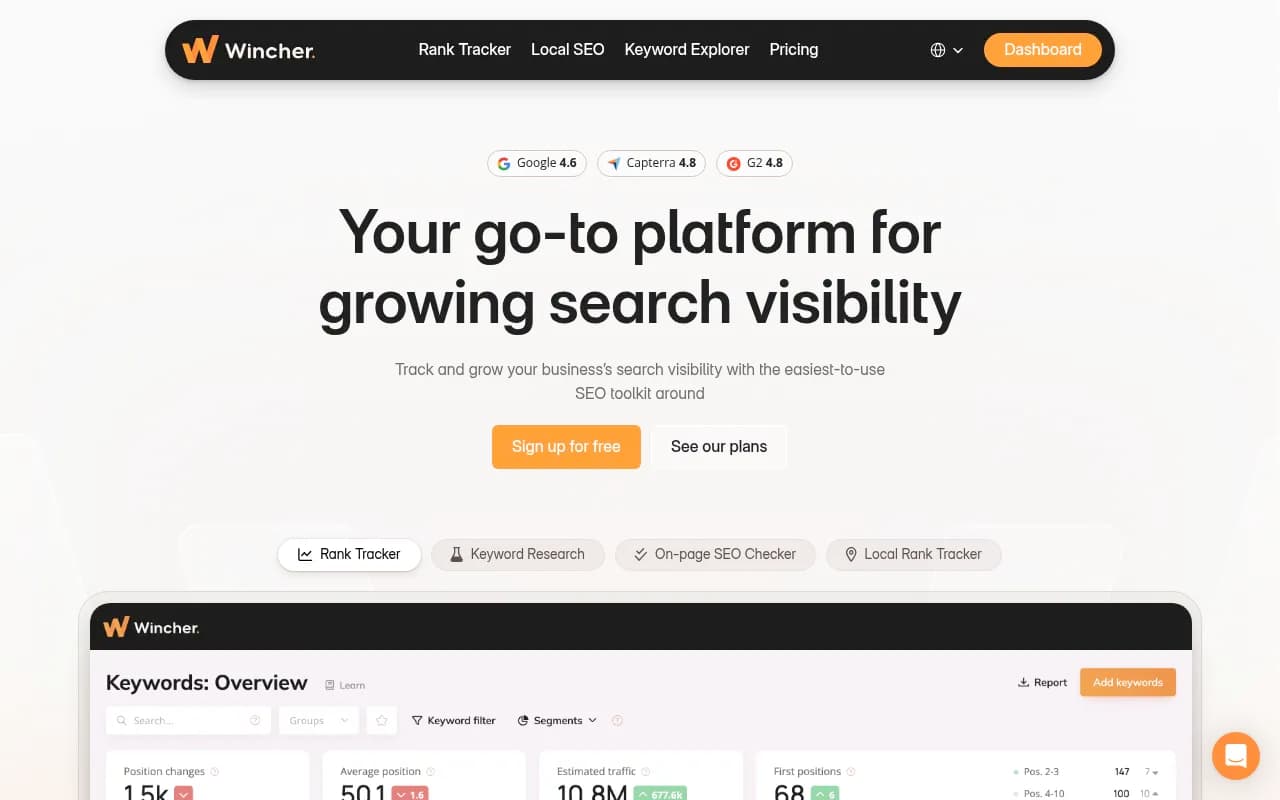
Wincher is a search visibility platform focused on Google keyword rankings. It's used by 700,000+ marketers and business owners -- a much larger user base, which reflects its accessibility and price point. It covers daily rank tracking, keyword research, competitor rank monitoring, on-page SEO scoring, and local rank tracking. Ratings are strong across the board: 4.8 on G2, 4.8 on Capterra, 4.6 on Google.
Wincher's pitch is simplicity. It's built for people who want clean, actionable SEO data without the complexity of tools like Semrush or Ahrefs.
Side-by-side comparison
| Feature | Promptwatch | Wincher |
|---|---|---|
| Primary channel | AI search (ChatGPT, Claude, Perplexity, etc.) | Google organic search |
| AI model monitoring | 10+ models | None |
| Google rank tracking | No | Yes, daily |
| Keyword research | No | Yes |
| On-page SEO checker | No | Yes |
| Local rank tracking | No | Yes |
| Content generation | Yes (AI writing agent) | No |
| Content gap analysis | Yes (Answer Gap Analysis) | Basic keyword gap |
| Competitor monitoring | AI visibility heatmaps | Google rank comparison |
| Crawler log analysis | Yes (real-time AI crawler logs) | No |
| Traffic attribution | Yes (GSC, code snippet, server logs) | GSC integration |
| Pricing (entry) | $99/mo | €49/mo |
| Free trial | 7 days | 7 days, no credit card |
| Target user | Marketing/SEO teams, agencies, brands | SMBs, freelancers, agencies |
| API access | Yes | Yes |
| White-label reporting | Yes (agency plans) | Yes |
| G2 rating | 4.7/5 | 4.8/5 |
Head-to-head feature deep-dive
Search channel coverage
This is the most fundamental difference between the two tools, and it's worth being blunt about it.
Wincher tracks Google. That's it. You get daily keyword positions, SERP feature tracking, and historical rank data for your domains. It does this well and at a fair price. If you're asking "where do I rank for 'best project management software'?" Wincher answers that question clearly.
Promptwatch tracks AI engines. It monitors 10 models: ChatGPT, Claude, Perplexity, Gemini, Grok, DeepSeek, Copilot, Mistral, Meta AI, and Google AI Overviews. It answers a different question: "When someone asks ChatGPT for a project management recommendation, does my brand come up?" These are related but distinct questions, and in 2026, both matter.
Verdict: Neither tool covers both channels. You need to decide which channel is more important to your business right now -- or use both.
Rank and visibility tracking
Wincher's rank tracker is its core product. You add keywords, assign them to projects, and get daily position updates with historical charts. The interface is clean and fast. Competitor tracking lets you see how your rankings compare to specific domains over time. Local rank tracking is available for businesses that care about city or region-level positions.
Promptwatch tracks "visibility scores" -- a measure of how often your brand appears in AI responses across your tracked prompts. You can see share of voice versus competitors, sentiment in AI mentions, and which specific AI models are citing you. Page-level tracking shows which URLs are getting cited and how often.
The two metrics are not interchangeable. A Google rank is a position (1st, 5th, 12th). An AI visibility score is more like a percentage of responses where your brand appears. Both are useful; they just describe different things.
Verdict: Wincher for Google rankings, Promptwatch for AI visibility. No overlap.
Keyword and prompt research
Wincher includes a keyword research tool that surfaces search volume, difficulty, and related terms. It's not as deep as Ahrefs or Semrush, but it covers the basics well and integrates directly with your rank tracking projects.
Promptwatch has Prompt Intelligence: volume estimates and difficulty scores for AI prompts, plus query fan-outs that show how one prompt branches into related sub-queries. This helps you prioritize which prompts to target -- similar logic to keyword research, but for AI search behavior.
Both tools give you a research layer on top of their tracking. The inputs are different (keywords vs. prompts), but the goal is the same: find the opportunities worth pursuing.
Verdict: Comparable in concept, completely different in execution. Wincher for Google keyword research, Promptwatch for AI prompt research.
Content optimization
Wincher has an on-page SEO checker that scores your pages against target keywords and gives recommendations for improving rankings. It's a useful sanity check, especially for teams without a dedicated SEO specialist.
Promptwatch's content layer is more ambitious. The Answer Gap Analysis identifies specific prompts where competitors appear in AI responses but you don't -- and shows you exactly what content your site is missing. The built-in AI writing agent then generates articles, listicles, and comparison pages grounded in real citation data from 880M+ analyzed citations. The idea is to create content that AI models will actually cite, not just content that ticks SEO boxes.
Verdict: Promptwatch has a significantly deeper content optimization story. Wincher's on-page checker is useful but limited to basic SEO recommendations.
Competitor analysis
Wincher lets you track competitor keyword rankings alongside your own. You can see how specific domains perform for the same keywords over time, which is useful for identifying where you're losing ground or gaining.
Promptwatch has competitor heatmaps that show AI visibility scores across models for you and your competitors. You can see who's winning for each prompt and which AI engines favor which brands. The Answer Gap Analysis is essentially competitor-driven: it surfaces prompts where a competitor is visible and you're not.
Verdict: Both tools do competitor analysis, but in their respective channels. Promptwatch's gap analysis is particularly actionable because it tells you not just that you're behind, but specifically what content to create.
Technical and integration features
Wincher integrates with Google Search Console for traffic data and supports API access for custom reporting. White-label reports are available on higher plans, which is useful for agencies.
Promptwatch has a few features that have no equivalent in Wincher. AI Crawler Logs show in real time when bots from ChatGPT, Claude, Perplexity, and others are crawling your pages -- which URLs they hit, errors they encounter, and how often they return. This is genuinely useful for diagnosing why certain pages aren't getting cited. Traffic attribution connects AI visibility to actual website traffic via a code snippet, GSC integration, or server log analysis. There's also a Looker Studio integration and API for custom workflows.
Verdict: Promptwatch has more technical depth, particularly around crawler analysis and traffic attribution. Wincher is simpler but covers the GSC integration that most Google-focused teams need.
Ease of use
Wincher is built around simplicity. The interface is clean, onboarding is fast, and you don't need SEO expertise to get value from it. This is a deliberate product choice and it shows in the user base -- 700,000+ users, many of them small business owners rather than SEO specialists.
Promptwatch has more moving parts by design. Crawler logs, citation analysis, content agents, prompt intelligence -- there's more to learn. That said, reviews consistently mention that the interface is well-organized and the learning curve is manageable. It's more complex than Wincher, but not overwhelming.
Verdict: Wincher wins on simplicity. Promptwatch is more complex but justified by the depth of what it does.
Pricing comparison
| Plan | Promptwatch | Wincher |
|---|---|---|
| Entry | $99/mo (Essential: 1 site, 50 prompts, 5 articles) | €49/mo (Basic: 250 keywords, 3 projects) |
| Mid-tier | $249/mo (Professional: 2 sites, 150 prompts, 15 articles, crawler logs) | €99/mo (Standard: 1,000 keywords, 10 projects) |
| Upper tier | $579/mo (Business: 5 sites, 350 prompts, 30 articles) | €199/mo (Professional: 2,500 keywords, 25 projects) |
| Agency/Enterprise | Custom pricing | Custom pricing |
| Free trial | 7 days | 7 days, no credit card required |
| Annual discount | Yes | Yes |
Wincher is meaningfully cheaper at every tier. For a team that just needs Google rank tracking, it's hard to argue with €49/mo for 250 keywords. Promptwatch's pricing reflects the complexity of what it does -- querying 10 AI models, processing citation data, running content agents -- but it's a higher commitment.
Worth noting: these tools aren't really competing for the same budget. Most teams that buy Promptwatch are doing so because they want AI search coverage, not as a replacement for their rank tracker.
Pros and cons
Promptwatch
Pros:
- Covers 10 AI models in a single platform
- Content gap analysis + AI writing agent closes the loop from monitoring to action
- AI crawler logs are unique -- no other tool at this price point offers real-time bot crawl data
- Traffic attribution connects AI visibility to revenue
- Strong agency features: multi-site, API, Looker Studio integration
- Reddit and YouTube citation tracking surfaces influence channels most tools ignore
Cons:
- No Google keyword rank tracking
- Higher price point than Wincher
- More complex to set up and learn
- 50 prompts on the entry plan is limiting for large sites with broad topic coverage
Wincher
Pros:
- Very affordable entry point (€49/mo)
- Clean, intuitive interface -- minimal learning curve
- Daily Google rank tracking is accurate and reliable
- Good for local rank tracking
- No credit card required for free trial
- Strong ratings across G2, Capterra, and Google
Cons:
- No AI search monitoring whatsoever
- No content generation features
- Keyword research is less deep than Semrush or Ahrefs
- On-page SEO checker is basic compared to dedicated tools
- Limited technical SEO features
Who should pick which tool
Pick Promptwatch if:
- You want to track and improve how your brand appears in ChatGPT, Claude, Perplexity, or other AI engines
- You're running a GEO or AEO strategy and need data to back it up
- You want to generate content that's specifically engineered to get cited by AI models
- You're an agency managing AI search visibility for multiple clients
- You want to understand which AI crawlers are hitting your site and how often
Pick Wincher if:
- Google organic search is your primary traffic channel and you need daily rank tracking
- You're a small business owner or freelancer who wants simple, affordable SEO monitoring
- You need keyword research and on-page optimization guidance
- Budget is a constraint and you don't yet have AI search on your roadmap
- You want a tool you can hand to a non-specialist and have them use immediately
Pick both if:
- You're a marketing or SEO team that cares about both Google rankings and AI search visibility (which, in 2026, is most teams)
- You're an agency that needs to report on traditional SEO and AI search for the same clients
Final verdict
Promptwatch and Wincher are solving different problems. Wincher is a solid, affordable Google rank tracker that does its job without fuss. Promptwatch is an AI search visibility platform that goes well beyond monitoring to help you actually improve your presence in AI-generated answers.
The honest answer: if you're only tracking one thing in 2026, the choice depends on where your traffic comes from. Google still drives the majority of search traffic for most businesses, which makes Wincher a defensible choice. But AI search is growing fast, and Promptwatch is the more forward-looking investment -- especially because it doesn't just tell you where you're invisible, it helps you fix it.