Key Takeaways
- Promptwatch is an end-to-end optimization platform with content gap analysis and AI writing tools -- LLMrefs focuses purely on tracking and analytics
- LLMrefs starts at $79/mo vs Promptwatch's $99/mo, but Promptwatch includes content generation credits even on the base plan
- Promptwatch tracks AI crawler logs in real-time and offers Reddit/YouTube citation tracking -- LLMrefs doesn't surface these data sources
- LLMrefs auto-generates prompt variations from real user conversations, while Promptwatch requires manual prompt setup but provides prompt volume estimates and difficulty scores
- Both platforms track the same core AI models (ChatGPT, Perplexity, Claude, Gemini, AI Overviews), but Promptwatch adds ChatGPT Shopping monitoring
- If you just need visibility dashboards and competitor benchmarking, LLMrefs is simpler and cheaper. If you want to actually fix visibility gaps with content optimization, Promptwatch closes that loop.
Overview
Promptwatch

Promptwatch is the market-leading AI visibility and Generative Engine Optimization (GEO) platform used by 7,000+ brands including Booking.com, Center Parcs, and Typeform. It tracks how your brand appears across 10 AI models -- ChatGPT, Perplexity, Claude, Gemini, AI Overviews, Grok, DeepSeek, Meta AI, Copilot, and Mistral. The core difference: Promptwatch doesn't just show you where you're invisible, it helps you fix it. Answer Gap Analysis identifies exactly which prompts competitors rank for but you don't, then the built-in AI writing agent generates content grounded in 880M+ citations to close those gaps. You also get AI crawler logs (see which pages ChatGPT and Claude are reading), Reddit/YouTube citation tracking, ChatGPT Shopping monitoring, and traffic attribution to connect visibility to revenue.
Pricing starts at $99/mo (Essential plan: 1 site, 50 prompts, 5 AI-generated articles). Professional ($249/mo) and Business ($579/mo) plans add crawler logs, more prompts, and higher article limits. All plans include a 7-day free trial.
LLMrefs
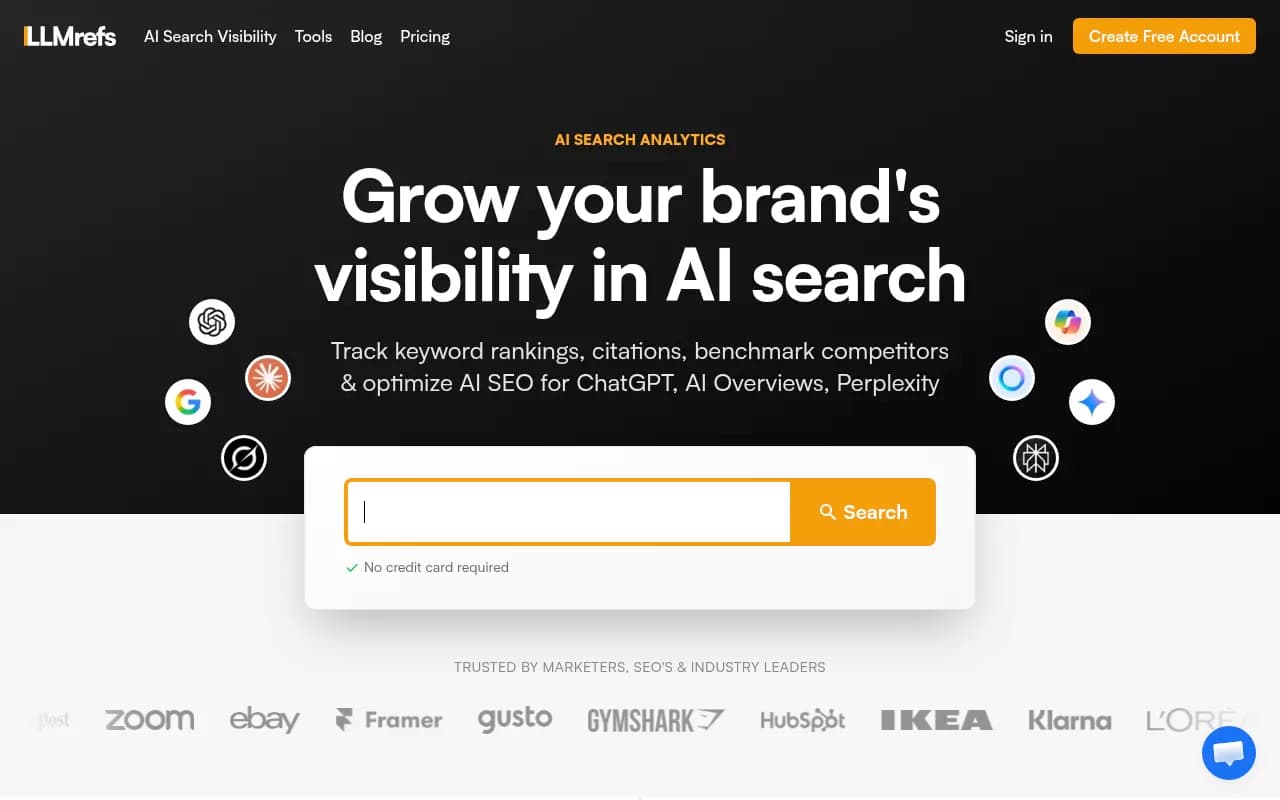
LLMrefs is an AI search analytics platform built for SEO teams and agencies who want to track keyword rankings and citations across AI models. It monitors ChatGPT, Perplexity, Claude, Gemini, AI Overviews, Grok, Copilot, and Meta AI. The standout feature: LLMrefs automatically generates prompt variations from real user conversations, so you're tracking how people actually search instead of guessing at prompts. You get citation tracking, competitor benchmarking, and rank monitoring -- but no content creation tools or crawler logs. It's a pure analytics play.
Pricing starts at $79/mo. LLMrefs positions itself as the more affordable option for teams that already have content workflows and just need the tracking layer.
Side-by-side comparison
| Feature | Promptwatch | LLMrefs |
|---|---|---|
| Starting price | $99/mo | $79/mo |
| Free trial | 7 days | Yes (details not public) |
| AI models tracked | 10 (ChatGPT, Perplexity, Claude, Gemini, AI Overviews, Grok, DeepSeek, Meta AI, Copilot, Mistral) | 8 (ChatGPT, Perplexity, Claude, Gemini, AI Overviews, Grok, Copilot, Meta AI) |
| Prompt setup | Manual with volume/difficulty scoring | Auto-generated from real conversations |
| Content generation | ✓ Built-in AI writer | ✗ |
| Answer Gap Analysis | ✓ | ✗ |
| AI crawler logs | ✓ | ✗ |
| Reddit/YouTube tracking | ✓ | ✗ |
| ChatGPT Shopping | ✓ | ✗ |
| Citation analysis | ✓ | ✓ |
| Competitor benchmarking | ✓ | ✓ |
| Multi-language support | ✓ | ✓ |
| API access | ✓ | Not specified |
| Looker Studio integration | ✓ | Not specified |
Prompt tracking and setup
LLMrefs has a clever edge here: it auto-generates prompt variations from real user conversations. You're not stuck guessing how people phrase queries -- the platform surfaces actual language patterns. This is huge if you're entering a new vertical and don't know the lingo yet.
Promptwatch takes a different approach. You manually add prompts, but you get prompt volume estimates and difficulty scores to prioritize which ones matter. The platform also shows query fan-outs -- how one prompt branches into sub-queries -- so you can see the full search tree. This is more work upfront but gives you tighter control over what you're tracking.
Verdict: LLMrefs wins for speed and discovery. Promptwatch wins if you want strategic prioritization and volume data.
Content optimization and generation
This is where the platforms diverge completely.
Promptwatch includes an AI writing agent that generates articles, listicles, and comparison pages grounded in citation data, prompt volumes, and competitor analysis. The content is engineered to get cited by AI models -- not generic SEO filler. Answer Gap Analysis shows you exactly which topics your site is missing, then the writer fills those gaps. Even the Essential plan ($99/mo) includes 5 articles per month.
LLMrefs has no content generation. You get the analytics, then you're on your own to create content. If you already have writers or an agency handling content, this is fine. If you're a lean team trying to move fast, it's a gap.
Verdict: Promptwatch by a mile if content creation is part of your workflow. LLMrefs if you're purely tracking.
AI crawler logs and indexing
Promptwatch surfaces real-time logs of AI crawlers (ChatGPT, Claude, Perplexity) hitting your website. You see which pages they read, errors they encounter, and how often they return. This is critical for diagnosing indexing issues -- if AI models aren't crawling a page, they can't cite it.
LLMrefs doesn't offer crawler logs. You're flying blind on whether AI models are even seeing your content.
Verdict: Promptwatch. Crawler logs are table stakes for serious AI SEO.
Citation and source analysis
Both platforms track which pages, domains, and sources AI models cite in their responses. Promptwatch breaks citations into Corporate (brand pages), Organic (articles/blogs), and News categories, with traffic estimates for each source. You also get Reddit thread tracking and YouTube video citations -- channels that heavily influence AI recommendations but most competitors ignore.
LLMrefs focuses on citation tracking and competitor benchmarking but doesn't surface Reddit or YouTube data. You see which domains are cited, but not the full context of where those citations come from.
Verdict: Promptwatch for depth. LLMrefs covers the basics.
Competitor benchmarking
Both platforms let you compare your visibility vs competitors across AI models. Promptwatch uses heatmaps to show who's winning for each prompt and why. LLMrefs offers similar benchmarking with a focus on keyword rankings.
The difference: Promptwatch's Answer Gap Analysis tells you exactly what content competitors have that you don't. LLMrefs shows you the gap but doesn't diagnose it.
Verdict: Tie for basic benchmarking. Promptwatch if you want actionable insights.
ChatGPT Shopping and product recommendations
Promptwatch tracks when your brand appears in ChatGPT's product recommendations and shopping carousels. This is a new revenue channel -- ChatGPT is starting to surface products directly in responses, and brands that show up here get clicks.
LLMrefs doesn't monitor ChatGPT Shopping.
Verdict: Promptwatch if you sell products. Not relevant otherwise.
Multi-language and multi-region support
Both platforms support multi-language tracking. Promptwatch lets you customize personas (e.g. "a small business owner in Texas") to match how your actual customers prompt. LLMrefs auto-generates prompts from real conversations, which inherently captures regional language patterns.
Verdict: Tie. Both handle this well.
Integrations and API
Promptwatch offers Looker Studio integration for custom reporting and a full API for building custom workflows. You can also connect Google Search Console to attribute traffic.
LLMrefs doesn't publicly list integrations or API access, though it's likely available on higher-tier plans.
Verdict: Promptwatch for confirmed integrations. LLMrefs unclear.
Pricing comparison
| Plan | Promptwatch | LLMrefs |
|---|---|---|
| Entry tier | Essential: $99/mo (1 site, 50 prompts, 5 articles, basic tracking) | From $79/mo (details not public) |
| Mid tier | Professional: $249/mo (2 sites, 150 prompts, 15 articles, crawler logs, state/city tracking) | Not specified |
| High tier | Business: $579/mo (5 sites, 350 prompts, 30 articles, full features) | Not specified |
| Enterprise | Custom pricing | Custom pricing |
| Free trial | 7 days | Yes (length not specified) |
| Annual discount | 25% off | Not specified |
LLMrefs is cheaper at the entry level ($79 vs $99), but Promptwatch includes content generation credits even on the base plan. If you value the AI writer, Promptwatch's $99/mo is a better deal than paying $79/mo for tracking plus hiring a writer separately.
Pros and cons
Promptwatch pros
- End-to-end optimization: tracking + content gap analysis + AI writing in one platform
- AI crawler logs show exactly what AI models are reading on your site
- Reddit and YouTube citation tracking (most competitors miss this)
- ChatGPT Shopping monitoring for product-based brands
- Prompt volume estimates and difficulty scoring for prioritization
- Traffic attribution connects visibility to revenue
- 880M+ citations analyzed for content recommendations
Promptwatch cons
- Higher starting price ($99/mo vs $79/mo)
- Manual prompt setup requires more upfront work
- Steeper learning curve due to feature depth
LLMrefs pros
- Auto-generates prompt variations from real user conversations
- Lower entry price ($79/mo)
- Simpler interface focused purely on analytics
- Good for teams that already have content workflows
LLMrefs cons
- No content generation or optimization tools
- No AI crawler logs (can't diagnose indexing issues)
- Missing Reddit/YouTube citation tracking
- No ChatGPT Shopping monitoring
- Less transparency on feature set and integrations
Who should pick which tool
Pick Promptwatch if:
- You're a lean team that needs tracking AND content creation in one platform
- You want to understand why you're invisible (Answer Gap Analysis) and fix it (AI writer)
- AI crawler logs matter to you -- you need to know if AI models are even reading your site
- You're tracking product visibility in ChatGPT Shopping
- You want Reddit and YouTube citation data to inform content strategy
- You're willing to pay $99/mo for an all-in-one solution
Pick LLMrefs if:
- You already have a content team or agency and just need the analytics layer
- You want auto-generated prompts from real conversations instead of manual setup
- Budget is tight and $79/mo is your ceiling
- You don't need crawler logs or Reddit/YouTube tracking
- You prefer a simpler, analytics-focused interface
Final verdict
Promptwatch is the better choice for most teams because it closes the loop from tracking to optimization. Seeing where you're invisible is only half the battle -- you need to create content that fixes those gaps. Promptwatch's Answer Gap Analysis + AI writer combo does that. Add in crawler logs, Reddit/YouTube tracking, and ChatGPT Shopping monitoring, and you're getting capabilities that LLMrefs simply doesn't offer.
LLMrefs makes sense if you're purely in analytics mode -- you have content covered and just need a dashboard. The auto-generated prompts are clever, and the $79/mo price is attractive. But you're missing the action layer that turns data into results.
For teams serious about AI visibility in 2026, Promptwatch's extra $20/mo buys you a platform that doesn't just show you the problem -- it helps you solve it.