Key Takeaways
- Promptwatch is an optimization platform, LLM Pulse is a monitoring dashboard -- Promptwatch includes content gap analysis and an AI writing agent to help you create content that ranks in AI search, while LLM Pulse focuses on tracking and reporting what AI models say about you
- Promptwatch costs more but delivers more action -- Essential plan at $99/mo vs LLM Pulse Starter at €49/mo (~$54), but Promptwatch includes crawler logs, content generation credits, and Answer Gap Analysis that LLM Pulse lacks entirely
- LLM Pulse offers cheaper high-volume tracking -- If you need to monitor 300+ prompts and don't care about content optimization, LLM Pulse's Scale plan (€299/mo for 300 prompts) undercuts Promptwatch Business ($579/mo for 350 prompts)
- Promptwatch has deeper data infrastructure -- 880M+ citations analyzed, AI crawler logs showing exactly when ChatGPT/Claude/Perplexity crawl your site, and traffic attribution via code snippet or GSC integration. LLM Pulse doesn't expose crawler activity or connect visibility to revenue.
- Both cover the same 10 AI models -- ChatGPT, Perplexity, Gemini, Google AI Overviews, Google AI Mode, Claude, DeepSeek, Grok, Copilot, Meta AI. No advantage either way on model coverage.
- Choose Promptwatch if you want to improve your AI visibility, choose LLM Pulse if you just want to watch it -- The core difference comes down to whether you need tools to act on the data or just a dashboard to report it.
Overview
Promptwatch

Promptwatch is the market-leading AI Search Visibility and Generative Engine Optimization (GEO) platform, used by 7,000+ brands including Booking.com, Center Parcs, and Yelp. It's built around a complete action loop: find content gaps (Answer Gap Analysis shows which prompts competitors rank for but you don't), create optimized content (built-in AI writing agent generates articles grounded in 880M+ citations), and track results (page-level visibility tracking plus traffic attribution). Promptwatch doesn't just show you where you're invisible in AI search -- it helps you fix it.
The platform monitors 10 AI models (ChatGPT, Perplexity, Gemini, Google AI Overviews, Google AI Mode, Claude, DeepSeek, Grok, Copilot, Meta AI) and includes features most competitors lack: AI crawler logs (see when ChatGPT/Claude/Perplexity crawl your site), Reddit and YouTube insights (surface discussions that influence AI recommendations), ChatGPT Shopping tracking, prompt volume estimates and difficulty scores, and multi-language/multi-region monitoring with customizable personas.
Pricing starts at $99/mo (Essential: 1 site, 50 prompts, 5 AI-generated articles), $249/mo (Professional: 2 sites, 150 prompts, 15 articles, crawler logs, state/city tracking), and $579/mo (Business: 5 sites, 350 prompts, 30 articles). 7-day free trial. Annual billing saves 25%.
LLM Pulse
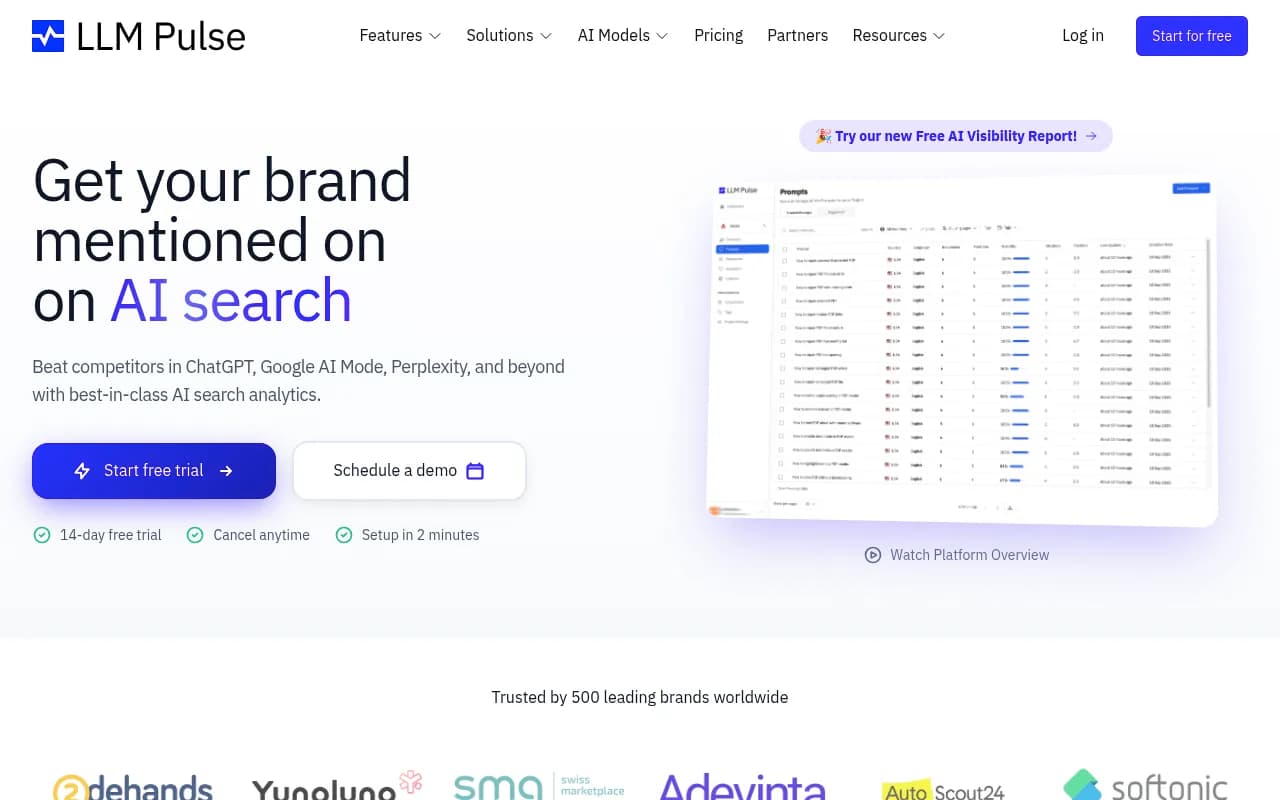
LLM Pulse is a focused AI visibility tracking platform that monitors how large language models respond to queries about your brand. Used by 500+ brands, it covers the same 10 AI models as Promptwatch and provides weekly tracking of key prompts, visibility scores, citation rates, sentiment analysis, and competitor benchmarking. The interface is clean and the setup is fast (claims 2 minutes).
What LLM Pulse does well: straightforward monitoring, detailed response capture with full context, and competitive pricing for high-volume prompt tracking. What it doesn't do: content optimization, gap analysis, or any tools to help you improve your visibility. It's a reporting dashboard, not an optimization platform. You see the data, but you're on your own to figure out what to do about it.
The platform offers AI-powered content recommendations (mentioned on their site under "Optimize"), but based on available information, this appears to be suggestion-based rather than a full content generation engine like Promptwatch's.
Pricing starts at €49/mo (~$54, Starter: 40 prompts), €99/mo (Growth: 100 prompts), and €299/mo (Scale: 300 prompts). 14-day free trial. Annual billing saves 17%.
Side-by-Side Comparison
| Feature | Promptwatch | LLM Pulse |
|---|---|---|
| Starting Price | $99/mo (50 prompts) | €49/mo (~$54, 40 prompts) |
| Mid-Tier Price | $249/mo (150 prompts) | €99/mo (100 prompts) |
| High-Volume Price | $579/mo (350 prompts) | €299/mo (300 prompts) |
| Free Trial | 7 days | 14 days |
| AI Models Covered | 10 (ChatGPT, Perplexity, Gemini, AI Overviews, AI Mode, Claude, DeepSeek, Grok, Copilot, Meta AI) | 10 (same) |
| Content Generation | Yes (5-30 articles/mo depending on plan) | No |
| Answer Gap Analysis | Yes | No |
| AI Crawler Logs | Yes (Professional+) | No |
| Traffic Attribution | Yes (code snippet, GSC, server logs) | No |
| Reddit/YouTube Tracking | Yes | No |
| ChatGPT Shopping | Yes | No |
| Prompt Volume Data | Yes (estimates + difficulty scores) | Not mentioned |
| Multi-language/Region | Yes (customizable personas) | Yes |
| Competitor Benchmarking | Yes (heatmaps) | Yes |
| Citation Analysis | Yes (880M+ citations) | Yes |
| Looker Studio Integration | Yes | Not mentioned |
| API Access | Yes | Not mentioned |
Pricing comparison
| Plan | Promptwatch | LLM Pulse |
|---|---|---|
| Entry | Essential: $99/mo (1 site, 50 prompts, 5 articles) | Starter: €49/mo (~$54, 40 prompts) |
| Mid | Professional: $249/mo (2 sites, 150 prompts, 15 articles, crawler logs) | Growth: €99/mo (100 prompts) |
| High | Business: $579/mo (5 sites, 350 prompts, 30 articles) | Scale: €299/mo (300 prompts) |
| Enterprise | Custom pricing | Not mentioned |
| Free Trial | 7 days | 14 days |
| Annual Discount | 25% | 17% |
LLM Pulse is cheaper at every tier if you only care about monitoring. Promptwatch costs roughly 2x more but includes content generation, crawler logs, and optimization tools that LLM Pulse doesn't offer.
Content optimization and gap analysis
This is where the two platforms diverge completely.
Promptwatch is built around closing the visibility gap. Answer Gap Analysis shows you exactly which prompts your competitors are visible for but you're not -- the specific topics, angles, and questions AI models want answers to but can't find on your site. The built-in AI writing agent then generates articles, listicles, and comparisons grounded in real citation data (880M+ citations analyzed), prompt volumes, persona targeting, and competitor insights. You're not guessing what to write -- the platform tells you what's missing and helps you create it. Each plan includes content generation credits (5 articles on Essential, 15 on Professional, 30 on Business).
LLM Pulse mentions "AI-powered content recommendations" in their "Optimize" section, but this appears to be advisory rather than generative. You get suggestions, not actual content. There's no Answer Gap Analysis, no content generation engine, and no way to see which prompts you're missing coverage on. You can see what AI says about you today, but you're on your own to figure out how to improve it.
Verdict: If you want to actively improve your AI visibility, Promptwatch is the only real option here. LLM Pulse will tell you there's a problem but won't help you fix it.
AI crawler logs and indexing insights
Another major difference.
Promptwatch (Professional plan and above) includes real-time AI crawler logs -- you see exactly when ChatGPT, Claude, Perplexity, and other AI models crawl your website, which pages they read, errors they encounter, and how often they return. This is critical for understanding how AI engines discover and index your content. If AI models aren't crawling a page, it won't get cited. Promptwatch surfaces these indexing issues so you can fix them.
LLM Pulse doesn't expose crawler activity at all. You see the output (citations, mentions) but not the input (whether AI models are actually reading your site). This is a blind spot.
Verdict: Promptwatch wins. Crawler logs are table stakes for serious AI visibility work.
Traffic attribution and ROI tracking
Both platforms track visibility, but only one connects it to revenue.
Promptwatch includes traffic attribution via code snippet, Google Search Console integration, or server log analysis. You can see which AI-driven visits convert, close the loop from visibility to actual business impact, and prove ROI. Page-level tracking shows exactly which pages are being cited, how often, and by which models.
LLM Pulse tracks visibility scores and citation rates but doesn't connect them to traffic or conversions. You know you're being mentioned, but you don't know if it's driving visitors or revenue.
Verdict: Promptwatch. If you need to justify the investment to leadership, traffic attribution is non-negotiable.
Prompt intelligence and prioritization
How do you decide which prompts to optimize for?
Promptwatch provides prompt volume estimates and difficulty scores for each tracked prompt, plus query fan-outs that show how one prompt branches into sub-queries. This helps you prioritize high-value, winnable prompts instead of guessing. The platform has processed over 1.1 billion citations, clicks, and prompts -- that data infrastructure feeds the intelligence layer.
LLM Pulse doesn't mention prompt volume data or difficulty scoring. You can track prompts, but you're flying blind on which ones actually matter.
Verdict: Promptwatch. Prioritization data is the difference between strategic optimization and random guessing.
Reddit and YouTube insights
AI models cite Reddit threads and YouTube videos constantly. Do you know which ones?
Promptwatch surfaces Reddit discussions and YouTube videos that directly influence AI recommendations in your space. This is a channel most competitors ignore entirely, but it's often where AI models pull "real user" perspectives.
LLM Pulse doesn't mention Reddit or YouTube tracking.
Verdict: Promptwatch. If you're not monitoring these channels, you're missing a big piece of the citation puzzle.
ChatGPT Shopping and product recommendations
ChatGPT now includes shopping carousels and product recommendations. Are you in them?
Promptwatch tracks when your brand appears in ChatGPT's shopping results and product recommendation carousels.
LLM Pulse doesn't mention ChatGPT Shopping tracking.
Verdict: Promptwatch. If you sell products, this feature alone could justify the price difference.
User interface and ease of use
Both platforms are relatively easy to set up.
LLM Pulse claims 2-minute setup and has a clean, straightforward interface focused on dashboards and reports. If you just want to see the data without a lot of complexity, LLM Pulse delivers.
Promptwatch has more features, which means more complexity. The interface is organized around the action loop (track, analyze, optimize), but there's a learning curve if you want to use everything. That said, most users don't need every feature on day one.
Verdict: Slight edge to LLM Pulse for simplicity, but Promptwatch isn't hard to use -- it just has more to explore.
Competitor benchmarking
Both platforms offer competitor tracking.
Promptwatch provides competitor heatmaps that compare your AI visibility vs competitors across LLMs. You see who's winning for each prompt and why, with citation-level detail.
LLM Pulse includes competitor benchmarking with share of voice and sentiment comparison.
Verdict: Roughly tied. Both do this well.
Data export and integrations
Promptwatch includes a Looker Studio connector for custom reporting and a full API for building custom workflows or integrating with other tools.
LLM Pulse doesn't mention Looker Studio integration or API access on their site.
Verdict: Promptwatch. If you need to plug AI visibility data into your existing reporting stack, Promptwatch makes it easy.
Multi-language and multi-region support
Both platforms support multi-language and multi-region tracking.
Promptwatch lets you customize personas (e.g. "a small business owner in Texas" vs "a CMO in Germany") to match how your actual customers prompt AI models. This is useful for localized campaigns.
LLM Pulse supports multi-language and region tracking but doesn't mention persona customization.
Verdict: Slight edge to Promptwatch for persona targeting.
Customer base and trust signals
Promptwatch is used by 7,000+ brands and agencies, including recognizable names like Booking.com, Center Parcs, Yelp, Typeform, and Google. The platform's data has been cited in the Wall Street Journal, Yahoo Finance, Seeking Alpha, and Axios. It's rated 4.7/5 stars on G2.
LLM Pulse claims 500+ brands but doesn't name them publicly (the homepage shows logo placeholders). Less third-party validation.
Verdict: Promptwatch has stronger trust signals and a larger user base.
Promptwatch vs LLM Pulse: Pros and cons
Promptwatch pros
- Complete optimization platform, not just monitoring
- Answer Gap Analysis shows exactly what content you're missing
- Built-in AI content generation (5-30 articles/mo)
- AI crawler logs reveal indexing issues
- Traffic attribution connects visibility to revenue
- Prompt volume estimates and difficulty scores
- Reddit and YouTube insights
- ChatGPT Shopping tracking
- Looker Studio integration and API access
- Larger customer base with recognizable brands
- 880M+ citations analyzed (deep data infrastructure)
Promptwatch cons
- More expensive (2x the cost of LLM Pulse at comparable tiers)
- Steeper learning curve due to more features
- Shorter free trial (7 days vs 14)
LLM Pulse pros
- Cheaper pricing (€49/mo entry vs $99/mo)
- Simple, focused interface
- Longer free trial (14 days)
- Fast setup (2 minutes)
- Good for teams that just need monitoring without optimization
LLM Pulse cons
- No content generation or gap analysis
- No AI crawler logs
- No traffic attribution or ROI tracking
- No Reddit/YouTube insights
- No ChatGPT Shopping tracking
- No prompt volume or difficulty data
- Smaller customer base, less third-party validation
- Doesn't help you improve visibility, only reports it
Who should choose Promptwatch?
Pick Promptwatch if:
- You want to actively improve your AI visibility, not just monitor it
- You need content gap analysis to see what you're missing
- You want an AI writing agent to generate optimized content
- You need to track AI crawler activity and fix indexing issues
- You need to connect AI visibility to traffic and revenue (ROI tracking)
- You care about Reddit and YouTube as citation sources
- You sell products and need ChatGPT Shopping tracking
- You need prompt volume data to prioritize optimization efforts
- You want Looker Studio integration or API access
- You have the budget for a premium platform ($99-$579/mo)
Promptwatch is for teams that treat AI visibility as a strategic channel, not just a reporting metric. If you're serious about ranking in ChatGPT, Perplexity, and Gemini the way you're serious about ranking in Google, Promptwatch gives you the tools to actually do it.
Who should choose LLM Pulse?
Pick LLM Pulse if:
- You just need monitoring and reporting, not optimization
- You have a tight budget (€49/mo entry point)
- You want a simple dashboard without a lot of complexity
- You're comfortable figuring out content strategy on your own
- You don't need crawler logs, traffic attribution, or advanced features
- You're tracking a high volume of prompts and want the cheapest per-prompt cost (€299/mo for 300 prompts vs $579/mo for 350)
LLM Pulse is a solid choice for teams that want visibility into what AI says about them but plan to handle optimization separately (or not at all). It's a reporting tool, not an action platform.
Final verdict
Promptwatch and LLM Pulse both monitor the same 10 AI models, but they serve different needs.
LLM Pulse is a monitoring dashboard. It shows you what AI says about your brand, tracks changes over time, and benchmarks you against competitors. It does this well and costs less. If you just need visibility into AI responses and don't care about optimization, LLM Pulse is a reasonable choice.
Promptwatch is an optimization platform. It shows you the gaps (Answer Gap Analysis), helps you fill them (AI content generation), and tracks the results (page-level visibility + traffic attribution). It includes features LLM Pulse doesn't offer: crawler logs, Reddit/YouTube insights, ChatGPT Shopping tracking, prompt volume data, and tools to actually improve your AI visibility. It costs more, but it delivers more.
The decision comes down to this: do you want to watch your AI visibility, or do you want to improve it?
If you're treating AI search as a strategic channel -- the way you treat Google Search -- Promptwatch is the clear winner. It's the only platform in this comparison that closes the loop from insight to action. LLM Pulse will tell you there's a problem. Promptwatch will help you fix it.
For most teams serious about AI visibility in 2026, Promptwatch is worth the premium.