Key Takeaways
- LLM Pulse costs 45% less at the entry level (€49/mo vs €89/mo) and tracks more prompts per euro across all tiers
- Peec AI offers better UX and visualization with cleaner dashboards and more intuitive competitor benchmarking
- LLM Pulse provides AI-powered content recommendations to help you improve visibility -- Peec AI stops at showing you the data
- Both track the same core AI models (ChatGPT, Perplexity, Gemini, Google AI Mode/Overviews) but LLM Pulse covers more models on enterprise plans
- Peec AI has stronger multi-language support with explicit focus on international markets
- Neither platform offers crawler logs, traffic attribution, or content generation -- they're monitoring-only tools that show you where you stand but don't help you create content that ranks
Overview
Peec AI

Peec AI is a monitoring platform built for marketing teams who need clean visibility into how AI models talk about their brand. The interface is polished -- you get visibility scores, sentiment tracking, and position metrics across ChatGPT, Perplexity, and Gemini. The platform emphasizes competitor benchmarking with side-by-side comparisons and trend charts. Multi-language support is a first-class feature, making it a solid pick for European brands tracking prompts in multiple markets.
The catch: Peec AI is diagnosis without treatment. You see that competitors appear in 62% of buyer prompts while you're at 47%, but the platform doesn't tell you why or what to do about it. No content gap analysis, no recommendations, no optimization tools. You're left staring at charts wondering what comes next.
LLM Pulse
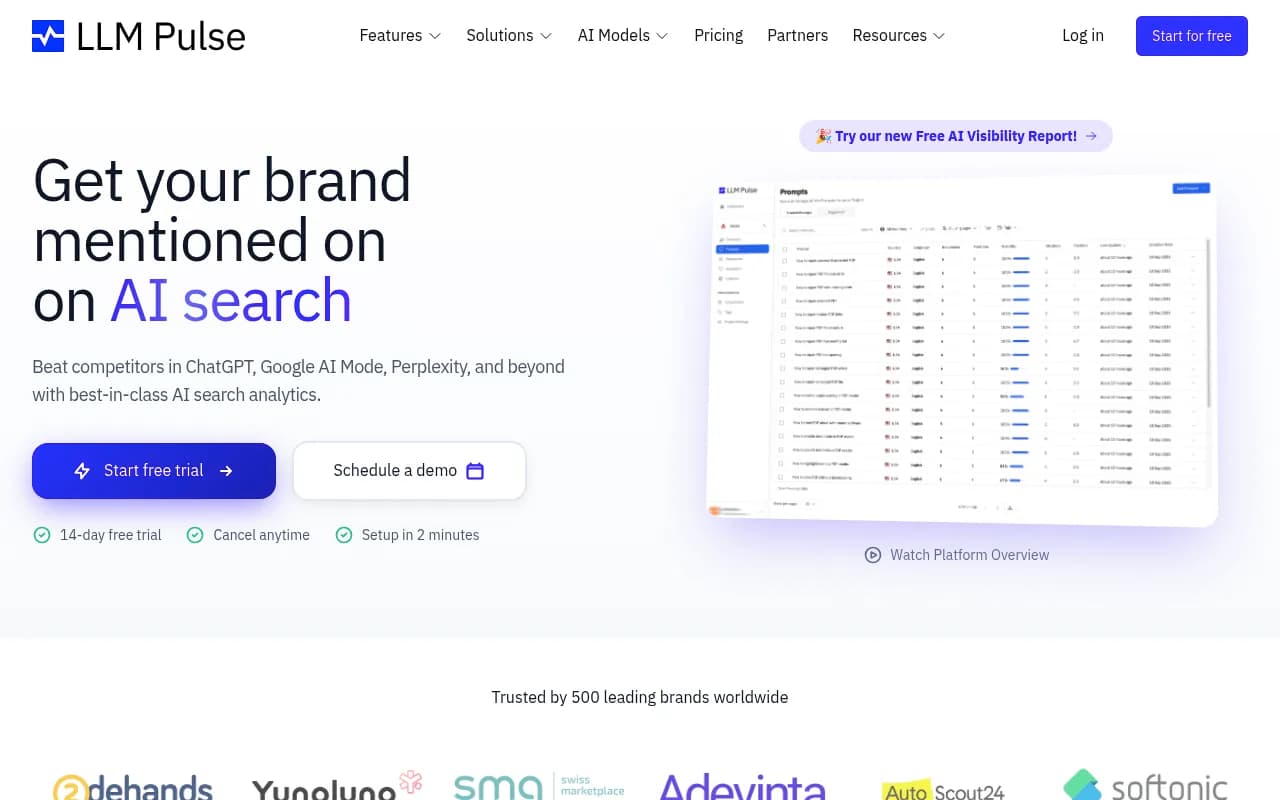
LLM Pulse takes a similar tracking approach but adds an optimization layer. You monitor prompts across 10+ AI models (ChatGPT, Perplexity, Gemini, Google AI Mode, DeepSeek, Grok, Claude, Copilot, Meta AI on enterprise plans), see citation analysis and visibility scores, then get AI-powered content recommendations to improve how you appear in responses. The interface is more utilitarian than Peec's, but the core value is in closing the loop: track, analyze, optimize.
Pricing is more aggressive -- €49/mo gets you started vs €89/mo for Peec AI. LLM Pulse also offers a free AI Visibility Report tool for quick brand checks without signing up.
Both platforms are monitoring-first. If you're looking for something that goes deeper -- crawler logs showing how AI models discover your content, traffic attribution connecting visibility to revenue, or built-in content generation -- tools like Promptwatch cover that territory.

Side-by-Side Comparison
| Feature | Peec AI | LLM Pulse |
|---|---|---|
| Starting price | €89/mo (Starter) | €49/mo (Starter) |
| Entry-level prompts | 40 prompts | 40 prompts |
| Mid-tier price | €199/mo (Professional) | €99/mo (Growth) |
| Mid-tier prompts | 100 prompts | 100 prompts |
| Free trial | Yes | 14 days |
| AI models tracked | 3-5 (ChatGPT, Perplexity, Gemini, Google AI) | 10+ (adds DeepSeek, Grok, Claude, Copilot, Meta AI on higher tiers) |
| Content recommendations | No | Yes (AI-powered) |
| Multi-language support | Strong (explicit feature) | Available |
| Competitor benchmarking | Yes (visual, intuitive) | Yes (functional) |
| Citation analysis | Yes | Yes |
| Sentiment tracking | Yes | Yes |
| Visibility scoring | Yes | Yes |
| User interface | Polished, marketing-team friendly | Functional, data-focused |
| Annual discount | Not specified | 17% |
| Crawler logs | No | No |
| Traffic attribution | No | No |
| Content generation | No | No |
Pricing comparison
LLM Pulse undercuts Peec AI at every tier while offering comparable or better prompt volumes.
| Plan tier | Peec AI | LLM Pulse |
|---|---|---|
| Starter/Entry | €89/mo (40 prompts) | €49/mo (40 prompts) |
| Professional/Growth | €199/mo (100 prompts) | €99/mo (100 prompts) |
| Enterprise/Scale | Custom pricing | €299/mo (300 prompts) |
| Cost per prompt (mid-tier) | €1.99 | €0.99 |
LLM Pulse's annual billing knocks another 17% off. Peec AI doesn't advertise an annual discount publicly. For a team tracking 100 prompts, you're looking at €2,388/year with Peec AI vs €987/year with LLM Pulse (annual billing) -- a €1,401 difference.
User interface and experience
Peec AI wins on polish. The dashboard feels like it was designed for marketing directors who want to drop screenshots into board decks. Competitor comparisons are visual and intuitive -- you see pie charts showing share of voice, trend lines for visibility over time, and clean cards for each tracked brand. The "Quick Actions" sidebar and tag-based prompt organization make it easy to segment tracking by product line, region, or campaign.
LLM Pulse's interface is more bare-bones. You get the data you need -- visibility scores, citation breakdowns, model-by-model comparisons -- but the presentation is functional rather than beautiful. If you're the type who wants to export CSVs and build your own reports, this won't bother you. If you need something that looks good in a client presentation out of the box, Peec AI has the edge.
Both platforms let you add custom prompts, track across countries, and organize with tags. Neither has a mobile app.
AI model coverage
Peec AI focuses on the big three: ChatGPT, Perplexity, and Gemini, plus Google AI Mode and AI Overviews. That covers the majority of consumer AI search traffic in 2026.
LLM Pulse tracks the same core models but extends coverage to DeepSeek, Grok, Claude, Copilot, and Meta AI on enterprise plans. If you're a brand that needs comprehensive LLM monitoring -- say you're in B2B software and your buyers use Claude heavily, or you're tracking how Grok surfaces your brand on X -- LLM Pulse gives you more breadth.
For most brands, the core 3-5 models Peec AI covers will be enough. The extended coverage matters if you're in a niche where specific models dominate or if you're doing competitive intelligence across the full LLM landscape.
Content optimization and recommendations
This is where the platforms diverge.
Peec AI shows you the problem but doesn't help you fix it. You see that your visibility score is 47% vs a competitor's 62%. You see that AI models cite Reddit threads and competitor blog posts more than your site. You see sentiment trending negative. Now what? Peec AI doesn't answer that question. No content gap analysis, no suggestions for what to write, no guidance on which prompts to prioritize.
LLM Pulse includes AI-powered content recommendations. After tracking your prompts, the platform suggests specific content improvements to boost your visibility in LLM responses. It's not a full content generation suite -- you're not getting 3,000-word articles written for you -- but you get directional guidance on what's missing and what to optimize.
If you want a true optimization platform that goes from diagnosis to treatment -- showing you exactly which prompts competitors rank for that you don't, then generating content grounded in citation data to close those gaps -- you're looking at something like Promptwatch. Peec AI and LLM Pulse both stop short of that.
Multi-language and international tracking
Peec AI explicitly markets multi-language support as a core feature. The platform is built for European brands tracking prompts in English, German, French, Spanish, and other languages. You can organize prompts by country and see how AI models respond differently across regions.
LLM Pulse supports multi-language tracking but doesn't emphasize it as heavily in their positioning. The functionality is there -- you can track prompts in any language and filter by country -- but Peec AI's interface and documentation make it clearer that international tracking is a first-class use case.
If you're a brand operating in multiple European markets and need to track "best CRM for startups" in five languages, Peec AI makes that workflow more obvious.
Citation and source analysis
Both platforms show you which sources AI models cite when they mention your brand or competitors. You see Reddit threads, blog posts, YouTube videos, and domains that influence LLM responses.
The analysis is surface-level on both platforms. You get a list of cited sources and maybe some basic metrics (how often each source appears), but you don't get deep insights into why those sources are being cited or how to replicate their success. Neither platform tracks Reddit discussions or YouTube content as a dedicated channel the way some competitors do.
For citation analysis that goes deeper -- showing you exactly which pages on your site AI models are reading, how often they crawl your content, and where you're missing coverage -- you'd need crawler logs and indexing analysis, which neither Peec AI nor LLM Pulse provides.
Competitor benchmarking
Peec AI makes competitor tracking feel effortless. You add competitor brands to your dashboard and see side-by-side visibility scores, sentiment comparisons, and share-of-voice breakdowns. The visual presentation -- pie charts, trend lines, heatmaps -- makes it easy to spot who's winning for which prompts.
LLM Pulse offers competitor benchmarking but the UX is less polished. You can compare your brand against competitors and see who ranks higher across different models, but the interface doesn't make the insights pop the way Peec AI's does.
Both platforms let you track multiple competitors. Neither offers advanced features like competitor content gap analysis (showing you which prompts competitors rank for that you don't) or prompt difficulty scoring.
What's missing from both platforms
Peec AI and LLM Pulse are monitoring tools. They tell you where you stand but don't help you improve your position in a meaningful way. Here's what you won't get:
- AI crawler logs: No visibility into how ChatGPT, Claude, or Perplexity bots are crawling your website, which pages they're reading, or errors they encounter
- Traffic attribution: No way to connect AI visibility to actual website traffic or revenue
- Content generation: No built-in tools to create articles, listicles, or comparisons optimized for AI search
- Prompt intelligence: No volume estimates or difficulty scores to help you prioritize which prompts to target
- Answer Gap Analysis: No systematic way to identify which prompts competitors rank for that you don't
If those capabilities matter to you -- if you want to move from "here's where you stand" to "here's how to fix it" -- you're looking at a different category of tool. Platforms like Promptwatch, Profound, or Scrunch offer some of these features, though at higher price points.
Pros and cons
Peec AI pros
- Clean, marketing-team-friendly interface
- Strong multi-language support for European brands
- Intuitive competitor benchmarking with visual comparisons
- Trusted by 1,500+ marketing teams
- Good for teams that need polished reporting
Peec AI cons
- 45% more expensive than LLM Pulse at entry level
- No content optimization or recommendations
- Limited to 3-5 AI models
- Monitoring-only -- doesn't help you improve visibility
- No crawler logs or traffic attribution
LLM Pulse pros
- €49/mo entry price (cheapest in category)
- AI-powered content recommendations included
- Tracks 10+ AI models on higher tiers
- 17% discount on annual billing
- Free AI Visibility Report tool
- Better cost-per-prompt ratio across all tiers
LLM Pulse cons
- Less polished interface than Peec AI
- Multi-language support not as emphasized
- Competitor benchmarking UX is functional but not beautiful
- Still monitoring-focused -- limited optimization depth
- No crawler logs or traffic attribution
Who should pick which tool
Pick Peec AI if:
- You're a European brand tracking prompts in multiple languages
- You need a polished interface for client or executive reporting
- Visual competitor benchmarking is a priority
- You have budget for the higher price point (€89-199/mo)
- You're comfortable building your own optimization strategy from the data
Pick LLM Pulse if:
- You want the lowest entry price in the category (€49/mo)
- AI-powered content recommendations matter to you
- You need broader AI model coverage (DeepSeek, Grok, Claude, etc.)
- You prioritize cost efficiency over interface polish
- You want a free trial to test before committing
Look elsewhere if:
- You need crawler logs showing how AI models discover your content
- You want traffic attribution connecting visibility to revenue
- You need built-in content generation to create articles optimized for AI search
- You want Answer Gap Analysis showing exactly which prompts competitors rank for that you don't
- You need prompt volume estimates and difficulty scoring to prioritize targets
Final verdict
LLM Pulse offers better value for most teams. At €49/mo vs €89/mo, you're getting comparable prompt tracking, broader AI model coverage, and content recommendations that Peec AI doesn't provide. The interface isn't as pretty, but the core functionality is stronger and the price is 45% lower.
Peec AI justifies its premium if you're a European brand that needs multi-language tracking and polished reporting for clients or executives. The UX is genuinely better -- it's the kind of dashboard you can screenshot and drop into a deck without explanation. But you're paying €40-100/mo extra for that polish, and you're not getting optimization tools to match.
Both platforms are monitoring-only. They show you where you stand in AI search but don't help you improve your position beyond surface-level recommendations. If you want a platform that closes the loop -- tracking visibility, identifying content gaps, generating optimized articles, and measuring results -- you're looking at a different tier of tool entirely.