Key Takeaways
- LLM Pulse offers better value at entry level: €49/mo for 40 prompts vs Otterly's $29/mo for only 15 prompts -- LLM Pulse gives you 2.6x more tracking capacity for roughly the same price
- Otterly.AI includes a GEO audit tool: The only monitoring platform in this comparison with built-in on-page optimization analysis (25+ factors) -- LLM Pulse focuses purely on tracking and recommendations
- LLM Pulse tracks more AI models on higher tiers: Enterprise plans include DeepSeek, Grok, Claude, Copilot, and Meta AI -- Otterly covers 6 models across all plans (ChatGPT, Perplexity, Google AI Overviews, AI Mode, Gemini, Copilot)
- Both lack content generation: Neither platform helps you create optimized content -- they show you the gaps but leave you to fill them manually
- LLM Pulse has cleaner pricing transparency: Three clear tiers with annual discounts listed upfront. Otterly's Premium tier is "custom" with no public pricing.
- Otterly positions itself as more affordable: Starts at $29/mo vs LLM Pulse's €49/mo, but the prompt limits tell a different story
Overview
Otterly.AI

Otterly.AI markets itself as the "#1 rated AI search monitoring platform" with a focus on affordability. It tracks brand mentions and website citations across ChatGPT, Perplexity, Google AI Overviews, Google AI Mode, Gemini, and Microsoft Copilot. The standout feature is the GEO Audit tool, which analyzes 25+ on-page factors to show what's holding your site back from earning citations. Otterly positions itself as the budget-friendly entry point for brands new to AI search monitoring.
Pricing starts at $29/mo for the Lite plan (15 prompts), $189/mo for Standard (100 prompts), and custom pricing for Premium (unlimited prompts). All plans include a 14-day free trial.
LLM Pulse
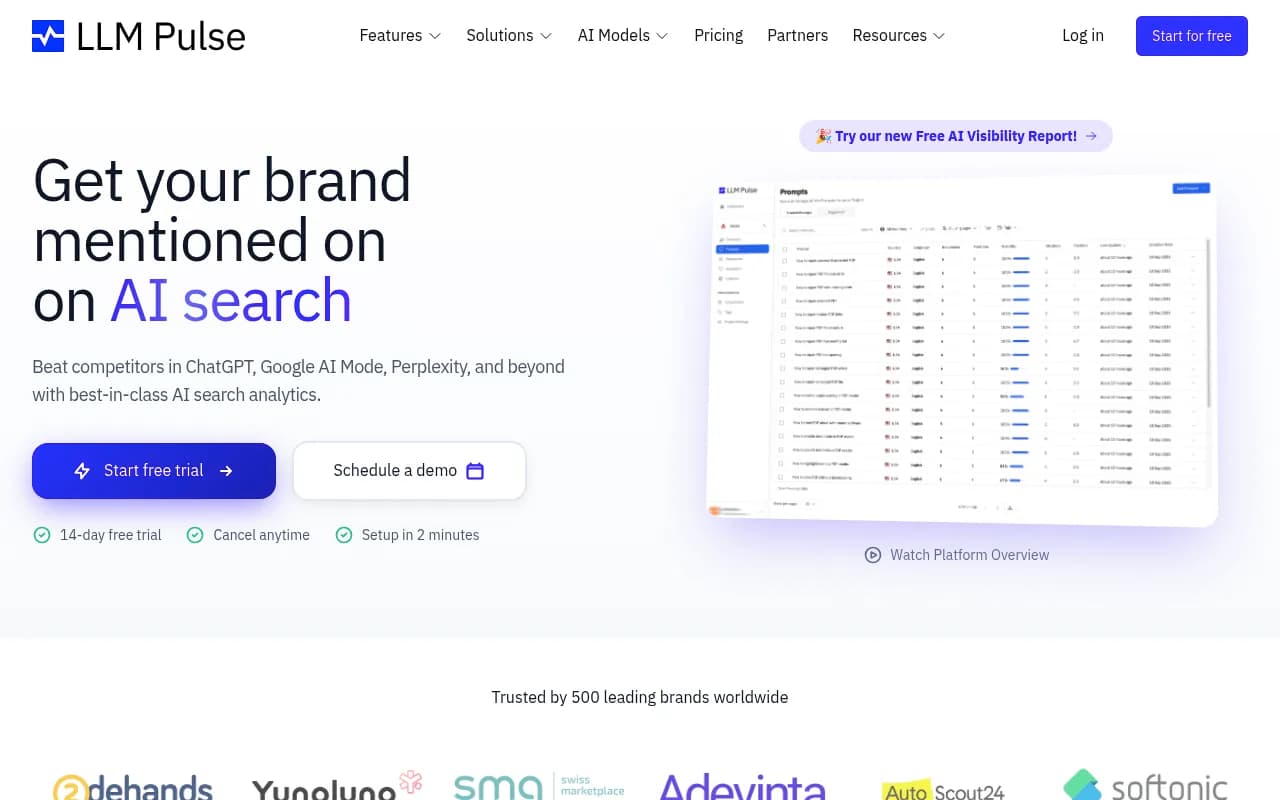
LLM Pulse describes itself as "your radar in the world of generative AI" and emphasizes structured analytics. It tracks prompts across ChatGPT, Perplexity, Gemini, Google AI Mode, and AI Overviews on all plans, with enterprise tiers adding DeepSeek, Grok, Claude, Copilot, and Meta AI. The platform measures visibility score, citation rate, sentiment, and share of voice, then provides AI-powered content recommendations to improve your presence.
LLM Pulse is used by 500+ brands and offers three public tiers: Starter at €49/mo (40 prompts), Growth at €99/mo (100 prompts), and Scale at €299/mo (300 prompts). Annual billing saves 17%. Setup takes 2 minutes and there's a 14-day free trial.
Side-by-Side Comparison
| Feature | Otterly.AI | LLM Pulse |
|---|---|---|
| Starting price | $29/mo | €49/mo (~$52/mo) |
| Entry-level prompts | 15 | 40 |
| Mid-tier price | $189/mo (100 prompts) | €99/mo (~$105/mo, 100 prompts) |
| High-volume tier | Custom (unlimited) | €299/mo (300 prompts) |
| Free trial | 14 days | 14 days |
| AI models tracked (standard) | 6 (ChatGPT, Perplexity, AI Overviews, AI Mode, Gemini, Copilot) | 5 (ChatGPT, Perplexity, Gemini, AI Mode, AI Overviews) |
| Enterprise models | Not specified | DeepSeek, Grok, Claude, Copilot, Meta AI |
| GEO audit tool | ✓ (25+ on-page factors) | ✗ |
| Content recommendations | Basic ("three levers" guidance) | AI-powered suggestions |
| Citation tracking | ✓ | ✓ |
| Sentiment analysis | Not specified | ✓ |
| Share of voice | ✓ | ✓ |
| Competitor benchmarking | ✓ | ✓ |
| Setup time | Not specified | 2 minutes |
| Annual discount | Not specified | 17% |
Pricing: Where the value really sits
Both platforms use prompt-based pricing, but the math gets interesting when you compare what you actually get.
Pricing breakdown
| Plan | Otterly.AI | LLM Pulse |
|---|---|---|
| Entry tier | $29/mo (15 prompts) = $1.93 per prompt | €49/mo (40 prompts) = €1.23 per prompt (~$1.30) |
| Mid tier | $189/mo (100 prompts) = $1.89 per prompt | €99/mo (100 prompts) = €0.99 per prompt (~$1.05) |
| High tier | Custom (unlimited) | €299/mo (300 prompts) = €1.00 per prompt (~$1.06) |
Otterly's headline price of $29/mo looks cheaper, but you're getting 15 prompts. That's barely enough to track a handful of key queries. LLM Pulse's €49/mo gets you 40 prompts -- enough to monitor a real set of brand-related questions across multiple angles.
At the mid tier, LLM Pulse is actually cheaper: €99/mo (~$105) vs Otterly's $189/mo for the same 100 prompts. That's a $84/mo difference.
Otterly's Premium tier with unlimited prompts could be compelling for high-volume users, but there's no public pricing. You have to contact sales, which means it's likely expensive enough that they don't want to scare you off upfront.
LLM Pulse's annual billing discount (17%) brings the effective monthly cost down further. Otterly doesn't mention annual discounts on their site.
Verdict: LLM Pulse offers better value at every comparable tier. Otterly's "affordable" positioning doesn't hold up when you look at cost per prompt.
Model coverage: Breadth vs depth
Otterly tracks 6 AI models across all plans: ChatGPT, Perplexity, Google AI Overviews, Google AI Mode, Gemini, and Microsoft Copilot. That's the full set you get regardless of which tier you're on.
LLM Pulse starts with 5 models on standard plans (ChatGPT, Perplexity, Gemini, Google AI Mode, AI Overviews), then adds 5 more on enterprise tiers: DeepSeek, Grok, Claude, Copilot, and Meta AI. That brings the total to 10 models.
The difference matters if you care about emerging platforms. DeepSeek has been climbing fast in 2026, and Grok is X's native AI -- both are blind spots if you're only using Otterly. Claude and Meta AI are also significant, especially for B2B and technical audiences.
That said, most brands will get 90% of the value from the core 5-6 models. ChatGPT and Perplexity dominate AI search usage, with Google AI Overviews and Gemini close behind. If you're not an enterprise with a dedicated GEO team, the extra models on LLM Pulse's enterprise tier might be overkill.
Verdict: LLM Pulse wins on breadth for enterprise users. For most brands, both platforms cover the models that matter.
Features: Monitoring vs optimization
This is where the platforms diverge in philosophy.
Otterly.AI's approach
Otterly positions itself as a monitoring tool with optimization guidance. The core features:
- AI keyword research: Discover search prompts your audience is asking on ChatGPT, Perplexity, and Google
- Brand monitoring & citation tracking: See which brands get recommended and which websites get cited
- GEO audit tool: Analyzes 25+ on-page factors to reveal what's holding your site back
- Action guidance: Otterly talks about "three levers" -- optimizing on-page content, ramping up media outreach, and mobilizing your community
The GEO audit is the differentiator. It's an actual diagnostic tool that scans your pages and tells you what's missing. Think of it like an SEO audit but for AI search -- checking for structured data, content depth, source credibility signals, and other factors that influence whether AI models cite you.
The downside: Otterly doesn't help you fix what it finds. It shows you the problems, then you're on your own to create content or adjust your site.
LLM Pulse's approach
LLM Pulse is pure monitoring with AI-powered recommendations. The feature set:
- Prompt tracking: Monitor key prompts weekly and see how responses change over time
- Visibility scoring: Measure your visibility score, citation rate, sentiment, and share of voice
- Competitor benchmarking: Compare your performance against competitors across models
- AI-powered content recommendations: Get suggestions on how to improve your presence
- Detailed response analysis: See the exact words AI uses to describe you
LLM Pulse emphasizes structured analytics. The visibility score is a single metric you can track over time, which makes it easier to report progress to stakeholders. The sentiment analysis is also useful -- you can catch negative framing before it becomes a problem.
The content recommendations are AI-generated suggestions based on what's working for competitors and what's missing from your current presence. It's more actionable than Otterly's "three levers" guidance, but still not as hands-on as a platform that actually generates content for you.
Verdict: Otterly wins if you need diagnostic depth (the GEO audit is genuinely useful). LLM Pulse wins if you want cleaner analytics and better recommendations.
What both platforms are missing
Neither Otterly nor LLM Pulse helps you create content. They show you the gaps, they tell you what's wrong, they even suggest what to fix -- but then you're stuck opening Google Docs and writing from scratch.
This is the core limitation of monitoring-only tools. You see that competitors are getting cited for "best project management software for remote teams" and you're not. Great. Now what? You still have to research the topic, figure out what angle will get cited, write the article, optimize it, publish it, and hope it works.
If you're serious about AI search visibility, you'll eventually need a platform that closes the loop from insight to action. Tools like Promptwatch take a different approach -- they analyze the gaps (like Otterly and LLM Pulse), but then generate optimized content grounded in citation data and prompt intelligence. That's the difference between seeing the problem and actually solving it.

For now, if you're choosing between Otterly and LLM Pulse, just know you're getting half the workflow. The monitoring half.
User experience and setup
LLM Pulse claims "setup in 2 minutes" and emphasizes ease of use. The interface looks clean from the screenshots -- structured dashboards with visibility scores, citation rates, and model comparisons laid out clearly.
Otterly's site doesn't specify setup time, but the dashboard screenshots show a similar layout: prompt tracking, brand mentions, citation analysis. The GEO audit tool adds an extra layer of complexity, which could be a plus or a minus depending on whether you want diagnostic depth or just want to see the numbers.
Both platforms offer 14-day free trials, so you can test the interface before committing.
Verdict: Roughly equivalent. LLM Pulse markets itself as faster to set up, but both are standard SaaS dashboards.
Customer base and trust signals
LLM Pulse lists "500 leading brands worldwide" as customers and shows a row of client logos on their homepage. The logos aren't named, so you can't verify who they are, but the visual suggests established traction.
Otterly claims to be the "#1 rated AI search monitoring platform" but doesn't cite a source for that rating. They mention that "brands see an increase in brand mentions and website citations" but don't provide case studies or specific numbers.
Neither platform has public reviews on G2, Capterra, or Trustpilot that I could find, which makes it hard to verify customer satisfaction independently.
Verdict: LLM Pulse has slightly stronger trust signals with the "500 brands" claim. Otterly's "#1 rated" claim feels like marketing without backing.
Pros and cons
Otterly.AI pros
- Lowest headline price ($29/mo entry point)
- GEO audit tool is a genuine differentiator -- no other monitoring platform offers on-page diagnostics
- Tracks 6 models on all plans, including Copilot
- Unlimited prompts available on Premium tier (if you can afford custom pricing)
Otterly.AI cons
- Terrible value at entry level -- 15 prompts for $29/mo is barely usable
- Mid-tier is expensive ($189/mo for 100 prompts)
- No public pricing for Premium tier
- Content recommendations are vague ("three levers" guidance)
- No sentiment analysis mentioned
- No annual discount advertised
LLM Pulse pros
- Better value at every tier -- €49/mo for 40 prompts, €99/mo for 100 prompts
- Cleaner analytics with visibility scoring and sentiment analysis
- AI-powered content recommendations are more actionable
- 10 AI models on enterprise tier (vs Otterly's 6)
- 17% discount on annual billing
- Fast setup (2 minutes)
- 500+ brands using it
LLM Pulse cons
- No GEO audit tool -- purely monitoring and recommendations
- Fewer models on standard plans (5 vs Otterly's 6)
- Pricing in euros might complicate budgeting for US companies
- Enterprise features (extra models) require higher-tier plans
Who should pick which tool
Pick Otterly.AI if:
- You need the GEO audit tool and want diagnostic depth on what's holding your site back
- You're willing to pay $189/mo for 100 prompts to get that audit capability
- You have a technical team that can act on audit findings without needing content generation
- You want Copilot tracking on a standard plan
Pick LLM Pulse if:
- You want better value -- more prompts for less money at every tier
- You care about sentiment analysis and structured visibility scoring
- You need AI-powered content recommendations that go beyond generic guidance
- You're an enterprise that wants to track DeepSeek, Grok, Claude, and Meta AI
- You prefer transparent pricing with annual discounts
Skip both if:
- You need a platform that actually generates optimized content, not just monitors and recommends. In that case, look at Promptwatch, which combines gap analysis with an AI writing agent that creates citation-optimized articles.
Final verdict
LLM Pulse is the better choice for most brands. The pricing is more honest (better value at every tier), the analytics are cleaner (visibility scoring and sentiment analysis), and the recommendations are more actionable. The only reason to pick Otterly is if you specifically need the GEO audit tool and have the budget to pay $189/mo for it.
Otterly's positioning as "affordable" doesn't hold up under scrutiny. $29/mo for 15 prompts is a trap -- you'll outgrow it immediately and end up paying $189/mo anyway. LLM Pulse's €49/mo for 40 prompts is the real entry point for serious monitoring.
That said, both platforms are monitoring-only tools. They'll show you where you're invisible in AI search, but they won't help you fix it. If you're looking for a complete workflow -- from gap analysis to content creation to tracking results -- you'll need a platform like Promptwatch that closes the loop. But if you just want visibility data and are comfortable creating content yourself, LLM Pulse is the smarter pick.