Key Takeaways
- Promptwatch is the best overall alternative -- it's the only platform that goes beyond monitoring to actually help you fix visibility gaps with content generation, crawler logs, and 880M+ citations analyzed
- AthenaHQ offers strong monitoring features and is used by major brands like ZoomInfo and Coinbase, but lacks content optimization tools
- Semrush brings traditional SEO power with an AI visibility add-on, though it uses fixed prompts and costs more when you add the AI toolkit
- Otterly.AI is the most affordable option starting at $29/mo, but it's monitoring-only with no optimization features
- Profound is enterprise-focused with the most comprehensive feature set, but pricing starts around $1,000+/month with no public tiers
Trakkr.ai entered the AI visibility space with a straightforward promise: track how ChatGPT, Claude, Gemini, and Perplexity mention your brand. The free tier and $79/mo Growth plan made it accessible for smaller teams. But as the market matured, limitations became clear. Trakkr shows you visibility scores and citation sources, but it stops there. You see the data, then you're on your own to figure out what to do about it.
That gap -- between seeing the problem and fixing it -- is why many teams started looking elsewhere. Some needed deeper analytics. Others wanted content optimization tools. A few needed enterprise features like API access or multi-brand tracking at scale. Here's how the alternatives stack up.
Promptwatch

Promptwatch is the only AI visibility platform rated as a "Leader" across all categories in a 2026 comparison of 12 GEO platforms. The core difference: most competitors show you where you're invisible, then leave you stuck. Promptwatch shows you what's missing, then helps you fix it.
The action loop works like this. Answer Gap Analysis shows exactly which prompts competitors rank for but you don't -- the specific topics, angles, and questions AI models want answers to but can't find on your site. Then the built-in AI writing agent generates articles, listicles, and comparisons grounded in real citation data (880M+ citations analyzed), prompt volumes, and competitor analysis. This isn't generic SEO filler. It's content engineered to get cited by ChatGPT, Claude, and Perplexity. Finally, page-level tracking shows your visibility scores improve as AI models start citing your new content, with traffic attribution to connect visibility to revenue.
Additional capabilities include AI Crawler Logs (real-time logs of ChatGPT, Claude, Perplexity crawlers hitting your site), Prompt Intelligence (volume estimates and difficulty scores), Reddit & YouTube Insights (surface discussions that influence AI recommendations), ChatGPT Shopping tracking, and multi-language/multi-region monitoring. Monitors 10 AI models including OpenAI/ChatGPT, Perplexity, Google AI Overviews, Claude, Gemini, Meta/Llama, DeepSeek, Grok, Mistral, and Copilot.
Pricing: Essential $99/mo (1 site, 50 prompts, 5 articles), Professional $249/mo (2 sites, 150 prompts, 15 articles, crawler logs), Business $579/mo (5 sites, 350 prompts, 30 articles). Free trial available.
Best for: Marketing teams and agencies that want to actually improve their AI visibility, not just track it. If you need content gap analysis, optimization tools, and crawler logs alongside monitoring, this is the platform.
Trade-offs: No free tier like Trakkr. Pricing is higher than basic monitoring tools, but you're paying for optimization capabilities most competitors don't have.
AthenaHQ

AthenaHQ is a comprehensive GEO platform used by ZoomInfo, Coinbase, and Volkswagen. It tracks visibility, sentiment, and position across 8+ AI models with a clean interface and solid analytics. The platform excels at monitoring and benchmarking -- you can see how you stack up against competitors, track trends over time, and analyze which sources AI models cite.
What sets AthenaHQ apart is the depth of its monitoring features. You get detailed sentiment analysis, position tracking, and visibility metrics broken down by model, prompt, and time period. The dashboard is well-designed and the data is reliable. They also offer case studies showing real results (Rootly achieved 10x citation rate growth, Lago saw 50% increase in demos from AI search).
The gap: AthenaHQ is monitoring-focused. You see where you're losing to competitors and which prompts you're invisible for, but the platform doesn't help you create content or optimize your site to fix those gaps. No content generation, no crawler logs, no visitor analytics. You export the insights and handle optimization elsewhere.
Pricing: Starts at $295/mo (self-serve) or $95/mo annual. Enterprise custom pricing. No free trial.
Best for: Established brands with existing content teams who need reliable monitoring and competitive benchmarking. If you have resources to handle optimization internally and just need visibility data, AthenaHQ delivers.
Trade-offs: Significantly more expensive than Trakkr with no free tier. Lacks content optimization and generation capabilities that platforms like Promptwatch include.
Semrush
Semrush is the traditional SEO giant that added AI visibility tracking in 2025. The AI Visibility Toolkit is a $99/mo add-on to Semrush One (starting at $165.17/mo annual billing). You get monitoring across Google AI Overviews, ChatGPT, Perplexity, Gemini, and other models, plus sentiment analysis and competitive tracking.
The advantage: if you're already using Semrush for SEO, adding AI visibility tracking keeps everything in one platform. You can correlate traditional search performance with AI visibility, use the same reporting tools, and manage it all from a familiar interface. The AI PR toolkit helps you find media outlets trusted by LLMs and launch outreach campaigns.
The limitations are significant. Semrush uses fixed prompts -- you can't add your own custom queries like you can with Trakkr, Promptwatch, or AthenaHQ. This means you're stuck monitoring generic prompts that may not match how your actual customers search. No crawler logs to see how AI bots interact with your site. No traffic attribution to connect AI visibility to revenue. And the total cost ($264+/mo) is higher than most dedicated AI visibility platforms.
Pricing: Semrush One from $165.17/mo (annual), AI Visibility Toolkit $99/mo add-on. 7-14 day free trial.
Best for: Existing Semrush users who want to add basic AI visibility monitoring without switching platforms. If you're heavily invested in the Semrush ecosystem, the integration makes sense.
Trade-offs: Fixed prompts are a major limitation. Higher total cost than dedicated platforms. Lacks advanced features like crawler logs, custom prompt tracking, and AI traffic attribution.
Otterly.AI

Otterly.AI is the budget option. Starting at $29/mo for 15 prompts, it's the most affordable way to get basic AI visibility tracking across ChatGPT, Perplexity, Google AI Overviews, Gemini, and Copilot. The platform monitors brand mentions, tracks website citations, and shows share of voice compared to competitors.
The GEO Audit tool analyzes 25+ on-page factors to reveal what's holding your site back from earning citations. You can do AI keyword research to discover prompts your audience is asking, and the interface is straightforward. For small businesses or solo marketers testing AI visibility for the first time, the $29/mo Lite plan is an easy entry point.
But Otterly is monitoring-only. No content generation. No crawler logs. No visitor analytics. No API access until you hit the Premium tier (custom pricing). The Standard plan at $189/mo gives you 100 prompts, which is reasonable, but you're still just seeing data without tools to act on it. The GEO Audit identifies issues, but you're on your own to fix them.
Pricing: Lite $29/mo (15 prompts), Standard $189/mo (100 prompts), Premium custom (unlimited prompts). 14-day free trial.
Best for: Small businesses and individual marketers who need basic AI visibility tracking on a tight budget. If you just want to see where you stand and don't need optimization tools, Otterly gets you started cheap.
Trade-offs: Very limited features compared to Promptwatch or Profound. No content optimization, no crawler logs, no advanced analytics. You get monitoring and that's it.
Peec AI

Peec AI is a multi-language AI visibility platform with smart suggestions and a clean interface. It tracks visibility, position, and sentiment across ChatGPT, Perplexity, Claude, and Gemini. The platform is used by 1,500+ marketing teams and offers strong multi-language support, which is rare in this space.
Peec's strength is its international capabilities. You can track AI visibility in multiple languages and countries, organize prompts with tags, and add your own custom prompts. The dashboard is well-designed and the metrics are clear. The platform also provides smart suggestions for improving visibility based on the data it collects.
The weakness: like most competitors, Peec is monitoring-focused. You see where you're visible and where you're not, but there's no content generation, no crawler logs, no traffic attribution. The suggestions are helpful, but you still need to create and optimize content yourself. Pricing is competitive but not cheap.
Pricing: Freemium model. Starter €89/mo, Professional €199/mo, Enterprise custom. Free trial available.
Best for: International brands that need multi-language AI visibility tracking. If you operate in multiple countries and languages, Peec's localization features are valuable.
Trade-offs: Monitoring-only platform. No content optimization tools. Pricing is in euros, which may be less convenient for US-based teams.
Profound

Profound is the enterprise Answer Engine Optimization platform used by MongoDB, Ramp, and Zapier. It's the most comprehensive tool in this comparison, offering monitoring, prompt volume data, AI crawler analytics, and automated content creation. Profound's Agents feature creates AI-optimized content at scale using proven templates (listicles, how-tos, comparisons) and integrates with your existing content stack.
The platform tracks 9 AI models including Perplexity, ChatGPT, Claude, Gemini, Grok, Microsoft Copilot, Meta AI, DeepSeek, and Google AI Overviews. You get deep analytics on citations, sources, sentiment, and competitor positioning. The Prompt Volumes feature shows estimated search volume and difficulty scores. Agent Analytics tracks AI crawler behavior on your site. The platform also monitors ChatGPT Shopping and provides Reddit/YouTube insights.
Profound's case study with Ramp is impressive: 7x boost in AI visibility, becoming the 5th most visible fintech brand globally in weeks. The platform clearly works at scale. But there's a catch: pricing is custom enterprise only, estimated at $1,000-$3,000+/month with no public tiers or free trial. You need to book a demo to even get a quote.
Pricing: Custom enterprise pricing (estimated $1,000-$3,000+/month). No public tiers or free trial.
Best for: Enterprise brands with serious budgets that need the most comprehensive AI visibility platform available. If you're MongoDB or Zapier and AI search is a strategic priority, Profound delivers.
Trade-offs: Extremely expensive compared to alternatives. No transparent pricing. Overkill for small to mid-size businesses. The feature set is impressive, but most teams don't need this level of sophistication.
ZipTie
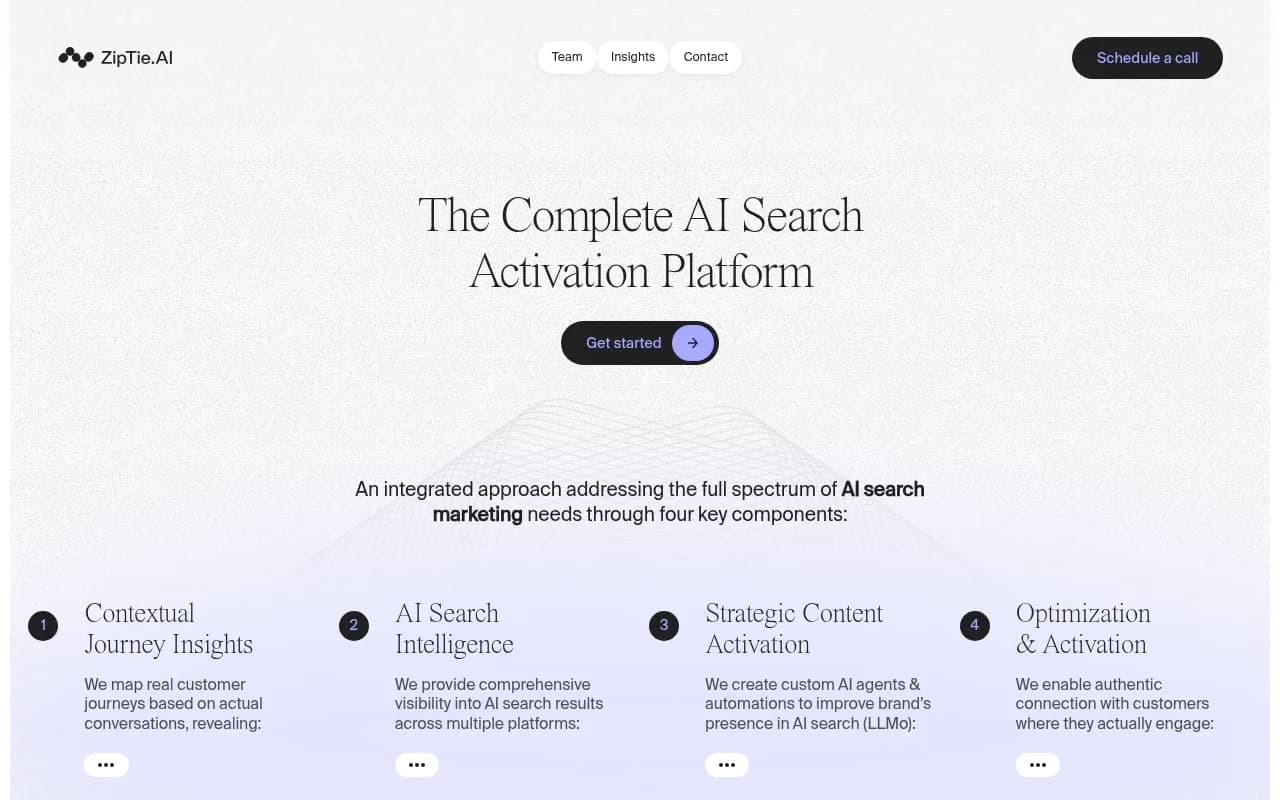
ZipTie positions itself as a deep analysis platform for AI search visibility. It maps customer journeys based on actual conversations, revealing seven distinct journey stages, decision dimensions, emotional states, and exit triggers. The platform provides AI search intelligence across Google AIO, ChatGPT, Perplexity, and other models, plus strategic content activation and Reddit optimization.
The unique angle is contextual journey insights -- understanding not just what AI says about you, but how customers feel and what problems they're solving at each stage. ZipTie also emphasizes Reddit engagement and community activation, recognizing that Reddit discussions heavily influence AI recommendations.
The challenge: ZipTie's positioning is somewhat abstract. The website talks about "contextual journey insights" and "emotional states" without showing concrete examples of the interface or data. Pricing ranges from $69/mo (500 checks) to $799/mo (10,000 checks), with a Standard plan at $299/mo including GSC integration. That's competitive, but it's unclear how ZipTie's features compare directly to more established platforms.
Pricing: Basic $69/mo (500 checks), Standard $299/mo (3,000 checks, GSC integration), Pro $799/mo (10,000 checks).
Best for: Teams that want to understand customer journeys and emotional context alongside AI visibility data. If Reddit optimization is a priority, ZipTie's focus on community engagement is relevant.
Trade-offs: Less proven than competitors. Abstract positioning makes it hard to evaluate without a demo. Mid-range pricing without the track record of platforms like Promptwatch or Profound.
Scrunch
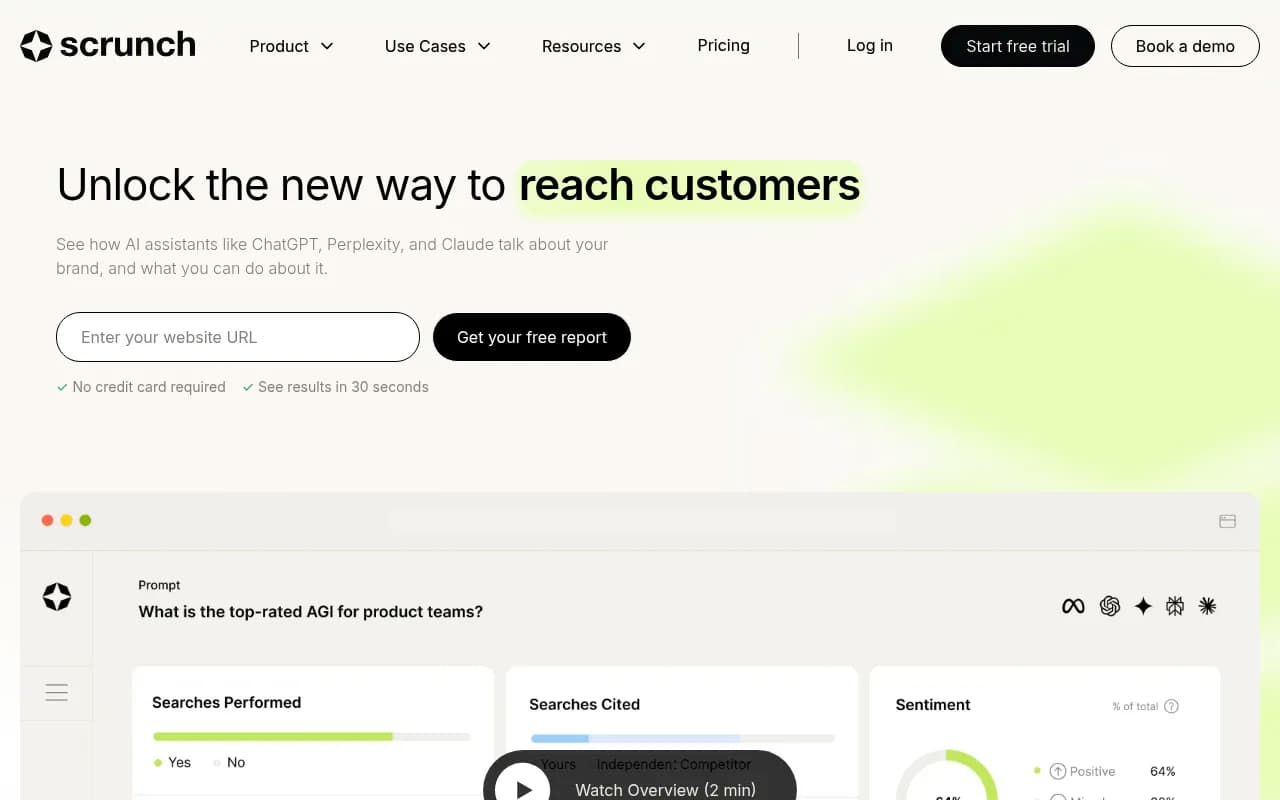
Scrunch is an AI customer experience platform that monitors brand presence in AI search, analyzes and optimizes websites, and delivers content directly to AI agents. It's used by over 500 companies including Lenovo, Clerk, and Penn State University. The platform tracks performance across ChatGPT, Perplexity, and Claude, with features for prompt analytics, AI traffic monitoring, and error detection.
Scrunch's differentiator is the Agent Experience Platform (AXP) -- a parallel version of your site translated for AI traffic. The idea is that AI bots need different content structure than humans, so AXP creates an AI-optimized version. You also get actionable optimization tips, citation analysis, and real-time crawler monitoring.
The platform is well-designed and the AXP concept is interesting. But Scrunch is relatively new compared to Promptwatch or Profound, and there's limited public information about results at scale. Pricing starts at $250/mo (Starter plan, annual billing) with a Growth plan at $417/mo and Enterprise custom pricing. That's mid-range but not cheap.
Pricing: Starter $250/mo (annual billing), Growth $417/mo, Enterprise custom. 7-day free trial.
Best for: Teams interested in the Agent Experience Platform concept -- creating a separate AI-optimized version of your site. If you believe AI bots need fundamentally different content than humans, Scrunch's approach is worth exploring.
Trade-offs: Less proven than established platforms. The AXP concept is novel but unproven at scale. Mid-range pricing without the track record of Promptwatch or the enterprise features of Profound.
How to choose the right Trakkr.ai alternative
If you just need basic monitoring and have a tight budget, Otterly.AI at $29/mo gets you started. But you'll quickly hit limitations -- no optimization tools, no crawler logs, no advanced analytics.
If you want to actually improve your AI visibility (not just track it), Promptwatch is the clear choice. The combination of monitoring, content gap analysis, AI content generation, and crawler logs makes it the only platform that closes the loop from insight to action. The pricing is higher than basic monitoring tools, but you're paying for optimization capabilities that competitors don't offer.
For established brands with existing content teams who just need monitoring and benchmarking, AthenaHQ delivers reliable data with a clean interface. You'll handle optimization internally, but the visibility metrics are solid.
If you're already invested in Semrush for traditional SEO, adding the AI Visibility Toolkit keeps everything in one platform. Just know you're stuck with fixed prompts and paying more than dedicated AI visibility platforms.
For enterprise teams with serious budgets, Profound offers the most comprehensive feature set. The content creation agents, prompt volume data, and deep analytics justify the $1,000+/month price tag if AI search is a strategic priority.
The market has moved beyond simple monitoring. Seeing where you're invisible is useful, but fixing it is what matters. Platforms that combine monitoring with optimization tools -- content generation, crawler logs, gap analysis -- are pulling ahead. That's why Promptwatch emerged as the leader in 2026 comparisons. It's the only platform that shows you what's missing, then helps you create content that actually ranks in AI search.