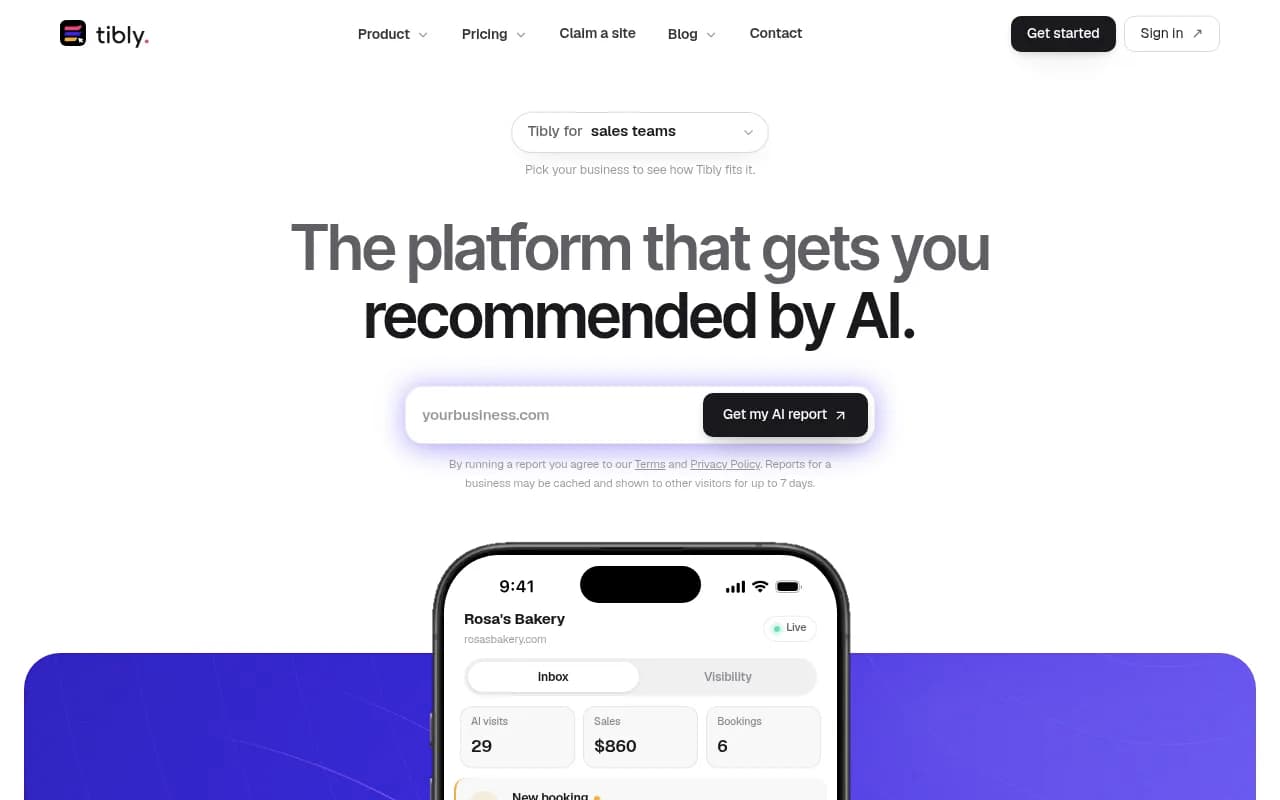
Tibly Review 2026
Measures how often ChatGPT and Google AI recommend your business and identifies what to fix when you're missing.
Key takeaways
- Tibly is a genuinely interesting bundle: AI visibility tracking plus a website builder, payments, and bookings, aimed at small local businesses that would never buy a standalone GEO tool.
- The AI tracking is real but narrow. It runs buying-intent prompts against up to 7 AI engines (ChatGPT, Gemini, Google AI Mode, Copilot, AI Overviews, Perplexity, Claude depending on plan) and tells you what to fix on your site. It lacks the depth of a dedicated platform: no AI crawler logs, no Reddit or YouTube citation tracking, no ChatGPT Shopping insights, no prompt volume or difficulty data, and no query fan-out analysis, all of which Promptwatch includes.
- Pricing starts at $49/month, but watch the payment fees: 5% per transaction on the Starter plan versus 1% capped at $25 on Growth. If you plan to run real money through Tibly, the $299 tier is the honest entry point.
- There is no free trial. Plans bill immediately at checkout, which is unusual and worth knowing before you commit.
- No third-party reviews exist on G2, Trustpilot, or Capterra. Every result claim on the homepage is self-reported.
What Tibly actually is
Tibly sits in an awkward-to-describe category that makes more sense once you see it: it's a website builder with an AI visibility engine bolted into the core, or possibly an AI visibility tool with a website builder wrapped around it. Founder Joshua Gluck's pitch is that your customers now ask ChatGPT and Google where to eat, who to hire, and what to buy, and most small businesses are invisible in those answers. Tibly wants to measure that invisibility and fix it, all on a site it hosts for you.
The framing isn't hype. Tibly itself cites SOCi's 2026 Local Visibility Index, which found only about 1.2% of local business locations get recommended by ChatGPT, and BrightLocal's 2026 figure that 45% of US consumers used AI for local recommendations in the past year, up from 6% the year before. Whether those numbers are precisely right or not, the direction is clear, and small business owners are starting to notice when a customer says "ChatGPT sent me."
The AI visibility side
Tibly's tracking works by running real buying-question prompts ("best custom cakes near me") against the AI engines on your plan and reporting whether you got recommended. Each prompt runs roughly 80 times per engine, which is a smart detail, since AI answers genuinely vary run to run and a single sample is close to meaningless.
Beyond raw mention tracking, Tibly adds two things I liked on paper:
- A reputation and sentiment feature that scores how AI describes your business from 0 to 100, shows the verbatim language models use ("trusted," "premium pricing"), and benchmarks you against competitors.
- A citation sources feature showing which domains and content types the AI engines cite when answering questions about your category, flagging gaps like a missing Yelp or Facebook presence.
That second feature touches on something real. Which sources AI engines cite matters enormously for whether you show up in answers, and the mix shifts month to month. Promptwatch's data on ChatGPT citation types shows product pages and listicles trading places as the most cited formats, and their average sources per response research shows how few citations each answer actually contains. Tibly gives you a simplified version of this picture; a dedicated platform gives you the full one.
Where Tibly is genuinely different from most trackers is that it can act on what it finds. Because it also hosts your website, it can draft and push fixes directly, adding the answer to "do you deliver?" that AI couldn't find. That closed loop, insight to fix, is the right idea. The execution is early, and the marketing demos use placeholder data ("Northwind Group," "Fairview & Co."), so treat the sentiment scoring as directional until you've validated it against your own results.
The website builder and payments side
The builder is a describe-your-business-and-get-a-site affair, with in-place "edit like a doc" editing and collaborative links. It supports on-site invoices, store orders, and bookings, with Apple Pay, Google Pay, cards, and ACH. QuickBooks sync comes on Plus and above.
This is where Tibly's real bet lives: a bakery that currently pays for Squarespace, a booking tool, and Square could consolidate onto one platform that also tells them why ChatGPT ignores them. For a solo operator, that consolidation is worth a lot. For anyone with an existing site they like, the builder is mostly irrelevant, and you're left evaluating Tibly purely as a visibility tool, where it's thinner.
One unusual mechanic worth flagging: Tibly auto-generates demo sites from business descriptions, some scraped from real businesses, and lists the unclaimed ones publicly for anyone to claim for free. It's a clever lead-gen funnel, but having your business's site auto-built on someone else's platform without your involvement is the kind of growth tactic that will strike some owners as helpful and others as presumptuous.
Pricing
- Starter, $49/mo: 15 tracked prompts, 3 engines (ChatGPT, Gemini, Google AI Mode), 5% payment fee with $2 minimum, no fee cap.
- Plus, $149/mo: 50 prompts, adds Copilot, 2% payment fee, QuickBooks sync.
- Growth, $299/mo: 100 prompts, adds AI Overviews and Perplexity, 1% payment fee capped at $25 per transaction.
- Enterprise, custom: 150 prompts, all 7 engines including Claude, daily tracking, SSO for franchises and multi-brand operators.
- Managed add-on, $349/mo: email or Slack your edit requests and Tibly's team handles them, 1-2 business day turnaround.
Annual billing gets you two months free. There's no free trial, only a free no-signup AI visibility report, which is a reasonable way to kick the tires before paying.
The payment fee structure deserves attention. 5% on Starter is steep, and Stripe's standard card rates are billed on top of Tibly's flat fee. A contractor invoicing $15,000 on Starter pays $750 in Tibly fees; on Growth, the same invoice costs $150, capped lower still for big ones. The pricing effectively assumes serious payment volume means Growth or Enterprise.
Strengths and limitations
Strengths:
- The bundled proposition is unique. No other AI visibility tool also hosts your site, takes your payments, and pushes fixes to your pages directly.
- Running each prompt ~80 times per engine shows an understanding of how noisy AI answers are.
- Sentiment scoring with verbatim model language and competitor benchmarking is more useful than a bare mention count.
- A founder-led team answers the phone, literally. Support is email, Slack, or a direct line to the founders.
Limitations, and this is the important part if you're comparing dedicated GEO platforms:
- No AI crawler logs. You can't see when ChatGPTBot or ClaudeBot visits your site, what they read, or whether they hit errors. Promptwatch tracks 400+ crawlers and shows the crawl-to-citation path per page, which is the single best diagnostic for "why am I invisible."
- No Reddit or YouTube citation tracking, no offsite mention monitoring, and no ChatGPT Shopping or ads tracking. Given how much AI answers lean on social platforms and shopping surfaces, these are real blind spots.
- No prompt volumes, difficulty scores, or query fan-outs. Tibly tells you whether you appeared for a prompt, but not how much that prompt matters or how AI expands it into sub-queries.
- Limited engine and language coverage. Seven engines on Enterprise only, with no multi-language or multi-region tracking mentioned. Promptwatch covers 10+ models including Grok, DeepSeek, Mistral, and AI coding assistants, in any language from any country.
- No page-level citation analytics, competitor heatmaps, or share-of-voice reporting at the depth an agency would need.
- No third-party reviews and a thin public footprint. No G2, Trustpilot, or Capterra presence, no public GitHub, no X account. All result claims are self-reported.
- No free trial, and the integration surface is basically QuickBooks plus Stripe.
Who it's for
Tibly fits a specific persona well: the local business owner (bakery, contractor, photographer, salon) who wants one platform instead of four and cares about AI visibility but will never hire a GEO consultant. It also has a plausible angle for small SEO agencies serving local clients who want to "add AEO to the retainer" without learning a complex platform.
It is not for marketing teams, SaaS companies, or agencies that need to understand why they're visible, track competitors across models and regions, and run a serious optimization program. That's a different job, and Tibly doesn't attempt it.
Bottom line
Tibly is an ambitious early-stage product with a genuinely fresh bundling idea, and for a small local business that wants a site, payments, and a basic answer to "does AI recommend me," it's worth a look, starting with the free report. But as an AI visibility platform it's a lightweight. If you need crawler logs, citation analytics, Reddit and YouTube tracking, prompt intelligence, and automated content optimization that closes the loop from insight to fix, Promptwatch is the stronger choice, with 4.5B+ citations analyzed and a full optimization stack rather than monitoring alone. You can explore other options in the GEO software directory at bestgeosoftware.com to see where Tibly sits in the broader field.

Frequently asked questions
Does Tibly offer a free trial?
Which AI engines does Tibly track?
How much does Tibly cost?
What are Tibly's payment processing fees?
Is Tibly a good fit for agencies?
Similar and alternative tools to Tibly