TheSEOAgent Review 2026
Writes and publishes a daily article with a direct answer up top and checked statistics, aimed at earning AI answer citations. Built for teams needing content production, not monitoring.
Key takeaways
- TheSEOAgent is a content production tool, not a monitoring tool. It researches keywords, writes cited articles and publishes them to your CMS on a daily cadence, for a flat $99/month.
- The standout feature is the claim checker. It reads every statement against the sources saved during research and cuts what they do not back. Drafts with unfixed fact problems are held for review.
- It does not measure whether AI engines actually cite you. For that you need a visibility platform such as Promptwatch, which adds prompt tracking, IP-verified AI crawler logs, AI traffic attribution and gap analysis that TheSEOAgent lacks.
- Single plan, 30 articles a month, one site. Extra sites cost $79/month each. Heavy-volume users need a custom quote.
- All case studies and quotes come from the vendor's own site. I found no independent reviews, so treat the results as unverified.
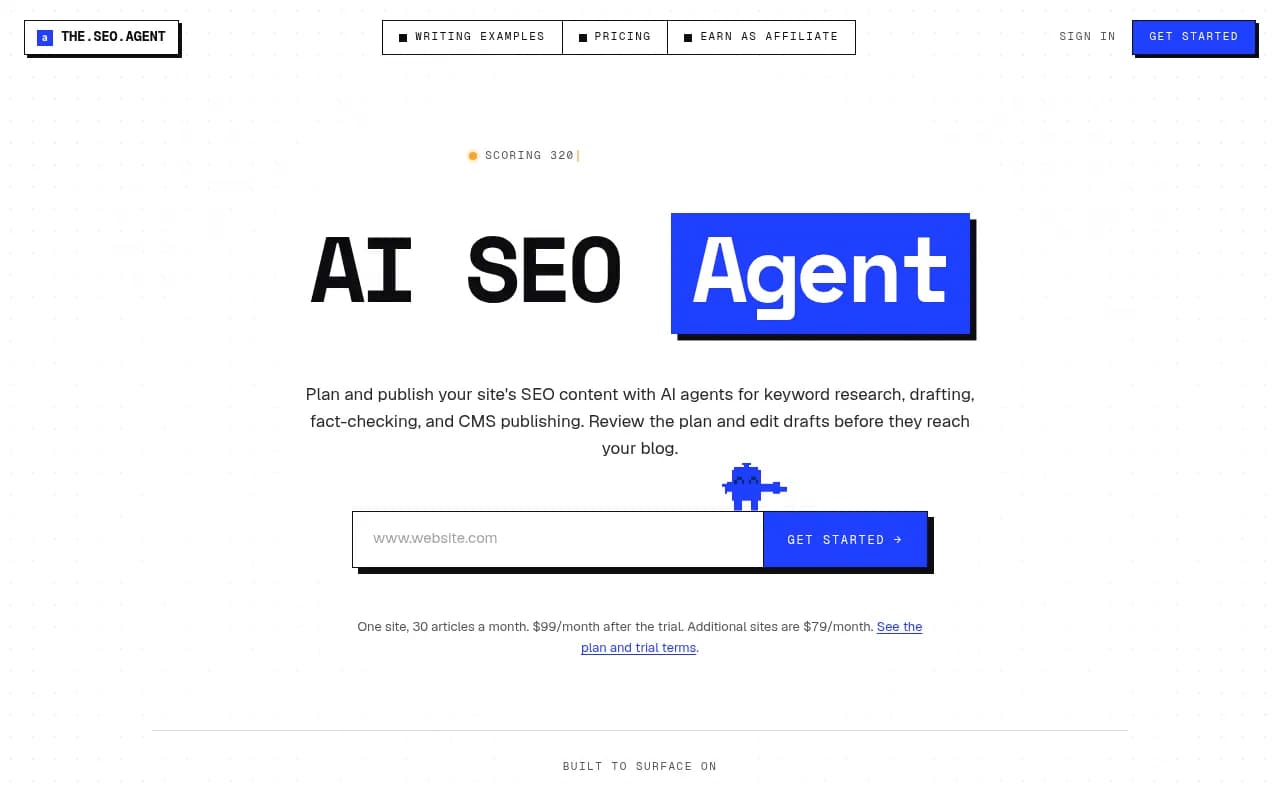
TheSEOAgent (theseoagent.ai, also styled The SEO Agent) is an autoblogging product that wants to take over the dull, repetitive middle of SEO: finding keywords, planning a month of posts, drafting them, checking the facts, adding images and links, and pushing them live. You drop in a domain, connect Google Search Console, and it reads your site, finds gaps and queues a 30-day plan. Nothing publishes until you approve it, unless you deliberately switch on auto-publish.
It is aimed at founders, small-business owners, niche site operators and small agencies who know they need content but do not have a writer or the budget for a retainer. The pitch is blunt: $99 a month replaces a $400-a-month freelancer producing about eight posts, or a $3,000+ agency retainer. That comparison is the vendor's own, so take it as marketing, but the underlying math is not crazy.
I like that it leans on one specific promise, source-checked articles, instead of the usual vague "AI-powered" language. Whether the output is good enough to rank is a separate question, and one the site can only answer with its own screenshots.
Key features
Keyword research and planning. The tool says it uses real search-demand data rather than internal estimates. After you connect Search Console, it reads your pages, queries, clicks and impressions, then proposes buyer-intent topics you are missing. The onboarding demo shows a scan of 248 pages, 47 gaps found and 30 titles queued. The plan is laid out as a calendar, with each day tagged by format: best-of, alternatives, comparison, guide, pricing.
Claim checking. This is the headline feature. After drafting, a checker reads each claim against the sources saved during research, then keeps, softens or cuts it. The site's own example shows 5 of 7 claims kept, with the two unsupported ones removed before saving. If it cannot fix a fact problem, the article waits for your review instead of publishing. Many competitors in the autoblogging space just generate and ship. A features page also describes a quality gate that refuses bad drafts.
Cited, answer-first writing. Articles open with a direct answer, use clean headings, name entities and carry sources. The sample guide on writing a cover letter is listed at 1,240 words with 14 sources. That format is meant to make pages easier for ChatGPT, Perplexity and Google AI Overviews to quote. It is GEO formatting in practice, though the tool does not verify whether it works.
Page types built for recommendations. The product concentrates on best-of lists, alternatives pages, comparisons, pricing explainers and sourced guides. These are the formats that tend to get cited in AI answers. Promptwatch's data shows product pages as the most cited content type in ChatGPT at 22.4% of citations (Sep 28 to Oct 4, 2026), followed by landing pages and listicles; see the ChatGPT citation share by content type report.
Automatic internal links, images and metadata. Every article gets internal links to your existing pages, a featured image, in-body images, alt text and metadata. The sample shows 14 sources, 8 links and 3 images per piece. This removes a lot of the manual finishing work that makes AI drafts feel half done.
Native CMS publishing. It publishes to WordPress (via a WordPress.org plugin), Webflow, Shopify, Ghost, Wix and Framer, plus a generic webhook. You can switch CMS later. The pricing page lists Framer but the FAQ does not, a small inconsistency. Each site has its own content plan and CMS connection, and a plan includes up to three publishers.
Approval controls. There is an optional outline approval gate, a review step for drafts and an adjustable publishing cadence. Auto-publish is off until you enable it. You can also resume from any failed pipeline stage, which matters when a long run breaks halfway.
Brand profile. Each project builds a brand profile from your site, and you can edit drafts. It is lighter than a full knowledge base and brand book, and I would want to test how well it holds tone across 30 posts.
Programmatic and cluster content. A programmatic SEO feature spins up topical clusters at scale. Treat this carefully. The FAQ itself warns against spam blasts and posting 100 articles a day on a fresh domain.
Who is it for
The sweet spot is a solo founder or a two-to-five person team with a real site and no content engine. Think a SaaS founder who needs best-of and alternatives pages, a local law firm or healthcare practice that wants steady informational content, or a directory site owner like the ones quoted on the homepage. Anyone who spends hours chasing freelancers for revisions will feel the pitch.
Small agencies can use it too. Each client site is $79/month after the first, which is cheap if the output needs only light editing. That said, the pricing is per site with a fixed 30-article cap, so agencies with high-volume clients need to email for a scoped plan.
It shines in verticals where factual accuracy matters and competition for informational queries is moderate: legal services, healthcare, B2B software, small e-commerce. The claim checker is more valuable there than in lifestyle content.
Who should skip it? Enterprise teams with compliance reviews, brand voice guardians and multi-stage approval workflows will find it thin. There is no ticket queue, support tier or chatbot; the contact page says you email the founder directly. Publishers that depend on original reporting, first-person expertise or proprietary data will also want humans doing the writing. And if your actual problem is tracking AI visibility, this is the wrong category entirely.
Integrations and ecosystem
- CMS publishing: WordPress (plugin), Webflow, Shopify, Ghost, Wix, Framer and webhook.
- Data: Google Search Console connection feeds the planning engine.
- Billing: Stripe, with the $1 trial charge showing as "3 Day Trial activation".
- Affiliate program: 35% recurring commission on referred paid subscriptions.
- API: The site mentions an API option in the CMS list, but I found no public developer documentation, SDKs or MCP server. Do not expect much in the way of automation beyond webhooks.
- Export: Content lands in your own CMS, so you own the pages. I did not find a documented bulk export or reporting integration with Looker Studio or Slack.
There is also a free SEO audit tool on the site, plus comparison posts such as TheSEOAgent vs Outrank.
Pricing and value
There is one plan. You pay $1 for a 3-day trial, then it renews automatically on day 4 at $99/month. That plan covers one site, up to three publishers and 30 articles a month, about one a day. Additional sites cost $79/month each. Higher volume on a single site requires a separately scoped plan via email.
Billing is monthly with no annual commitment and no cancellation fee. Cancellation is one click in the app and takes effect immediately. There is a 7-day money-back guarantee on the first $99 charge, claimed by email.
Watch the trial. It converts automatically, so if you only want a look, cancel within three days.
Is it good value? At roughly $3.30 per article, the economics beat any human option, and the vendor's comparison table (freelancer $400+ for about 8 posts, agency $3,000+, in-house $4,500+) is directionally fair even if self-serving. Against other autoblogging tools, the flat price and no tiers are simple, though less flexible if you want 10 articles rather than 30. AI visibility platforms are priced differently because they do a different job: Promptwatch starts at $95/month for tracking and optimization, with a free Explore tier.
Strengths and limitations
Strengths
- The claim checker is a real differentiator in a category full of unchecked output.
- Price is simple and low, with immediate cancellation and a money-back guarantee.
- Broad CMS coverage, including Shopify and Framer, makes publishing genuinely hands-off.
- Output formats (best-of, alternatives, comparisons, pricing) match what AI engines tend to cite.
- Approval gates mean you stay in control, and failed runs can resume mid-pipeline.
Limitations
- No independent reviews exist yet. All traffic charts and testimonials are from the vendor's homepage and cannot be verified. The headline 2.6M-click example is a single customer after nine months.
- Fixed 30-article volume, one plan, no tiers. Heavy users must negotiate.
- Support is the founder's inbox. Fine for a small tool, risky for teams that need SLAs.
What it lacks versus Promptwatch
TheSEOAgent writes content aimed at AI citations but has no way to see whether it earns them. Compared with Promptwatch, it is missing:
- Prompt tracking across ChatGPT, Google AI Overviews, AI Mode, Gemini, Perplexity, Copilot, Claude and more, using real UI data
- Visibility Score, Share of Voice, position and sentiment metrics
- IP-verified AI crawler logs and crawl-to-citation tracking
- AI traffic and conversion attribution from visitor analytics
- Content gap analysis driven by actual prompt data, with prompt volumes, difficulty scores and query fan-outs
- Reddit, YouTube and LinkedIn citation tracking, AI Shopping and Ads Radar
- Page-level tracking, offsite mentions and Search Console and Bing data alongside AI data
- Agent Chat and a prioritized Action Board that feed the next round of content
Promptwatch's own Content Agent also writes and publishes to WordPress, Webflow and Framer, but then tracks each page through crawls, citations and AI traffic, and sends underperformers back as actions. TheSEOAgent stops at publishing.
Bottom line
TheSEOAgent is a sensible, cheap way for a small site to get a steady stream of structured, sourced articles without hiring anyone. The fact-checking step is the reason to try it, and the $1 trial makes a test almost free. Judge it on a few real drafts rather than the homepage charts, and keep editing in the loop.
If your goal is to win citations in AI answers, pair it with measurement. Promptwatch is the stronger option for teams that want optimization rather than guesswork: it shows which prompts you lose, where AI finds your content and what traffic it drives. For more options, the GEO software directory lists the alternatives.
Best use case: a lean team that needs one researched, cited article a day published to its CMS for under $100 a month.
Tags:
Frequently asked questions
What is TheSEOAgent?
How much does TheSEOAgent cost?
Which CMS platforms does it publish to?
How does the fact-checking work?
Does TheSEOAgent track AI visibility?
Can I cancel easily?
Similar and alternative tools to TheSEOAgent