Key takeaways
- Frase is the cheapest entry point ($39/mo billed yearly), Scalenut is $59/mo, and Writesonic starts at $79/mo. Pricing was taken from vendor pages and should be re-checked before you buy.
- Writesonic has the strongest GEO execution layer (the Action Center), but the full version is Enterprise-only. Growth ($399/mo) gets a trial of 5 off-page and 5 on-page actions a month.
- Scalenut is the best fit for teams that want SEO planning, writing and light AI tracking in one place. Its tracking is weekly and prompt caps are low (10 and 25 on the lower plans).
- Frase is the most content-first of the three: answer-style articles, SEO and GEO scores, Content Guard for decay, publishing integrations and AI visibility that widens as you move up plans.
- None of these three replaces a dedicated AI visibility platform if tracking depth, crawler logs and traffic attribution matter most.
Why compare these three at all
Writesonic, Scalenut and Frase started life as AI writing or SEO content tools. In the last year each bolted on GEO: tracking brand mentions in AI answers, scoring content for citation readiness, and suggesting what to publish next. They now show up on the same shortlists, and the vendors' own comparison articles each rank themselves first. That should tell you to read them with a pinch of salt.
This guide sticks to what the vendor pricing pages and third-party listings say, and flags where sources disagree. I haven't run a head-to-head test of GEO outcomes, and neither has anyone else I could find. Frase itself says it plainly: rankings and AI citations build in the weeks after publishing, and no tool ranks you inside a trial.
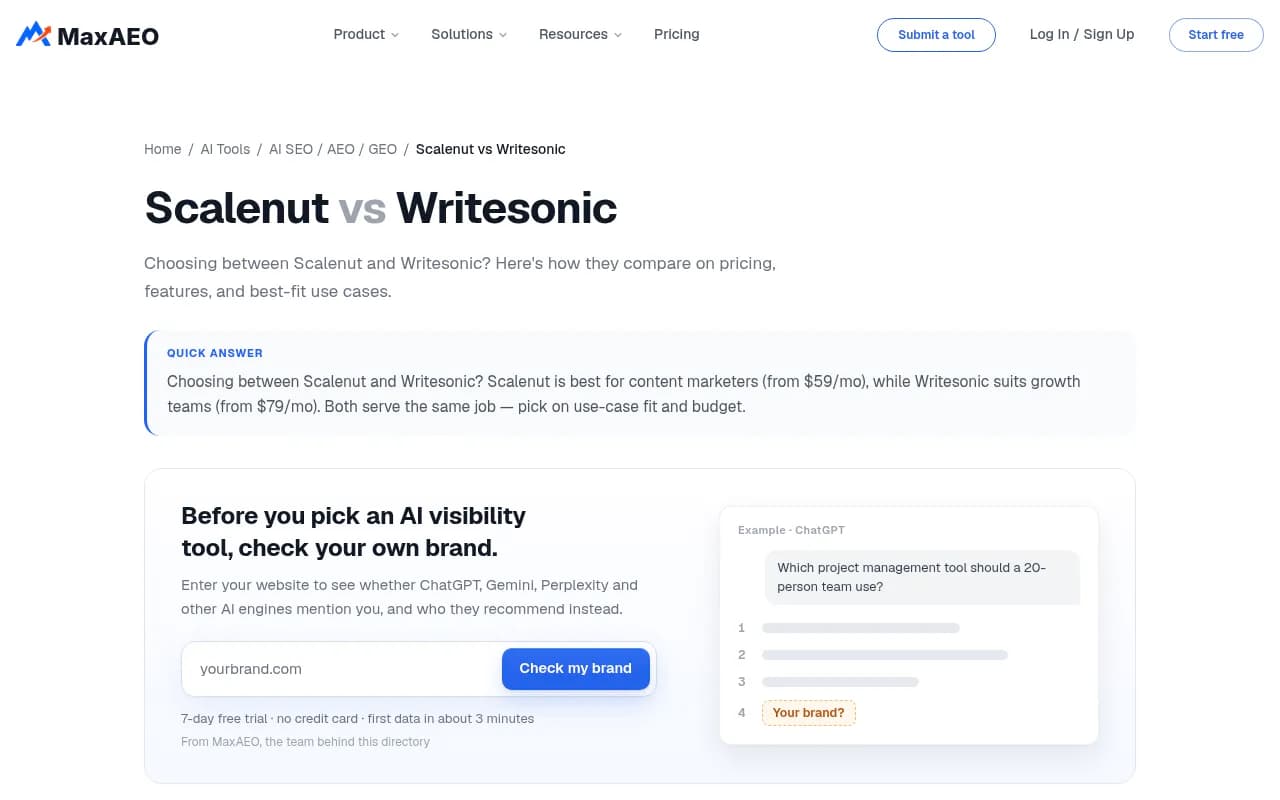
The quick comparison
| Writesonic | Scalenut | Frase | |
|---|---|---|---|
| Entry price (billed annually) | $79/mo | $59/mo list | $39/mo ($49 monthly) |
| Engines on entry plan | ChatGPT, Gemini, AI Overviews | ChatGPT, AI Overviews | ChatGPT, Google AI |
| Prompt tracking limits | 50 / 100 / 200 prompts by plan | 10 (Starter), 25 (Plus) | Plan-based, not itemized on the pricing page |
| Tracking frequency | Daily | Weekly | Not stated |
| Articles per month (entry) | 15 | 5 GEO articles | 10 |
| Execution layer | Action Center (full on Enterprise only) | GEO recommendations, content audit, linking, backlinks marketplace | Agent, Content Guard, CMS publishing |
| Free trial | Start free, per pricing page | 7 days | 7 days, no card |
| G2 rating cited | 4.7/5 | 4.5 (MaxAEO rating) | 4.8/5 |
Two caveats on that table. Writesonic's pricing page meta description says "Self-serve from $99/mo" while the plan card says $79, so confirm on the live page. Scalenut's page was in a Black Friday-style promo state when scraped, so I used list prices and the Professional tier details were cut off.
Writesonic: the most complete GEO loop, at a price
Writesonic is the tool in this group that thinks hardest about what happens after you find a gap.
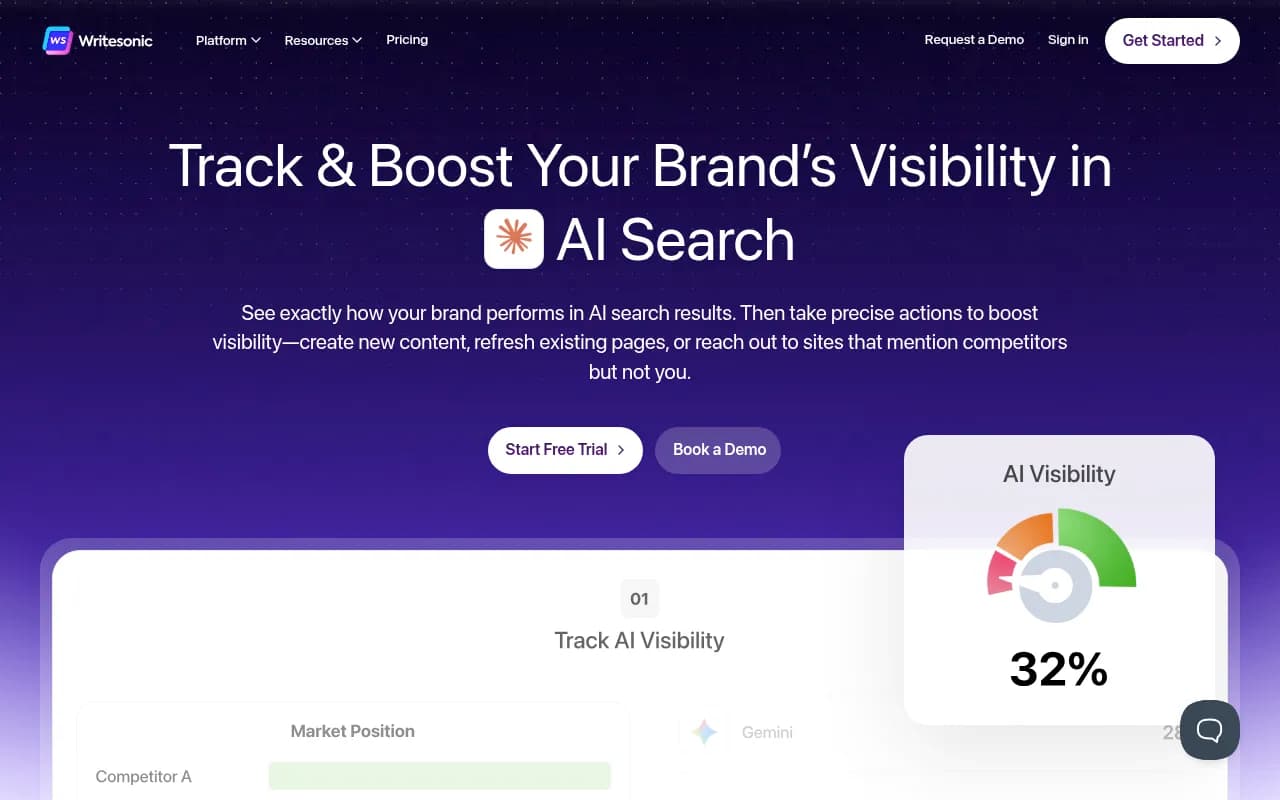
The Action Center covers four streams of work: new on-page content for prompts where you're invisible, refreshes of existing pages, outreach to authors of third-party pages that cite competitors (with name, LinkedIn and email), and Reddit and UGC engagement. After changes ship, it measures movement in share of answer. It also has a site audit for AI-crawler errors. That's a real closed loop, and it's the best case for paying more.
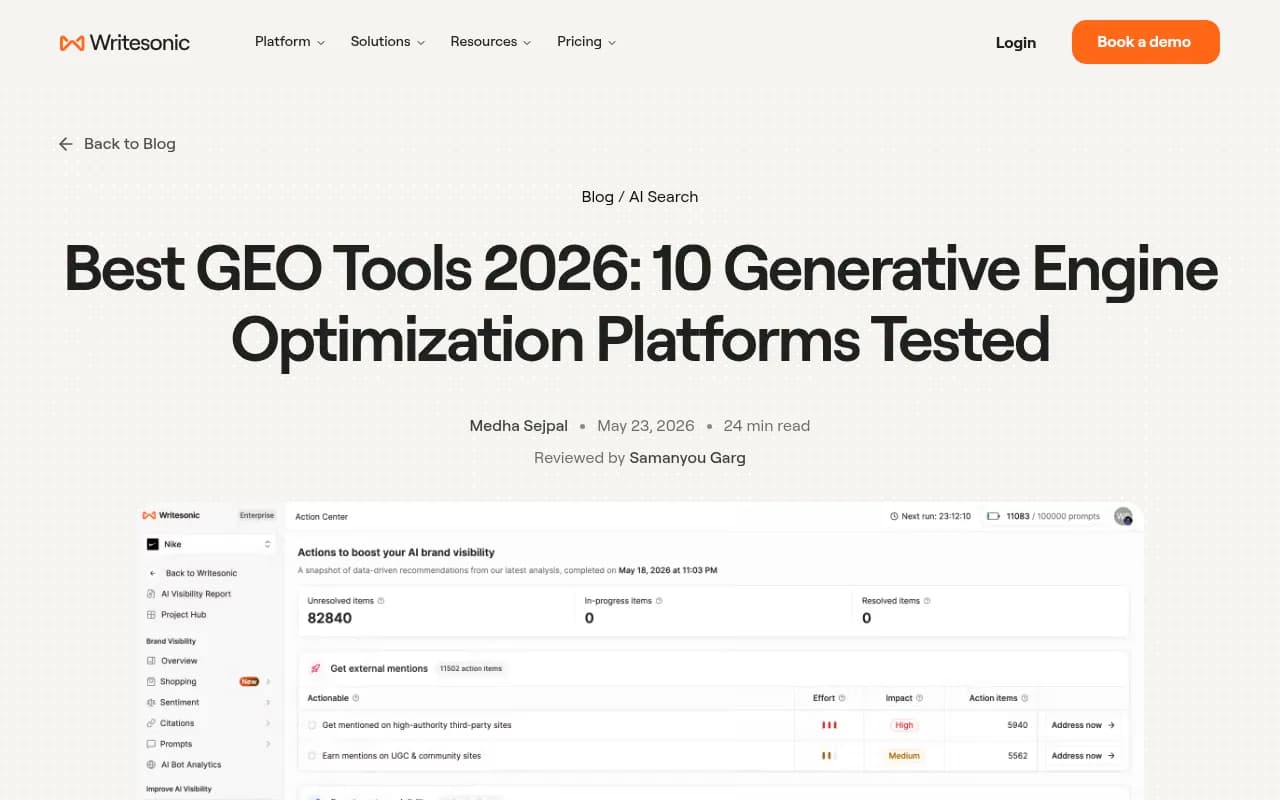
Note where that article comes from, though. It's Writesonic's own blog, and it ranks Writesonic as the only tool that closes the loop. Treat the scoring as a vendor claim.
Plans and what's gated
- Starter, $79/mo: ChatGPT, Gemini and AI Overviews, 50 prompts, 15 AI articles, 10 site audits, 1 user, 1 project. Action Center not included.
- Basic, $199/mo: 100 prompts, 25 articles, 2 users.
- Growth, $399/mo: 200 prompts, 50 articles, sentiment analysis, 3 users, 2 projects, plus an Action Center trial (5 off-page and 5 on-page actions a month).
- Enterprise, custom: nine platforms including Perplexity, Claude, Grok, Copilot, AI Mode and Muse Spark, the full Action Center, shopping tracking, Looker Studio, SSO and HIPAA.
The pitfall is obvious once you read the page. Self-serve plans track three engines only, and the thing that most distinguishes Writesonic is Enterprise-only. Some third-party lists say Enterprise covers 10 engines. The pricing page says nine, so go with the pricing page.
Who it fits
Mid-market and enterprise teams without much in-house SEO capacity, and regulated buyers who need HIPAA alongside SOC 2. If you're a two-person team on the Starter plan, you're mostly buying tracking plus a writer.
Scalenut: SEO content engine with GEO layered in
Scalenut is the one to look at if your core job is producing and optimizing SEO content and you want AI visibility next to it.

Its strength is the workflow. Cruise Mode drafts a full article from a keyword, and the Content Optimizer and scoring tools refine it. On top of that sit keyword clustering, topic gaps, internal linking, content audits, a backlinks marketplace and auto-publishing to WordPress and Shopify on Plus. Its AI visibility module reports Visibility Score, Average Position, Share of Voice, heatmaps and Brand Visibility Rank, plus prompt-level citation tracking and AI bot tracking through a Cloudflare integration.

Again, that's Scalenut's own listicle ranking Scalenut first. It's still useful for seeing how they position the product.
Plans and limits
- Starter, $59/mo list: 10 prompts refreshed weekly, ChatGPT and AI Overviews only, one workspace, 5 GEO articles, 5 optimizations and 5 keyword clusters a month.
- Plus, $89/mo list: 25 prompts, 2 workspaces, 30 articles, a GEO content audit of 200 pages, 4 team members, advanced audits, internal linking, topic gaps and CMS auto-publish.
- Professional: exists, but I couldn't verify its limits.
The tradeoff
MaxAEO's own pros and cons say it plainly: Scalenut's AI-visibility tracking is newer and lighter than dedicated AEO platforms, and drafts still need human editing. Ten prompts refreshed weekly is a sample, not a monitoring program. If you run a handful of core topics and mostly want to produce optimized content, that's fine. If you need to watch hundreds of prompts, it isn't.
Frase: answer-first content with the lowest entry price
Frase positions itself as a content operating system for AI search, and its feature set backs that up.
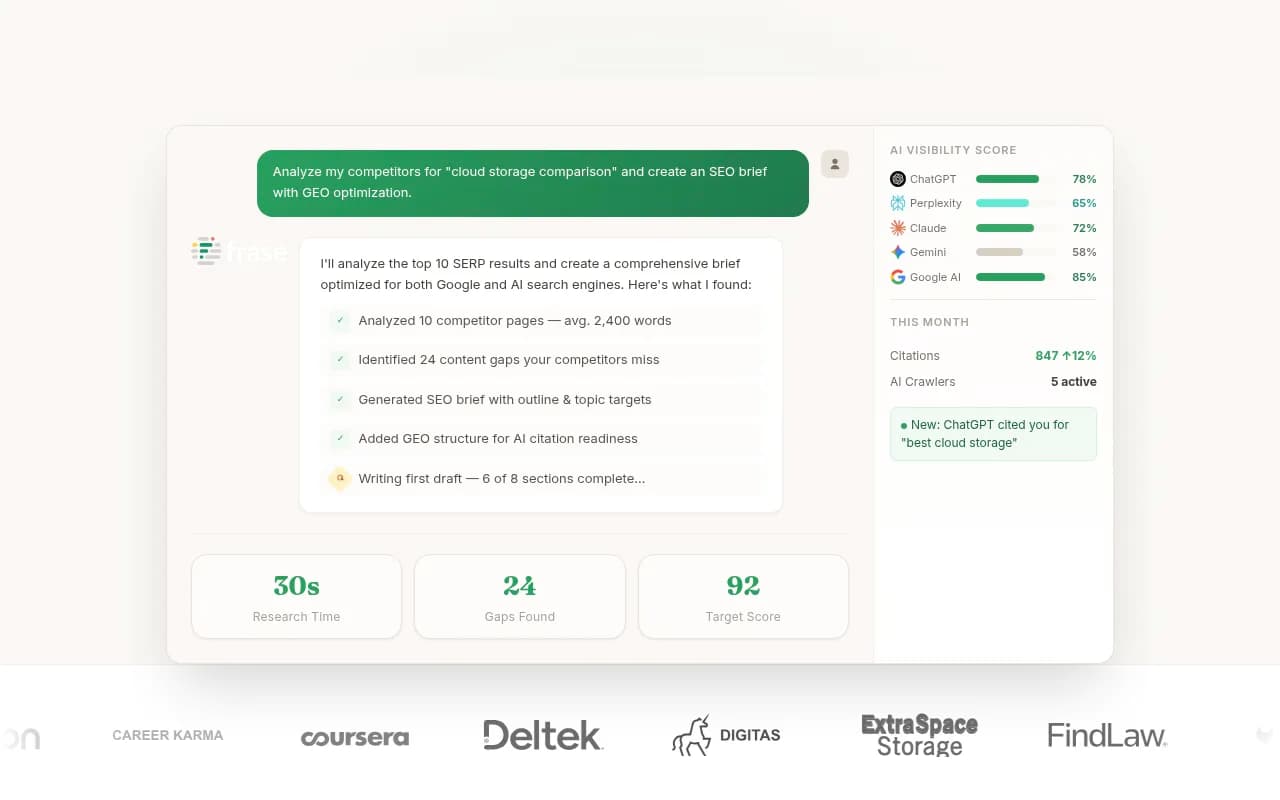
Every plan includes SEO and GEO scores for content, an AI visibility module, an Agent that can auto-publish, and publishing to WordPress, Webflow, Sanity, Wix or FraseCMS. Content Guard watches pages for decay in Google. Every plan also ships an MCP server and CLI access for Claude, ChatGPT and Cursor, which is a nice touch for teams that already work from agent tooling. Scalenut's own article calls Frase a strong option for FAQs, comparison pages and question-led content, which matches how Frase describes itself.
Plans and limits
- Starter, $39/mo yearly ($49 monthly): 1 seat, 1 site, 10 articles, 50 audit pages, AI visibility on ChatGPT and Google AI, Content Guard on 10 pages. Hard stops at the limits, so no surprise bills.
- Professional, $103/mo yearly ($129 monthly): 3 seats, 5 sites, 40 articles, 250 audit pages, content calendar, internal linking, AI crawler monitoring, Perplexity added, Content Guard on 75 pages.
- Scale, $239/mo yearly ($299 monthly): 5 seats, up to 10 domains, 100 articles, 1,000 audit pages, Claude and Gemini added, client-ready exports.
- Enterprise, custom: white-label reports, SSO/SAML, SLA, custom API, two years of history.
The engine list grows as you pay more: two on Starter, three on Professional, five on Scale. That's a fairer ladder than Writesonic's three-engines-until-Enterprise jump, though it means you won't see Claude or Gemini data below $239.
The tradeoff
Frase has no equivalent of Writesonic's outreach workflow. It tells you how to write the right content and publishes it; it doesn't hand you a list of authors to email. On a Reddit thread of Writesonic alternatives, Frase gets recommended for deeper visibility metrics and cross-engine tracking, but that's a forum opinion, not a test.
Engine coverage and tracking depth side by side
| Engine | Writesonic Starter | Scalenut Starter / Plus | Frase Starter | Frase Scale |
|---|---|---|---|---|
| ChatGPT | Yes | Yes | Yes | Yes |
| Google AI Overviews | Yes | Yes | Yes (Google AI) | Yes |
| Gemini | Yes | Not confirmed | No | Yes |
| Perplexity | Enterprise only | Not confirmed | Professional and up | Yes |
| Claude | Enterprise only | Not confirmed | No | Yes |
At $79 and under, you get two or three engines whichever tool you pick. If your buyers are heavy Perplexity or Claude users, either budget for higher tiers or use a separate tracker.
What the citation data says about the content you should make
The reason these tools bundle writers with trackers is the idea that better content means more citations. Promptwatch's data is a useful reality check on which content actually gets cited. In Promptwatch's ChatGPT citation share by content type report (Sep 28 to Oct 4, 2026), product pages made up 22.4% of classified citations and landing pages 16.8%. Listicles got 13.6%, how-tos 8.7%, comparisons 5.9% and FAQ pages 3.3%.
For commercial prompts the skew is stronger: product pages (26.0%), landing pages (20.6%), listicles (15.0%) and comparisons (7.9%) together make up almost 70% of citations.
What that means for these three tools:
- A GEO article generator produces articles, and articles are only part of what gets cited. You still need accurate product, landing and comparison pages.
- Frase's answer-first FAQ and comparison focus lines up with the editorial formats that do get cited, though FAQ pages are a small share overall.
- Plan content per intent. Branded prompts lean on product and landing pages, while informational prompts give how-tos and docs more weight.
Freshness matters too. In Promptwatch's ChatGPT content half-life data, tracking pages cited on July 6, 2026 for 90 days, landing pages (78%) and docs (76%) were still cited after 30 days, while half of news pages were gone after 36 days. Product pages, reviews and how-tos had about 55% still cited at day 60. Refresh features, whether Frase's Content Guard, Scalenut's optimize and audit tools or Writesonic's refresh actions, earn their keep here.
Which one should you pick
| If you are... | Lean toward | Why |
|---|---|---|
| A small team on a tight budget | Frase | Cheapest entry, no-card trial, hard spending stops |
| A content marketer running a keyword-to-article pipeline | Scalenut | Clustering, Cruise Mode, optimizer and audits in one flow |
| A mid-market or enterprise team that wants the gap-to-outreach loop | Writesonic (Enterprise) | Action Center with author contacts and impact tracking |
| In healthcare or finance with HIPAA needs | Writesonic | Only one of the three listing HIPAA |
| An agency needing client exports | Frase Scale, or Writesonic Enterprise | White-label and client-ready exports on higher tiers |
| Monitoring hundreds of prompts daily | Writesonic Growth, or a dedicated tracker | Scalenut's weekly, low-cap tracking won't cut it |
A few practical warnings
- Run the trial on your own prompts. All three offer a free start, and the point is to see whether the recommendations are things you would actually act on.
- Don't buy the Action Center on faith. At Growth you get a trial allotment of 10 actions a month. Use it before committing to Enterprise.
- Check what's included at the plan you can afford, not the plan in the screenshot. The marketing pages show nine engines and outreach flows; the $79 plan has three engines and no Action Center.
When a dedicated AI visibility platform makes sense
These three are writing tools first, with GEO tracking attached. If tracking is the main job, or you need to understand why you're not cited, a purpose-built platform goes further. Promptwatch tracks real ChatGPT, AI Overviews, Gemini and Perplexity interfaces, shows IP-verified AI crawler logs, ties AI traffic to your site, and has a Content Agent that publishes to Webflow, Framer or WordPress. Plans run from $95/mo, with the free Explore tier for a first look.

Many teams pair a content tool like Frase or Scalenut with a dedicated tracker rather than relying on the bundled GEO module. For more options, the GEO software directory at bestgeosoftware.com lists the wider field.
Bottom line
Pick Frase if you want the cheapest credible way to publish answer-ready content with GEO scoring. Pick Scalenut if SEO content operations are the core job and AI tracking is a bonus. Pick Writesonic if you can afford Enterprise and want one surface that goes from gap to outreach to measurement. Whichever you choose, verify the live pricing pages first, since two of the three had conflicting or promo-state numbers when I checked.