Key takeaways
- Homepages get cited because they're broad, authoritative, and well-linked -- product pages fail because they're transactional, thin on context, and written for conversion, not comprehension.
- Only 12% of URLs cited by ChatGPT, Gemini, and Copilot rank in Google's top 10 for the same prompt, meaning traditional SEO and AI citation are now two separate games.
- ChatGPT skips web search entirely on roughly 65% of queries -- so if your product page doesn't match the specific question being asked, it never even gets retrieved.
- The fix isn't more content. It's the right content: pages that answer real questions, carry external signals of trust, and are structured so AI models can extract and attribute specific claims.
- Tools like Promptwatch can show you exactly which prompts your competitors are being cited for that you're not -- and help you create content that closes those gaps.
You've probably noticed it. Ask ChatGPT something like "what's the best project management software for remote teams" and your brand name shows up -- but it links to your homepage, not your project management product page. Or worse, it cites a competitor's product page while yours gets nothing.
This isn't random. There's a specific, fixable reason it happens. And once you understand the mechanics, the path forward becomes pretty clear.
Why homepages win by default
Homepages have a structural advantage in AI citation that has nothing to do with how good your product is.
They accumulate backlinks from everywhere -- press coverage, partner sites, directories, social profiles. They're written in broad, general language that matches a wide range of queries. They tend to have high domain authority signals concentrated on a single URL. And they've been around long enough for AI training data to have absorbed them thoroughly.
When ChatGPT or Perplexity retrieves sources to answer a general question about your brand or category, the homepage is the safest, most corroborated answer it can give. It's the URL that appears in the most external contexts, so it gets cited in the most AI responses.
Product pages, by contrast, are written for a different job. They're designed to convert someone who's already decided they want what you sell. The language is imperative ("Get started," "Try free"), the structure is visual and interactive, and the content assumes the reader already understands the problem being solved. That's fine for conversion -- but it's exactly the wrong format for an AI model trying to answer an informational question.
The real mechanics of AI citation selection
Before fixing anything, it helps to understand what's actually happening when ChatGPT decides which URLs to cite.
Retrieval vs. citation: two separate decisions
ChatGPT pulls roughly six times more pages than it actually cites, according to a LinkedIn analysis of citation patterns. Being retrieved is step one. Being cited is step two. Most product pages fail at step two even when they make it to step one.
The model retrieves pages that seem relevant to the query. Then it decides which ones to actually attribute when constructing its response. Pages get cited when they contain a specific, extractable claim that directly answers part of the question -- and when the model has enough external corroboration to trust that claim.
Your product page might say "the fastest onboarding in the industry." ChatGPT can read that. But it won't cite it, because there's no external signal confirming it's true. Your homepage, on the other hand, has been mentioned in 47 blog posts, 3 press releases, and a Reddit thread -- so when the model sees a claim there, it has context to trust it.
The 65% problem
Here's something that gets missed in most AI SEO advice: ChatGPT skips web search entirely on roughly 65% of queries. It answers from its training data, not from live retrieval. That means for the majority of questions, your freshly optimized product page was never even in the running.
This matters because it changes where you should focus. Getting cited in ChatGPT's live search responses is one goal. But getting your brand and product information embedded in AI training data -- through third-party coverage, Reddit discussions, YouTube reviews, and authoritative publications -- is a parallel and arguably more important goal.
What actually drives citation selection
Two signals dominate, based on Semrush's 17-month analysis and Ahrefs' breakdown of 1.4 million prompts:
Title and heading match. The page title is doing more work than most people realize. If your product page is titled "Project Management Software | YourBrand" and someone asks "what project management software is best for remote teams," the title doesn't contain the key phrase "remote teams." A competitor whose page is titled "Project Management Software for Remote and Distributed Teams" has a structural advantage before anything else matters.
External corroboration. AI models weight pages that are mentioned, linked to, or discussed in external sources. A product page that exists only on your own domain -- with no third-party mentions, no review coverage, no forum discussions -- lacks the corroboration signals that make a model comfortable citing it as a source.
Why product pages specifically struggle
Product pages have four structural problems that make them hard for AI models to cite.
1. They answer the wrong questions
A product page answers "what does this do and how do I buy it." AI models get cited when they answer "which option is best for X use case" or "how does X compare to Y" or "what are the limitations of X." Those are the questions people actually ask AI assistants. Product pages, as traditionally written, don't answer them.
2. They're thin on context
Most product pages assume the reader already understands the problem. They skip the "why this matters" explanation because it feels redundant for someone already on a product page. But AI models need that context to understand what the page is actually about and match it to a query.
A product page that says "AI-powered scheduling with calendar sync" gives an AI model very little to work with. A page that explains "teams that manage scheduling across time zones typically spend 3-4 hours per week on coordination -- this tool reduces that to under 30 minutes by automatically detecting conflicts and suggesting alternatives" gives the model something extractable and citable.
3. They lack structured answers
AI models extract claims from pages and attribute them. If your page is a wall of marketing copy, there's nothing clean to extract. Pages that use clear question-and-answer structures, comparison tables, numbered lists, and specific data points give AI models the building blocks they need to construct a cited response.
4. They have weak external signals
Homepages attract links naturally. Product pages rarely do. Unless you've actively built external coverage for specific product pages -- through PR, third-party reviews, comparison articles, or community mentions -- those pages exist in an external-signal vacuum.
The citation gap audit: where to start
Before you start rewriting pages, you need to know which prompts you're missing and which competitors are winning them.
The most useful starting point is running the actual queries your customers use in ChatGPT, Claude, and Perplexity, then noting which URLs get cited. If a competitor's product page shows up for "best [category] tool for [use case]" and yours doesn't, that's your gap.
Promptwatch automates this process -- it runs prompts across 10 AI models, shows you which competitors are being cited and for which queries, and identifies the specific content gaps on your site. The Answer Gap Analysis feature shows you exactly which prompts competitors are visible for that you're not.

For a more manual approach, tools like Ahrefs Brand Radar and SE Ranking's AI visibility module can surface some of this data, though they tend to be monitoring-focused rather than action-oriented.
How to fix product pages for AI citation
Rewrite titles to match real queries
Stop writing titles for humans who are already on your site. Write titles that match the questions people ask AI assistants before they've decided to visit your site.
Instead of: "Marketing Automation Software | YourBrand" Try: "Marketing Automation for Small E-commerce Teams: What YourBrand Does Differently"
Instead of: "Enterprise Security Platform" Try: "Enterprise Security Platform for Multi-Cloud Environments: Features, Pricing, and Limitations"
The title signals to the AI model what question this page answers. Make that signal explicit.
Add a "who this is for" section near the top
AI models love specificity. A clear section that says "This tool works best for teams that [specific situation], especially when [specific constraint]" gives the model an extractable, attributable claim. It also helps the model match your page to queries that include those specific conditions.
Include comparison content
Pages that compare your product to alternatives -- honestly, with specific trade-offs -- get cited far more often than pure product pages. This feels counterintuitive because you're mentioning competitors. But AI models are constantly answering "X vs Y" questions, and if your page addresses that question directly, it becomes a citation candidate for those queries.
A section titled "How we compare to [Competitor A] and [Competitor B]" with a genuine comparison table will generate more AI citations than three additional feature bullets.
Add specific, verifiable data points
Vague claims ("industry-leading performance") get ignored. Specific claims ("reduces average onboarding time from 14 days to 3 days, based on data from 2,400 customer implementations") get cited. AI models are looking for claims they can attribute and that sound credible because they're specific.
If you have customer data, case study numbers, or benchmark results, put them on the product page -- not just in a separate case studies section.
Use FAQ and Q&A structure
Add a genuine FAQ section to product pages that answers the questions people actually ask AI assistants about your product category. Not "How do I get started?" but "Is [product] suitable for teams without a dedicated IT department?" and "What happens to my data if I cancel?" and "How does [product] handle [common edge case]?"
These are the questions people ask ChatGPT. If your page answers them directly, it becomes a citation candidate when those questions get asked.
Building external signals for product pages
Fixing the page itself is necessary but not sufficient. You also need external corroboration.
Get product pages mentioned in third-party content
Reach out to bloggers, journalists, and review sites that cover your category and ask them to link to your specific product pages, not just your homepage. When you do PR, include links to product pages in your press kit. When you publish guest content, link to product pages where relevant.
Seed Reddit and community discussions
Reddit discussions directly influence AI recommendations. Find subreddits where your target customers discuss their problems and contribute genuinely useful answers -- ones that mention your product page as a resource. This isn't spam; it's being present in the conversations that AI models use to calibrate their recommendations.
Promptwatch's Reddit tracking feature surfaces discussions that are already influencing AI recommendations in your category, which tells you exactly where to focus.
Build comparison and review coverage
"Best [category] tools" listicles and comparison articles are among the most-cited content types in AI responses. Getting your product featured in these articles -- with a link to the specific product page -- builds exactly the external corroboration signal that AI models look for.
If you can't get featured in existing articles, create your own comparison content on your site (as described above) and promote it to build links.
Tracking whether it's working
The frustrating thing about AI citation is that traditional rank tracking doesn't tell you anything useful. You need to track citation rates across AI models, not keyword positions.
Here's a comparison of the main approaches:
| Approach | What it measures | Useful for |
|---|---|---|
| Manual ChatGPT testing | Citation presence for specific prompts | Quick spot checks |
| Ahrefs Brand Radar | Brand mentions in AI responses | Brand-level monitoring |
| SE Ranking AI Visibility | Citation tracking across models | Mid-market teams |
| Promptwatch | Citations, gaps, traffic attribution, content generation | Full optimization loop |
| Semrush AI toolkit | AI Overview tracking | Google-focused teams |
The key metric to track is citation rate by page, not just by brand. You want to know: for the prompts relevant to each product page, how often does that specific page get cited? And is that rate improving after you make changes?
Page-level citation tracking is where most tools fall short. Promptwatch's page-level tracking shows exactly which pages are being cited, how often, and by which models -- and connects that to actual traffic through GSC integration or server log analysis.
A realistic timeline
Don't expect overnight results. AI models update their retrieval and citation patterns as they re-crawl the web and incorporate new training data. Changes you make today might not show up in citation rates for 4-8 weeks.
The sequence that tends to work:
- Audit your citation gaps (week 1)
- Rewrite product page titles and add Q&A sections (weeks 2-3)
- Build external coverage for those pages (weeks 3-8)
- Track citation rate changes (ongoing from week 4)
The brands that are winning in AI search right now started this process 6-12 months ago. The brands that start now will be ahead of the ones that wait until 2027.
What this means for your content strategy overall
The homepage citation problem is a symptom of a broader issue: most websites are built for a world where humans navigate to specific pages. AI models don't navigate -- they retrieve and synthesize. Every page on your site needs to be able to stand alone as an answer to a specific question, with enough context and external corroboration to be trusted.
That's a different way of thinking about product pages. Instead of asking "does this page convert visitors?" ask "does this page answer a question that someone might ask an AI assistant?" Ideally, the answer to both is yes -- but if you're only optimizing for one, make sure it's the question your customers are asking before they've decided to visit your site.
The citation gap between your homepage and your product pages isn't a mystery. It's a structural problem with a structural fix. The teams closing it fastest are the ones who've stopped treating AI visibility as a separate project and started building it into how they write and distribute content from the start.
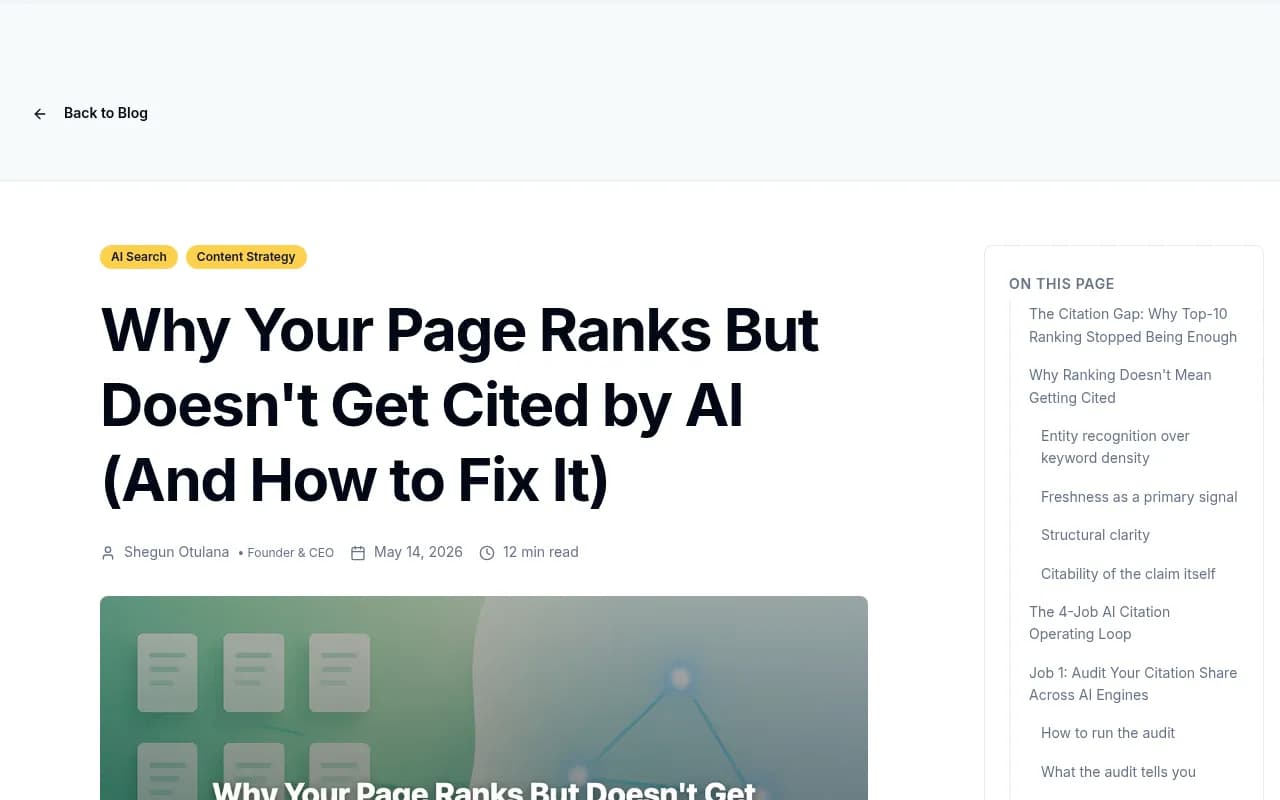
For a deeper look at the retrieval mechanics and the 4-job operating loop for keeping pages cited across multiple AI engines, the Frase.io breakdown is worth reading alongside this guide.