Key takeaways
- Owned and brand-managed pages are the largest citation source in every major study, but the share ranges from 44% to 86% depending on how each vendor defines "brand" and which queries it samples.
- Promptwatch Data shows 39% of ChatGPT citations (Sep 28 to Oct 4, 2026) go to product pages and landing pages, which are pages describing what a company sells.
- Reddit is no longer a safe bet in ChatGPT. Its share fell from about 4% to 0.5% on August 14, 2026, while Google AI Overviews still cite social platforms at 12.2%.
- Each engine has its own habits, so one blended "AI visibility" number hides the real gaps. Measure per engine, per industry and per location.
- Enterprise teams should fix the owned layer first (structured facts, crawlable pages), then profiles and listings, then third-party validation.
Why the 26 billion number matters less than the pattern
The headline figure in the title is the size of the Promptwatch dataset: 26.5B+ citations, clicks and prompts analyzed. No single chart in it answers "where do AI sources come from?" Instead, the useful move is to put the first-party data next to the published studies from Yext, Profound and Birdeye and look for what repeats.
What repeats is this: the largest single bucket of citations is pages that companies publish or manage themselves. The size of that bucket is argued about. The direction is not.
One caveat before the numbers. Most of these studies are run by vendors who sell something related to what they found. Yext sells listings and structured data management. Profound and Promptwatch sell AI visibility tracking. Birdeye sells reputation management. Their definitions of "brand", "earned" and "social" differ, so treat the figures as separate lenses, not one dataset.
What each study actually found
Yext: 86% brand-managed, but location-driven
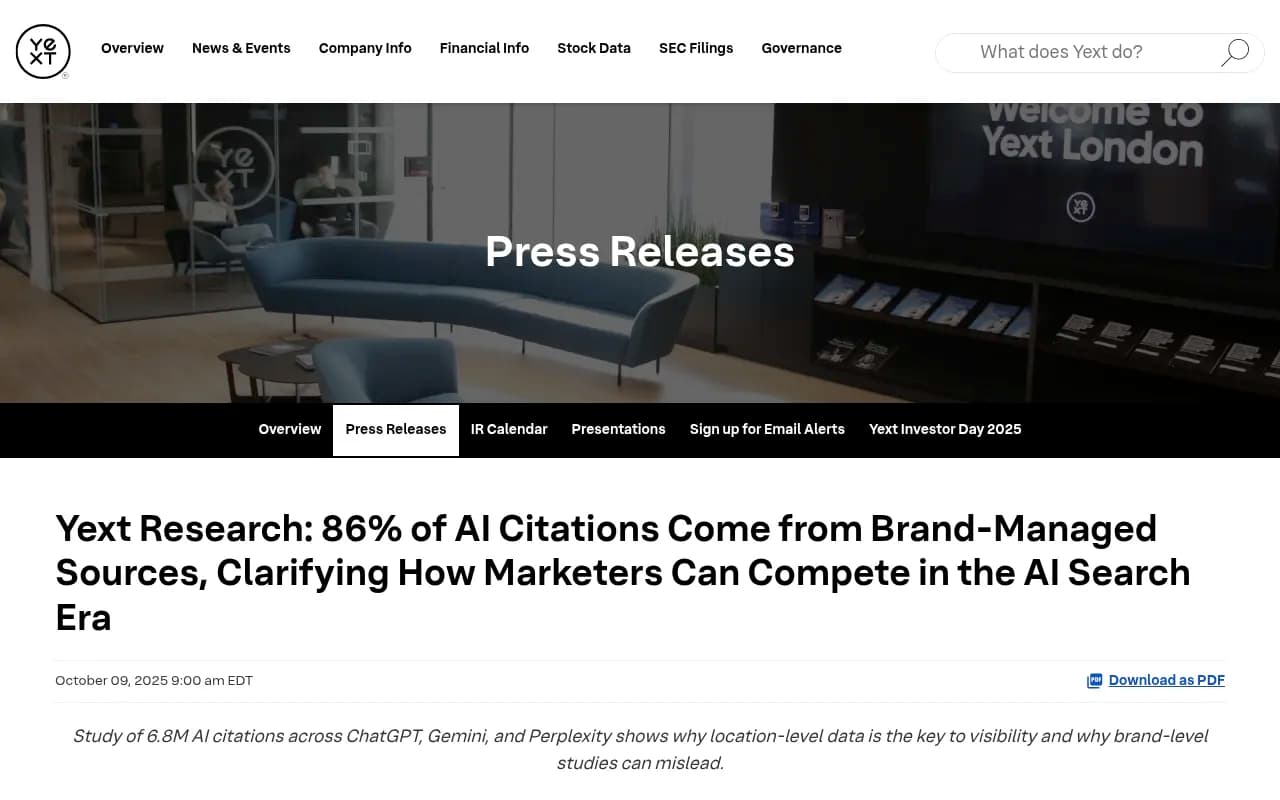
Yext's October 2025 study analyzed 6.8 million citations across ChatGPT, Gemini and Perplexity. It started from a consumer query in a specific location, which is a sensible way to sample local and multi-location brands.
Its breakdown:
- First-party websites: 44% (2.9M citations)
- Listings: 42% (2.9M citations)
- Reviews and social: 8% (545K citations)
- Reddit and similar forums: 2%
Add the first three and you get the 86% headline. Note that "brand-managed" includes listings and review profiles a brand can influence but does not fully own. Yext also found Gemini leaned on websites (52.1%), OpenAI on listings (48.7%), and Perplexity spread across sources like MapQuest and TripAdvisor. For unbranded, objective queries, websites and local pages made up nearly 60% of citations.
Profound: 57% brand sites, with big engine and industry swings
Profound's July 2026 analysis covered 11.8 billion citations across 29 industries and 8 models. Globally, about 57% of citations were brand sites. In 24 of the 29 industries, the median Profound customer got more citations from brand sites than from earned or social sources.
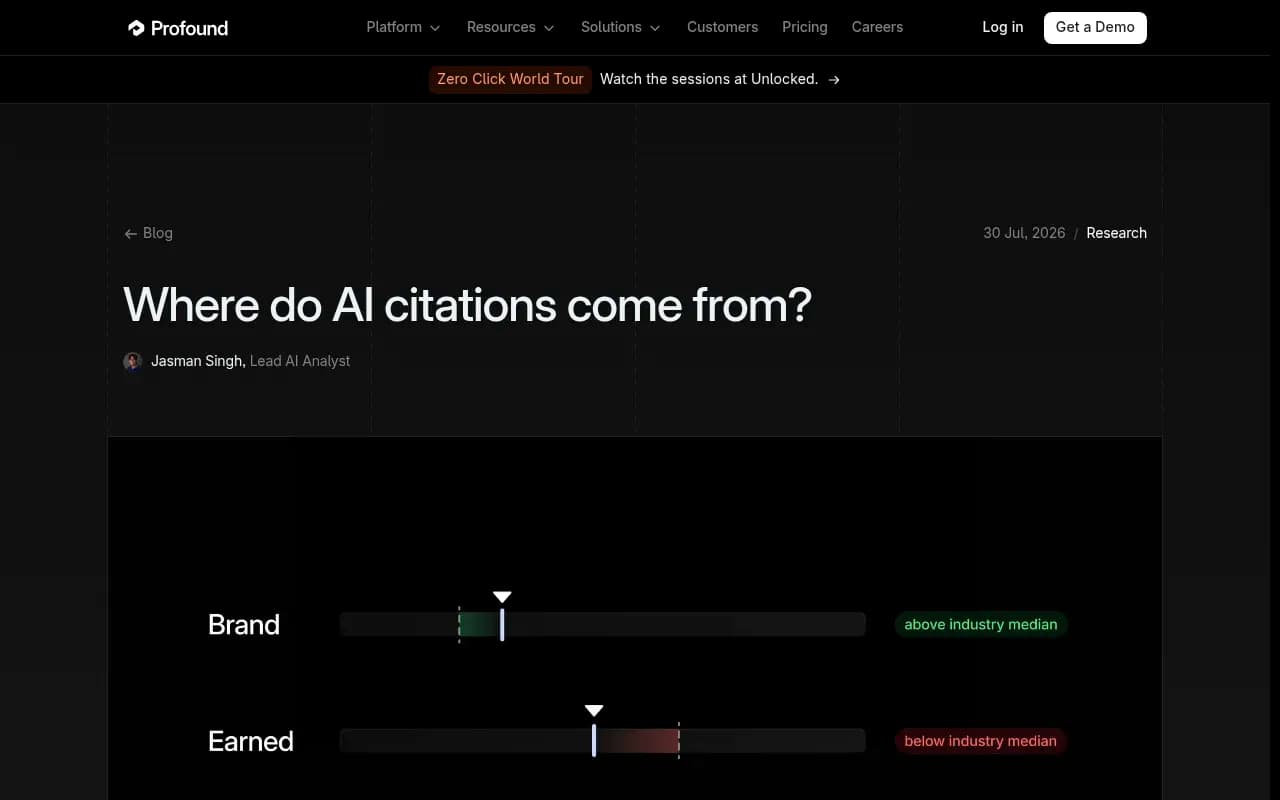
The engine differences are large. ChatGPT used brand sites the least at 47% of citations, while Gemini sat at 69%. By industry, cybersecurity was the most brand-heavy at a 74% median brand share, pharma was around 33%, and government and nonprofit was the lowest at 15.9%. Fashion leans on social at 16.5% of citations, pharma at only 5%.
Birdeye: the trust stack for multi-location brands
Birdeye's State of AI Search 2026 report is less a citation count and more a model of how engines choose. It describes layers: owned content first, then profile content (Google Business Profile, Apple Business Connect), then citation networks and aggregators, then reviews and social proof for validation. Its headline stat for enterprises: 80% of brands are cited at least once, but only 15% earn the top citation position with their own domain.
The outlier: only 4% from your own site
A roundup of 34 studies on Substack claims only about 4% of AI citations come from a brand's own website, with YouTube, Reddit and review sites dominating. That conflicts with everything above. The likely explanation is definition: if "brand's own website" means the one site of a single tracked brand, it is a small slice of a huge long tail. Profound's finding that the biggest bucket is a long tail of many companies' sites reconciles the two. Your own domain is small; company websites collectively are huge.
What Promptwatch Data adds: the page type matters more than the domain
The vendor studies sort citations by who owns the source. Promptwatch's content-type report sorts by what the page is, using ChatGPT citations from Sep 28 to Oct 4, 2026.
| Content type | Share of ChatGPT citations |
|---|---|
| Product pages | 22.4% |
| Landing pages | 16.8% |
| Listicles | 13.6% |
| How-tos | 8.7% |
| Documentation | 7.5% |
| General articles | 6.1% |
| Comparisons | 5.9% |
| News | 5.7% |
| FAQ | 3.3% |
| Reviews | 1.7% |
Product and landing pages together are 39%. That lines up with the owned-source finding: the thing AI most often cites is a page explaining what a company sells. It gets sharper by prompt type. For commercial prompts, product pages hit 26.0% and landing pages 20.6%. For branded prompts, landing pages rise to 22.8% and reviews jump to 5.6%, more than 3x their overall share.
How long does a cited page stay cited? The content half-life report tracked every page ChatGPT cited on July 6, 2026 for 90 days. Landing pages and docs lasted longest. News lost half its pages within 36 days. If your plan leans on news coverage for citations, expect to keep re-earning it.
Two more datapoints worth knowing for enterprise planning:
- Almost half of ChatGPT responses cite 10 or more unique domains (unique domains report), so there are many slots to compete for, but each is shared.
- Mid-authority sites (domain rank 46 to 75) earned almost half of ChatGPT citations in August 2026, while DR 91 to 100 fell to about 3% (domain rank report). You do not need a giant domain. You need the right page.
Reddit and social: the part that changed under everyone's feet
The Yext figure (Reddit about 2%) looks modest, and it was measured on location-aware queries. The Promptwatch numbers explain why it keeps shrinking. On August 14, 2026, reddit.com's share of ChatGPT citations fell from roughly 4% to 0.5% (Reddit citations report). It was a repeat of a smaller version of the same thing: in early September 2025, Reddit's share dropped about 90% within days.
The October 2026 social media citations report (Sep 28 to Oct 4) shows how different each engine is:
| Engine | Social share of citations | Notable platforms |
|---|---|---|
| ChatGPT | 0.46% | LinkedIn about 0.3%, Reddit 0.09% |
| Perplexity | 2.7% | LinkedIn 0.86%, Reddit 0.86%, YouTube 0.79% |
| Google AI Overviews | 12.2% | YouTube 4.28%, Facebook 2.38%, Reddit 2.15% |
That is a 26x gap between ChatGPT and AI Overviews. A social strategy built on one engine's behavior will mislead you on the others. For Google, YouTube then Facebook and Instagram are the better bets. For ChatGPT, don't count on Reddit. For Perplexity, LinkedIn and Reddit are still worth publishing on. X barely registers anywhere.
The lesson isn't "Reddit is dead." It is that any single third-party platform is a single point of failure, and the owned layer is the one nobody can switch off.
How the studies line up
| Source | Sample | Main finding | Caveat |
|---|---|---|---|
| Yext | 6.8M citations, ChatGPT, Gemini, Perplexity | 86% brand-managed (44% websites, 42% listings) | Location-driven queries; counts listings as brand-managed |
| Profound | 11.8B citations, 29 industries, 8 models | About 57% brand sites; ChatGPT 47%, Gemini 69% | Based on Profound customers' categories |
| Birdeye | Enterprise multi-location focus | 80% cited at least once, 15% top-cited on own domain | Framework-heavy; local-business lens |
| Promptwatch Data | ChatGPT, one week of content-type data | 39% of citations are product or landing pages | Single engine, single week |
| Substack roundup | 27M citations | About 4% from a brand's own site | Different definition of "brand" |
What this means for an enterprise brand
Fix the owned layer before chasing third parties
If two thirds or more of what AI cites is brand-controlled material, the cheapest gains sit in your own pages. For enterprises that means the product and landing pages you already have: accurate, specific, crawlable and consistent across locations. Retail (47.6% first-party in Yext's data) and finance (48.2%) reward structured local pages. Food service is more reputation-driven, with reviews and social at 13.3% of citations and listings at 41.6%.
Check that AI crawlers can actually read your pages
A great page that a bot cannot fetch never gets cited. Server logs that show which AI crawlers hit which pages, and where they fail, separate an access problem from a content problem. Promptwatch's AI crawler logs do this with IP-verified requests, and the free Agentic Readiness Check is a quick first pass.

Build a per-engine, per-industry baseline
Profound's point holds up: your industry sets the baseline, not the ceiling. A fintech with 30% earned share against a 15% industry median is ahead. You cannot know that without measuring by engine and by topic. Tools worth a look in this category include Profound, Peec AI, Scrunch and Otterly.AI for monitoring, and Yext or Birdeye for the listings and reputation side. The difference worth checking is whether a tool stops at reporting or also helps you fix gaps and verify that fixes worked.

For enterprise multi-location brands, listings and reviews platforms such as Reputation.com and BrightLocal cover the profile layer that Birdeye's trust stack puts second.
If you want to compare more options, the GEO software directory at bestgeosoftware.com lists dozens of trackers side by side.
Match third-party effort to the engine
- Gemini and AI Overviews: owned sites, YouTube, Facebook and Instagram
- ChatGPT: product pages, landing pages, listicles and docs; software brands should also care about GitHub, Microsoft docs and G2, which lead software citations
- Perplexity: LinkedIn and Reddit threads still show up
- Regulated industries: authoritative institutions matter. In healthcare prompts, NIH, the FDA and the NHS lead ChatGPT citations
Close the loop on content
Monitoring tells you where you lack citations. The next step is shipping the page that fills the gap and checking whether AI cites it. Promptwatch's Content Agents write and publish against visibility gaps, then page tracking and visitor analytics show whether the page gets crawled, cited and clicked. Pricing starts at $95/mo for Essential, with the Content Agent on the Business plan at $579/mo; confirm on promptwatch.com/pricing. There is a 7-day free trial on monthly billing, plus a free AI visibility report if you only want a baseline.
Common mistakes when reading citation studies
- Treating a vendor's category definitions as universal. Yext's "brand-managed" includes listings; Profound's "brand" includes competitors' and adjacent companies' sites.
- Using stale numbers. The 2025 Reddit share of 10 to 14% in ChatGPT is gone. Check the period on every figure.
- Averaging across engines. A blended number of 57% brand sites hides 47% on ChatGPT and 69% on Gemini.
- Ignoring query intent. Unbranded objective queries lean on websites and local pages (nearly 60% in Yext's data); branded and subjective queries lean on listings and reviews.
- Assuming rank equals citation. One roundup found only 38% of AI citations come from top 10 ranking pages.
A practical 90-day plan
- Weeks 1 to 2: audit crawler access, site health, and which of your pages get cited today.
- Weeks 3 to 4: build prompt monitors per engine, country and persona; record Visibility Score and Share of Voice against two or three competitors.
- Weeks 5 to 8: fix the top owned-page gaps (product, landing, docs), and clean up profile and listing data.
- Weeks 9 to 12: add third-party work matched to each engine, then re-measure and compare against the baseline.
Promptwatch's 90-day GEO program guide lays out a similar cadence if you want a template.
The bottom line
Whoever you read, the same answer comes back: the pages you control are the biggest lever, and the engines disagree enough about everything else that you have to measure each one separately. Start with your own product and landing pages, make sure bots can read them, and treat any single third-party platform as a bonus, not a foundation.