Key takeaways
- A single-location business needs four things: a complete Google Business Profile, consistent listings, a way to see where you rank block by block, and a way to check whether AI assistants name you. Everything else is optional.
- Start with free tools and free credits. Buy management tooling only after you know what is actually broken.
- Skip multi-location listing suites, enterprise reputation platforms, and all-in-one agency CRMs. Their pricing curves are built for chains.
- AI assistants share each answer with many other sites. Promptwatch Data found that 47.6% of ChatGPT responses with citations cite 10 or more domains, so third-party listicles, reviews and directories matter as much as your own site.
- Budget realistically: a lean stack can run well under $150 a month, and the free layer covers more than most vendors admit.
Why the stack changed in 2026
For years the local playbook was simple. Fix your Google Business Profile, clean up citations, collect reviews, watch the map pack. That still matters. But people now ask ChatGPT, Gemini and Perplexity who to call, and those answers come from a different set of sources.
Technova's 2026 roundup cites BrightLocal's Local Consumer Review Survey 2026 as finding that the share of consumers using AI assistants to discover local businesses jumped from 6% to 45% in a year, while Google slipped from 83% to 71%. I haven't verified that against BrightLocal's own page, so treat the exact numbers with some caution. The direction is hard to argue with, though. A separate guide from Geek Powered Studios, citing SOCi's 2026 Local Visibility Index, says less than half of businesses leading Google local search also show up in AI recommendations. Ranking in the map pack no longer guarantees you get named.
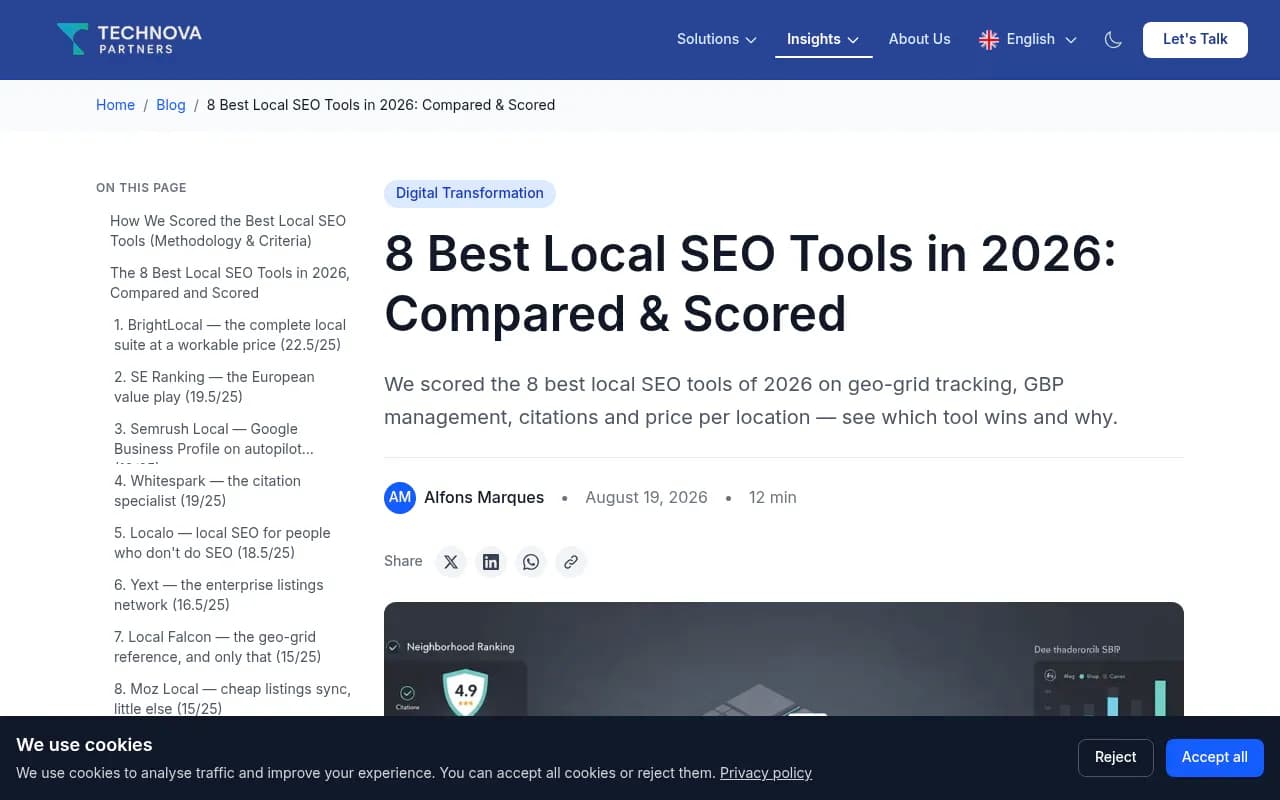
The problem for a single-location owner is that most tools were designed for agencies and chains. Technova makes a useful point here: local SEO tools are priced per location almost everywhere, so you want to judge the entry price and what the base plan includes, not the multi-location discounts you will never use.
The four jobs your stack has to do
Before buying anything, name the job. Every tool below fits one of these.
- Profile and presence. Your Google Business Profile (GBP), Bing Places, and your own site.
- Listings and citations. Consistent name, address and phone data across directories, plus the third-party sites AI actually cites.
- Local rank tracking. Seeing where you appear across your service area, not one city-wide number.
- AI visibility. Knowing whether ChatGPT, Gemini, Perplexity and AI Overviews mention you, and where they pull the answer from.
Reviews cut across all four, so they get their own section later.
Layer one: the free foundation
This is where the money should not go yet, because the best tools here cost nothing.
Google Business Profile
It controls how you appear in Search and Maps. A community thread on r/localseo about preparing for 2026 gave the same advice most practitioners do: make the profile completely optimised, with categories, services, images and Q&A filled in. Boring, free, and the single highest-return task on this list.
Google Search Console
Free, and it tells you which queries and pages bring people in. It is also the only honest source for what Google itself thinks of your site. Connect it before you pay for any rank tracker.
PageSpeed Insights and a schema generator
Local customers are on phones. PageSpeed Insights is free. For markup, a free schema generator covers LocalBusiness, Service, FAQ and Review types. The Geek Powered Studios contractor guide treats the four-schema stack as non-skippable and claims 3.2x more AI Overview citations with complete LocalBusiness schema. That figure comes from the vendor and I would not bank on the multiplier, but complete structured data costs you an afternoon, so just do it.
Free checkers and starter credits
Technova's advice for budget-constrained owners is sensible: start with Local Falcon's 100 free scan credits and Whitespark's free checkers to measure where you stand, then buy management tooling once you know what needs fixing. I would do exactly that. Measure first, spend second.
Layer two: what is worth paying for
Local rank tracking with geo-grids
A single average position hides a lot. Your business might rank third on the street where your shop sits and nowhere two miles out. Geo-grid tools scan from many points around your area and show a heat map.
A reviewer at filipkonecny.com sets out a good buying test for these tools: grid tracking, tracking over time, competitor context, and cost as usage grows. The last one is the trap. A cheap starting plan can become the wrong buy fast if normal tracking burns through the included credits. If you are a single location, run a small number of keywords on a weekly or monthly schedule and watch your credit usage.
Local Falcon is the specialist pick for pure geo-grid work. BrightLocal is more attractive when rank tracking is one item on a broader checklist. Localo is a cheaper, GBP-focused option for owners. Verify current pricing on each vendor's page, since I could not confirm it. StoreRocket's roundup lists plans from roughly $41 to $65 a month for one entry-level tool, but that snippet may be stale.
Listings and citation management
Citations still feed both Google and the sources AI draws on. For one location you have two sensible routes:
- Do it by hand once, using a free checker to find inconsistencies, and re-audit twice a year.
- Pay for a small one-location plan from BrightLocal, Whitespark or Moz Local if you do not want to spend the hours.
What you should not buy is an enterprise listing platform. Yext is a capable product for chains, but for one storefront it is overkill.
A review request workflow
Reviews matter more for AI than most owners expect. Promptwatch Data's content-type report (Sep 28 to Oct 4, 2026) found that for branded prompts, reviews rise to 5.6% of ChatGPT citations, more than three times their overall 1.7% share. Collecting reviews on trusted sites, not just Google, gives AI more places to find you. Full details are in Promptwatch's ChatGPT citation share by content type report.
You do not need a reputation suite for this. A review link, a text or email template, and a monthly check will do. If you do want software, a lightweight tool is plenty.
Layer three: AI visibility for a local business
This is the new part, and also where the most money gets wasted. There are dozens of AI visibility trackers now, and most are built for SaaS brands tracking hundreds of prompts.
What a local business actually needs to know
Three questions:
- When someone asks for a plumber, dentist or café in my city, am I named?
- Which pages do the AI answers cite instead of mine?
- Is any of this sending me customers?
The citation data tells you where to focus. Promptwatch Data's report on unique domains per response found that organic, unbranded prompts cite 10 or more domains 52.5% of the time. For a local business, that means you share every answer with many sites, and third-party listicles, reviews and directories are often how a business gets in. Read the full numbers in the unique domains per ChatGPT response report. The practical takeaway: measure across many prompts, not one, and treat "best of" roundups and directories as part of your marketing.
Tools worth a look
If you want one platform that tracks AI answers and then helps you act on them, Promptwatch tracks ChatGPT, Google AI Overviews, AI Mode, Gemini, Perplexity and others, and its Essential plan at $95 a month (50 prompts, country tracking) is plenty for one location. Check promptwatch.com/pricing before buying. It also has a free tier with 10 prompts on ChatGPT, which is enough to see whether this matters for your business.

If you only want a cheap check, entry-level trackers are enough while you learn what your market looks like. Options in our catalog include Otterly.AI and Peec AI for simple monitoring.


SOCi is worth knowing about if you ever grow into multiple locations, since it focuses on local search, social and reviews with agentic automation. For one storefront it is more than you need.
For browsing more options, the directory at bestgeosoftware.com lists GEO platforms side by side.
Comparison: what to buy, use free, or skip
| Need | Free option | Paid option worth considering | Skip |
|---|---|---|---|
| Profile and presence | Google Business Profile, Bing Places | None needed | Autopilot GBP posting suites |
| Site health | Search Console, PageSpeed Insights | SEOptimer or Screaming Frog if you want audits | Enterprise crawlers |
| Listings | Free checkers, manual cleanup | BrightLocal, Whitespark, Moz Local single-location plan | Yext-scale platforms |
| Rank tracking | Local Falcon free credits | Local Falcon or BrightLocal on a light schedule | Daily scans of dozens of keywords |
| Reviews | Review link plus template | Lightweight request tool | Birdeye-style suites at chain pricing |
| AI visibility | Free AI visibility scans | Entry plan from a GEO platform | Enterprise GEO suites |
| Agency CRM bundles | n/a | n/a | GoHighLevel unless you run an agency |
What to skip, and why
Multi-location management suites
If the pitch includes bulk workflows, location groups or franchise reporting, it was not built for you. You would be paying for features that sit idle.
All-in-one agency platforms
The filipkonecny.com review notes that a platform like GoHighLevel makes sense when you run an agency and your rank tracker, CRM, funnels and follow-up are scattered across apps. If you own one shop, that logic does not apply. It also points out that paying for more data will not speed anything up if you are not yet doing enough work to use it. Fair.
Full SEO suites for local-only needs
Technova says single-location businesses with no need for the wider suite will find better standalone value in Localo or BrightLocal than in Semrush Local. I agree. Semrush and Ahrefs are excellent, but you would be paying for keyword databases you will not open.
Hyper-frequent scanning
Daily geo-grid scans across many keywords feel productive and burn credits fast. Weekly or monthly on your five or six money terms is enough to see a trend.
Schema and llms.txt hype
Schema is worth doing. Markdown files are another matter: Promptwatch Data found they make up just 0.05% of AI search citations, because markdown serves AI agents, not AI search. See the markdown in AI search report. Do not spend a weekend on it for local visibility.
A sample stack at three budgets
Under $20 a month
GBP, Search Console, PageSpeed Insights, free schema generator, free citation checkers, Local Falcon free credits, a manual review request routine, and the free AI visibility scan from a GEO platform. This is a legitimate starting point, not a compromise.
Around $100 to $150 a month
Add one paid local tool (BrightLocal or Local Falcon, whichever matches your biggest gap) and a small AI visibility plan. Run the AI tracker on 30 to 50 prompts that mirror how customers phrase real requests, such as "best emergency plumber near me" and "who fixes water heaters in [your city]".
Around $250 a month
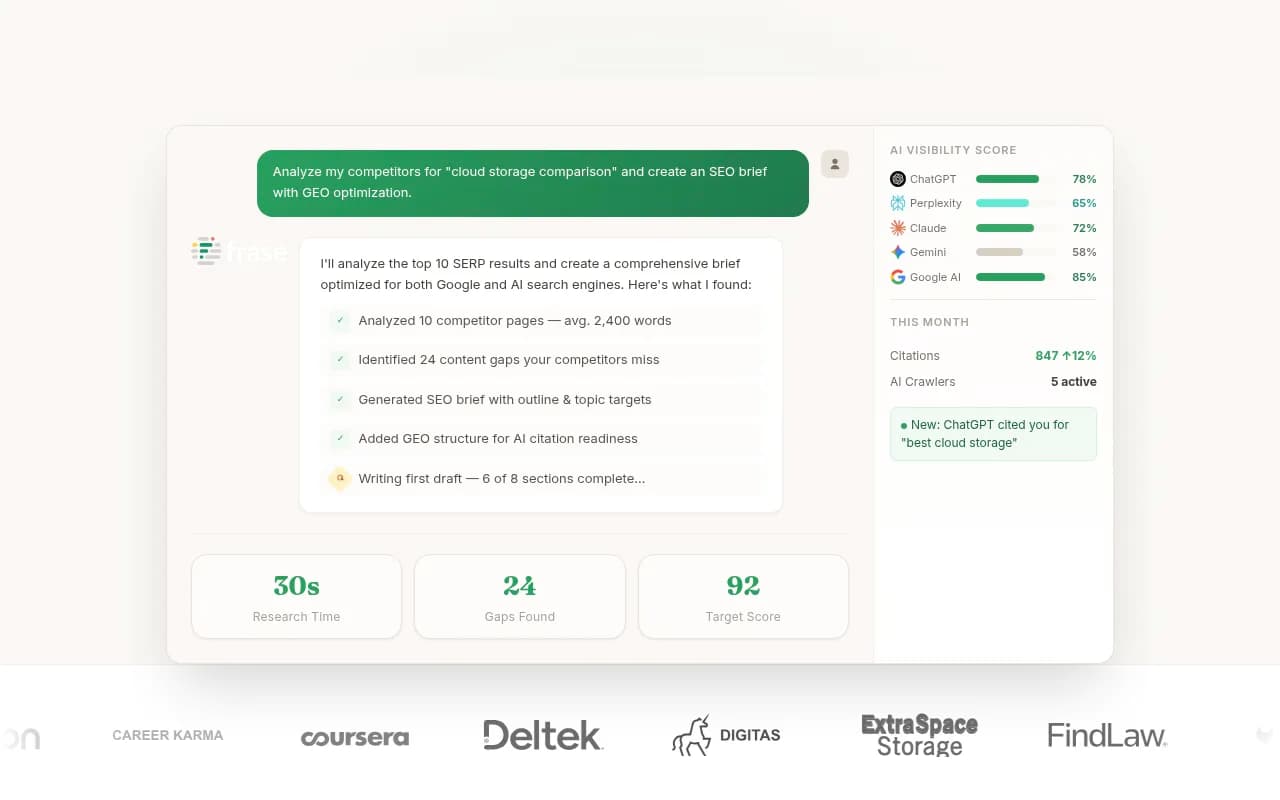
Only if you are in a competitive market and already acting on the data. At this level you might add content tooling, such as a writing assistant that works from your actual service pages. Surfer SEO or Frase can help here, but only once the basics are done.
Setting it up in the right order
- Finish your GBP: categories, services, hours, photos, Q&A.
- Fix NAP consistency across listings.
- Add LocalBusiness, Service, FAQ and Review schema to your site.
- Run a baseline: one geo-grid scan on your top keyword, plus an AI visibility check across a set of prompts. Geek Powered Studios calls this Share of Model baseline one of the steps you cannot skip, and it is right. Without a starting number you cannot tell whether anything worked.
- Build service pages that answer questions directly and carry real prices, hours and specifics. Promptwatch Data shows product and landing pages take 39% of ChatGPT citations combined, so pages that clearly describe what you sell earn their keep.
- Get named in third-party roundups and trusted review sites in your category.
- Re-measure monthly. Change one thing at a time.
Common mistakes
- Buying a rank tracker before the profile is complete. You will just get a prettier picture of a weak profile.
- Judging AI visibility from a single prompt. Answers vary by phrasing and by session.
- Ignoring Bing. ChatGPT and Copilot lean on Bing data, so Bing Places is cheap insurance.
- Chasing social citations. According to Promptwatch Data, ChatGPT drew 0.46% of its citations from social platforms between Sep 28 and Oct 4, 2026, while Google AI Overviews drew 12.2%. See the social media citations report. Your social effort will matter more for AI Overviews than for ChatGPT.
When it makes sense to hire help
If you would rather not run any of this yourself, a specialist agency is a legitimate option. 1001 SEO Media publishes this site and runs local SEO and AI search work for brands, with no long-term contracts. For most single-location owners, though, the lean stack above plus an hour a week gets you most of the way.
The bottom line
Buy one local tool, one AI visibility tool, and nothing else until the data tells you what is broken. Use the free layer fully first. Skip anything priced for chains or agencies. If your numbers move, keep the stack. If they do not, change your pages and your third-party presence before you change your software.