Key takeaways
- AI brand monitoring means tracking whether ChatGPT, Perplexity, Gemini, Claude, Grok, and Google AI Overviews mention your brand, in what position, with what sentiment, and against which competitors.
- Coverage isn't uniform. ChatGPT cites around 5 sources per answer, while Perplexity and Google AI Overviews cite roughly 10 each, so a tool that only watches ChatGPT is watching the smallest, most contested channel (Promptwatch's data on sources per response).
- Citation shares move fast: Reddit's share of ChatGPT citations fell from 6.11% in May 2026 to 3.71% in June, then collapsed further to roughly 0.5% by mid-August (Promptwatch Data). A one-off audit tells you almost nothing about next month.
- Most tools stop at monitoring. A smaller group, including Promptwatch, also generates content, publishes it to your CMS, and turns findings into a prioritized action list.
- Budget for $95 to $600+/month depending on prompt volume and engine coverage; the category average sits around $337/month according to Rankability's survey of 30+ tools.
Why this category exists now
A few years ago, "are we visible?" had one boring but reliable answer: check your Google ranking. That's no longer the whole picture. People ask ChatGPT or Perplexity a question, get a named answer with two or three brands in it, and never look at a results page. If you're not in that answer, you don't show up in your analytics as a missed opportunity. You just don't exist for that person. That's the gap AI brand monitoring platforms are built to close, and it's why a market that barely existed in 2024 now has dozens of vendors.
I'll be upfront about something worth flagging: this guide leans on data from Promptwatch, a platform I think is genuinely strong in this category, and I'll say so plainly rather than pretending to be a disinterested observer. But the goal here is to help you buy the right tool for your situation, not just one tool.
What you're actually measuring
Strip away the marketing language and every AI brand monitoring tool is trying to answer four questions:
- Mentions: does your brand come up at all when someone asks a relevant question?
- Position: where in the answer, and how prominently?
- Sentiment: is the mention positive, neutral, or does it quietly frame you as the budget option?
- Share of voice: how do you stack up against named competitors on the same prompts?
A fifth question matters more than most buyers realize going in: why. Why did a page get cited and another one didn't? Why did a brand disappear from an answer between March and April? Answering "why" requires crawler-level data, not just answer-level snapshots, and it's one of the biggest feature gaps separating basic trackers from full platforms.
The four mistakes that waste a monitoring budget
Before comparing tools, it's worth naming the setup mistakes that make any tool look bad, because they have nothing to do with which platform you pick.
First, single-platform monitoring. ChatGPT and Google AI disagree on brand recommendations 62% of the time according to BrightEdge data cited by industry researchers. If you only watch one engine, you're extrapolating from a coin flip.
Second, snapshot-only checks. Citation shares can swing by 40% in a single month, as the Reddit example above shows. A quarterly spreadsheet audit is basically a photo of a river, taken once, presented as if it describes the current.
Third, prompt lists that bake the brand name into the query ("[Brand] AI monitoring tool" instead of "how do I know if my brand shows up in ChatGPT answers?"). Buyer-intent phrasing that mirrors real search behavior typically drops apparent mention rates by 30-50% compared to name-seeded prompts. If your prompt list is flattering you, your dashboard will lie to you.
Fourth, counting mentions and ignoring accuracy. AI answers regularly get facts wrong, mixing up pricing, blending your features with a competitor's, or citing outdated information. A tool that only tracks yes/no mentions misses the version of the problem that actually costs you customers.
What separates a tracker from a platform
Here's the honest split in this market. Most vendors, including well-funded ones, are monitoring tools: they run prompts on a schedule, extract mentions, and hand you a dashboard. That's useful, but it stops at diagnosis. A smaller number of platforms go further, using crawler logs to explain why AI systems do or don't cite you, tying visibility to actual site traffic, and then generating or fixing content to close the gaps they find.
Promptwatch sits in that second group. It monitors ChatGPT, Gemini, Claude, Perplexity, Grok, DeepSeek, Mistral, Copilot, Meta Llama, Google AI Overviews and AI Mode, plus AI coding assistants like Claude Code, and it backs that with 4.5B+ citations analyzed across 1,840+ customers including Duolingo, Yelp, and Typeform. What makes it different from a pure tracker is the rest of the stack: AI crawler logs (Agent Analytics) that show exactly which pages ChatGPTBot, ClaudeBot, or PerplexityBot actually read and where they errored out, Reddit and YouTube citation tracking that most competitors skip entirely, and Content Agents that plan, write, and publish GEO-optimized articles straight to Webflow, Framer, or WordPress. Unified Actions turns all of that into a prioritized to-do list instead of leaving you to interpret a dashboard yourself.

Platform coverage differs more than you'd expect
This is the detail that trips up a lot of buyers: "tracks 8+ AI engines" on a pricing page often means something narrower once you look at the actual tier. Profound advertises up to 9 answer engines, but full breadth including Claude, Gemini, Copilot, and Grok is Enterprise-only; the self-serve Growth plan at $399/month covers just 3 engines and 100 prompts on one brand. Otterly's base engines (Google AI Overviews, ChatGPT, Perplexity, Copilot) stay consistent across tiers, but Gemini and AI Mode are $9-149/month add-ons and Claude is $29-439/month on top, which can push a nominal $189/month plan closer to $357/month once you add the engines you actually need. Ahrefs Brand Radar covers 6 platforms and is described by independent reviewers as skewed heavily toward AI Overviews, with no native sentiment analysis.
Worth noting: third-party comparison sites don't fully agree on Peec AI's and Scrunch's tier-by-tier engine gating for Claude and Grok, so if either matters to you, check the vendor's live pricing page before you commit.
Pricing snapshot
| Platform | Entry price | Engine coverage | Notable limitation |
|---|---|---|---|
| Promptwatch | $95/mo (Essential) | ChatGPT, Gemini, Claude, Perplexity, Grok, DeepSeek, Mistral, Copilot, Llama, AI Overviews/Mode | Free tier limited to ChatGPT only |
| Otterly.AI | $29/mo (Lite) | 4 base engines; Gemini/AI Mode/Claude are paid add-ons | Steep 6.5x jump from Lite to Standard |
| Profound | $99/mo (Starter, annual) | Up to 9 engines, full breadth Enterprise-only | Growth tier caps at 3 engines, 100 prompts |
| Peec AI | ~€70/mo (Starter, annual) | Up to 11 models on Enterprise | Claude often gated to Enterprise |
| Scrunch AI | $250/mo (Core) | Advertised 9 engines; lower tiers reportedly narrower | Tier-by-tier engine gating disputed across sources |
| Ahrefs Brand Radar | $199/mo per index, $699/mo bundle | 6 engines, skewed to AI Overviews | No native sentiment analysis |
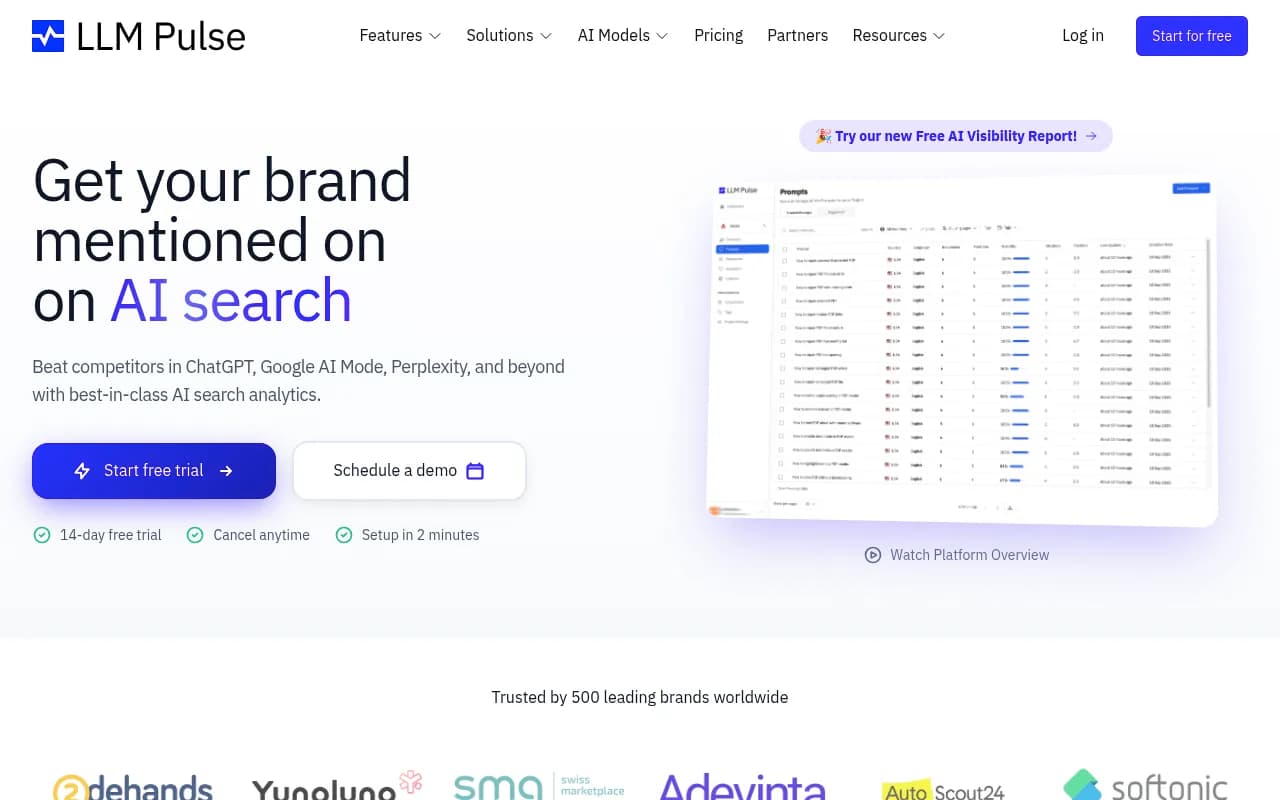
| LLM Pulse | $399/mo (Growth) | ChatGPT, Perplexity, AI Overviews (100 prompts) | Narrower engine set at entry tier |
Prices and tier details shift often in this category; verify against the vendor's current pricing page before budgeting.



A framework for choosing, step by step
Start with which engines actually matter to your buyers
If your customers are mostly asking ChatGPT and Google, a narrower tool is fine and cheaper. If you sell into technical or developer audiences, Claude and Perplexity coverage matters more than most vendors' entry tiers assume. Don't pay for Grok and DeepSeek coverage you'll never look at.
Ask how the tool defines "citation," not just "mention"
A brand can be mentioned in an AI answer without being cited (linked) as a source, and the two behave very differently. Social citation patterns alone vary sharply by engine: ChatGPT is heavily Reddit-weighted (5.19% of its citations), while AI Overviews and Grok lean YouTube (4.08% and 4.85% respectively). If a tool's "social tracking" claim doesn't specifically cover Reddit and YouTube, it's covering the wrong channels; X and TikTok never break 0.25% share on any engine according to Promptwatch's social citation data.
Check whether it explains the "why"
This is where crawler logs earn their keep. AI crawler traffic is also shifting quickly: OpenAI's share of verified AI crawler requests dropped from 94.8% in early June 2026 to 79.8% by early September as Anthropic, Google, and Perplexity picked up share. A robots.txt rule that seemed harmless a year ago can now quietly cut you off from a provider that's grown into real relevance. Tools with crawler-log visibility (Promptwatch's Agent Analytics, Profound's Agent Analytics) catch this; most prompt-only trackers don't.
Decide if you need content execution, not just diagnosis
If your team is already stretched, a tool that only tells you what's wrong adds another dashboard to check without reducing the workload. Platforms with Content Agents or comparable automated publishing close that loop, though you should pilot the output quality before turning on full automation.
Run a free baseline before you buy anything
You can sanity-check the category for free. Pick 20-30 buyer-intent prompts (not brand-seeded ones), run them manually across ChatGPT, Perplexity, Gemini, and Google AI Overviews, and log mention/citation/accuracy/competitor-presence in a spreadsheet. This tells you whether you have a real visibility gap before you commit to a monthly subscription, and it gives you a baseline to judge any tool's reported numbers against.
Which tool fits which buyer
- Mid-market B2B teams that need broad model coverage plus content generation and CMS publishing: Promptwatch, roughly $95-$579/month depending on site and prompt volume.
- Enterprises with $25K+ annual budgets and procurement teams who want white-label reporting and SSO: Profound Enterprise, quote-only.
- European teams needing multi-language tracking: Peec AI, EUR-priced with add-on model tiers.
- Agencies running Looker Studio dashboards for clients on a tight budget: Otterly.AI, starting at $29/month for the base four engines.
- SEO-first teams already inside Ahrefs who want a bolt-on rather than a new vendor: Ahrefs Brand Radar, aware of its narrower coverage and missing sentiment data.
For a wider scan of the category, including smaller and newer entrants, the GEO software directory at bestgeosoftware.com and the AI rank tracking listings at ai-rank-tools.com are both useful starting points.
What to expect once you've picked a tool
Buying the platform is the easy part. The work that follows looks like this: identify which prompts you're losing, check whether the losses trace back to a crawler access problem or a genuine content gap, fix the content or the access issue, and measure the change over the following weeks rather than days, since citation shares are volatile enough that a single week of data can mislead you. Crisp, for example, reportedly used this loop to scale to 5-10 published articles a day and saw meaningfully higher conversion rates from AI-driven traffic than from traditional channels, but that only works if the monitoring layer is feeding the content layer directly rather than sitting in a separate dashboard nobody checks weekly.
If the whole exercise still feels like more than your team can run in-house, that's a fair reason to bring in outside help. 1001 SEO Media works specifically on this kind of AI search and GEO optimization alongside traditional technical SEO and content production, without long-term contracts, if you'd rather have specialists own the execution while you keep the dashboard.
Bottom line
Don't buy on engine-count marketing copy alone; check what's actually included at your price tier. Don't run a monitoring tool once and call it done; citation shares move too fast for that. And decide early whether you want a tracker that tells you the problem or a platform that also does something about it, because that single decision will determine how much manual work your team is doing six months from now.