Key takeaways
- Most GEO platforms stop at monitoring -- they show you where you're invisible but don't help you fix it. Searchable, Relixir, and Promptwatch all claim to go further.
- Relixir has an AI-native CMS and autonomous content publishing built into its core product, which makes it genuinely different from pure monitoring tools.
- Searchable covers the basics of AI visibility tracking but lacks the depth of content optimization features that brands need to actually improve their rankings.
- Promptwatch is the most complete end-to-end platform: it finds content gaps, generates articles grounded in real citation data, and tracks whether those articles get cited by AI models -- closing the loop from discovery to results.
- If your goal is to publish content that AI models actually cite, the platform's content generation and citation feedback loop matters more than its dashboard aesthetics.
The GEO platform market in 2025 was flooded with tools that looked impressive in demos. Most of them showed you a dashboard with your brand's "AI visibility score," a few competitor comparisons, and maybe a list of prompts where you weren't showing up. Then they stopped.
The harder question -- the one that actually matters for marketing teams -- is: which platforms helped you do something about it? Which ones published content, tracked whether that content got cited, and fed those results back into the next round of optimization?
That's what this comparison is about. We're looking at three platforms that positioned themselves as more than monitors in 2025: Searchable, Relixir, and Promptwatch. Let's be honest about what each one actually delivered.
What "ranking" means in AI search
Before comparing tools, it's worth being clear about what we're measuring. In traditional SEO, ranking means appearing on page one of Google for a keyword. In AI search, the equivalent is being cited in a response from ChatGPT, Perplexity, Claude, Gemini, or another model.
Getting cited isn't random. AI models pull from sources they've crawled, indexed, and found authoritative. If your website doesn't have content that directly answers the questions users are asking, you won't appear -- regardless of your domain authority or backlink profile.
This means the content you publish for AI visibility needs to be:
- Structured around specific prompts and questions, not just keywords
- Grounded in what AI models are already citing (so you can match or exceed those sources)
- Published consistently, not as a one-off experiment
The platforms that helped brands rank in 2025 were the ones that understood this workflow and built tools around it.
Searchable: solid monitoring, limited optimization
Searchable is an AI search visibility platform that covers the monitoring fundamentals reasonably well. You can track brand mentions across major AI models, see how your visibility compares to competitors, and get alerts when your share of voice changes.
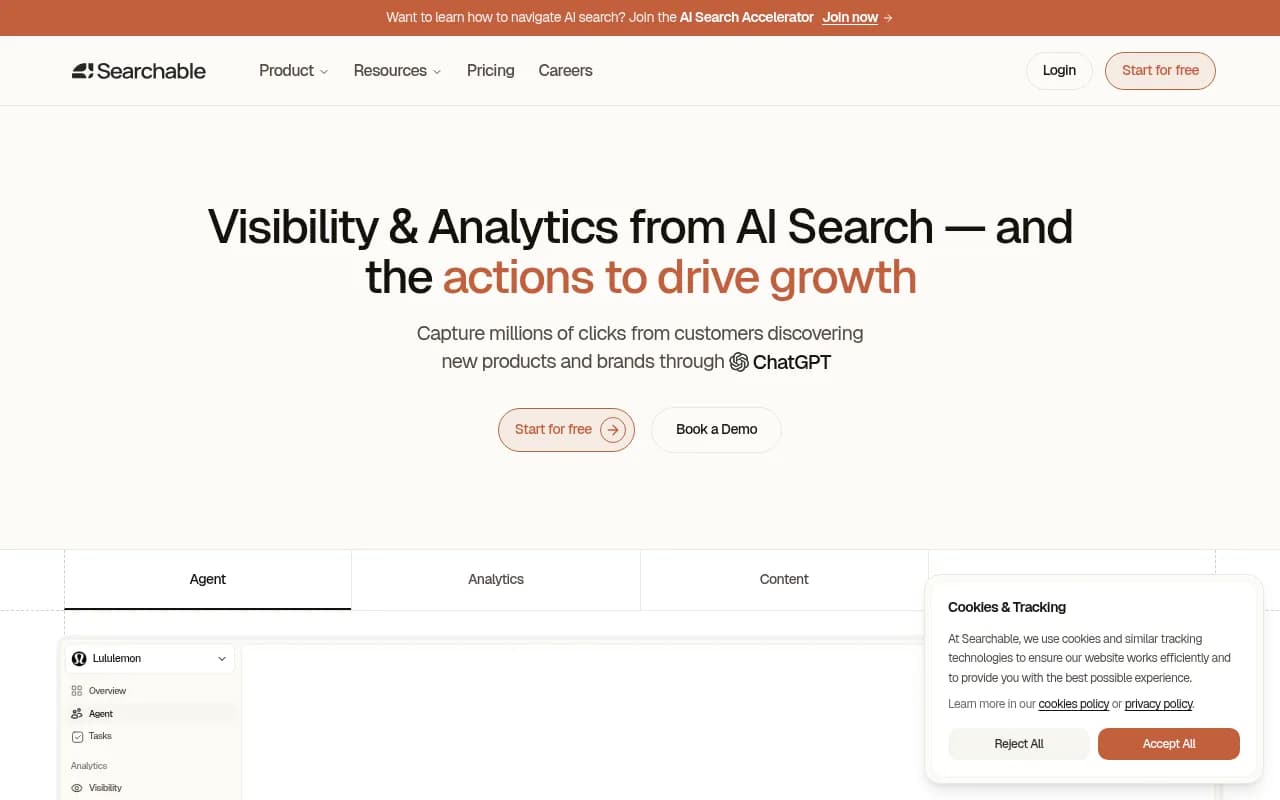
Where Searchable runs into trouble is the gap between data and action. The platform shows you that you're not being cited for certain prompts. It doesn't do much to help you figure out what content to create, how to structure it, or whether the content you publish afterward actually moved the needle.
For teams that already have strong content operations and just need a visibility dashboard, Searchable can work. But for most marketing teams -- especially those without dedicated SEO writers who understand AI citation patterns -- the monitoring data alone doesn't translate into results.
A few specific limitations worth noting:
- No built-in content generation or AI writing tools
- Limited prompt intelligence (no volume estimates or difficulty scoring)
- No crawler log data to understand how AI bots are actually reading your site
- No Reddit or YouTube tracking, which matters because AI models frequently cite these sources
The platform is reasonably priced for what it does, but "what it does" is mostly the first step of a three-step process.
Relixir: the most content-forward challenger
Relixir takes a noticeably different approach. It's built around an AI-native CMS and autonomous content publishing, which puts it closer to an optimization platform than a pure monitoring tool.
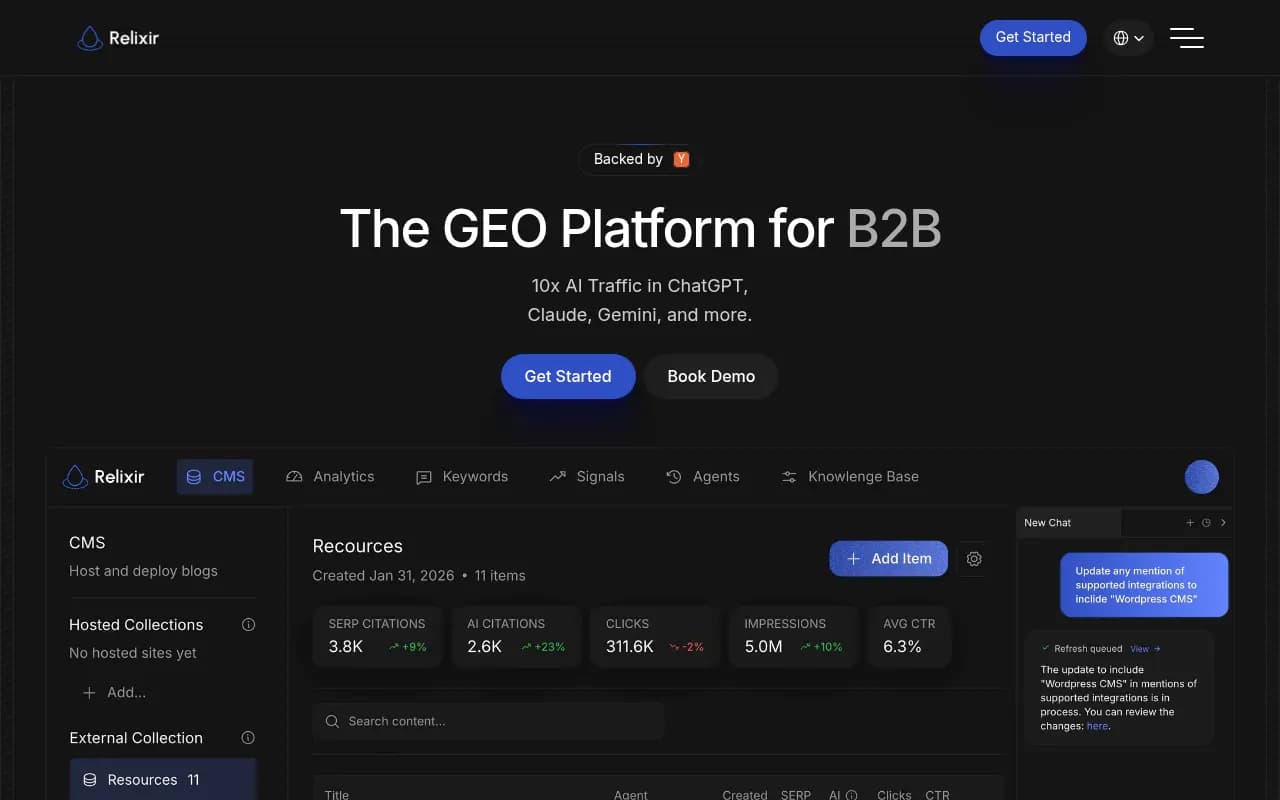
The core idea is that Relixir doesn't just identify gaps -- it generates and publishes content to fill them. The autonomous publishing angle is genuinely interesting: the platform can create articles, schedule them, and push them live without requiring a human to manually approve every piece. For teams that need to publish at scale, that's a real capability.
In practice, though, there are some caveats. Autonomous publishing sounds appealing until you consider the quality control problem. AI-generated content that goes live without editorial review can be inconsistent, and if AI models detect low-quality or repetitive content, it can actually hurt your citation rate rather than help it. Teams using Relixir in 2025 reported needing to build review workflows on top of the autonomous publishing feature, which reduces some of the speed advantage.
Relixir also covers AI visibility tracking across major models and includes competitive analysis. The citation data it surfaces is useful for understanding which sources AI models prefer in your category.
Where Relixir is weaker:
- Citation data depth is thinner than platforms that have processed billions of citations
- Prompt intelligence (volume, difficulty, fan-outs) is less developed
- No AI crawler logs to diagnose why your pages might not be getting indexed by AI bots
- Traffic attribution (connecting AI visibility to actual revenue) is limited
Relixir is probably the right choice for content-heavy teams that want to move fast and are comfortable with autonomous publishing workflows. It's less suited to brands that need deep diagnostic data or want to understand the why behind their visibility changes.
Promptwatch: the complete loop
Promptwatch is the platform that most consistently shows up in 2025 post-mortems from teams that actually improved their AI search visibility. The reason isn't any single feature -- it's that the platform covers the full workflow: find gaps, create content, track results.

The Answer Gap Analysis is where most teams start. It shows you exactly which prompts your competitors are visible for that you're not -- and crucially, it shows you the specific content your site is missing. Not just "you're not ranking for this topic" but "here's what AI models are looking for and can't find on your site."
From there, the built-in AI writing agent generates articles grounded in real citation data. Promptwatch has processed over 880 million citations, which means the content it generates isn't generic -- it's shaped by what AI models are actually citing in your category. The difference between content written to match citation patterns and content written to match keyword density is significant, and it shows up in results.
The tracking side closes the loop. Page-level tracking shows which specific pages are being cited, by which AI models, and how often. When you publish a new article, you can watch whether it starts getting cited over the following weeks. Traffic attribution -- via a code snippet, Google Search Console integration, or server log analysis -- connects those citations to actual website visits and revenue.
A few other capabilities that matter for teams serious about AI visibility:
- AI crawler logs that show which pages ChatGPT, Claude, and Perplexity are actually reading (and which ones they're ignoring or hitting errors on)
- Prompt volume estimates and difficulty scores so you can prioritize high-value, winnable prompts instead of chasing everything
- Reddit and YouTube tracking, because AI models cite these sources constantly and most platforms ignore them entirely
- ChatGPT Shopping tracking for e-commerce brands
- Multi-language and multi-region monitoring with customizable personas
The pricing reflects the depth: Essential at $99/month, Professional at $249/month, Business at $579/month. It's not the cheapest option, but teams that have gone through the full optimization cycle -- gap analysis, content creation, citation tracking -- consistently report that the ROI justifies it.
Head-to-head comparison
| Feature | Searchable | Relixir | Promptwatch |
|---|---|---|---|
| AI visibility monitoring | Yes | Yes | Yes (10 models) |
| Competitor analysis | Basic | Yes | Yes + heatmaps |
| Content gap analysis | Limited | Yes | Yes (Answer Gap Analysis) |
| Built-in content generation | No | Yes (autonomous) | Yes (citation-grounded) |
| Citation data depth | Moderate | Moderate | 880M+ citations |
| AI crawler logs | No | No | Yes |
| Prompt volume + difficulty | No | Limited | Yes |
| Reddit + YouTube tracking | No | No | Yes |
| ChatGPT Shopping tracking | No | No | Yes |
| Traffic attribution | No | Limited | Yes (3 methods) |
| Multi-language/region | Limited | Limited | Yes |
| Pricing (entry) | ~$49/mo | Custom | $99/mo |
| Free trial | Yes | Yes | Yes |
The table tells a clear story. Searchable covers the monitoring basics. Relixir adds content publishing. Promptwatch covers the full stack.
Which platform actually drove results in 2025?
The honest answer is: it depends on how you define "results."
If you define results as "published content," Relixir wins on volume. Its autonomous publishing capability means teams can ship articles faster than with any other platform. Whether those articles consistently got cited is a different question -- and the answer depends heavily on how much editorial oversight teams applied.
If you define results as "improved AI visibility scores," Promptwatch wins. The combination of citation-grounded content generation and page-level citation tracking creates a feedback loop that the other platforms don't have. Teams that ran the full cycle -- gap analysis, content creation, citation monitoring -- saw measurable improvements in their AI share of voice.
If you define results as "understanding where you stand," Searchable is adequate. It's a reasonable starting point for teams that are new to GEO and want to benchmark their current visibility before investing in optimization.
The pattern that kept showing up in 2025: teams that started with a monitoring-only tool eventually hit a ceiling. They knew they were invisible for certain prompts, but they didn't have the tools to fix it. The ones that moved to a platform with content generation and citation feedback loops saw the biggest gains.
Who should use which platform
Use Searchable if you're early in your GEO journey, have a limited budget, and mainly need to understand your current AI visibility before deciding on a bigger investment.
Use Relixir if you have a content-heavy operation, are comfortable with autonomous publishing workflows, and need to ship a high volume of AI-optimized content quickly. Just build in editorial review.
Use Promptwatch if you want the complete workflow: finding gaps, generating content that's actually grounded in citation data, and tracking whether that content gets cited. It's the right choice for marketing teams, SEO teams, and agencies that need to show measurable AI visibility improvements.
A note on the broader GEO platform landscape
These three aren't the only options. The GEO platform market now has well over 200 tools, and the quality varies enormously. Some worth knowing about:
- Profound and AthenaHQ are strong enterprise-focused monitoring platforms, though they lean heavily toward data and analytics rather than content optimization.


- Otterly.AI and Peec.ai are affordable entry points for teams that need basic AI visibility tracking without a large budget.


- Scrunch AI covers monitoring with some competitive analysis features.
The consistent pattern across the market: the further right you are on the "monitoring vs. optimization" spectrum, the more you can actually do with the data. Monitoring tells you what's happening. Optimization tools help you change it.
The bottom line
The GEO platforms that delivered real results in 2025 were the ones that treated content publishing and citation tracking as core features, not afterthoughts. Relixir gets credit for making content publishing central to its product. Promptwatch gets credit for making the entire loop -- from gap identification to content creation to citation tracking to traffic attribution -- work as a coherent system.
If you're evaluating GEO platforms in 2026, the question to ask every vendor is simple: "After I publish content through your platform, how do I know if AI models are citing it?" If they can't give you a specific answer, you're buying a monitoring dashboard, not an optimization platform.