Key takeaways
- All four platforms track brand visibility in AI search engines, but they differ significantly in what they do after showing you the data
- Promptwatch is the only platform in this comparison that closes the full loop: find gaps, generate content, track results
- Profound and AthenaHQ are strong enterprise monitoring tools but lean heavily on dashboards without built-in content creation
- Searchable sits at the lighter end of the market, better suited to smaller teams or those just getting started
- If you're paying for an AI visibility platform in 2026, you should expect it to help you improve your visibility, not just measure it
The AI search market has moved fast enough that most marketing teams are still catching up. ChatGPT, Perplexity, Claude, and Google's AI Overviews are now real traffic sources, and brands that aren't showing up in those responses are quietly losing ground. That's created a whole category of tools promising to fix the problem.
The four platforms in this comparison, Searchable, Promptwatch, Profound, and AthenaHQ, all sit in that category. They all track how your brand appears in AI-generated answers. But there's a meaningful gap between them in terms of what you can actually do with what they show you.
This guide breaks down each platform honestly, compares them on the dimensions that matter, and gives a clear recommendation for different use cases.
What these platforms actually do (and don't do)
Before getting into specifics, it helps to understand the two broad types of tools in this space.
The first type is a monitoring dashboard. You set up prompts, the tool queries AI models on your behalf, and you get back data on how often your brand appears, which competitors show up, and how your visibility changes over time. Most platforms in this space are primarily this.
The second type goes further. It identifies why you're not appearing, surfaces the specific content gaps causing it, and helps you create content that gets cited. This is the optimization loop, and very few platforms have built it properly.
Where each platform falls on that spectrum is the most important thing to understand before spending money.
Searchable
Searchable is positioned as an accessible entry point into AI visibility tracking. It covers the basics: monitoring brand mentions across AI models, tracking competitor visibility, and surfacing citation data.
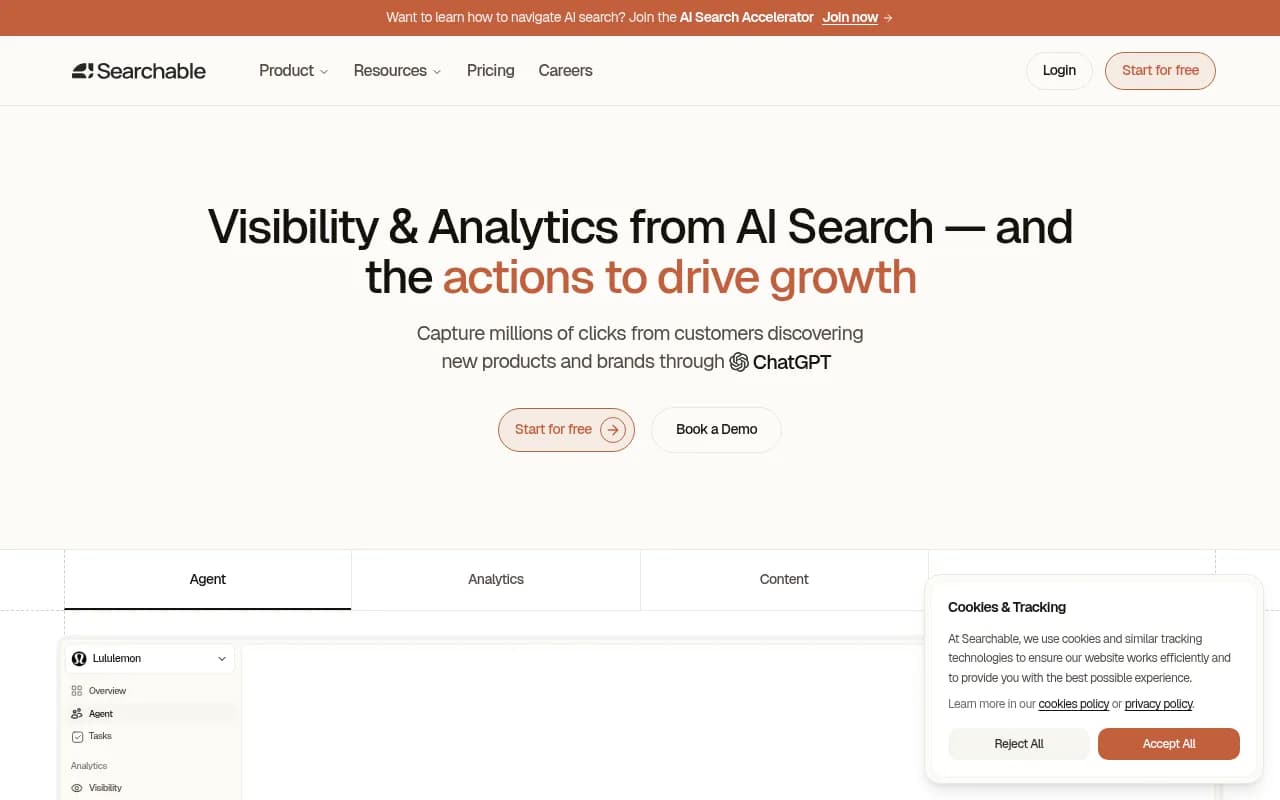
For smaller teams or companies just starting to think about AI search, Searchable works as a way to get a read on where you stand. The interface is clean and the setup is relatively quick.
The limitations show up when you want to go deeper. Searchable doesn't offer the kind of prompt intelligence (volume estimates, difficulty scoring, query fan-outs) that helps you prioritize which gaps to close first. There's no built-in content generation, no crawler log access, and the AI model coverage is narrower than the other platforms here. It's a reasonable starting point but not a platform you'd scale a serious GEO program on.
AthenaHQ
AthenaHQ has built a solid reputation in the enterprise AEO space. The platform covers 8+ AI search engines, has a 4.9 rating on G2, and counts SoFi, ZoomInfo, and Wix among its customers. Their State of AI Search 2026 report is genuinely useful research, and the platform reflects that depth of thinking.

Where AthenaHQ excels is visibility scoring and citation tracking. You get a clear picture of how your brand performs across AI platforms, how that compares to competitors, and where the gaps are. The competitor heatmap view is particularly useful for understanding relative positioning.
The honest limitation is that AthenaHQ is primarily a monitoring and analysis tool. It shows you the problem clearly but leaves the fixing largely to you. There's no built-in content generation, no AI writing agent, and no direct path from "here's a gap" to "here's the content that closes it." For enterprise teams with dedicated content resources, that's workable. For leaner teams, it means the insights sit in a dashboard while the actual work happens somewhere else.
Profound
Profound is one of the more feature-complete monitoring platforms in the market. It covers prompt volumes, shopping tracking, agent analytics, and answer engine insights. The team has invested heavily in research (the Profound Index, AEO reports) and the platform shows that rigor.

Pricing is a real consideration with Profound. The entry tier is limited enough that you'll likely need the $399/month plan or higher to get meaningful coverage across modern AI models. For enterprise teams, that's justifiable. For mid-market companies, it's a significant commitment.
The other thing worth noting: Profound's own comparison page against AthenaHQ (written by their growth team) acknowledges that customers sometimes struggle to translate insights into concrete next steps. That's a telling admission. The data is good; the path from data to action is less clear.
Promptwatch
Promptwatch is the platform that most directly addresses the "now what?" problem. Where the other tools in this comparison show you where you're invisible, Promptwatch is built around helping you fix it.
Promptwatch covers 10 AI models (ChatGPT, Perplexity, Claude, Gemini, Google AI Overviews, Google AI Mode, Grok, DeepSeek, Copilot, and Meta AI), which is the broadest coverage in this comparison. But the model count is almost secondary to what the platform does with the data.

The core workflow works like this: Answer Gap Analysis surfaces the specific prompts where competitors appear but you don't. You see exactly what content is missing from your site, the topics and questions AI models want to answer but can't find on your pages. From there, the built-in AI writing agent generates articles, listicles, and comparisons grounded in real citation data (880M+ citations analyzed), prompt volumes, and competitor analysis. Then page-level tracking shows whether the new content is actually getting cited, and by which models.
That loop, find gaps, create content, track results, is what separates Promptwatch from the monitoring-only tools. Most competitors stop at step one.
A few other things worth calling out:
- AI Crawler Logs show which pages ChatGPT, Claude, Perplexity, and others are actually reading, how often they return, and what errors they hit. This is rare in the category and genuinely useful for diagnosing indexing issues.
- Prompt Intelligence includes volume estimates and difficulty scores, so you can prioritize high-value, winnable prompts rather than guessing.
- Reddit and YouTube tracking surfaces the discussions that directly influence AI recommendations, a channel most platforms ignore entirely.
- ChatGPT Shopping tracking monitors when your brand appears in product recommendations and shopping carousels.
- Traffic attribution connects AI visibility to actual revenue through a code snippet, GSC integration, or server log analysis.
Pricing starts at $99/month for the Essential plan (1 site, 50 prompts, 5 articles), $249/month for Professional (2 sites, 150 prompts, 15 articles, crawler logs), and $579/month for Business (5 sites, 350 prompts, 30 articles). A free trial is available.
Feature comparison
| Feature | Searchable | AthenaHQ | Profound | Promptwatch |
|---|---|---|---|---|
| AI models covered | Limited | 8+ | Multiple | 10 |
| Brand visibility tracking | Yes | Yes | Yes | Yes |
| Competitor analysis | Basic | Yes | Yes | Yes |
| Prompt volume/difficulty | No | Limited | Yes | Yes |
| Answer gap analysis | No | Limited | No | Yes |
| Built-in content generation | No | No | No | Yes |
| AI crawler logs | No | No | No | Yes |
| Reddit/YouTube tracking | No | No | No | Yes |
| ChatGPT Shopping tracking | No | No | Yes | Yes |
| Traffic attribution | No | No | Limited | Yes |
| Page-level citation tracking | No | Limited | Limited | Yes |
| Free trial | Yes | Yes | Yes | Yes |
| Starting price | Lower | Mid | $399+ for full features | $99/mo |
| Best for | Small teams | Enterprise monitoring | Enterprise monitoring | Teams that want to act on data |
Which platform is right for which team
If you're just starting out
Searchable or the Essential tier of Promptwatch. Searchable is lighter and cheaper. Promptwatch's entry plan gives you more to work with, including the content generation that makes the data actionable.
If you're an enterprise team with dedicated content resources
AthenaHQ or Profound both work well here. The monitoring depth is strong, and if you have writers and strategists who can take insights and run with them, the lack of built-in content generation isn't a dealbreaker. AthenaHQ's G2 rating and customer list suggest it's the more polished experience. Profound has more features but a steeper price and some reported reliability concerns.
If you want to actually improve your AI visibility, not just track it
Promptwatch. This is the honest answer. The other platforms show you the problem. Promptwatch shows you the problem and helps you fix it. The Answer Gap Analysis, AI writing agent, crawler logs, and traffic attribution form a complete workflow that the monitoring-only tools don't offer.
For marketing teams or SEO teams that need to demonstrate results, not just report metrics, that distinction matters a lot.
If you're an agency managing multiple clients
Promptwatch's agency and enterprise tiers are worth exploring. The multi-site support, white-label options, and Looker Studio integration make it more practical for client reporting than the other platforms here.
The bigger picture
The Reddit thread from r/seogrowth that surfaced in research for this piece made a fair point: some of these platforms are useful for entity clarity assessment and understanding how AI models perceive your brand, even if they're not the complete solution. That's true. Monitoring has value.
But in 2026, with AI search traffic becoming a real revenue channel for more brands, "monitoring has value" is a low bar. McKinsey's projection of $750 billion flowing through AI-powered search by 2028 means the stakes are high enough that knowing you have a problem isn't enough. You need to fix it.
That's the real question to ask when evaluating any platform in this category: does it help me fix the problem, or does it just help me see it more clearly?
For most teams, the answer to that question points pretty clearly in one direction.