Key takeaways
- Profound is the more mature, data-rich platform with 400M+ prompt insights and strong enterprise features, but it comes at a price point that strains mid-market budgets
- Searchable is lighter and more accessible, but lacks several capabilities that teams serious about optimization (not just monitoring) will eventually need
- Both tools are primarily monitoring-focused -- they show you where you stand but don't actively help you close the gap
- For mid-market teams that need to move from tracking to actually improving AI visibility, there are stronger options worth considering alongside these two
- The right choice depends heavily on how many AI models you need to track, whether you need content tools, and what your team can realistically act on
The AI visibility tool market has exploded in 2026. There are now dozens of platforms claiming to tell you how your brand appears in ChatGPT, Perplexity, Claude, and the rest. Most of them do roughly the same thing: run prompts, count mentions, show you a dashboard.
Profound and Searchable are two of the more talked-about options for teams that aren't quite enterprise but have outgrown the cheapest tier of tools. Both are worth taking seriously. But they're also genuinely different in what they prioritize, and choosing the wrong one means either overpaying for features you won't use or hitting a ceiling just when you need to scale.
This guide is for marketing and SEO teams at mid-market companies -- roughly 50 to 500 employees, with real budgets but real accountability for results. Let's get into it.
What Profound actually does
Profound has positioned itself as one of the more comprehensive AI visibility platforms available. According to a 2026 analysis by Nick Lafferty that scored nine platforms on an AEO (Answer Engine Optimization) rubric, Profound came out on top with a score of 92/100, citing its coverage of 10+ AI engines and a database of 400M+ prompt insights.

The platform tracks how your brand appears across major AI models, lets you monitor competitors, and gives you prompt-level data on where you're winning and losing. It has SOC 2 Type II certification, which matters if you're in a regulated industry or need to get security sign-off from IT before purchasing.
Where Profound genuinely shines is depth. The prompt database is large, the competitive benchmarking is solid, and the reporting is detailed enough to bring to a CMO. SE Ranking's 2026 guide to AI Mode tracking tools called it "the best AI Mode tracking tool for companies that want to transition to AI-driven commerce" -- which is a fair characterization if enterprise-grade data is your priority.
The catch: Profound is priced accordingly. It's not the most expensive tool in this space, but it's toward the higher end for teams that don't have a dedicated AI search budget. And like most platforms in this category, it's primarily a monitoring and analytics tool. It tells you what's happening. Acting on that data is largely up to you.
What Searchable actually does
Searchable is a newer entrant that takes a somewhat different approach. It combines AI visibility monitoring with content tools -- the pitch being that you can track your visibility and then do something about it from within the same platform.
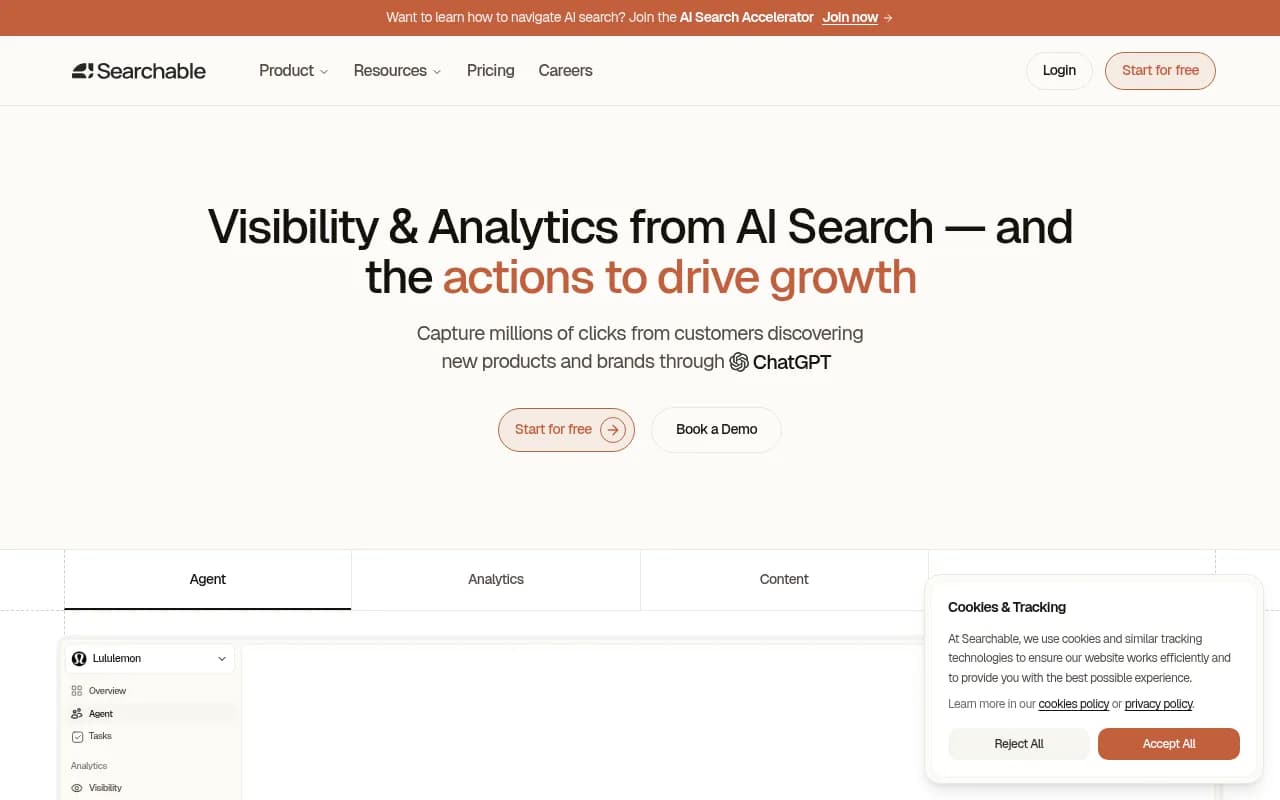
In practice, Searchable covers the core monitoring use cases: tracking brand mentions across AI engines, competitive share of voice, and prompt-level visibility. The content side includes tools for identifying gaps and generating content to fill them, though the depth of those features varies depending on which plan you're on.
For mid-market teams that are just getting started with AI visibility, Searchable's more approachable interface and lower entry price can make it easier to get buy-in internally. You're not asking your CFO to approve an enterprise contract before you've proven the value of AI search monitoring.
The tradeoff is that Searchable doesn't have the same breadth of prompt data or the same depth of competitive intelligence as Profound. If you're in a competitive category where you need granular data on exactly which prompts your competitors are winning, you may find Searchable's data thinner than you'd like.
Head-to-head comparison
Here's how the two platforms stack up across the dimensions that matter most to mid-market teams:
| Feature | Searchable | Profound |
|---|---|---|
| AI models tracked | Core models (ChatGPT, Perplexity, Gemini, Claude) | 10+ AI engines |
| Prompt database size | Moderate | 400M+ prompt insights |
| Competitive benchmarking | Basic | Strong |
| Content generation tools | Yes (built-in) | Limited |
| Content gap analysis | Yes | Limited |
| AI crawler logs | No | No |
| Reddit/YouTube tracking | No | No |
| ChatGPT Shopping tracking | No | No |
| Traffic attribution | Limited | Limited |
| SOC 2 certification | Not confirmed | Yes (Type II) |
| Pricing tier | Mid-range | Mid-to-high |
| Best for | Teams new to AI visibility | Data-focused teams, regulated industries |
The honest summary: Profound wins on data depth and enterprise credibility. Searchable wins on accessibility and having content tools in the same product. Neither wins on the full optimization loop -- both are still primarily monitoring platforms.
The monitoring-only problem
This is worth addressing directly because it affects both tools equally.
Most AI visibility platforms -- including Profound and Searchable -- are built around the same core workflow: run prompts, show you where you appear, show you where competitors appear. That's genuinely useful. But it leaves a gap.
Knowing you're invisible for a prompt doesn't tell you what to write to fix it. Knowing a competitor is getting cited doesn't tell you why their content gets picked up and yours doesn't. The data is the starting point, not the solution.
For mid-market teams with limited bandwidth, this matters a lot. You probably don't have a dedicated GEO strategist who can take a visibility report and translate it into a content roadmap. You need tools that close that loop.
This is where platforms like Promptwatch take a different approach. Rather than stopping at the monitoring layer, Promptwatch is built around an action loop: find the gaps (Answer Gap Analysis shows exactly which prompts competitors rank for that you don't), generate content to fill them (an AI writing agent trained on 880M+ citation data points), and then track whether that content actually improves your visibility scores. It's a meaningful structural difference from tools that only show you the problem.

That said, Profound and Searchable are still worth evaluating on their own merits. Not every team needs the full optimization stack on day one.
Which team should use Profound?
Profound makes the most sense if:
- You're in a regulated industry and need SOC 2 compliance before you can get a tool approved
- You have a data-heavy team that will actually use 400M+ prompt insights rather than just looking at a summary dashboard
- You're competing in a crowded category and need granular competitive intelligence across 10+ AI engines
- You have budget flexibility and are willing to pay for depth over breadth
It's a serious tool for serious use cases. If you're a B2B SaaS company with a complex competitive landscape and you need to understand exactly how AI models are positioning you versus three or four named competitors, Profound gives you that.
Which team should use Searchable?
Searchable makes more sense if:
- You're newer to AI visibility and want to start tracking without a large upfront commitment
- You want content tools and monitoring in the same product, even if neither is the deepest in class
- Your team is small and you need something you can actually get value from without a dedicated analyst
- You're in an earlier stage of building out your AI search strategy and need to prove ROI before investing in a more expensive platform
The built-in content tools are a genuine differentiator over pure monitoring platforms. If your team is going to act on visibility data by creating new content, having that workflow in one place reduces friction.
What to watch out for with both
A few things worth knowing before you commit to either:
Profound's pricing can escalate quickly as you add more prompts, more competitors, or more users. Make sure you understand what the base plan actually includes before signing up, and model out what you'd pay at full usage.
Searchable's content tools are newer and less battle-tested than its monitoring features. If content generation is a primary reason you're considering it, ask to see examples of what the output actually looks like for your industry before committing.
Neither platform currently offers AI crawler logs -- the ability to see which AI bots are actually crawling your site, which pages they're reading, and what errors they're encountering. This is a meaningful gap if you want to understand not just your visibility scores but the underlying technical reasons for them.
Neither tracks Reddit or YouTube, which are increasingly important sources for AI citations. If you're in a category where community discussions influence what AI models recommend, you'll need a supplementary tool or a platform that covers this.
Alternatives worth considering
If you've read this far and neither Profound nor Searchable feels like the right fit, here are a few other tools worth looking at:
For monitoring with a cleaner interface:

Otterly.AI is lightweight and focused. Good for teams that just want basic tracking without complexity.

Peec AI has solid multi-language support, which matters if you're operating across markets.
For enterprise-grade data:

AthenaHQ covers 8+ AI engines and has a strong monitoring feature set, though like Profound it's primarily a tracking platform.
For the full optimization loop:
Promptwatch is the only platform in this comparison that covers monitoring, content gap analysis, AI content generation, crawler logs, Reddit/YouTube tracking, and traffic attribution in one product. If your team needs to move beyond tracking and actually improve your AI visibility scores, it's the most complete option available in 2026.
The bottom line
Profound is the better tool if data depth and enterprise credibility are your primary requirements. Searchable is the better starting point if you want something more accessible with content tools included.
But both tools share the same fundamental limitation: they show you where you stand without giving you a clear path to improving it. For mid-market teams that need to demonstrate results -- not just report on them -- that gap matters.
The right question to ask before choosing any AI visibility platform isn't "which tool has the best dashboard?" It's "what will my team actually do with this data, and does the tool help us do it?" Answer that honestly and the choice becomes clearer.