
Key takeaways
- There is no independent ground-truth accuracy benchmark for either tool. The closest thing is a Webvy test that ran the same 10 prompts in both platforms for 5 days.
- In that test, rankings and share of voice transferred well between tools (rank correlation 0.88, top-10 share of voice 66.8% vs 67.5%). The proprietary Visibility Score did not.
- Visibility Score definitions differ by vendor, so use scores to track movement inside one tool, never to compare across tools.
- Profound's pricing is the shakiest fact in most comparisons. Verify at tryprofound.com/pricing before you budget.
- Most comparison pages are written by one of the vendors or a competitor. Treat them as biased inputs, including this one's sources.
What "accuracy" can and cannot mean here
I want to be upfront. The title promises a prompt-by-prompt accuracy test, and the honest version is this: nobody has published a controlled one with ground truth. Ground truth would mean knowing what ChatGPT, Perplexity or Google AI Overviews actually told a real user at a given moment. Neither tool can prove that, and neither claims to.
What we do have is a good agreement test. Two tools run the same prompts, and you compare the outputs. Agreement is not accuracy, but if two independent collection systems land in the same place, that is at least reassuring. If they diverge, you learn which metrics to distrust.
So this guide does three things. It summarizes the best head-to-head evidence available, it flags why exact matches are unlikely, and it gives you a protocol to run the same test on your own prompts.
The two tools in one paragraph each
Searchable is an AI visibility platform with monitoring plus content and optimization tooling, pitched at teams that want actionable guidance. Profound leans enterprise: deeper data, prompt demand analysis, compliance and agents at scale.

The best head-to-head evidence: the Webvy test
Webvy ran the same 10 prompts through both tools. All were variants of "best AI video generators." Each tool ran them daily for 5 days across ChatGPT, Google AI Overviews and Perplexity, at 30 answers per day, which gives 150 answers per platform. That is a small sample, so read the results as directional.
What matched
| Metric | Profound | Searchable | Verdict |
|---|---|---|---|
| Top brands overlap | 9 of top 10 shared | 9 of top 10 shared | Strong agreement |
| Rank correlation (9 shared brands) | 0.88 | 0.88 | Strong agreement |
| Top-10 share of voice | 66.8% | 67.5% | Near identical |
| Share of Voice average absolute gap | n/a | 0.67 points | Barely moved |
| Visibility Score average gap | n/a | Searchable 3.5 points lower, 5.7 absolute | Meaningful drift |
The one brand mismatch was small: Profound surfaced Adobe, Searchable surfaced Canva. That is the kind of difference you expect at the tail of a list.
What did not match
Visibility Score diverged on specific brands:
- Runway: 86.7% in Profound vs 78.0% in Searchable
- Synthesia: 62.3% vs 50.0%
- Kling AI: 40.6% vs 48.0%
- Google Veo: 58.5% vs 61.0%
The direction even flips. Searchable is lower for Runway and Synthesia but higher for Kling AI. That is a sign the gap is not just a calibration offset.
Why the scores differ
The definitions are not the same. Profound's Visibility Score is the share of responses that contain the brand. Searchable documents its score as a composite of mention frequency, position, context quality and sentiment. Different formulas, different numbers.
Webvy found one useful wrinkle. Dividing Visibility Score by Share of Voice gives a near-constant ratio inside each tool: 6.63 for Profound and 6.05 for Searchable. Rescale Searchable by that ratio and the average signed gap moves from -3.5 to +0.7 points. So part of the gap is a scale difference, which is encouraging, but it is a post-hoc fix rather than something either tool tells you.
Webvy's takeaway, and mine: rankings and share of voice transfer across tools, the proprietary score does not. Use the score to watch trend lines inside one platform.
Why two trackers will rarely match exactly
Even a perfect tool would not reproduce another tool's cited URLs. Two structural reasons.
Citation sets are extremely long-tailed
Promptwatch Data's ChatGPT citation share report for November 2026 (Nov 1-25) shows the most cited of 20 popular sites, Reddit, at only 0.23% of ChatGPT citations, down from 3.71% in June. G2 and LinkedIn sit at 0.18% each, and the 20 sites together earn under 2%. The rest is spread over hundreds of thousands of domains. With a tail that long, two trackers sampling different runs will almost never cite the same exact URLs.
Behavior changes by date
Promptwatch's ChatGPT query fanout data shows average fanouts per response at 2.15 in early December, about 1.84 by early March, and exactly 1.0 when the data resumed in April. Average fanout query length fell from about 117 characters to about 53. (The page's intro mentions "3-8+" searches per prompt, which conflicts with those averages, so I use the averages.) If the underlying engine changes how it searches, a tool's fanout and citation numbers move with it. A comparison run in March and another in April are not the same test.
The practical rule: fixed dates, same prompts, repeated runs.
Pricing and coverage, with a staleness warning
Pricing is where these two get compared most and where the sources disagree.
| Item | Searchable | Profound |
|---|---|---|
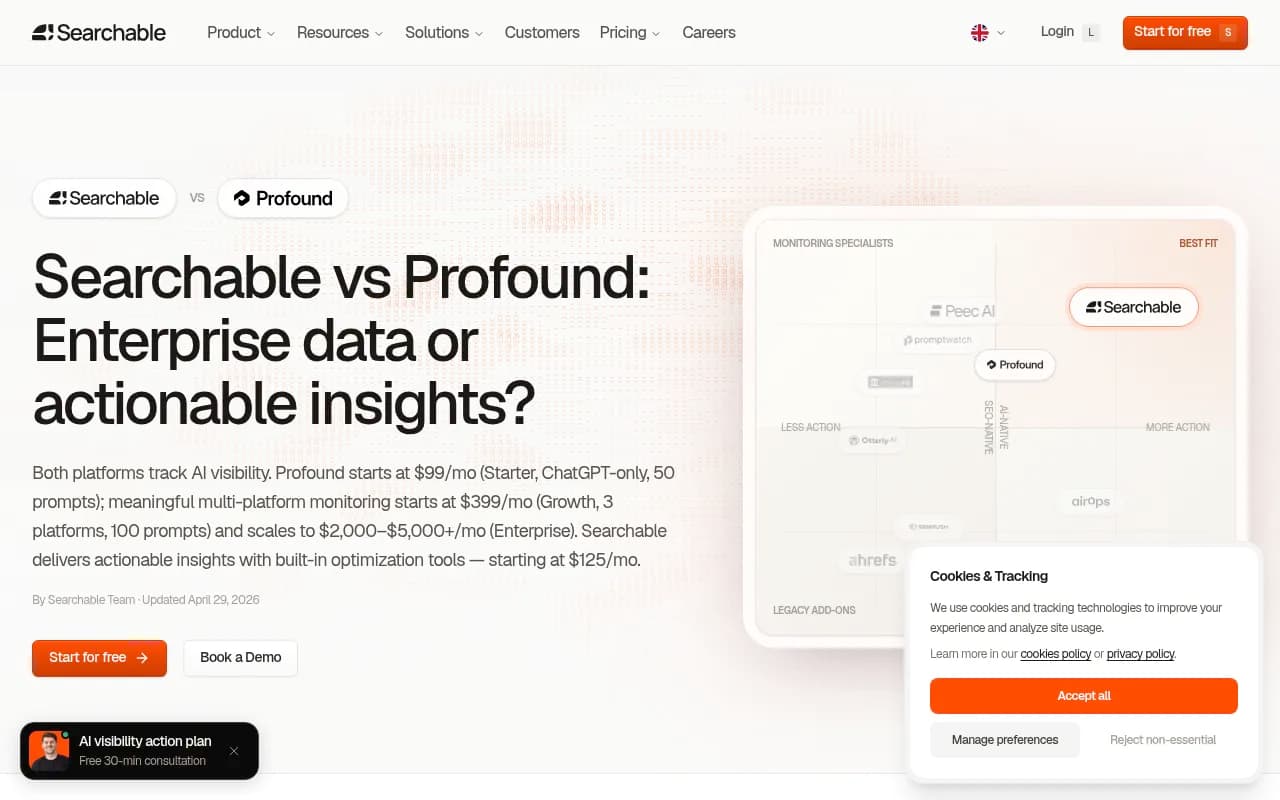
| Entry price (per Searchable's April 29, 2026 page) | From $125/mo | Starter $99/mo, ChatGPT only, 50 prompts |
| Mid tier | Scale $400/mo | Growth $399/mo, 3 platforms, 100 prompts |
| Top tier | Enterprise from $999 | Enterprise $2,000-$5,000+/mo |
| Engines | ChatGPT, AI Overviews, Perplexity on Pro; Gemini, AI Mode, Claude and others as add-ons | Up to 10 answer engines on Enterprise |
| Extras | Content Studio, technical optimization, MCP, agent | API, CSV/JSON export, SSO/SAML, SOC 2 Type II |
Now the caveat. Searchable's April page lists Profound's Starter and Growth tiers. Canlah.ai's check on November 19, 2026 saw only a single custom-priced Enterprise plan reached through a demo request, with no free trial. Both could be right at different times. Confirm Profound's current tiers on its own pricing page.
Who says what, and who is biased
- Searchable's comparison page is a vendor page and favors Searchable.
- Profound's "Searchable Review" article is written by the competitor.
- Canlah.ai discloses that it competes with both tools. It picks Searchable on price, engine coverage, prompt volume and content production, and Profound on demand data, SOC 2 Type II and agents at scale.
- Webvy's test is the most useful of the group, but it is a small, single-vertical sample.
I could not find an independent benchmark, and I did not retrieve every comparison out there, including Scrunch's and Newsprint's. Newsprint frames the two from a PR angle, where cited sources tell you which outlets to pitch.
How to run your own prompt-by-prompt test
If you are choosing between the two, a one-week bake-off beats any review, including this one.
Step 1: Pick 10 to 20 prompts
Mix three types: organic category prompts ("best X for Y"), brand-specific prompts and competitor comparisons. Keep them identical in both tools. Webvy used one vertical, which makes brand overlap easy to read but narrows what you learn. Use at least two topics.
Step 2: Fix the dates and engines
Run both tools on the same engines for the same days. Start both on the same morning. Do not change prompts mid-test.
Step 3: Compare the transferable metrics first
- Brand overlap in the top 10.
- Rank correlation across shared brands.
- Share of voice per brand.
If these agree, you have a baseline of trust. If they do not, stop and investigate before looking at scores.
Step 4: Treat the score as tool-internal
Look at whether each tool's score moves in the same direction week to week, not whether the values match. Divide score by share of voice if you want to check for a constant scaling ratio, as Webvy did.
Step 5: Spot-check against the real interfaces
Pick five prompts and run them by hand in ChatGPT, Perplexity and Google. You will not get identical answers (these engines vary run to run), but you can see whether a tool's reported brands are plausible. Free browser tools help here; the GEO Inspector extension from Promptwatch shows fan-outs and fetched vs cited sources for ChatGPT.
Step 6: Score the workflow, not just the data
Ask what happens after the number. Does the tool tell you what to fix, draft the content, or only chart it? That decides whether you get value in month three.
Which one fits which team
| If you are... | Lean toward | Why |
|---|---|---|
| A small team or agency that wants monitoring plus content tools at a lower price | Searchable | Lower listed entry price, more prompts per tier, content production built in |
| An enterprise with security review and compliance needs | Profound | SOC 2 Type II, SSO/SAML, API, up to 10 engines |
| A team that needs prompt demand data | Profound | Prompt Analysis groups how people ask by intent and funnel stage |
| A PR team mapping which outlets AI cites | Either | Cited-source reports in both; check coverage of your engines |
A third option worth testing
If your goal is not just seeing the numbers but acting on them, add one more tool to the bake-off. Promptwatch collects data from the real interfaces of ChatGPT, Google AI Overviews, Google AI Mode, Gemini, Perplexity, Copilot and others, then pairs tracking with IP-verified AI crawler logs, a Content Agent that writes and publishes to WordPress, Webflow or Framer, and visitor analytics that show whether AI traffic converts. Its comparison pages cover both rivals: Promptwatch vs Profound and Promptwatch vs Searchable. You can start with the 7-day free trial and check prices at promptwatch.com/pricing.

For a wider shortlist, the GEO software directory at bestgeosoftware.com lists dozens of alternatives.
Other tools in the same bracket
If neither fits, these come up in the same searches:


Bottom line
On the evidence we have, Searchable and Profound agree on who is winning a category and by roughly how much. They disagree on their own scores, and the disagreement is partly a scale difference. Pick on price, engine coverage, compliance needs and what you want done after the dashboard, then run a week-long bake-off on your own prompts with fixed dates. Verify Profound's current pricing before you put a number in a budget.
FAQ
Is Searchable or Profound more accurate?
No independent ground-truth test exists. The Webvy 10-prompt test found strong agreement on rankings and share of voice, and divergence on Visibility Score.
Can I compare Visibility Scores across the two tools?
Not directly. Profound counts the share of responses that contain the brand. Searchable uses a composite of frequency, position, context quality and sentiment.
How much does Profound cost in 2026?
Searchable's April page lists Starter at $99/mo and Growth at $399/mo, while a November check found only a custom Enterprise plan. Confirm on Profound's pricing page.
Why do cited URLs differ between tools?
Citations are spread over a very long tail of domains, and engine behavior like query fanouts shifts over time, so exact matches are rare.