Key takeaways
- Answer gap analysis -- finding which prompts competitors rank for that you don't -- varies dramatically in quality across platforms
- Peec AI and Otterly.AI both surface gaps but stop there; neither generates content or tells you what to do next
- Searchable has monitoring capabilities but limited depth on gap analysis compared to the other three
- Promptwatch is the only platform here that closes the loop: it finds the gaps, generates content to fill them, and tracks whether that content gets cited
Answer gap analysis sounds simple. Find the prompts where your competitors show up in AI responses and you don't. Then fix it.
The problem is that "finding the gap" is only useful if you know what to do with it. A list of prompts where you're invisible is just a to-do list without context. The better question is: which platform gives you enough signal to actually act on what it finds?
That's what this comparison is really about. We're looking at four platforms -- Searchable, Peec AI, Otterly.AI, and Promptwatch -- specifically through the lens of answer gap analysis quality. Not just whether they have the feature, but how deep it goes, how actionable it is, and whether it connects to anything that helps you close the gap.
What good answer gap analysis actually looks like
Before comparing the tools, it's worth being specific about what "quality" means here. A strong answer gap analysis should do at least three things:
- Show you which prompts competitors are visible for that you're not -- with enough context to understand why
- Give you some signal about which gaps are worth prioritizing (volume, difficulty, competitive density)
- Connect the gap data to something actionable, whether that's a content brief, a page audit, or a specific recommendation
Most platforms in 2026 can do the first thing. Fewer do the second. Almost none do the third -- at least not without you doing a lot of manual work in between.
Searchable
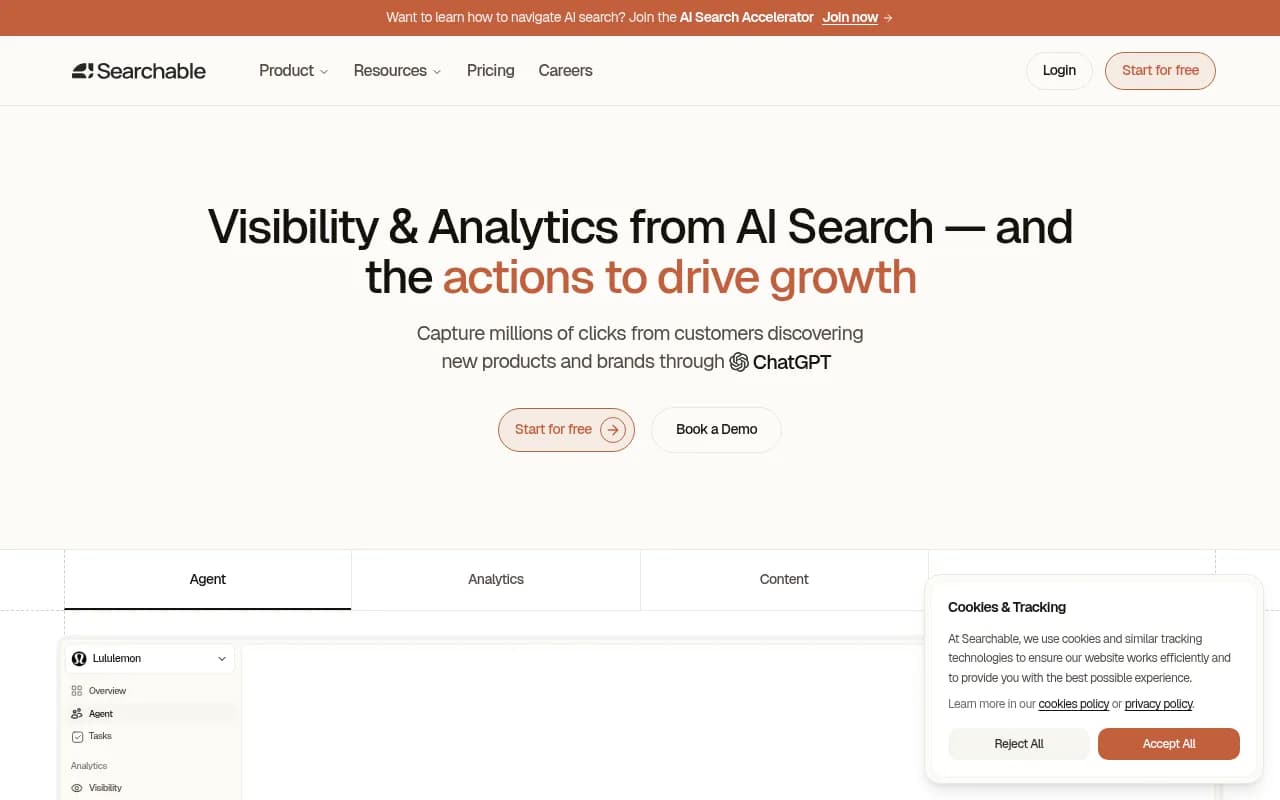
Searchable sits in the monitoring-and-content category, which means it's trying to do more than pure tracking. The platform covers AI visibility across major models and surfaces brand mentions and citations in AI responses.
On gap analysis specifically, Searchable shows you where competitors appear that you don't, and it does this across multiple AI engines. That's the baseline. Where it gets murkier is in the depth of the signal. Prompt volume estimates, difficulty scoring, and query fan-outs (how one prompt branches into related sub-queries) aren't a strong suit here. You get the gap, but you don't get much help understanding whether it's a high-value gap or a low-priority one.
The content tooling is present but feels secondary to the monitoring function. For teams that want a clean dashboard to track AI mentions and do some basic gap spotting, Searchable works. For teams that want to build a systematic GEO content strategy from gap data, it's a starting point rather than a complete solution.
Peec AI

Peec AI has a clear identity: clean, simple, multi-language tracking across AI engines. It does prompt tracking well, covers ChatGPT, Perplexity, Google AI Overviews, and DeepSeek on its Pro plan (Claude, Gemini, and AI Mode are enterprise add-ons), and handles unlimited countries and languages without extra charges -- which genuinely sets it apart from most competitors.
On gap analysis, Peec tracks visibility at the topic or prompt cluster level. You can see which categories of queries your competitors are winning and you're not. That's useful for product and content teams trying to understand broad patterns.
But there are real limits. The Pro plan caps you at 100 prompts and 9,000 AI answers per month. There's no content creation tooling, no site audit capability, and no way to go from "here's the gap" to "here's what to write." The gap data is clean and readable, but it's a dead end. You export it, take it to your content team, and figure out the next step yourself.
For teams that just want monitoring and are comfortable doing the strategy work manually, Peec is genuinely good at what it does. For teams that want the gap analysis to feed directly into content production, it doesn't get you there.
Otterly.AI

Otterly.AI is one of the more feature-complete monitoring platforms in this comparison. It covers prompt tracking, citation analysis, multi-engine monitoring, competitor benchmarking, and brand mentions. Its MCP server integration is a genuine differentiator for AI-native teams who want to query brand data without leaving their workflow.
On gap analysis, Otterly surfaces competitor visibility gaps with reasonable depth. The citation analysis is strong -- you can see not just that a competitor is being cited, but which sources are driving those citations. That's useful context for understanding why a gap exists, not just that it exists.
The limitation is the same one that affects most monitoring-first platforms: the gap data doesn't connect to content generation. Otterly's GEO Content Audit feature gives you some structural guidance, but there's no content agent that takes the gap data and produces a draft or a brief grounded in real prompt data. You're still doing the translation work yourself.
Crawler logs are in beta, which means the ability to understand how AI engines are actually discovering (or not discovering) your pages is limited compared to platforms where this is fully shipped.
Otterly is a strong choice for teams that want deep monitoring with good citation analysis and are willing to handle content strategy separately. It's less suited for teams that want a single platform to carry them from gap identification to published content.
Promptwatch
Promptwatch takes a different structural approach to gap analysis. The Answer Gap Analysis feature shows you exactly which prompts competitors are visible for that you're not -- but it also tells you why, using page-level citation tracking that shows which specific pages are being cited and how often. That's a meaningful difference from platforms that show you the gap at the brand level without explaining the content mechanics behind it.

The prompt intelligence layer adds volume estimates and difficulty scores for each gap, plus query fan-outs that show how a single prompt branches into related sub-queries. In practice, this means you can prioritize: instead of treating every gap as equally important, you can focus on high-volume, winnable prompts first.
Where Promptwatch separates from the other three platforms is what happens after you identify a gap. Content Agents generate articles, listicles, comparisons, and briefs grounded in the gap data -- using real prompt volumes, citation data, competitor analysis, and brand guidance. The content isn't generic; it's engineered to answer the specific questions AI models are already exposing as gaps in your coverage.
Then the loop closes: AI Crawler Logs (available on Professional and Business plans) show you when AI crawlers hit your new pages, what errors they encounter, and when pages move from crawled to cited. Traffic attribution connects visibility improvements to actual revenue.
That full cycle -- find gaps, generate content, track results -- is what makes this a different category of tool rather than just a better monitoring dashboard.
Head-to-head comparison
| Feature | Searchable | Peec AI | Otterly.AI | Promptwatch |
|---|---|---|---|---|
| Prompt tracking | Yes | Yes (100 prompt cap on Pro) | Yes | Yes |
| Multi-engine coverage | Yes | 4 base engines (Pro) | Yes | 10 engines |
| Competitor gap analysis | Basic | Cluster-level | Strong | Page-level + why |
| Prompt volume/difficulty scoring | No | No | No | Yes |
| Query fan-outs | No | No | No | Yes |
| Citation source analysis | Limited | Yes | Strong | Yes |
| Content generation from gaps | Limited | No | No | Yes (Content Agents) |
| AI crawler logs | No | No | Beta | Yes (Pro+) |
| Traffic attribution | No | No | No | Yes |
| Reddit/YouTube insights | No | No | No | Yes |
| ChatGPT Shopping tracking | No | No | No | Yes |
| Multi-language/region | No | Yes (unlimited) | Yes | Yes |
| Pricing (entry) | Custom | €199/mo (Pro) | Varies | $99/mo (Essential) |
Which platform fits which situation
The honest answer is that these four tools serve different needs, and the right choice depends on what you actually want to do with gap data.
If you want clean, multi-language monitoring across AI engines and you're comfortable doing content strategy manually, Peec AI is genuinely good at that. The unlimited language and country coverage at no extra cost is a real advantage for international teams.
If you want deep citation analysis and strong monitoring with good competitor benchmarking, Otterly.AI is a solid option. The MCP integration is a nice touch for technical teams. Just don't expect it to generate content from the gaps it finds.
If you're evaluating Searchable, it's worth being specific about what you need from gap analysis before committing. The monitoring is functional, but the gap analysis depth is thinner than Otterly or Promptwatch.
If you want the gap analysis to connect directly to content production and then to measurable visibility improvements, Promptwatch is the only platform here that does all three. The Content Agents, crawler logs, and traffic attribution form a complete loop that the other platforms don't replicate.
A note on what "gap analysis" actually requires
One thing that gets lost in feature comparisons: answer gap analysis is only as useful as the prompt data underneath it. Platforms that construct their own hypothetical prompts are measuring something different from platforms that track real user behavior.
Promptwatch tracks how AI search engines behave in real user interfaces, not just through API calls. This matters because user-facing answers, citations, and shopping recommendations can differ from what you'd see querying the API directly. The gap data is grounded in what real users are actually asking, which changes the quality of the gaps you find.
That's not a knock on the other platforms -- it's a structural difference worth understanding before you commit to a tool for this specific use case.
Bottom line
Answer gap analysis in 2026 is table stakes for any serious GEO strategy. All four platforms here offer some version of it. The meaningful differences are in depth (do you get volume, difficulty, and fan-outs?), explainability (do you understand why the gap exists?), and actionability (does the platform help you close it?).
Peec AI and Otterly.AI are solid monitoring tools that surface gaps clearly. Searchable covers the basics. Promptwatch is the only one that takes the gap data and runs it through a full optimization loop -- from gap identification to content generation to citation tracking to revenue attribution.
For teams that want to treat GEO as a systematic growth channel rather than a reporting exercise, that distinction matters quite a bit.