Key takeaways
- Qwairy, Promptwatch, Gauge, and Rankability all track brand visibility in AI search engines, but they take very different approaches to competitive intelligence.
- Promptwatch is the only platform in this group that closes the full loop: find gaps, create content to fill them, then track the results. The others are primarily monitoring tools.
- Gauge focuses on strategic competitive intelligence with clean share-of-voice reporting. Rankability targets agencies. Qwairy leans into GEO strategy and optimization workflows.
- If you need to monitor and act -- not just watch a dashboard -- Promptwatch is the strongest option here. If you want a lighter monitoring tool for competitive benchmarking, Gauge is worth a look.
Why competitive intelligence in AI search is different
Traditional competitive intelligence was straightforward: you checked who ranked above you on Google, looked at their backlinks, and adjusted your content strategy. The feedback loop was slow but predictable.
AI search doesn't work that way. When someone asks ChatGPT "what's the best project management tool for remote teams," the answer isn't a ranked list of URLs. It's a synthesized recommendation, often with one or two brands named confidently and the rest invisible. There's no page two. There's no "position 4." You're either in the answer or you're not.
That changes what competitive intelligence means. You're no longer tracking rankings -- you're tracking which brands AI models recommend, which sources they cite, and what questions they're answering that you're not. That's a fundamentally different data problem, and it's why a new category of tools has emerged to solve it.
This guide compares four of the more interesting players in that space: Qwairy, Promptwatch, Gauge, and Rankability. They're all targeting the same broad problem, but they solve it differently.
The four tools at a glance
Before going deep on each tool, here's a quick side-by-side view:
| Feature | Qwairy | Promptwatch | Gauge | Rankability |
|---|---|---|---|---|
| AI models tracked | Multiple LLMs | 10+ (ChatGPT, Claude, Gemini, Perplexity, Grok, DeepSeek, Copilot, more) | Multiple LLMs | Multiple LLMs |
| Competitive intelligence | Yes | Yes, with prompt-level competitor heatmaps | Strong focus | Yes |
| Content gap analysis | Yes | Yes, with Answer Gap Analysis | Limited | Limited |
| Content generation | Yes | Yes, AI Content Agents | No | No |
| Crawler / agent logs | No | Yes | No | No |
| Reddit & YouTube tracking | No | Yes | No | No |
| ChatGPT Shopping tracking | No | Yes | No | No |
| Traffic attribution | No | Yes | No | No |
| Agency features | Limited | Yes (custom plans) | No | Yes (agency focus) |
| Free trial | Yes | Yes | Yes | Yes |
| Starting price | Custom | $99/mo | Custom | Custom |
The gap between "monitoring" and "optimization" is the most important distinction in this table. Qwairy and Gauge are primarily monitoring and intelligence tools. Rankability leans into agency reporting. Promptwatch is the only one here that takes you from data to published content to measurable results.
Qwairy
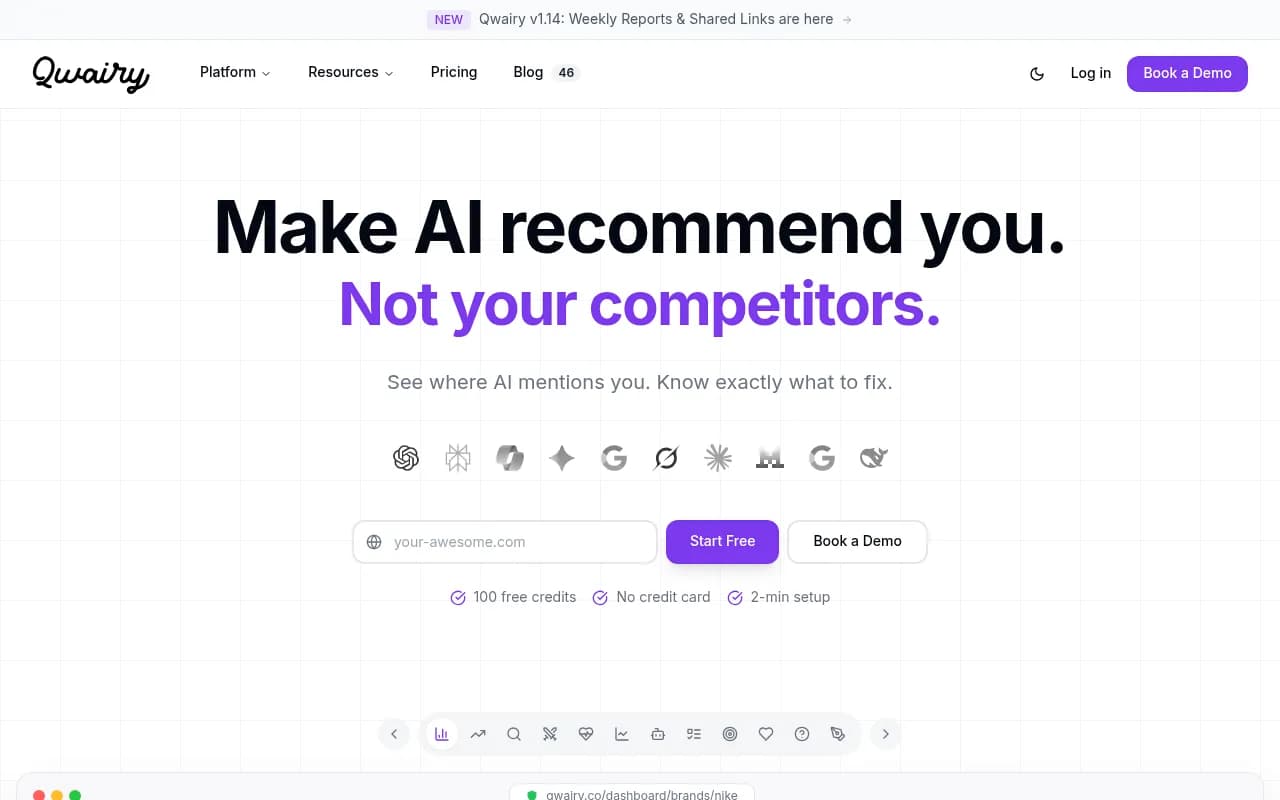
Qwairy positions itself as a GEO strategy and optimization platform. The pitch is that it doesn't just show you where you're visible -- it helps you understand why certain brands appear in AI answers and what you'd need to do to compete.
The competitive intelligence side is genuinely useful. You can track how your brand compares to competitors across a set of prompts, see which sources AI models are citing in your category, and identify the content gaps that are costing you visibility. The interface is clean and the data is presented in a way that makes it easy to build a strategic picture.
Where Qwairy gets more limited is in the execution layer. It can point you toward the gaps, but the actual work of filling them -- creating content, optimizing existing pages, tracking whether those changes moved the needle -- requires other tools or manual effort. That's not a fatal flaw, but it's worth knowing going in.
For teams that want to do deep competitive research before building a GEO content strategy, Qwairy is a solid starting point. For teams that want one platform to handle the whole workflow, it's only part of the answer.
Promptwatch
Promptwatch takes a different approach. It's built around what the team calls an "action loop": find the gaps, create content to fill them, then track whether that content actually gets cited.

The competitive intelligence features are strong. Competitor heatmaps show you which brands are winning for which prompts across each AI model. Answer Gap Analysis surfaces the specific questions your competitors are being cited for that you're not. Prompt Intelligence gives you volume estimates and difficulty scores so you can prioritize the gaps worth chasing.
But the part that separates Promptwatch from most tools in this space is what happens after the analysis. Content Agents generate articles, comparisons, and briefs grounded in real prompt data -- not generic SEO filler, but content engineered around the specific gaps AI models are exposing. Then page-level tracking and agent analytics show you when AI crawlers visit your new content, when it gets cited, and which models are picking it up.
A few capabilities that are genuinely rare in this category:
- AI Crawler Logs that show which pages AI agents are reading, how often they return, and what errors they're hitting
- Reddit and YouTube tracking, which matters because AI models frequently cite community discussions
- ChatGPT Shopping tracking for brands selling products
- Traffic attribution that connects AI citations to actual revenue
Promptwatch tracks 10+ AI models including ChatGPT, Claude, Gemini, Perplexity, Grok, DeepSeek, Copilot, and Google AI Overviews. It's used by 1,480+ brands and agencies, including Booking.com and Center Parcs.
Pricing starts at $99/month for the Essential plan (1 site, 50 prompts, 5 articles), $249/month for Professional (2 sites, 150 prompts, 15 articles, crawler logs), and $579/month for Business (5 sites, 350 prompts, 30 articles). Agency and enterprise pricing is available on request.
The honest assessment: if you're serious about competitive intelligence in AI search and you want to do something with what you learn, Promptwatch is the most complete platform in this comparison.
Gauge
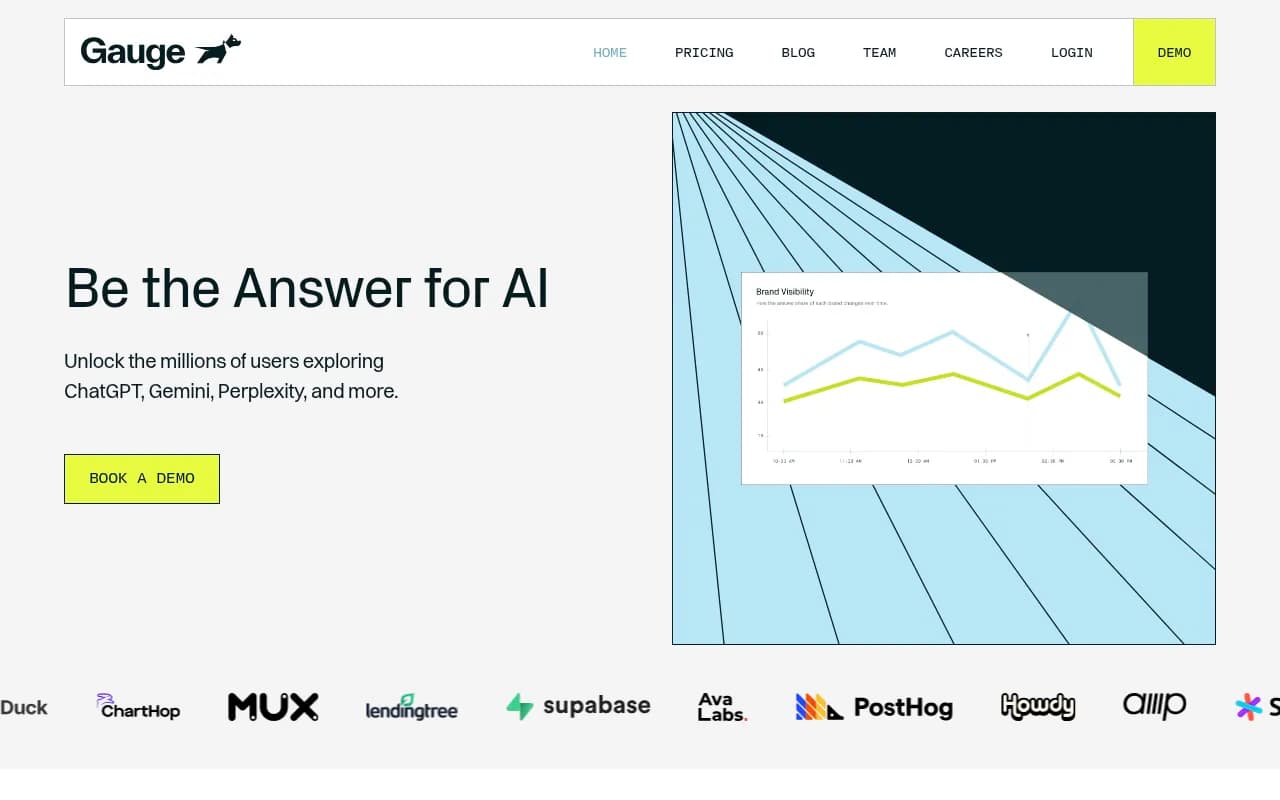
Gauge focuses specifically on strategic competitive intelligence for AI visibility. The emphasis is on share-of-voice analysis -- understanding how your brand stacks up against competitors across a defined set of prompts and AI platforms.
The reporting is clean and the competitive benchmarking is well-executed. Gauge is particularly useful for teams that need to present AI visibility data to stakeholders or clients, because the visualizations are clear and the narrative is easy to follow. You can see which competitors are dominating specific topic areas, how your visibility has shifted over time, and where the biggest competitive gaps are.
What Gauge doesn't do is help you close those gaps. There's no content generation, no content brief builder, no crawler logs, no traffic attribution. It's an intelligence tool, not an optimization platform. That's a deliberate choice -- Gauge is built for the research and reporting phase, not the execution phase.
For teams that already have a content operation and just need better data to inform it, Gauge is a good fit. For teams that want an end-to-end platform, it's not designed for that.
Rankability
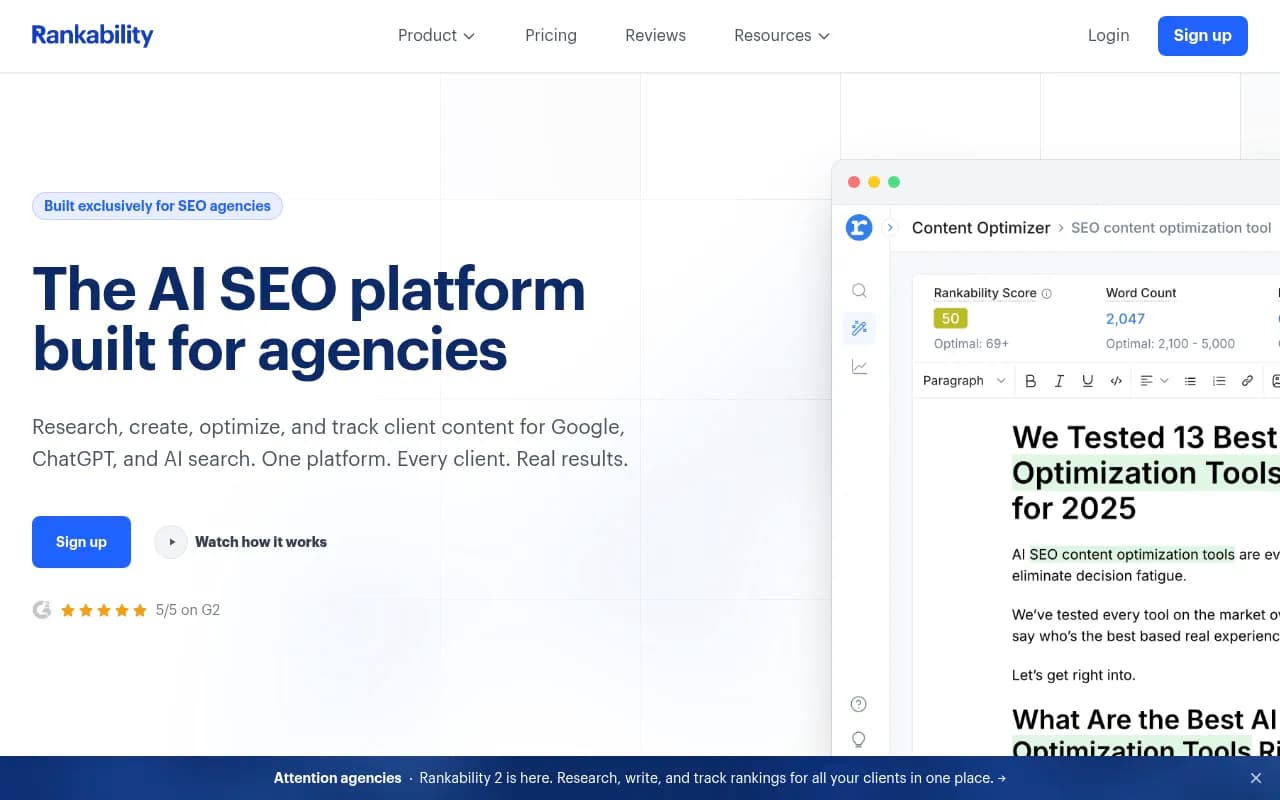
Rankability is built with agencies in mind. The platform tracks AI visibility across multiple clients, generates reports that can be white-labeled or shared with stakeholders, and provides the kind of structured data that agency account managers need to demonstrate value.
The competitive intelligence features are solid for the use case. You can track how a client's brand compares to competitors, identify which AI models are most influential in a given category, and build a picture of the competitive landscape over time.
The limitations are similar to Gauge: Rankability is primarily a monitoring and reporting tool. Content optimization and generation aren't core features. If an agency wants to use the data to actually improve a client's AI visibility, they'll need to bring their own content workflow.
That said, for agencies that are selling AI visibility as a service and need a clean, reportable platform to back it up, Rankability is one of the more purpose-built options available.
Head-to-head: competitive intelligence capabilities
The specific competitive intelligence features vary quite a bit across these four tools. Here's a closer look at what each one actually delivers:
Prompt-level competitor tracking
All four tools let you track how competitors appear in AI responses for a set of prompts. The depth varies. Promptwatch's competitor heatmaps are particularly granular -- you can see which specific prompts a competitor is winning, which AI models are citing them, and how that's changed over time. Gauge's share-of-voice reporting is strong for high-level benchmarking. Qwairy and Rankability both offer competitive tracking but with less granularity at the prompt level.
Source and citation analysis
Understanding which sources AI models cite in your category is one of the most actionable pieces of competitive intelligence available. If a competitor is getting cited because they have a strong Reddit presence or a frequently-referenced comparison page, that tells you exactly where to invest.
Promptwatch tracks citations at the source level -- specific pages, Reddit threads, YouTube videos, and third-party domains. It also has dedicated Reddit and YouTube tracking. The other three tools in this comparison don't go this deep on citation sources.
Content gap analysis
Qwairy and Promptwatch both offer content gap analysis. Promptwatch's Answer Gap Analysis is particularly specific: it shows you the exact prompts competitors are visible for that you're not, which makes it easy to build a prioritized content roadmap. Gauge and Rankability don't have dedicated content gap features.
Reporting and stakeholder communication
Rankability is the strongest here, by design. Gauge is also well-suited to reporting. Promptwatch has solid dashboards but is more oriented toward internal teams taking action than external reporting. Qwairy is somewhere in the middle.
Which tool is right for you?
The right choice depends on what you're actually trying to do with competitive intelligence.
If you want to monitor competitors and build a strategic picture of the AI visibility landscape, Gauge or Qwairy will serve you well. Gauge is cleaner for reporting; Qwairy goes deeper on strategy.
If you're an agency that needs to track multiple clients and present AI visibility data to stakeholders, Rankability is purpose-built for that workflow.
If you want to turn competitive intelligence into action -- identifying gaps, creating content to fill them, and tracking whether it works -- Promptwatch is the only platform in this comparison that handles the full cycle. The combination of Answer Gap Analysis, Content Agents, crawler logs, and traffic attribution is genuinely difficult to replicate by stitching together other tools.
A few other tools worth knowing about in this space:

Profound is strong on enterprise prompt research and has good coverage across AI models. It's a monitoring-first platform but with more depth than most.

Peec AI offers flexible model selection and multi-language tracking at a competitive price point. Good for teams that need broad coverage without enterprise pricing.

Otterly.AI is the most affordable entry point in the category at $29/month. It's monitoring-only, but for smaller teams that just want to start tracking, it's a reasonable starting point.

AthenaHQ covers 8+ AI search engines and has solid monitoring capabilities. Like most competitors, it stops at tracking rather than helping you optimize.
The monitoring vs. optimization gap
One thing worth saying plainly: most AI visibility tools are monitoring dashboards. They show you data. They tell you where you're invisible. Then they leave you to figure out what to do about it.
That's useful, but it's only half the job. The teams that are actually winning in AI search aren't just tracking their visibility -- they're systematically identifying what content AI models want to cite, creating that content, and verifying that it gets picked up.
That's the workflow Promptwatch is built around, and it's the main reason it stands out in a comparison like this. The competitive intelligence is good, but it's the connection between intelligence and action that makes it worth the price difference over monitoring-only tools.
The AI search landscape is moving fast. ChatGPT alone now accounts for roughly 20% of global search traffic, and AI-referred visits convert at significantly higher rates than traditional organic traffic. The brands that invest in understanding and improving their AI visibility now will have a meaningful advantage over those that wait until it becomes obvious.
The tools in this comparison are all reasonable ways to start. The question is whether you want to monitor the problem or solve it.