Key takeaways
- Frase is a solid content research and brief-building tool, but its GEO/AI visibility capabilities are limited -- it's still primarily built for traditional SEO.
- Writesonic has added AI search visibility tracking to its content creation suite, making it a reasonable option for small teams that want both in one place, but its monitoring depth is shallow compared to dedicated GEO platforms.
- Promptwatch is the only platform of the three built specifically around the full optimization loop: find content gaps, generate AI-optimized content, and track visibility improvements across 10+ AI models.
- If your goal is to rank in ChatGPT, Perplexity, Claude, and Google AI Overviews -- not just Google -- the platform you choose matters a lot more than most people realize.
The question of which tool "best combines AI content creation with GEO visibility" sounds simple. It isn't. These three platforms approach the problem from completely different angles, and picking the wrong one means either paying for tracking you can't act on, or generating content that has no connection to how AI models actually cite sources.
Let me break down what each platform actually does, where the gaps are, and which one makes sense for what kind of team.
What we're actually comparing
Before getting into the platforms, it's worth being clear about what "combining content creation with GEO visibility" means in practice. There are two distinct jobs here:
- Knowing where you're invisible in AI search (which prompts your competitors appear for but you don't, which AI models cite you, how often, with what sentiment)
- Creating content that fixes that invisibility (not generic SEO articles, but pieces engineered to get cited by ChatGPT, Perplexity, Claude, and similar models)
Most tools do one of these reasonably well. Very few do both. And even fewer close the loop by showing you whether the content you created actually moved your visibility scores.
That's the standard we're holding these three platforms to.
Frase: great research tool, limited GEO story
Frase has been around long enough to earn genuine credibility in the content research space. Its core workflow -- pull SERP data, build a content brief, write and optimize against a content score -- is clean and genuinely useful for teams producing high volumes of Google-optimized content.
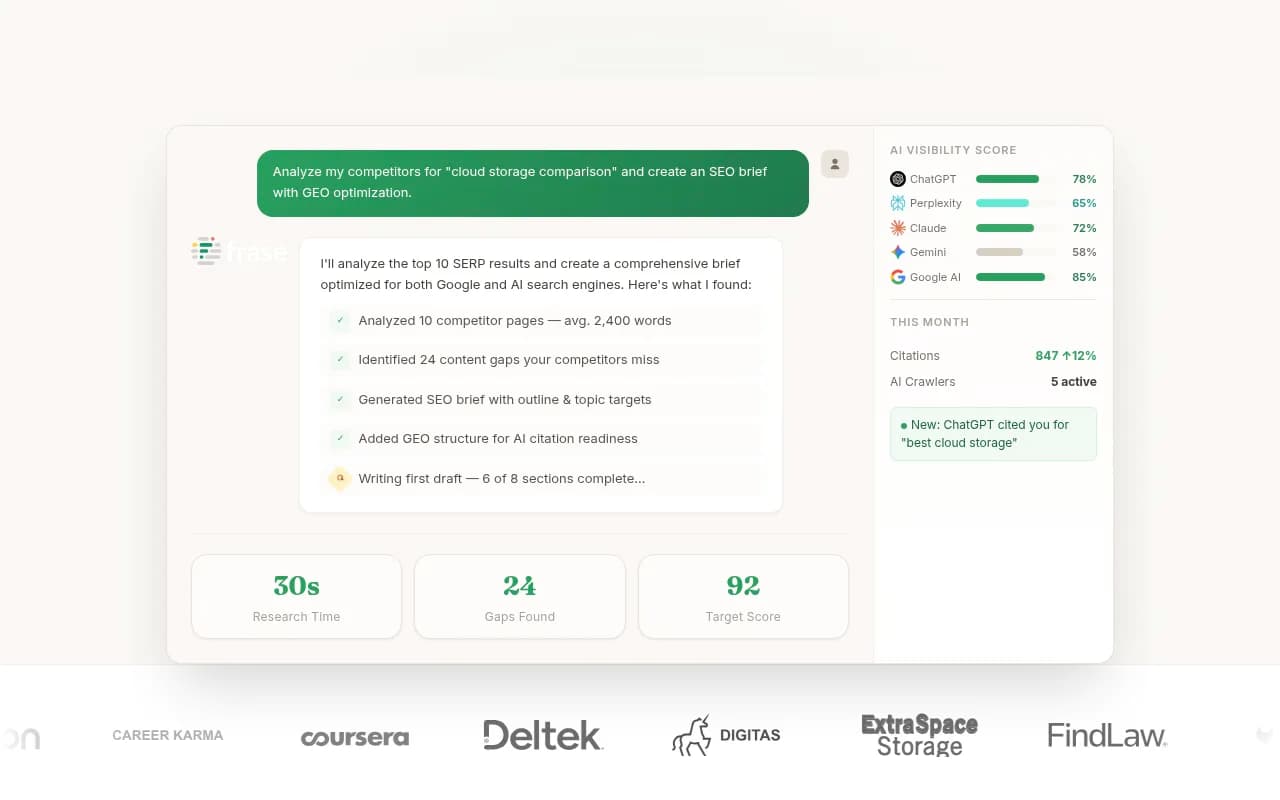
Where Frase gets complicated is the GEO question. The platform has added some AI-oriented features, but its foundation is traditional search. The content scoring, the brief generation, the optimization suggestions -- all of it is calibrated against Google SERPs, not AI model citation patterns.
This matters because the signals that make content rank in Google and the signals that make content get cited by ChatGPT or Perplexity are meaningfully different. AI models tend to cite content that directly answers specific questions, comes from authoritative domains, and covers topics comprehensively at a semantic level. Frase's optimization framework doesn't really account for that distinction.
For teams whose primary goal is Google traffic, Frase is a reasonable choice. For teams trying to appear in AI-generated answers, it's a tool that will help you write better content without telling you whether that content is actually getting cited anywhere.
What Frase does well
- Content brief generation from SERP data is fast and accurate
- The editor with real-time content scoring is genuinely useful for writers
- Pricing is accessible for smaller teams
- Good for teams already comfortable with traditional SEO workflows
Where it falls short for GEO
- No monitoring of AI model citations or brand mentions in LLM responses
- No prompt-level visibility data (which questions are being asked, which competitors appear)
- Content optimization is calibrated for Google, not AI search engines
- No way to close the loop between content you publish and AI visibility improvements
Writesonic: the most ambitious attempt at integration
Writesonic has made the most explicit effort to combine content creation with AI search visibility. The platform added GEO tracking features to its existing content generation suite, which means you get both in one subscription rather than paying for separate tools.
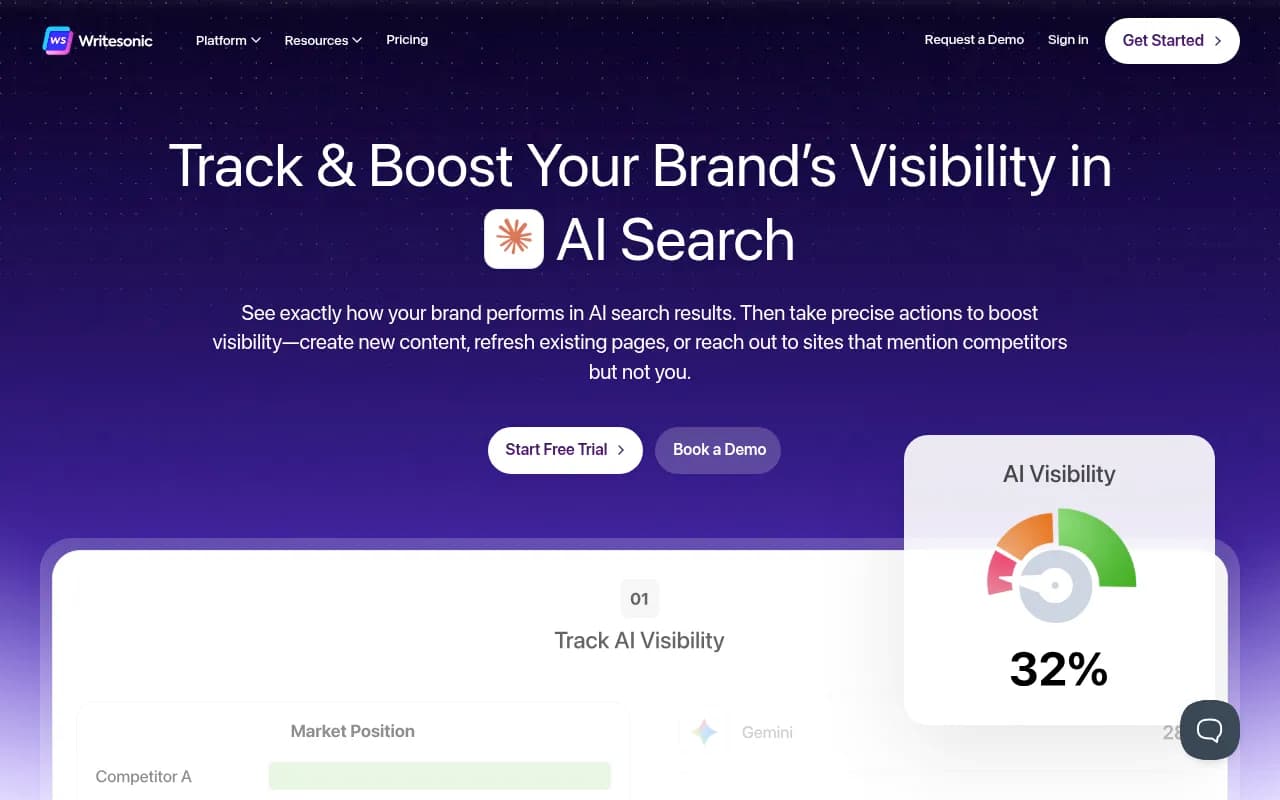
According to Semrush's 2026 roundup of AI visibility tools, Writesonic "combines AI visibility tracking with content creation in a single platform" and "works well for small content teams that want to monitor AI search presence alongside content production." That's a fair characterization.
The tracking side covers major AI models and gives you visibility scores, brand mention monitoring, and some competitive comparison. The content creation side is mature -- Writesonic has been building AI writing tools for years and the output quality is solid.
The limitation is depth. Writesonic's GEO tracking is broad rather than precise. You get a general sense of your AI visibility, but the platform doesn't give you the granular data you'd need to actually act on it systematically. There's no answer gap analysis that shows you the specific prompts your competitors rank for but you don't. There's no AI crawler log showing you which pages AI bots are reading (or ignoring). There's no prompt volume data to help you prioritize which gaps to close first.
For a small team that wants a single subscription covering both content writing and basic AI visibility monitoring, Writesonic is a reasonable choice. For a team that's serious about GEO as a growth channel, the monitoring layer isn't deep enough to drive a real optimization strategy.
What Writesonic does well
- Mature AI content generation with good output quality
- Covers both content creation and AI visibility in one platform
- Reasonable pricing for what you get
- Good for teams new to GEO who want a low-friction starting point
Where it falls short
- GEO tracking lacks the depth needed for systematic optimization
- No answer gap analysis showing specific prompts competitors rank for
- No AI crawler logs or page-level citation tracking
- Content generation isn't grounded in citation data from AI models
- Monitoring coverage across AI models is less comprehensive than dedicated platforms
Promptwatch: built around the optimization loop
Promptwatch takes a different approach from both Frase and Writesonic. Rather than adding GEO features to an existing content tool (Writesonic) or adding AI features to a traditional SEO tool (Frase), Promptwatch was built from the ground up around a specific question: how do you actually improve your AI search visibility, not just measure it?

The answer it's built around is a three-step loop. First, find the gaps -- specifically, which prompts your competitors appear for in AI responses but you don't. The Answer Gap Analysis shows you the exact questions and topics where you're invisible, ranked by prompt volume and difficulty so you can prioritize. Second, create content that closes those gaps. The built-in AI writing agent generates articles, listicles, and comparisons grounded in citation data from 880M+ analyzed citations, not just keyword frequency. Third, track whether it worked -- page-level visibility tracking shows exactly which pages are being cited by which AI models, and traffic attribution connects those citations to actual site visits and conversions.
This loop is what separates Promptwatch from monitoring-only tools. Most GEO platforms (and Writesonic's tracking layer falls into this category) show you data and leave you to figure out what to do with it. Promptwatch shows you the gap, helps you fill it, and then confirms whether filling it worked.
A few specific capabilities worth calling out:
The AI crawler logs are something most competitors don't offer at all. You can see in real time which AI crawlers (ChatGPT, Claude, Perplexity, etc.) are hitting your site, which pages they're reading, and what errors they're encountering. If an AI model is ignoring your best content, you'll know why.
Prompt intelligence goes beyond simple visibility scores. Each prompt comes with volume estimates, difficulty scores, and query fan-outs showing how one prompt branches into related sub-queries. This lets you prioritize high-value, winnable prompts instead of guessing.
The platform monitors 10 AI models: ChatGPT, Perplexity, Google AI Overviews, Google AI Mode, Claude, Gemini, Meta/Llama, DeepSeek, Grok, and Mistral. That's broader coverage than either Frase or Writesonic.
What Promptwatch does well
- Full optimization loop: gap analysis, content generation, visibility tracking
- AI crawler logs for diagnosing indexing issues
- Prompt volume and difficulty scoring for prioritization
- Page-level citation tracking across 10 AI models
- Content generation grounded in real citation data
- Reddit and YouTube insights showing which discussions influence AI recommendations
- ChatGPT Shopping tracking for e-commerce brands
- Traffic attribution connecting AI citations to revenue
Where it's less ideal
- More expensive than Frase or Writesonic at comparable tiers
- The depth of features has a learning curve -- not a tool you'll master in an afternoon
- Overkill for teams that only need basic content writing without GEO focus
Side-by-side comparison
| Feature | Promptwatch | Writesonic | Frase |
|---|---|---|---|
| AI visibility monitoring | Yes (10 models) | Yes (limited) | No |
| Answer gap analysis | Yes | No | No |
| AI content generation | Yes | Yes | Yes |
| Content grounded in citation data | Yes | No | No |
| AI crawler logs | Yes | No | No |
| Prompt volume & difficulty scoring | Yes | No | No |
| Page-level citation tracking | Yes | No | No |
| Traffic attribution | Yes | No | No |
| Reddit/YouTube insights | Yes | No | No |
| ChatGPT Shopping tracking | Yes | No | No |
| Traditional SEO content optimization | Partial | Yes | Yes |
| Starting price | $99/mo | ~$49/mo | ~$45/mo |
| Best for | Teams serious about GEO as a growth channel | Small teams wanting basic AI tracking + content | Teams focused on Google SEO content |
Which platform should you actually use?
The answer depends on what you're trying to accomplish.
If your primary goal is Google SEO and you want a clean content research and writing workflow, Frase is a solid, affordable choice. It's not trying to be a GEO platform and it doesn't pretend to be one. Use it for what it's good at.
If you're new to GEO and want to dip your toes in without committing to a dedicated platform, Writesonic gives you basic AI visibility monitoring alongside content creation. It won't give you the depth to run a serious optimization program, but it's a reasonable starting point for understanding where you stand.
If AI search visibility is a real strategic priority -- if you want to actually appear when potential customers ask ChatGPT or Perplexity for recommendations in your category -- Promptwatch is the more serious tool. The gap analysis, the citation-grounded content generation, the crawler logs, the page-level tracking: these aren't features you can replicate by stitching together a monitoring tool and a writing tool. They're designed to work together as a system.
The honest version: Frase and Writesonic were built for a world where Google was the only search engine that mattered. Promptwatch was built for the world we're actually in.
A note on the broader GEO tool landscape
These three aren't the only options worth knowing about. The GEO platform space has grown significantly in 2026, with tools ranging from basic monitoring dashboards to full optimization suites.
A few worth considering depending on your needs:



For teams that want enterprise-grade monitoring without the content generation layer, tools like Profound and AthenaHQ are worth evaluating. For budget-conscious teams that just need basic AI mention tracking, Peec AI covers the fundamentals at a lower price point.
But if the question is specifically which platform best combines content creation with GEO visibility -- which is what this guide is about -- the answer in 2026 is Promptwatch. It's the only platform of the three that treats content creation and visibility tracking as parts of the same workflow rather than separate features bolted together.
The Search Influence comparative analysis of AI SEO tracking tools in 2026 puts the market in useful context: platforms vary enormously in how they handle the gap between monitoring and optimization. The ones that close that gap are the ones worth paying for.