Key takeaways
- MarketMuse, Frase, and Scalenut are traditional AI SEO tools built around Google rankings -- they help you write and optimize content for classic SERPs.
- Promptwatch operates in a different category: it tracks and improves your visibility in AI search engines like ChatGPT, Perplexity, Claude, and Google AI Overviews -- then helps you create content that gets cited by those models.
- If your goal is purely traditional on-page SEO, Frase or Scalenut offer solid value at accessible price points.
- If you're serious about AI search visibility (GEO/AEO), Promptwatch is the only tool in this comparison that closes the full loop: find gaps, generate content, track results.
- Most content teams in 2026 need both traditional SEO and AI visibility coverage -- and the tools don't overlap as much as vendors suggest.
There's a comparison that keeps coming up in SEO Slack channels and agency forums: "Should I use MarketMuse, Frase, or Scalenut for content?" It's a fair question -- they're all AI-assisted content tools, they all promise better rankings, and they all look similar on a features page.
But in 2026, that question has a new wrinkle. AI search engines -- ChatGPT, Perplexity, Google AI Overviews, Claude -- now handle a meaningful chunk of how people find information. And none of the three tools above were built for that world. That's where Promptwatch enters the picture.
This guide breaks down what each tool actually does well, where each one falls short, and how to decide which belongs in your stack.
What problem is each tool actually solving?
Before comparing features, it's worth being clear about what each tool was designed to do.
Frase, MarketMuse, and Scalenut were all built to help you rank on Google. They analyze top-ranking pages, suggest topics and keywords to include, help you write drafts, and score your content against competitors. That's valuable work -- traditional SEO still matters.
Promptwatch was built for a different problem: getting your brand and content cited by AI models. It monitors how ChatGPT, Perplexity, Claude, Gemini, and other AI engines respond to prompts related to your category, identifies where competitors appear but you don't, and then helps you create content specifically designed to close those gaps.
These are genuinely different jobs. Conflating them leads to bad tool decisions.
Promptwatch: built for the AI search era

Promptwatch tracks your visibility across 10 AI models -- ChatGPT, Perplexity, Google AI Overviews, Google AI Mode, Claude, Gemini, Meta/Llama, DeepSeek, Grok, and Copilot. That breadth matters because different AI models pull from different sources, and your visibility can vary dramatically between them.
What makes it different from monitoring-only tools is the action loop. It doesn't just show you a dashboard of where you're missing -- it tells you which specific prompts competitors rank for that you don't (Answer Gap Analysis), then gives you a built-in AI writing agent to create content grounded in 880M+ citations analyzed. Once that content is published, page-level tracking shows whether AI models start citing it.
A few capabilities worth knowing about:
- AI Crawler Logs: Real-time logs of when ChatGPT, Claude, Perplexity, and other AI crawlers visit your site -- which pages they read, how often, and any errors they hit. Most competitors don't have this.
- Prompt Intelligence: Volume estimates and difficulty scores for prompts, plus query fan-outs showing how one prompt branches into sub-queries. This helps you prioritize which gaps to close first.
- Reddit and YouTube tracking: Surfaces discussions that directly influence AI recommendations -- a channel most SEO tools ignore entirely.
- ChatGPT Shopping tracking: Monitors when your brand appears in ChatGPT's product recommendation carousels.
Pricing starts at $99/month (Essential: 1 site, 50 prompts, 5 articles), $249/month (Professional: 2 sites, 150 prompts, crawler logs), and $579/month (Business: 5 sites, 350 prompts, 30 articles). A free trial is available.
The honest limitation: Promptwatch isn't trying to replace your traditional SEO content workflow. It doesn't generate keyword clusters for Google rankings or produce content briefs optimized for classic SERP factors. It's focused on AI search visibility, and it does that job better than anything else in this comparison.
MarketMuse: deep content intelligence, premium price
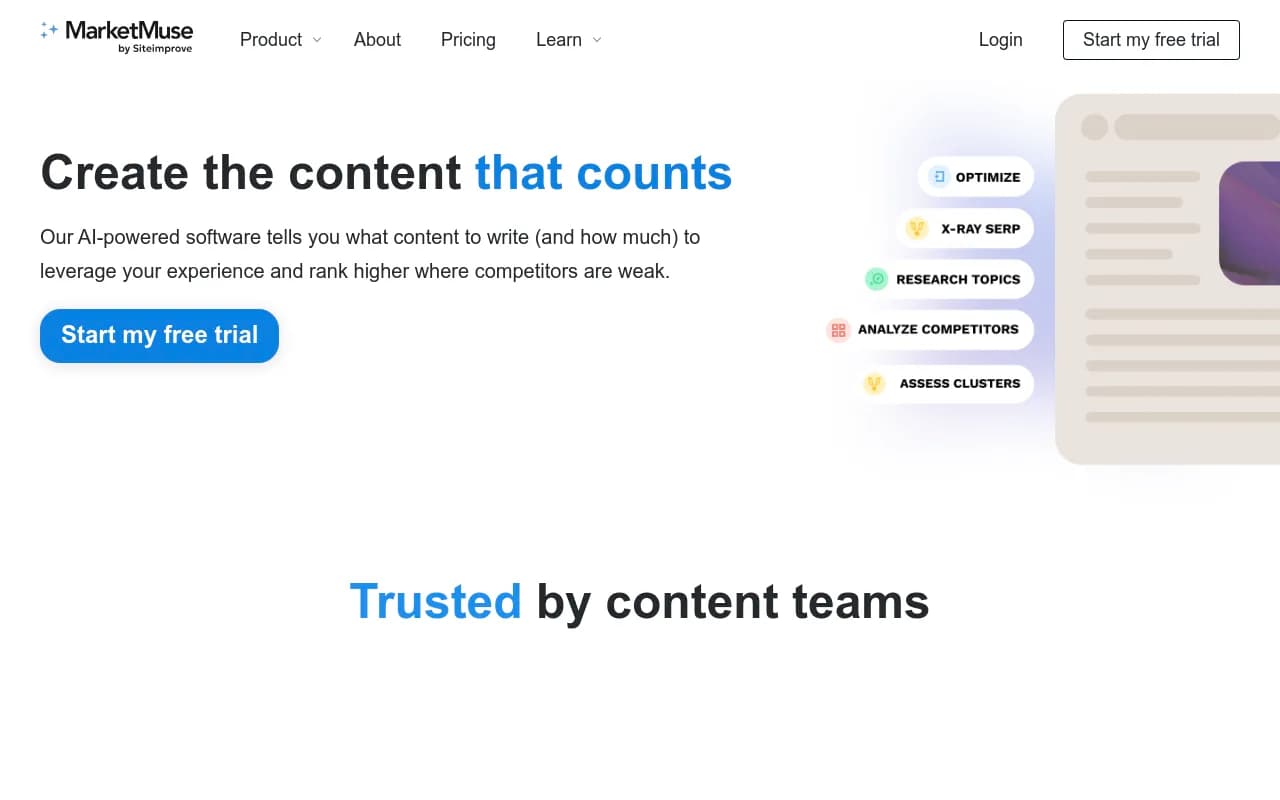
MarketMuse has been around long enough to build a genuinely sophisticated content model. Its core strength is topic modeling -- it maps out the full semantic territory of a subject, identifies which subtopics you've covered versus missed, and scores your content against a personalized difficulty metric based on your existing site authority (not generic industry averages).
The content briefs are detailed. You get recommended topics, questions to answer, internal linking suggestions, and a target word count. For teams producing long-form editorial content at scale, that level of structure is useful.
Where it gets complicated is price. MarketMuse's plans start at around $149/month for limited queries, and the full feature set sits at $399/month or higher. For smaller teams or agencies with many client sites, that math gets uncomfortable fast.
It also doesn't track AI search visibility. There's no monitoring of how ChatGPT or Perplexity responds to prompts in your category, no citation analysis, no content gap analysis for AI models. If you're asking "why isn't my brand appearing in AI answers?", MarketMuse won't help you answer that.
Best for: content strategists at mid-to-large companies who need deep topical authority mapping for Google and have the budget to support it.
Frase: research-first, good value, limited ceiling
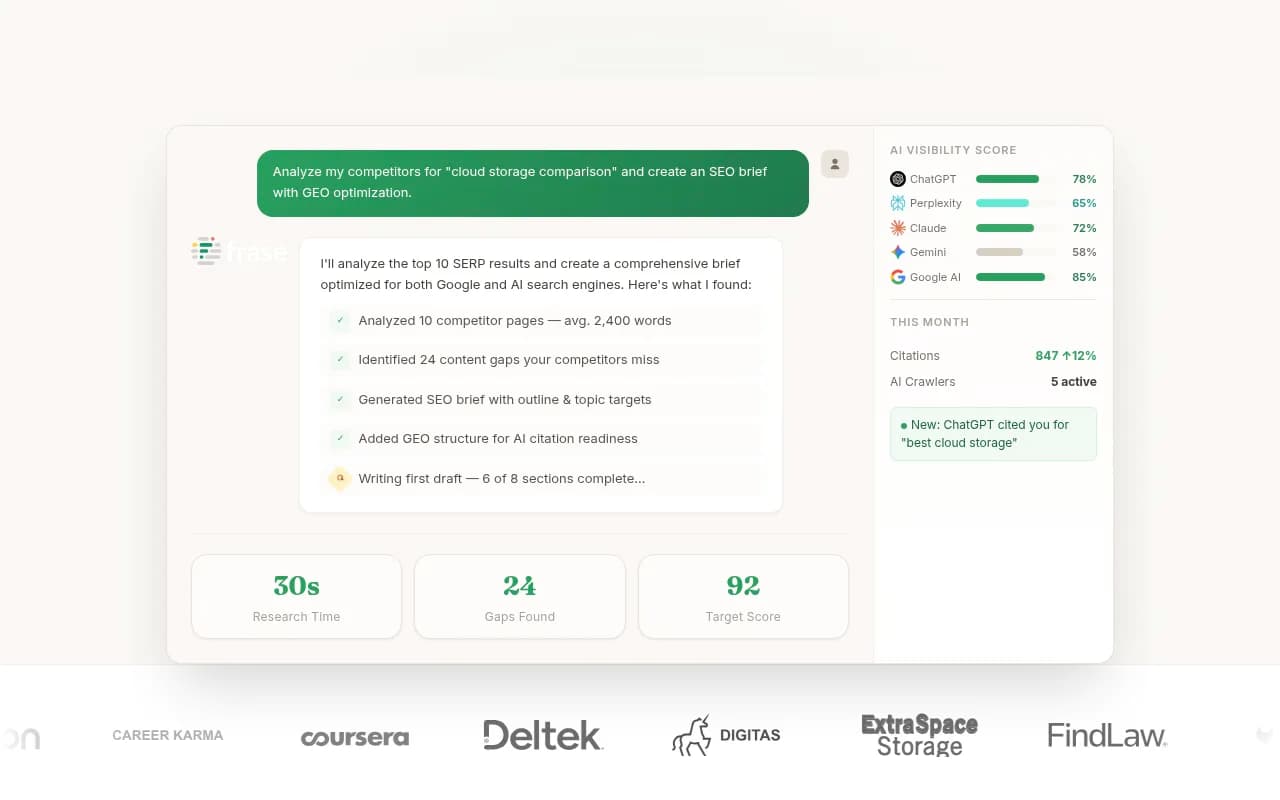
Frase built its reputation on making content research fast. You enter a keyword, it pulls the top-ranking pages, extracts the key topics and questions they cover, and generates an outline. The AI writing assistant then helps you draft against that structure. The workflow is genuinely smooth -- you can go from blank page to a structured draft in under an hour.
The content scoring is real-time as you write, which is a nice touch. You can see your topic coverage score update as you add content, which keeps writers focused on what matters for ranking.
Frase's pricing is more accessible than MarketMuse -- plans start around $15/month for solo users, with team plans in the $115/month range. That affordability is a genuine advantage for freelancers and small agencies.
The ceiling, though, is visible. The topic modeling isn't as deep as MarketMuse. The AI writing quality is decent but not exceptional. And like MarketMuse and Scalenut, it has no AI search visibility features -- no tracking of how AI models respond to prompts, no citation analysis, no gap identification for LLM visibility.
Best for: freelance writers and small content teams who need a fast research-to-draft workflow for traditional SEO at a reasonable price.
Scalenut: all-in-one ambition, mixed execution

Scalenut's pitch is consolidation: keyword planning, content briefs, AI drafting, and on-page optimization in one platform. For teams that hate managing multiple tools, that's appealing. The Cruise Mode feature -- where you input a keyword and it generates a full SEO article -- is genuinely fast.
The NLP optimization is solid. Scalenut pulls terms and entities from top-ranking pages and shows you which ones to include, similar to how Surfer SEO works. The content editor scores your piece in real time.
The tradeoffs: the AI-generated drafts often need significant editing before they're publishable. The keyword research module is functional but not as deep as dedicated tools like Semrush or Ahrefs. And like the others, there's no AI search visibility layer -- no monitoring of ChatGPT responses, no citation tracking, no GEO functionality.
Pricing is more accessible than MarketMuse, with plans starting around $39/month, which makes it a reasonable entry point for teams wanting an integrated workflow.
Best for: content teams that want a single tool covering research, briefs, and drafting for Google SEO, and don't mind editing AI output before publishing.
Head-to-head comparison
| Feature | Promptwatch | MarketMuse | Frase | Scalenut |
|---|---|---|---|---|
| Traditional SEO content optimization | No | Yes | Yes | Yes |
| AI search visibility monitoring | Yes (10 models) | No | No | No |
| Content gap analysis for AI models | Yes | No | No | No |
| AI content generation | Yes (citation-grounded) | Limited | Yes | Yes |
| Crawler logs (AI bots) | Yes | No | No | No |
| Prompt volume & difficulty scoring | Yes | No | No | No |
| Reddit/YouTube tracking | Yes | No | No | No |
| ChatGPT Shopping tracking | Yes | No | No | No |
| Page-level AI citation tracking | Yes | No | No | No |
| Traffic attribution from AI | Yes | No | No | No |
| Starting price | $99/mo | ~$149/mo | ~$15/mo | ~$39/mo |
| Best for | AI search visibility & GEO | Topical authority (Google) | Fast research-to-draft | All-in-one Google SEO |
The question most teams are avoiding
Here's the uncomfortable reality: a lot of content teams are still optimizing exclusively for Google rankings while their category is quietly being answered by ChatGPT and Perplexity. Users ask AI models "what's the best [product category]?" and get a direct answer -- often without clicking through to any website.
MarketMuse, Frase, and Scalenut don't address this. They're excellent at what they were designed for, but they were designed for a search environment that's changing fast.
Promptwatch is the only tool in this comparison that was built specifically for AI search visibility. The Answer Gap Analysis shows you exactly which prompts competitors appear in that you don't. The content generation is grounded in citation data -- what AI models actually cite, not just what ranks on Google. And the tracking closes the loop, showing whether your new content is getting picked up by AI models.
That's a fundamentally different workflow than what Frase or Scalenut offer, and it's not a knock on those tools -- it's just a different job.
How to decide which tool you actually need
The right answer depends on what's actually driving your traffic and where your gaps are.
If most of your organic traffic still comes from Google and you're producing long-form content at scale, Frase or Scalenut are solid choices. Frase if you prioritize research speed and affordability; Scalenut if you want a more integrated workflow.
If you're at a larger company and topical authority mapping is a strategic priority, MarketMuse's depth is worth the price -- but go in with eyes open about what it doesn't do.
If you're seeing AI search engines answer queries in your category and you're not appearing in those answers, Promptwatch is the tool to look at. It's the only one here that can tell you why you're invisible in AI results and help you fix it.
And if you're running a serious content program in 2026, the honest answer is probably that you need both a traditional SEO content tool and an AI visibility platform. They're not competing for the same job.
A note on what "AI SEO tool" actually means in 2026
The term "AI SEO tool" has gotten stretched to cover two very different things: tools that use AI to help you write content for Google, and tools that help you appear in AI-generated search results. MarketMuse, Frase, and Scalenut are the former. Promptwatch is the latter.
Neither category is going away. Google still processes billions of searches a day. But AI search engines are handling a growing share of informational queries -- the kind where someone wants a direct answer, not a list of links. Brands that aren't visible in those answers are losing ground in ways that traditional rank tracking doesn't even show.
That's the gap Promptwatch was built to close. Whether it belongs in your stack depends on how much of your audience is already asking AI models about your category -- and that number is almost certainly higher than your current analytics suggest.
Bottom line
MarketMuse, Frase, and Scalenut are all legitimate tools for traditional content SEO. They help you rank on Google, and that still matters. The differences between them are mostly about depth, price, and workflow preference.
Promptwatch is solving a different problem -- one that the other three tools don't touch. If AI search visibility is on your radar (and in 2026, it should be), it's the only tool in this comparison that can actually help you improve it.
The tools aren't really competing. They're covering different parts of the search landscape. The question is which parts of that landscape you're currently ignoring.